
Home/产品中心Products/Living Life Defender

产品详解 · 约 10 分钟Product Deep Dive · 10 min

Living Life Defender:七项独家条款

Living Life Defender: Seven Exclusive Riders

同样是 IUL,产品之间的差别主要在条款库里,不在封顶数字上。 这一篇把 Defender 系列最值钱的部分拆开来看。

Among IUL products, the differences sit mostly in the rider library, not the headline cap. This piece opens up the most valuable parts of the Defender line.

幻灯片 · 11 页 · 每页下方附详细讲解Slides · 11 pages · full presenter notes under each ↓ 跳到全文↓ Skip to the full article

Living Life Defender
条款、奖金与贷款
Living Life Defender
Riders, Bonuses & Loans

Presented by Team Rise

各位伙伴好,这一组我们专门讲国家人寿的 Living Life Defender,大家平时简称 LLD。

Welcome, everyone. This set is all about National Life's Living Life Defender, which most of us just call LLD.

一共分四块。第一块是这张保单的七项条款,每一项是干什么的、有什么条件。 第二块是 Enhancer 系列:三个档位怎么收费、利息加成怎么算,再看两组用现在的参数回测过去的表格, 以及大家常见的那张「1997 年存 10 万」的回算图。

There are four parts. First, the policy's seven riders: what each one does and what conditions apply. Second, the Enhancer series: how the three tiers are charged and how the interest bonus is calculated, followed by two back-tests that apply today's parameters to past years, and the familiar "$100,000 in 1997" back-cast chart.

第三块是四种保单贷款方式,利率怎么定、借出去的钱还能不能继续计息。 第四块是两张同业的生前福利对照表,教大家怎么读、怎么用才不出错。

Third, the four policy loan options: how the rate is set and whether the borrowed money keeps earning. Fourth, two peer comparison tables of living benefits, and how to read and use them without getting into trouble.

先说清楚一件事:今天会出现不少回测数字和演示值。它们是用现在的产品参数去算过去, 用来帮助理解机制,不是保证,也不是给客户的收益承诺。每一页下面都写了这一页该怎么讲、哪些话不能说, 讲之前先把讲稿看一遍。

One thing up front: you'll see a lot of back-tested figures and illustrated values today. They apply today's product parameters to the past to help explain the mechanics. They are not guarantees and not a promise of returns to any client. Under each slide is how to present it and what not to say, so read the notes before you present.

互动设计Interaction

开场请大家在聊天框里回答一个问题:你给客户讲 IUL 时,客户最常问的是什么? 是「会不会亏」、「能拿多少」,还是「怎么取钱」?今天这四块正好对应这几个问题。

Open by asking everyone to answer in the chat: when you present an IUL, what do clients ask most? "Can I lose money?", "How much will I get?", or "How do I take money out?" Today's four parts map onto exactly those questions.

LLD 的七项条款LLD's Seven Riders

  1. Combo Multi-Choice Rider (CMC)
    • 为本人或有保险利益的人加 20 / 30 年定期Adds 20- or 30-year term on the insured or anyone with an insurable interest
    • 比另买定期便宜,之后可转换成 LLDCheaper than separate term; convertible to LLD later
    • 大幅提高 MEC 上限,能多存Raises the MEC limit substantially, so more can go in
  2. Gap Protector Rider (GPR)
    • 需要时自动增加保额,无需重新核保Increases the face amount automatically, no new underwriting
  3. Extended Hospital Stay Death Benefit
    • 连续住院至少 20 天后在院身故,另付 $5,000Pays an extra $5,000 on death in hospital after 20+ consecutive days
  4. Unemployment Waiver of Surrender Charge
    • 连续失业 12 个月、申请时仍失业,全额退保免退保费After 12 months' unemployment, still unemployed at request: no surrender charge on full surrender
  1. Guaranteed Flex Rider (GFR)
    • 保证期 10 / 20 / 30 / 40 年Guarantee period of 10, 20, 30 or 40 years
    • 10 年免费,更长期限收少量月费10 years free; longer periods carry a small monthly charge
    • 条件:每月交够保证保费Condition: the monthly guaranteed premium is met
  2. Enhancer / Enhancer Plus / Enhancer Max
    • 任何保额都能开,换更高的利息加成上限Available at any face amount, for a higher interest-bonus ceiling
  3. 更低的保单成本与费用Lower policy cost and expense
    • 存同样的钱,留在保单里积累的更多For the same premium, more stays in the policy to accumulate

这一页是 LLD 的七项条款。公司资料里把它们叫作 exclusive features, 我们讲给客户时,只讲这张保单的条款是怎么写的,不说「别家都没有」。下面一项一项过。

These are LLD's seven riders. The carrier's material calls them exclusive features. With a client, we describe what this policy's riders say and leave out "no one else has this." Let's go through them one at a time.

第一,CMC 多人定期附约。可以在 LLD 上为本人、配偶,或者和你有保险利益的人,加一份 20 年或 30 年的定期。 比另外单独买一份定期便宜,以后还能转换成 LLD。它还有一个作用:定期保额加进来以后,MEC 上限会大幅提高, 同一张保单能多存不少钱,资料里的例子能做到一年存 $100 万。规则要记住:最多 5 个人,合计最多主保额的 3 倍; 一个人不符合某项生前福利,所有人都失去这一项。

One, the CMC multi-life term rider. On an LLD you can add 20- or 30-year term for yourself, a spouse or anyone with an insurable interest. It costs less than a separate term policy and can be converted into LLD later. It does one more thing: once the term face is added, the MEC limit rises substantially, so the same policy can take in much more money; the example in the carrier's material reaches $1M in a single year. Remember the rules: up to five people, no more than 3× the base face in total, and if one person fails a living benefit, everyone loses that benefit.

第二,GPR。人生阶段变了,比如又生了孩子、换了大房子,保额可以自动往上加,不用重新核保。 第三,延长住院身故金。连续住院至少 20 天后在医院去世,额外赔 $5,000。金额不大, 但正好落在家属压力最大的那段时间。第四,失业豁免退保费。连续失业 12 个月、申请时仍在失业, 全额退保时免收退保费用。这是给最坏情况留的一条退路。

Two, GPR. When life changes, say another child or a bigger house, the face amount can rise automatically with no new underwriting. Three, the extended hospital stay benefit. If the insured dies in hospital after at least 20 consecutive days there, it pays an extra $5,000. A small sum, but it lands when the family is under the most strain. Four, the unemployment waiver. After 12 months of continuous unemployment, and still unemployed when asking, a full surrender carries no surrender charge. It's an exit kept open for the worst case.

第五,GFR 保证期条款。保证期可以选 10、20、30 或 40 年,10 年是免费的,更长的收少量月费。 讲的时候一定带上条件:每月交够保证保费,这段时间内保单才不会失效。 第六,Enhancer 系列,不论保额多少都能开,后面两页细讲。 第七,保单成本和费用更低。听起来最不起眼,影响却最大:成本每个月从现金值里扣, 成本低一点,几十年下来留在保单里的钱就多一截。

Five, the GFR guarantee rider. The period can be 10, 20, 30 or 40 years; 10 is free and the longer ones carry a small monthly charge. Always state the condition: the policy won't lapse during the period only if the monthly guaranteed premium is met. Six, the Enhancer series, available at any face amount; the next two slides cover it. Seven, lower policy cost and expense. It sounds the least exciting and does the most: charges come out of cash value every month, so a slightly lower charge leaves noticeably more in the policy over decades.

合规提醒Compliance

GFR 不能说成「保证不断保」,要说「满足缴费条件,这段时间内保单不会失效」。 「一年存 $100 万」是资料里的设计例子,能存多少要看具体演示,不要当成每张保单都能做到。

Don't call GFR "guaranteed never to lapse"; say "meet the funding condition and the policy won't lapse during the period." "$1M in a year" is a design example from the carrier's material; what a given case can take depends on its illustration.

Enhancer 三档:用费用换加成上限Three Enhancer Tiers: a Charge for More Headroom

Enhancer

  • 利息加成 15%Interest bonus 15%
  • 加成最多 0.85%Bonus capped at 0.85%
  • 无额外费用No extra charge

Enhancer Plus

  • 利息加成 45%Interest bonus 45%
  • 加成最多 2.5%Bonus capped at 2.5%
  • 每年 1% 费用1% charge a year

Enhancer Max

  • 第 2–20 年:95%,最多 6%Years 2–20: 95%, up to 6%
  • 第 21–30 年:70%,最多 4.25%Years 21–30: 70%, up to 4.25%
  • 第 31 年起:45%,最多 2.5%Year 31+: 45%, up to 2.5%
  • 费用:第 1–19 年 3%,
    20–29 年 2%,30 年起 1%
    Charge: 3% years 1–19,
    2% years 20–29, 1% from 30

加成 = 当年所记利息 × 比例,当年记 0%,加成也是 0Bonus = the year's credited interest × the rate; a 0% year earns no bonus

费用从第 1 年开始扣,加成从第 2 年开始给 · 标普 500 策略 · 比例与上限为当前值,可下调到保证值Charges start in year 1, bonuses in year 2 · S&P 500 strategy · current rates and caps, which can fall to the guaranteed level

IUL 的基础指数策略,封顶一般在 11% 左右。Enhancer 系列做的事情,就是让你在这个基础上, 对当年记到的利息再加一个比例,同时把加成的上限往上提。三个档位,代价不同。

An IUL's base index strategy typically caps around 11%. The Enhancer series adds a percentage on top of whatever interest was credited that year and raises the ceiling on that bonus. There are three tiers, each at a different price.

先把「15%」讲对。Enhancer 的 15% 不是额外 15 个百分点,是对当年所记利息的加成比例。 比如当年指数记了 4%,加成就是 4% × 15% = 0.6%,一共 4.6%;当年记 0%,加成也是 0。 这一句一定要讲清楚,客户最容易把它听成「保证多拿 15%」。

First, get the "15%" right. Enhancer's 15% is not fifteen extra percentage points; it's a percentage uplift on the interest credited that year. If the index credits 4%, the bonus is 4% × 15% = 0.6%, for 4.6% in total. In a 0% year, the bonus is zero too. Make this crystal clear, because clients easily hear it as "a guaranteed extra 15%."

Enhancer 基础档:加成 15%,加成最多 0.85%,不收额外费用。 Enhancer Plus:加成 45%,最多 2.5%,每年收 1% 的费用。 Enhancer Max 分三段:第 2 到 20 年加成 95%,最多 6%;第 21 到 30 年 70%,最多 4.25%; 第 31 年起 45%,最多 2.5%。它的费用也分三段:第 1 到 19 年 3%,第 20 到 29 年 2%,第 30 年起 1%。 注意两组年份不完全对齐:费用从第 1 年就开始扣,加成从第 2 年才开始给。

Enhancer: a 15% bonus, capped at 0.85%, with no extra charge. Enhancer Plus: 45%, capped at 2.5%, for a 1% annual charge. Enhancer Max runs in three bands: 95% up to 6% in years 2 to 20; 70% up to 4.25% in years 21 to 30; 45% up to 2.5% from year 31. Its charge also steps down: 3% in years 1 to 19, 2% in years 20 to 29, 1% from year 30. Note the two sets of years don't line up exactly: the charge starts in year 1 and the bonus in year 2.

这里的比例和上限都是当前值。费用是固定的,加成比例和上限公司可以下调,最低到保证值: Enhancer 15%,Plus 20%,Max 三段是 30%、25%、20%。所以选档位,等于对未来二十年指数表现下一次判断: 指数好的年份,Max 的加成远超 3% 的费用;连着几年记 0%,这 3% 就是净流出。 要按客户的风险承受度和缴费能力来选,不是默认选最高档。

These rates and caps are current values. The charge is fixed; the bonus rate and cap can be lowered, down to the guaranteed level: 15% for Enhancer, 20% for Plus, and 30%, 25% and 20% across Max's three bands. Choosing a tier is therefore a judgment about the next two decades of the index. In good years Max's bonus far exceeds its 3% charge; in a run of 0% years that 3% is a net outflow. Choose by the client's risk tolerance and funding capacity, not by defaulting to the top tier.

合规提醒Compliance

不说「保证额外 15% 利息增长」。说:「有一个利息加成,把当年记到的利息再乘上一个比例;那一年记 0,加成也是 0。」

Never say "a guaranteed extra 15% interest." Say: "There's a bonus that multiplies the interest credited that year. In a zero year, the bonus is also zero."

互动设计Interaction

请大家算一道题:指数当年 6%,开 Enhancer Plus,一共记多少?(6% + 6% × 45% = 8.7%,没超过加成上限 2.5%; 再扣 1% 费用。)然后问:如果当年记 0%,Max 那一年是什么结果?(加成 0,费用 3% 照扣。)

Ask the room: the index credits 6% and the client has Enhancer Plus; what's the total? (6% + 6% × 45% = 8.7%, under the 2.5% bonus cap, before the 1% charge.) Then: in a 0% year, what happens with Max? (No bonus, and the 3% charge still comes out.)

Enhancer 参数表:费用、加成、上限Enhancer Parameters: Charge, Bonus, Ceiling

档位Tier 费用Charge 利息加成比例Bonus rate 加成上限Bonus cap 记 1% 时变成1% credit becomes 11% 封顶变成11% cap becomes
Enhancer无None15%0.85%1.15%11.85%
Enhancer Plus1%45%2.50%1.45%13.50%
Max加成第 2–20 年bonus years 2–203%第 1–19 年years 1–1995%6.00%1.95%17.00%
Max加成第 21–30 年bonus years 21–302%第 20–29 年years 20–2970%4.25%1.70%15.25%
Max加成第 31 年起bonus year 31+1%第 30 年起year 30+45%2.50%1.45%13.50%

投保时二选一:Enhancer 系列,或不收费的利息奖金(第 2–9 年 0.25%,第 10 年起多数策略 0.50%,Basic、Fixed 策略 0.25%)Chosen at issue, one or the other: the Enhancer family, or the free Interest Bonus (0.25% in years 2–9; 0.50% from year 10 on most strategies, 0.25% on Basic and Fixed)

标普 500 点对点策略 · 当前值,非保证S&P 500 point-to-point · current values, not guaranteed

上一页是三个档位的样子,这一页把参数放进一张表,并且换成一个更直观的读法:看两个例子。

The last slide showed the three tiers. This one puts the parameters in a single table and reads them through two simple examples.

第一个例子,当年指数只记了 1%。Enhancer 变成 1.15%,Plus 变成 1.45%, Max 前二十年变成 1.95%。这就是「加成比例」的意思:1% 乘以 1.15、1.45、1.95。 但是别忘了左边那一列费用:Plus 每年 1%,Max 前十九年 3%。指数只记 1% 的年份,Plus 加成 0.45%、费用 1%, Max 加成 0.95%、费用 3%,都是付出去的比拿回来的多。

Example one: the index credits just 1%. Enhancer turns it into 1.15%, Plus into 1.45%, Max in its first twenty years into 1.95%. That is all the bonus rate means: 1% times 1.15, 1.45 or 1.95. But don't forget the charge column on the left: 1% a year for Plus, 3% for Max in years 1 to 19. In a 1% year Plus adds 0.45% and charges 1%; Max adds 0.95% and charges 3%. Both pay out more than they bring in.

第二个例子,指数涨得多,碰到了 11% 的封顶。这时候加成会被它的上限卡住: Enhancer 最多加 0.85%,变成 11.85%;Plus 最多加 2.5%,变成 13.5%;Max 前二十年最多加 6%,变成 17%, 第 21 到 30 年 15.25%,第 31 年起 13.5%。大家常说的「最高 17%」就是从这里来的:11% 封顶加 6% 的加成上限, 而且只在 Max 的第 2 到 20 年才有。

Example two: a strong year that hits the 11% cap. Now the bonus is limited by its own ceiling: Enhancer adds at most 0.85% for 11.85%; Plus at most 2.5% for 13.5%; Max at most 6% for 17% in years 2 to 20, then 15.25% in years 21 to 30 and 13.5% from year 31. That's where the familiar "up to 17%" comes from: an 11% cap plus a 6% bonus ceiling, and only in Max's years 2 to 20.

表下面还有一行要讲:LLD 投保时要在两种结构里二选一,之后不能在两类之间换。 一种是 Enhancer 系列;另一种是不收费的「利息奖金」,第 2 到 9 年加 0.25%,第 10 年起多数指数策略加 0.50%, Basic 和 Fixed 两个策略仍是 0.25%。后面两页回测表里那一列「利息奖金」,指的就是这个选项。

One more line under the table matters: at issue, LLD takes one of two structures, with no switching between them later. One is the Enhancer family; the other is the free Interest Bonus, which adds 0.25% in years 2 to 9 and 0.50% from year 10 on most index strategies, staying at 0.25% on the Basic and Fixed strategies. The "Interest Bonus" column in the next two back-test tables means this option.

最后再提醒一次:表里的加成比例和上限都是当前值,公司可以下调到保证值;费用不会跟着降。

A final reminder: the bonus rates and caps in this table are current values that the carrier can lower to the guaranteed level; the charges don't come down with them.

讲师提醒Presenter note

原始资料里 Max 的费用年份(1–19、20–29、30+)和加成年份(2–20、21–30、31+)是两组, 讲的时候分开说,不要合成「第 1–19 年 95%」。

In the source material Max's charge years (1–19, 20–29, 30+) and bonus years (2–20, 21–30, 31+) are two different sets. Keep them apart; don't merge them into "95% in years 1–19."

回测①:2005–2024 每年记息Back-test ①: Annual Crediting, 2005–2024

年份Year标普S&P利息奖金Int. bonusEnh.PlusMax
20053.00%3.40%3.45%4.31%5.67%
200613.62%11.25%11.85%13.50%17.00%
20073.53%3.96%4.06%5.07%6.68%
2008−38.49%0.25%0.00%−1.00%−3.00%
200923.45%11.25%11.85%13.50%17.00%
201012.78%11.25%11.85%13.50%17.00%
20110.00%0.25%0.00%−1.00%−3.00%
201213.41%11.25%11.85%13.50%17.00%
201329.60%11.25%11.85%13.50%17.00%
201411.39%11.25%11.85%13.50%17.00%
年份Year标普S&P利息奖金Int. bonusEnh.PlusMax
2015−0.73%0.50%0.00%−1.00%−3.00%
20169.54%10.52%10.97%13.50%17.00%
201719.42%11.50%11.85%13.50%17.00%
2018−6.24%0.50%0.00%−1.00%−3.00%
201928.88%11.50%11.85%13.50%17.00%
202016.26%11.50%11.85%13.50%17.00%
202126.89%11.50%11.85%13.50%17.00%
2022−19.44%0.50%0.00%−1.00%−3.00%
202324.23%11.50%11.85%13.50%17.00%
202423.31%11.50%11.85%13.50%17.00%
标普S&P利息奖金Int. bonusEnh.PlusMax
近 10 年几何平均10-yr geometric avg.11.07%7.98%8.07%8.94%未扣费before charge10.60%未扣费before charge
20 年几何平均20-yr geometric avg.8.22%7.71%7.91%8.80%扣费后约 7.99%≈7.99% after charge10.56%扣费后约 8.07%≈8.07% after charge
波动率Volatility17.07%4.97%5.35%6.49%8.87%

回测,非保证 · 用现在的参数套历史标普价格涨幅(不含分红) · Plus、Max 在涨的年份未扣附约费用Back-test, not guaranteed · today's parameters on historical S&P price returns (no dividends) · Plus and Max shown before the rider charge in up years

这一页是回测。先说清楚它是什么:把现在的产品参数,套到 2005 到 2024 年标普 500 每一年的实际涨跌上, 看每一种选择那一年会记多少。它不是哪一张真实保单的历史,也不代表以后。

This is a back-test. First, what it is: today's product parameters applied to the S&P 500's actual moves in each year from 2005 to 2024, to see what each option would have credited. It isn't the history of any real policy, and it says nothing certain about the future.

先看标亮的五年:2008、2011、2015、2018、2022。这些年标普是跌的或者持平,2008 年跌了 38.49%。 同一年,「利息奖金」那一列还记了 0.25% 或 0.50%;Enhancer 记 0;而 Plus 和 Max 是负 1% 和负 3%。 为什么开了 Enhancer 反而是负的?因为指数记 0,加成也是 0,但附约费用照扣。 这就是我们前面说的:0 的年份不是没有代价。

Start with the five highlighted years: 2008, 2011, 2015, 2018 and 2022, when the S&P fell or went nowhere; in 2008 it lost 38.49%. In those years the Interest Bonus column still credited 0.25% or 0.50%, Enhancer credited zero, and Plus and Max show −1% and −3%. Why negative with an Enhancer? Because a zero credit means a zero bonus, while the rider charge still comes out. That's the point we made earlier: a zero year isn't free.

再看涨的年份。2013 年标普涨了 29.6%,IUL 各列都被上限卡住:Enhancer 11.85%,Plus 13.5%,Max 17%。 这就是 IUL 的交换:跌的时候指数部分不记负数,涨的时候也拿不全。

Now the up years. In 2013 the S&P rose 29.6%, and every IUL column hit its ceiling: 11.85% for Enhancer, 13.5% for Plus, 17% for Max. That's the IUL trade: the index side never goes negative in a down year, and you don't get all of a strong year either.

最下面三行最要小心读。20 年几何平均,标普 8.22%,Enhancer 7.91%。 Plus 和 Max 写着 8.80% 和 10.56%,但这两个数在涨的年份没有扣附约费用;扣掉以后,按下一页的累计金额算, 20 年大约是 7.99% 和 8.07%。波动率那一行倒是很清楚:标普 17%,IUL 各列在 5% 到 9% 之间, 起伏小得多。

Read the bottom three rows carefully. Over 20 years the geometric average is 8.22% for the S&P and 7.91% for Enhancer. Plus and Max show 8.80% and 10.56%, but those figures leave out the rider charge in up years; take it out, using the cumulative values on the next slide, and the 20-year figures are about 7.99% and 8.07%. The volatility row is clear enough: 17% for the S&P, between 5% and 9% for the IUL columns, a much smoother ride.

合规提醒Compliance

这是回测,不是保证,也不是回报率。不要把 10.56% 这类数字单独截出来发给客户; 要讲,就把「未扣费用」「用现在的参数回算」一起讲。上限和加成比例以后可能下调。

This is a back-test, not a guarantee and not a rate of return. Don't clip a figure like 10.56% and send it to a client; if you use it, say "before charges" and "today's parameters applied backwards" in the same breath. Caps and bonus rates may be lowered in future.

回测②:2004 年存 $10 万,到 2024 年Back-test ②: $100,000 from 2004 to 2024

年份Year标普S&P利息奖金Int. bonusEnh.PlusMax
2004$100,000$100,000$100,000$100,000$100,000
2005$103,000$103,400$103,450$103,263$102,504
2006$117,029$115,033$115,709$116,032$116,332
2007$121,160$119,584$120,406$120,693$120,377
2008$74,525$119,883$120,406$119,486$116,765
2009$92,002$133,370$134,674$134,260$132,517
2010$103,759$148,374$150,633$150,861$150,393
2011$103,759$148,745$150,633$149,353$145,882
2012$117,673$165,478$168,483$167,820$165,561
2013$152,505$184,095$188,448$188,571$187,895
2014$169,875$204,805$210,779$211,888$213,242
年份Year标普S&P利息奖金Int. bonusEnh.PlusMax
2015$168,635$205,829$210,779$209,769$206,845
2016$184,723$227,476$233,904$235,707$234,748
2017$220,596$253,636$261,622$264,852$266,416
2018$206,831$254,904$261,622$262,204$258,424
2019$266,563$284,218$292,624$294,625$293,285
2020$309,907$316,903$327,300$331,055$332,849
2021$393,241$353,347$366,085$371,990$377,750
2022$316,795$355,114$366,085$368,271$366,418
2023$393,554$395,952$409,466$413,807$415,848
2024$485,291$441,487$457,987$464,974$471,946
年化Annual.8.22%7.71%7.91%7.99%8.07%

回测,非保证 · 用现在的参数回算历史,不是当年真实存在的保单
IUL 各列扣了附约费用,没扣保险成本与保单费用 · 标普为价格涨幅,不含分红、不扣基金费用
Back-test, not guaranteed · today's parameters applied to history, not a policy that existed then
IUL columns net of rider charges but not of insurance and policy costs · S&P is price return, no dividends, no fund fees

上一页是每年记多少,这一页把它累计起来:假设 2004 年放进去 $10 万,每一列滚到 2024 年是多少。 IUL 这几列已经扣了附约费用,所以 Plus 和 Max 是扣费后的结果。

The last slide showed each year's crediting; this one accumulates it. Put $100,000 in at 2004 and roll each column forward to 2024. The IUL columns are net of the rider charges, so Plus and Max here are after their fees.

先看 2008 年这一行。标普从 $121,160 掉到 $74,525,一年少了将近四成; IUL 各列基本不动,Enhancer 停在 $120,406,Max 因为扣了 3% 费用,从 $120,377 降到 $116,765。 到 2011 年,标普才回到 $10 万出头,IUL 各列已经在 $14.6 万到 $15.1 万之间。 这就是 IUL 最好讲的地方:大跌那几年,指数部分不跟着跌。

Start with 2008. The S&P drops from $121,160 to $74,525, losing almost 40% in a year. The IUL columns barely move: Enhancer stays at $120,406, and Max slips from $120,377 to $116,765 because of its 3% charge. By 2011 the S&P is only just back above $100,000, while the IUL columns sit between $146,000 and $151,000. This is the easiest part of the IUL story to tell: in the crash years the index side doesn't fall with the market.

再看 2024 年这一行,要诚实地读。二十年下来,标普是 $485,291,年化 8.22%; IUL 最高的 Max 是 $471,946,年化约 8.07%;Enhancer $457,987,利息奖金 $441,487。 也就是说,在这二十年里,标普最后的数字比 IUL 各列都高,IUL 换来的是一路上起伏小得多。 讲给客户听的是这个交换,不是「比标普还高」。

Then read 2024 honestly. After twenty years the S&P is at $485,291, 8.22% a year; the best IUL column, Max, is at $471,946, about 8.07%; Enhancer $457,987; the Interest Bonus $441,487. Over these twenty years, the S&P ends above every IUL column; what the IUL buys is a far smoother path. That trade is what to explain to a client, not "it beats the S&P."

还有两条口径一定要说。第一,这几列 IUL 只扣了附约费用,没扣保险成本和保单费用, 真实保单的现金值会比这里低,前几年低得更多。第二,标普这一列是价格涨幅,不含分红,也没扣基金费用。 两边都不是真实账户,只是帮助理解机制。

Two caveats must go with it. First, the IUL columns deduct only the rider charges, not the cost of insurance or policy expenses, so a real policy's cash value would be lower, especially in the early years. Second, the S&P column is price return, with no dividends and no fund fees. Neither side is a real account; both are there to explain the mechanics.

讲师提醒Presenter note

这张表的标普一列按上一页的每年涨幅重新算过:原稿 2007 年和 2010 年两格接错了, 导致之后每年都偏低,2024 年写成 $467,718;按上一页 8.22% 的 20 年平均,应为 $485,291。

The S&P column has been recalculated from the previous slide's annual returns: the original sheet broke at 2007 and 2010, which understated every later year and showed $467,718 for 2024. At the previous slide's 8.22% twenty-year average it comes to $485,291.

回算:1997 年存 $10 万(节选)Back-cast: $100,000 in 1997 (Excerpt)

年份Year 标普 500
点对点
S&P 500
pt-to-pt
标普
累计
S&P
value
LLD 记息
0–11.85%
LLD credit
0–11.85%
LLD
累计
LLD
value
LLD + Max
记息
LLD + Max
credit
LLD + Max
累计(扣 3%)
LLD + Max
value (−3%)
1997—$100,000—$100,000—$100,000
2000–02−10.14% / −13.04% / −23.37%$90,6640%$125,1040%$118,611
20073.53%$151,3074.06%$185,9056.88%$187,748
2008−38.49%$93,0690%$185,9050%$182,116
201411.39%$212,14411.85%$325,44017.00%$340,129
2022−19.44%$395,6200%$565,2240%$597,699
202324.23%$491,47911.85%$632,20317.00%$681,377
若增值按 20% 计税If gains taxed at 20%$413,183保单内增值延税;以贷款取用、保单维持到身故,才不产生所得税Tax-deferred inside the policy; loans create no income tax only if the policy stays in force to death

用现在的产品参数回算历史,不是当年真实存在的保单 · 回算,非保证
口径不同:真实保单现金值要扣保险成本与保单费用,表中 IUL 两列只算了记息;标普不含分红、不扣费用
Today's product parameters applied to history, not a policy that existed then · back-cast, not guaranteed
Different bases: a real policy's cash value is net of insurance and policy costs, while these IUL columns show crediting only; the S&P has no dividends and no fees

这一页和下一页,就是大家在很多讲座上见过的那张「1997 年存 10 万」。我们保留它, 因为它把 IUL 的机制画得很直观;但是讲法必须改,先把它是什么说清楚。

This slide and the next are the "$100,000 in 1997" picture many of you have seen at seminars. We keep it because it shows the IUL mechanism vividly, but the way it's presented has to change, starting with saying exactly what it is.

它是回算:用 LLD 现在的参数,封顶 11% 加 Enhancer 加成最多 0.85%,以及 Enhancer Max 最多 17%、 扣 3% 费用,去套 1997 年以来标普每年的点对点涨幅。LLD 是 2023 年才推出的,1997 年并没有这张保单。

It's a back-cast: LLD's current parameters, an 11% cap plus an Enhancer bonus of up to 0.85%, and Enhancer Max at up to 17% less a 3% charge, applied to the S&P's point-to-point move in each year since 1997. LLD launched in 2023; no one held this policy in 1997.

表里我们节选了几个关键年份。2000 到 2002 年科技泡沫,三年连跌,标普从 $15.14 万掉到 $9.07 万; LLD 这三年都记 0,停在 $125,104。2008 年金融危机,标普跌 38.49%,从 $151,307 掉到 $93,069;LLD 还是记 0, Max 那一列因为扣 3% 费用略降。到 2023 年,标普 $491,479,LLD $632,203,LLD 加 Max $681,377。

We've excerpted the key years. In the 2000–2002 dot-com bust the S&P fell three years running, from $151,400 to $90,700; LLD credited zero in all three and stayed at $125,104. In the 2008 crisis the S&P fell 38.49%, from $151,307 to $93,069; LLD again credited zero, and the Max column slipped slightly because of its 3% charge. By 2023 the S&P stands at $491,479, LLD at $632,203, and LLD with Max at $681,377.

为什么不能直接说「比标普还高」?因为两边的口径不一样。表里 IUL 两列只算了记息, 没扣每个月的保险成本和保单费用,真实保单的现金值会低不少;标普那一列不含分红,也没扣任何费用。 最下面那行税的比较也一样:按增值 20% 计税,标普税后约 $413,183;保单这边是延税, 要靠保单贷款取用、并且保单维持到身故,才不产生所得税,中途断保要补税。

Why not just say "it beats the S&P"? Because the two sides aren't on the same basis. The IUL columns show crediting only, without the monthly cost of insurance and policy charges, so a real policy's cash value would be noticeably lower; the S&P column has no dividends and no fees. The tax line works the same way: with gains taxed at 20%, the S&P nets about $413,183; the policy side is tax-deferred, and only becomes free of income tax if money comes out as policy loans and the policy stays in force to death. A lapse makes it taxable.

合规提醒Compliance

照这样说:「这是用现在的参数回算历史,不是当年真实存在的保单,只能当成一种参考。」 不说「1997 年存 10 万,今天比标普还高」,也不把这张表单独截图发给客户。

Say it this way: "This is today's parameters applied backwards, not a policy anyone actually held. Treat it as illustrative only." Don't say "$100,000 in 1997 is ahead of the S&P today," and don't send this table to a client as a stand-alone screenshot.

讲师提醒Presenter note

原表 2014 年 LLD 一格记成 11.39%,按封顶 11% 加 0.85% 加成应为 11.85%,之后各年已跟着改; 「税后」一行原表连本金一起按 20% 扣了,这里只对增值计税。完整逐年数字见全文第三节。

The original sheet credited LLD 11.39% in 2014; at an 11% cap plus a 0.85% bonus it should be 11.85%, and later years have been updated to match. The original "after tax" line taxed the principal as well; here only the gain is taxed. The full year-by-year figures are in section 3 of the article.

回算折线:1997 年同时存 $10 万Back-cast Chart: $100,000 in 1997

$0$200K$400K$600K$800K 199720022008201220172023 $681,377 $632,203 $491,479 2000–02 2008
标普 500(虚线)S&P 500 (dashed) Living Life Defender LLD + Enhancer MaxLLD + Enhancer Max

回算,非保证 · 用现在的参数回算历史,不是当年真实存在的保单 · IUL 两条线没扣保险成本与保单费用,标普不含分红Back-cast, not guaranteed · today's parameters on history, not a real policy · IUL lines exclude insurance and policy costs; S&P excludes dividends

同一组数字,画成折线。这一页不念数字,只看三条线的形状。

The same numbers, drawn as lines. Don't read numbers on this slide; look at the shape of the three lines.

虚线是标普 500。它有两个很深的坑:一个是 2000 到 2002 年,一个是 2008 年,图上用浅色底标出来了。 每一次掉下去,都要好几年才爬回原来的位置。两条金色的线是 LLD 和 LLD 加 Enhancer Max, 在这两个坑的位置几乎是平的,没有跟着往下走,涨的年份又被上限卡住,所以是一条比较平稳往上走的线。

The dashed line is the S&P 500. It has two deep dips, 2000–2002 and 2008, shaded on the chart. Each time it fell, it took years to climb back. The two gold lines are LLD and LLD with Enhancer Max. Through both dips they run almost flat instead of falling, and in the up years they're held back by the cap, so they climb along a steadier path.

讲这张图最好的说法是:IUL 拿走了大跌,也拿走了一部分大涨,换来的是一路上起伏小。 对一个快退休、经不起在错误时间大跌一次的人,这条平稳的线有它的意义。

The best way to put it: the IUL removes the big drops and also part of the big gains, and what you get in exchange is a smoother ride. For someone near retirement who can't afford one big drop at the wrong time, that steadier line means something.

但是这张图有它的边界,要一起说。第一,起点挑在 1997 年,紧接着就是两次大跌,对 IUL 特别有利; 换一个起点,结论会不一样,上一页那张 2004 年起算的表里,二十年后标普就排在最前面。 第二,两条金线没扣保险成本和保单费用,真实保单会低一些。 第三,这些都是用今天的参数算过去,以后的封顶和加成可能下调。

But the chart has limits, and they go with it. One, starting in 1997, just before two big crashes, favours the IUL; pick another start and the conclusion changes. In the table starting from 2004, the S&P finished on top after twenty years. Two, the gold lines don't deduct insurance and policy costs, so a real policy would be lower. Three, all of this applies today's parameters to the past, and future caps and bonuses may be lowered.

合规提醒Compliance

不要拿保单的净值去跟不含费用的指数曲线并排比,再下结论「保单比股市好」。 这张图只用来解释机制:不记负数、有封顶。讲完一定补一句「这是回算,不是真实保单,也不代表以后」。

Don't line a policy value up against a gross index curve and conclude "the policy beats the market." Use this chart only to explain the mechanism: no negative crediting, and a cap. Always finish with "this is a back-cast, not a real policy, and it isn't a forecast."

互动设计Interaction

先遮住两条金线,只放标普那条,问大家:如果你 2007 年底退休,靠这笔钱生活,2008 年会是什么感觉? 再放出金线。

Hide the gold lines and show only the S&P. Ask: if you'd retired at the end of 2007 and were living off this money, how would 2008 have felt? Then reveal the gold lines.

四种贷款方式Four Ways to Borrow

① 标准贷款 Standard Loan① Standard Loan

  1. 前 10 年:净成本 0.5%Years 1–10: 0.5% net cost
  2. 第 11 年起:贷款利率与返还利率持平,净成本为 0From year 11: charge and credit match, zero net cost
  3. 贷出部分不参与指数Borrowed amount leaves the index

② 参与型固定利息贷款② Participating Fixed Loan

  1. 利率固定每年 5%,上限 5%Fixed at 5% a year, capped at 5%
  2. 贷出部分留在保单里,继续参与计息Borrowed amount stays in and keeps earning

③ 参与型浮动利息贷款③ Participating Variable Loan

  1. 随穆迪公司债券指数变化Tracks the Moody's corporate bond index
  2. 上限 = 基础策略利率 + 3%,没有固定封顶Ceiling = base strategy rate + 3%; no fixed cap
  3. 资料时点约 5.4%,疫情期间最低 2.3%About 5.4% when published; as low as 2.3% in the pandemic

④ 参与型分红贷款④ Participating Declared Loan

  1. 国家人寿宣布,上限 8%,资料时点约 5.5%Declared by National Life, capped at 8%; about 5.5% when published
  2. 贷出部分另加 0.35% 利息Borrowed amount earns an extra 0.35%
  3. 开了 Enhancer 不能选这一种Not available with an Enhancer

参与型:指数记息高于贷款利率时多赚,记 0% 时利息照付 · 利率随时会变,用前查当期Participating: earn the spread when crediting beats the loan rate; in a 0% year the interest is still owed · rates change, check the current sheet

保单贷款是把现金值拿出来用的主要方式。LLD 有四种贷款,区别全在两件事: 利率怎么定,和借出去的那部分钱还能不能继续计息。

Policy loans are the main way to use the cash value. LLD offers four, and they differ on just two things: how the rate is set and whether the borrowed portion keeps earning.

第一种,标准贷款。借出来的钱按一个利率收利息,同时公司按差不多的利率返还。 前 10 年返还比收取少 0.5%,所以这十年有 0.5% 的净成本;从第 11 年起,两边持平,净成本是 0。 大家常听到的「无息贷款」说的就是第 11 年以后这个状态,讲的时候要带上「前 10 年有 0.5% 成本」这个条件。 借出的部分不再参与指数,适合短期用钱、以后会还回去的情况。

One, the standard loan. The borrowed money is charged a rate and the carrier credits back roughly the same rate. In years 1 to 10 the credit is 0.5% lower than the charge, so those years carry a 0.5% net cost; from year 11 the two match and the net cost is zero. The "interest-free loan" people talk about is that post-year-10 state, so always add the condition that the first ten years cost 0.5%. The borrowed part leaves the index, which suits short-term needs that will be repaid.

后面三种都是参与型:借出去的钱还留在保单里继续参与计息。 固定利息那种,利率锁在 5%。浮动利息那种跟着穆迪公司债券指数走, 上限是基础策略利率加 3%,这个上限本身也会变,资料成稿时利率在 5.4% 左右,疫情期间最低到过 2.3%。 分红贷款的利率由国家人寿宣布,上限 8%,资料时点约 5.5%,借出的部分还能多拿 0.35% 的利息; 但是如果保单开了 Enhancer,这一种就不能选。

The other three are participating: the borrowed money stays in the policy and keeps earning. The fixed version locks the rate at 5%. The variable version follows the Moody's corporate bond index, with a ceiling of the base strategy rate plus 3%, and that ceiling moves too; when the material was written the rate was around 5.4%, and in the pandemic it fell as low as 2.3%. The declared loan's rate is set by National Life, capped at 8% and about 5.5% at the time, and the borrowed portion earns an extra 0.35%; but if the policy has an Enhancer, this option isn't available.

参与型的道理一句话:如果今年指数记的利息比贷款利率高,你手上有现金,借出去的那部分也还在赚,这是正套利; 反过来,指数当年记 0%,贷款利息照样要付,就是负套利。参与型把收益和风险一起放大了。 一般的选法是:利率高于 5% 时选固定的锁住 5%,低于 5% 时再看浮动或分红。

The logic of participating loans in one line: if the index credits more than the loan rate this year, you have the cash and the borrowed portion is still earning, which is positive arbitrage. If the index credits 0%, the loan interest is still due, and the arbitrage runs against you. Participating loans magnify both the upside and the risk. The usual rule: when rates are above 5%, lock 5% with the fixed loan; below 5%, look at variable or declared.

合规提醒Compliance

不说「免税退休金」「无息贷款随便借」。说:「用保单贷款取钱,只要保单维持到身故就不产生所得税; 如果中途断保,之前取的钱要补税。」贷款太多、现金值不够扣,保单会失效。

Don't say "tax-free retirement income" or "borrow interest-free as much as you like." Say: "Income comes out as a policy loan, which creates no income tax as long as the policy is kept in force to death. If it lapses, what you took becomes taxable." Over-borrow and let the cash value run short, and the policy lapses.

讲师提醒Presenter note

这一页的 5.4%、5.5%、6% 上限等都是某一时点的数字,《保单贷款》那一页成稿时浮动上限是 6.5%、分红贷款 6.25%。 讲之前查一次当期利率表。

The 5.4%, 5.5% and the ceilings here are point-in-time figures; when the Policy Loans page was written, the variable ceiling was 6.5% and the declared rate 6.25%. Check the current rate sheet before you present.

十一家 IUL 生前福利条款对照Living-Benefit Riders Across Eleven IULs

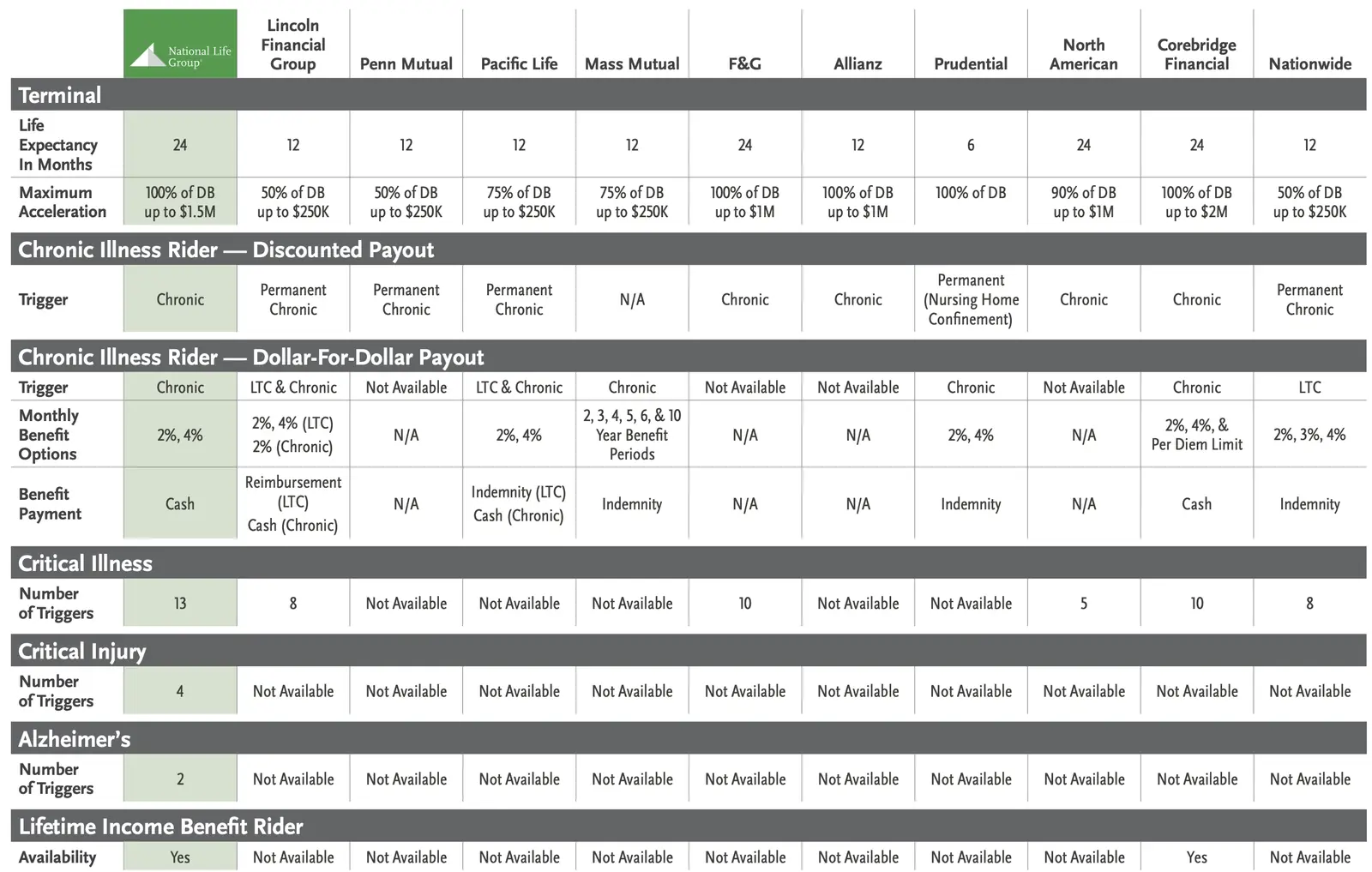
国家人寿与 Lincoln、Penn Mutual、Pacific Life、MassMutual、F&G、Allianz、Prudential、North American、Corebridge、Nationwide 的生前福利条款对照:末期预期寿命月数与最高提前给付、慢性疾病触发与给付方式、重疾与重伤触发项数、阿兹海默触发项数、终身收入附约 / Living-benefit rider comparison of National Life with ten other carriers: terminal life expectancy and maximum acceleration, chronic illness triggers and payout, critical illness and injury trigger counts, Alzheimer's triggers, and lifetime income rider availability
各家条款资料汇总,非当期官方对照 · 内部培训用,不给客户看 · 用前查各家最新版本Compiled from carrier rider material, not a current official comparison · internal training only · check each carrier's latest version

这一页是一张英文的条款规格表,左边绿色那一列是国家人寿,右边是另外十家公司。 我们用它来学一件事:生前福利要比,就比条款规格,每一格都能回到条款原文去核对。

This is an English rider-spec table, with National Life in the green column on the left and ten other carriers to the right. We use it to learn one thing: when you compare living benefits, compare the rider specifications, where every cell can be checked against the rider itself.

按行读。Terminal 末期:预期寿命 24 个月以内可以触发,最多提前给付 100% 保额,上限 $150 万。 Chronic 慢性:LLD 的慢性疾病条款有两种给付方式,一种是折现给付,另一种是可以另加的 Premium Chronic Care, 按每月 2% 或 4% 的给付比例给现金。Critical Illness 重疾 13 项,Critical Injury 重伤 4 项, 阿兹海默 2 项。最后一行是 Lifetime Income Benefit Rider,也就是 LIBR 终身收入条款,LLD 有。

Read it row by row. Terminal: triggered with a life expectancy of 24 months or less, up to 100% of the death benefit advanced, capped at $1.5M. Chronic: LLD's chronic illness benefit comes two ways, a discounted payout, and the optional Premium Chronic Care, which pays cash monthly at a 2% or 4% benefit rate. Critical Illness: 13 conditions. Critical Injury: 4. Alzheimer's: 2. The last row is the Lifetime Income Benefit Rider, LIBR, which LLD includes.

讲给客户时,只讲「这张保单的条款是怎么写的」:触发条件是什么、最多能提前多少、额度上限多少。 别家那几列是给我们自己做功课用的,帮我们知道客户手上的保单可能是什么样,不拿来说别家不好。

With a client, describe only what this policy's rider says: what triggers it, how much can be advanced, and the cap. The other carriers' columns are homework for us, so we know what a client's existing policy might look like; they are not material for saying another carrier is worse.

还要记住两件事。第一,这里写的是条款上限,实际能预支多少,是公司在触发时按病情、年龄、剩余寿命算的, 签单时给不出具体数字。第二,同业条款每年在变,这张表上的格子可能已经过期,用之前查各家最新版本。

Remember two more things. First, these are rider maximums; the amount actually advanced is computed by the carrier at the trigger from the condition, age and remaining life expectancy, so no specific figure can be quoted at sale. Second, peer riders change every year and cells here may already be out of date, so check each carrier's latest version before using it.

合规提醒Compliance

不说「别家只有……我们才有……」。贬低同业在加州属于 §790.03 明文禁止的行为, 而且条款每年在变,「只有我们有」很快就不成立。竞品对比页属于内部资料,不给客户看、不截图转发。

Never say "other carriers only have… we're the only ones with…". Disparaging another insurer is prohibited under California §790.03, and since riders change every year, "only we have it" goes stale fast. Competitor comparison pages are internal material: don't show them to clients or forward screenshots.

六家对照:五类生前福利的条款上限Six Carriers: Rider Limits for Five Living Benefits

National Life
LLD
New York Life Allianz American National Corebridge Nationwide
末期疾病Terminal24 个月,最高 $150 万24 months, to $1.5M12 个月,最高 $50 万12 months, to $500K12 个月,最高 $100 万12 months, to $1M24 个月;0–64 岁最高 $200 万,65 岁起 $100 万24 months; to $2M at 0–64, $1M from 6524 个月,最高 $200 万24 months, to $2M12 个月,50% 保额,最高 $25 万12 months, 50% of DB, to $250K
慢性疾病Chronic最高 $150 万To $1.5M另付费的
长期护理附约
Separately priced LTC rider
最高 $100 万To $1M最高 $200 万;65 岁起不适用To $2M; not from 65最高 $200 万To $2M最多 20% 保额Up to 20% of DB
重大疾病Critical illness最高 $100 万13 项To $1M13 conditions无None无None最高 $200 万;65 岁起不适用To $2M; not from 65最高 $200 万To $2M每次 ≤10% 保额
或 $2.5 万,最多 5 次
≤10% of DB or $25K per claim, 5 claims max
重大伤害Critical injury最高 $100 万4 项To $1M4 conditions无None无None最高 $200 万;65 岁起不适用To $2M; not from 65最高 $200 万To $2M同重疾,每次 ≤10% 或 $2.5 万As CI, ≤10% or $25K per claim
阿兹海默Alzheimer's最高 $150 万2 项To $1.5M2 conditions无None无None无None无None无None

「24 个月」指预期寿命在 24 个月以内可触发 · 均为条款上限,实际预支由公司按病情、年龄、剩余寿命计算
同业条款每年在变,用前查各家最新版本 · 内部培训用
"24 months" = triggered with a life expectancy of 24 months or less · all figures are rider maximums; the carrier computes the actual advance from condition, age and life expectancy
Peer riders change every year; check each carrier's latest version · internal training only

这一页把五类生前福利,按条款上限排成一张中文表,六家公司横着放。 我们照样只讲第一列,也就是 LLD 的条款怎么写,别家几列是我们做功课用的。

This slide lays out the five living benefits by rider limit in one table, with six carriers across the top. Again, we present only the first column, what LLD's riders say; the other columns are our homework.

末期疾病:预期寿命在 24 个月以内可以触发,上限 $150 万。 慢性疾病:上限 $150 万,和末期、阿兹海默共用这个额度。 重大疾病 13 项,包括侵袭性癌症、心脏病、中风、主要器官移植、终末期肾衰竭等; 重大伤害 4 项:昏迷、瘫痪、严重烧伤、创伤性脑损伤,两类上限都是 $100 万。 阿兹海默 2 项,阿兹海默症和路易体痴呆,上限 $150 万。

Terminal illness: triggered with a life expectancy of 24 months or less, capped at $1.5M. Chronic illness: capped at $1.5M, a limit shared with terminal and Alzheimer's. Critical illness: 13 conditions, including invasive cancer, heart attack, stroke, major organ transplant and end-stage renal failure. Critical injury: 4 conditions, coma, paralysis, severe burns and traumatic brain injury; both are capped at $1M. Alzheimer's: 2 conditions, Alzheimer's disease and Lewy body dementia, capped at $1.5M.

讲这些上限时,一定换成正确的说法。以 $100 万保额为例:触发以后,可以预支一部分死亡赔偿金, 条款写的是上限,具体多少由公司按病情、年龄、剩余寿命计算,签单的时候给不出一个确定的数。 预支的钱是从死亡赔偿金里扣的,不是另外多给的。

When you state these limits, use the correct framing. Take a $1M face: once triggered, part of the death benefit can be advanced. The rider states a maximum; the actual amount is computed by the carrier from the condition, age and remaining life expectancy, and no firm figure can be given at sale. What's advanced comes out of the death benefit; it isn't paid on top.

右边几列也看得出另一件事:有的公司末期上限更高,比如 $200 万那几格。 这种格子如果客户问到,要主动、如实地说,不回避。同业条款每年都在改,这张表只是某一时点的整理,用前查最新版本; 全文第六节有一张带日期的对照,可以一起看。

The right-hand columns show something else too: some carriers have higher terminal caps, such as the $2M cells. If a client asks, say so plainly and don't sidestep it. Peer riders change every year and this table is a snapshot, so check the latest versions before use; section 6 of the article has a dated comparison to read alongside it.

合规提醒Compliance

不说「生病赔多少万」,也不说「别家只有……我们才有……」。说:「触发之后可以预支一部分死亡赔偿, 具体多少由公司按当时情况算,条款里有算法,我们可以一起看。」

Don't say "pays $X on illness," and don't say "other carriers only have… we're the only ones with…". Say: "Once triggered you can advance part of the death benefit. The carrier computes the amount at that time; the method is in the rider and we can read it together."

互动设计Interaction

自测:LLD 的生前福利分哪五类?各自的上限是多少?(末期、慢性、阿兹海默 $150 万,共用额度;重疾、重伤 $100 万。)

Self-check: what are LLD's five living-benefit categories, and their caps? (Terminal, chronic and Alzheimer's at $1.5M, shared; critical illness and injury at $1M.)

Living Life Defender 是国家人寿 IUL 产品线的当前主力, 2023 年推出,2025 年更新至 2.0 版本。它的前身依次是 Living Life(2016)与 Living Life By Design(2019)。每一代的改进方向都很一致: 降低保单成本,增加条款灵活度,提高利息上限。

Living Life Defender is National Life's current flagship IUL, launched in 2023 and updated to 2.0 in 2025. Its predecessors were Living Life (2016) and Living Life By Design (2019). Each generation has moved in the same direction: lower policy costs, more rider flexibility, higher crediting ceilings.

一、产品线沿革1. The product line

2007

带生前福利的 IUL 出现

IUL with living benefits

生前福利条款开始成为指数型万能寿险的标准配置。

Living benefit riders begin to be embedded into IUL as standard.

2016

Living Life

第一代命名产品。

The first named generation.

2019

Living Life By Design

条款结构与设计弹性进一步扩展。

Broader rider structure and design flexibility.

2023

Living Life Defender

引入 Defender 系列的独家条款组合。

Introduces the Defender exclusive rider set.

2025

Living Life Defender 2.0

当前在售版本,保单成本与费用进一步下降。

The current version, with further reductions in policy cost and expenses.

二、七项独家条款2. The seven exclusive riders

Combo Multi-Choice Rider (CMC)

允许为被保险人、或与其存在保险利益的其他个人,附加 20 年或 30 年的定期保险。 比另外单独购买一份定期寿险便宜,而且这份定期保险之后可以转换为 Living Life Defender。 更关键的是它能大幅提升 MEC 上限:在合规范围内,一年最多可以存入 $100 万用于长期理财。

Adds 20- or 30-year term coverage on the insured or another person with an insurable interest. Cheaper than buying that term separately, and it can later be converted into Living Life Defender. Most importantly it raises the MEC limit substantially: within the rules, it allows as much as $1M of funding in a single year for accumulation purposes.

规则要点:最多 5 人、合计最多主保额 3 倍;一人不符合某项生前福利,全体都失去这一项;20 年期要在 15 年内、30 年期在 20 年内转换。 可保利益和额度见《产品与附约速查》。

Key rules: up to five people and 3× the base face in total; if one person fails an ABR, everyone loses it; convert 20-year CMCs within 15 years and 30-year within 20. Insurable interest and limits are in Products & Riders.

Gap Protector Rider (GPR)

允许客户在需要时自动增加保额,无需重新核保。 人生阶段会变,比如再生一个孩子、换更大的房子、生意做大了, 这个条款让保额可以跟着需求走,而不必因为体检结果变差而被卡住。

Lets the client increase coverage automatically, without new underwriting. Life changes (another child, a bigger mortgage, a growing business), and this rider lets coverage follow the need instead of being blocked by a health change.

Extended Hospital Stay Death Benefit

如果被保险人连续住院至少 20 天后在医院去世,此条款额外支付 $5,000 理赔。 金额不大,但覆盖的是一段家属通常压力最大、开销也最密集的时期。

If the insured dies in hospital after at least 20 consecutive days of admission, this rider pays an additional $5,000. A small amount, but it lands in the window when a family's stress and out-of-pocket costs are highest.

Unemployment Waiver of Surrender Charge

如果被保险人连续失业 12 个月、且在提出请求时仍处于失业状态, 完全退保时的退保费用将被免除。这是一条"最坏情况"条款: 客户真走到必须动用这笔钱的地步,也不会在那个时候再被罚一笔。

If the insured has been unemployed for 12 consecutive months and is still unemployed when they request it, surrender charges on a full surrender are waived. This is a worst-case rider: if someone does have to reach for this money, they aren't penalized at that moment.

Guaranteed Flex Rider (GFR)

提供 10 年、20 年、30 年或 40 年的保证期, 在保证期内保单不会因现金价值不足而失效。10 年期免费,更长的期限收取少量月费。 这是对冲"断保风险"最直接的工具。

Provides a guarantee period of 10, 20, 30, or 40 years during which the policy won't lapse for insufficient cash value. The 10-year version is free; longer periods carry a small monthly charge. This is the most direct hedge against lapse risk.

Enhancer / Enhancer Plus / Enhancer Max

利息提升条款,不论保额多少都可以开启。 在很多同类产品上,高上限策略只对大保额客户开放; Defender 把这个门槛拿掉了。详见下一节。

Interest-bonus riders, available at any face amount. On many competing products the high-ceiling strategies are reserved for large cases; Defender removes that threshold. See the next section.

更低的保单成本与费用

Lower policy cost and expense

这一条听起来最不起眼,实际影响最大。保单成本每月从现金价值中扣除, 在 30 年的复利尺度上,存同样的钱,成本低一点, 累积的现金价值就高一截。

The least glamorous item on the list and the one with the largest effect. Policy charges come out of cash value every month, and over thirty years of compounding, a lower charge compounds into meaningfully more accumulation for the same premium.

三、Enhancer 系列:用费用换上限3. The Enhancer series: paying for headroom

基础 IUL 策略的封顶通常在 11% 左右。Enhancer 系列的作用, 是用一笔额外付费换取更高的利息奖金与更高的上限。三个档位的差别如下:

A base IUL strategy typically caps around 11%. The Enhancer riders trade an extra charge for a higher interest bonus and a higher ceiling. The three tiers:

条款Rider 奖金比例
当前 / 保证
Bonus rate
current / guaranteed
奖金上限
标普 500 当前 / 保证
Bonus ceiling
S&P 500 current / guaranteed
额外付费Charge
Enhancer 15% / 15% 0.85% / 0.40% 无None
Enhancer Plus 45% / 20% 2.50% / 1.50% 1%
Enhancer Max 第 2–20 年:95% / 30%Years 2–20: 95% / 30% 6% / 2.50% 第 1–19 年 3%3% years 1–19
第 21–30 年:70% / 25%Years 21–30: 70% / 25% 4.25% / 2.00% 第 20–29 年 2%2% years 20–29
第 31 年起:45% / 20%Year 31+: 45% / 20% 2.50% / 1.50% 第 30 年起 1%1% from year 30

时间点要讲对:费用从保单第 1 年就开始扣,奖金从第 2 年才开始给。 表里的当前值是 2025 年 10 月的数字(波动控制策略的上限更高:Enhancer 0.95%,Plus 3.00%,Max 7% / 5% / 3%); 费用是固定的,奖金比例和上限可以下调,最低到保证值。完整对照见《产品与附约速查》。

Get the timing right: charges start in policy year 1; bonuses start in year 2. Current values are as of October 2025 (vol-controlled strategies have higher ceilings: Enhancer 0.95%, Plus 3.00%, Max 7% / 5% / 3%); the charge is fixed, while bonus rates and ceilings can be lowered to the guaranteed level. Full comparison in Products & Riders.

Enhancer 和「利息奖金」二选一。LLD 投保时要在两种结构里选一种,之后不能在两类之间换: 一种是上面的 Enhancer 系列(系列内每段结束时可以换档);另一种是不收费的利息奖金(Interest Bonus), 第 2–9 年 0.25%,第 10 年起多数指数策略 0.50%(Basic、Fixed 策略仍是 0.25%),按平均账户价值计,同样是当前值、非保证。 还要注意:开了 Enhancer,就不能选参与型分红贷款(见下一节)。

Enhancer or Interest Bonus, not both. LLD takes one of two structures at issue, with no switching between them later: the Enhancer family above (within which you can change tier at each segment end), or the free Interest Bonus, 0.25% in years 2–9 and 0.50% from year 10 on most index strategies (still 0.25% on Basic and Fixed), on average account value, likewise current and not guaranteed. Note too that an Enhancer rules out the participating declared loan (next section).

回测:用现在的参数算过去Back-tests: today's parameters applied to the past

培训里常用两组回测,都是把现在的参数套到历史标普涨跌上,不是当年真实存在的保单。 IUL 各列只扣了附约费用,没扣保险成本和保单费用,真实现金值会更低;标普一列是价格涨幅,不含分红、也不扣基金费用。 两边口径不同,只能用来解释机制,不能当成回报率比较。

Two back-tests come up in training. Both apply today's parameters to historical S&P moves; neither is a policy that existed at the time. The IUL columns deduct only rider charges, not insurance or policy costs, so real cash values would be lower; the S&P column is price return, with no dividends and no fund fees. The bases differ, so use them to explain mechanics, never as a comparison of returns.

2004 年存 $10 万$100,000 in 2004 标普 500S&P 500 利息奖金Interest Bonus Enhancer Plus Max
2008 年末End of 2008$74,525$119,883$120,406$119,486$116,765
2024 年末End of 2024$485,291$441,487$457,987$464,974$471,946
20 年年化(扣附约费用后)20-year annualized (after rider charges)8.22%7.71%7.91%7.99%8.07%
每年记息的波动率Volatility of annual crediting17.07%4.97%5.35%6.49%8.87%

这一组要诚实地读:二十年下来,标普的数字比 IUL 各列都高;IUL 换来的是 2008、2022 这类年份不跟着跌, 一路上起伏小得多(波动率 5%–9%,标普 17%)。Plus、Max 在指数为 0 的年份会因附约费用记成 −1%、−3%。

Read this one honestly: after twenty years the S&P finishes above every IUL column. What the IUL buys is not falling in years like 2008 and 2022, and a much smoother path (volatility of 5–9% against 17%). In a zero-index year Plus and Max show −1% and −3% because of the rider charge.

另一组是常见的「1997 年同时存 $10 万」。起点紧挨着 2000–2002 和 2008 两次大跌,对 IUL 特别有利,换一个起点结论会不同。 LLD 一列按封顶 11% 加 Enhancer 加成(最多 0.85%)计;LLD + Max 一列按最多 17% 记息、每年扣 3% 费用计。 若对标普的增值按 20% 计税,2023 年税后约 $413,183;保单内是延税,以保单贷款取用、且保单维持到身故,才不产生所得税。

The other is the familiar "$100,000 in 1997." Its start sits just before the 2000–2002 and 2008 crashes, which favours the IUL; another start date gives a different answer. The LLD column uses the 11% cap plus the Enhancer bonus (up to 0.85%); LLD + Max credits up to 17% less a 3% annual charge. If the S&P gain is taxed at 20%, it nets about $413,183 in 2023; inside the policy growth is tax-deferred, and is free of income tax only if taken as policy loans with the policy kept in force to death.

年份Year 标普 500 点对点S&P 500 pt-to-pt 标普累计S&P value LLD 记息LLD credit LLD 累计LLD value LLD + Max 记息LLD + Max credit LLD + Max 累计(扣 3%)LLD + Max value (−3%)
1997—$100,000—$100,000—$100,000
199826.67%$126,67011.85%$111,85017.00%$114,000
199919.53%$151,40911.85%$125,10417.00%$129,960
2000−10.14%$136,0560.00%$125,1040.00%$126,061
2001−13.04%$118,3140.00%$125,1040.00%$122,279
2002−23.37%$90,6640.00%$125,1040.00%$118,611
200326.38%$114,58111.85%$139,92917.00%$135,217
20048.99%$124,88210.34%$154,39817.00%$154,147
20053.00%$128,6293.45%$159,7245.85%$158,540
200613.62%$146,14811.85%$178,65217.00%$180,736
20073.53%$151,3074.06%$185,9056.88%$187,748
2008−38.49%$93,0690.00%$185,9050.00%$182,116
200923.45%$114,89411.85%$207,93517.00%$207,612
201012.78%$129,57711.85%$232,57517.00%$236,678
20110.00%$129,5770.00%$232,5750.00%$229,577
201213.41%$146,95311.85%$260,13517.00%$261,718
201329.60%$190,45111.85%$290,96117.00%$298,359
201411.39%$212,14411.85%$325,44017.00%$340,129
2015−0.73%$210,5950.00%$325,4400.00%$329,925
20169.54%$230,68610.97%$361,14117.00%$376,114
201719.42%$275,48511.85%$403,93617.00%$428,770
2018−6.24%$258,2950.00%$403,9360.00%$415,907
201928.88%$332,89011.85%$451,80317.00%$474,134
202016.26%$387,01811.85%$505,34117.00%$540,513
202126.89%$491,08711.85%$565,22417.00%$616,185
2022−19.44%$395,6200.00%$565,2240.00%$597,699
202324.23%$491,47911.85%$632,20317.00%$681,377

回算,非保证:用现在的产品参数回算历史,不是当年真实存在的保单。

Back-cast, not guaranteed: today's product parameters applied to history, not a policy that existed then.

Enhancer Max 在第 1–19 年收取 3% 的额外费用。 在指数表现好的年份,95% 的额外利息增长远远覆盖这笔费用; 但在指数连续为 0% 的年份,这 3% 是净流出:你付了费用,却没有额外利息可拿。 所以选 Enhancer 档位,等于对"未来 20 年指数表现"下一次判断, 应该结合客户的风险承受度与缴费能力来定,而不是默认选最高档。

Enhancer Max charges 3% in years 1–19. In strong index years the 95% bonus far outweighs it, but in a string of 0% years that 3% is a net outflow: you pay the charge and receive no bonus. Choosing an Enhancer tier amounts to a judgment about the next two decades of index behavior, and should follow from the client's risk tolerance and funding capacity rather than defaulting to the highest tier.

Defender 独家条款的另一项作用,是把任何保额的封顶上限提高到最高 17%。 在传统产品上,这类高上限策略通常有保额门槛。

A further effect of the Defender exclusives is that any face amount can access a cap ceiling of up to 17%. On traditional products, high-ceiling strategies usually come with a face-amount threshold.

四、四种贷款方式4. Four ways to borrow

保单贷款是把现金价值拿出来用的主要方式:只要保单维持到身故,贷款不产生所得税;中途断保,之前取的钱要补税。 国家人寿提供四种贷款类型,它们在利率、风险和收益上的取舍完全不同:

Policy loans are the main way to use the cash value: as long as the policy stays in force to death, loans create no income tax; if it lapses, what was taken becomes taxable. National Life offers four loan types, each with a different balance of rate, risk, and upside:

贷款类型Loan type 利率Rate 贷出金额是否继续计息Borrowed amount keeps earning?
Standard Loan
标准贷款Wash loan
前 10 年净成本 0.5%;第 11 年起贷款利率与返还利率持平,净成本为 0(常说的「无息」指的是这一段)0.5% net cost in years 1–10; from year 11 the loan rate matches the rate credited back, for zero net cost (what people call "interest-free" is this stage) 否No
Participating Fixed Loan
参与型固定利息贷款Index loan, fixed rate
固定每年 5%,上限 5%Fixed 5% per year, capped at 5% 是Yes
Participating Variable Loan
参与型浮动利息贷款Index loan, variable rate
随穆迪公司债券指数变化,上限为基础策略利率 + 3%,上限本身也会变,没有固定封顶(资料时点约 6%,《保单贷款》成稿时 6.5%)。资料时点约 5.4%,疫情期间最低曾至 2.3%Tracks the Moody's corporate bond index, capped at the base crediting rate + 3%; that ceiling moves too, so there is no fixed cap (about 6% in the training material, 6.5% when Policy Loans was written). Around 5.4% in the material; it fell as low as 2.3% during the pandemic 是Yes
Participating Declared Loan
参与型分红贷款Index loan, declared rate
由国家人寿决定,上限 8%,资料时点约 5.5%(《保单贷款》成稿时 6.25%);贷款金额可获额外 0.35% 利息;开了 Enhancer 不能选Declared by National Life, capped at 8%, around 5.5% in the training material (6.25% when Policy Loans was written); the borrowed amount earns an extra 0.35%; not available with an Enhancer 是Yes

参与型贷款的逻辑:你借出去的钱仍然留在保单内参与计息。 如果今年指数增长高于贷款利率,你拿到了现金,被贷出的那部分也还在继续赚钱,这叫正套利。 但反过来,如果指数当年为 0%,你仍然要支付贷款利息,这时就是负套利。 参与型贷款放大了收益,也放大了风险。

How participating loans work: the borrowed amount stays in the policy and keeps earning. If the index credits more than the loan rate that year, you have the cash and the borrowed balance is still growing. That's positive arbitrage. But if the index credits 0%, you still owe the loan interest, and the arbitrage runs against you. Participating loans amplify both the upside and the risk.

表里的利率都是某一时点的数字,随时会变,用之前查一次当期利率表。四种贷款的算例和怎么选,见《保单贷款》。

The rates in the table are point-in-time figures and change; check the current rate sheet before using them. Worked examples and how to choose are on the Policy Loans page.

五、怎么选:三种典型情形5. Choosing: three typical cases

情形 ACase A

保障优先

Protection first

家里有房贷、孩子还小、预算有限。重点在把保额做够, 搭配 Guaranteed Flex Rider 保证不断保,Enhancer 选基础档即可。 CMC Rider 可以用更低的成本补足短期保额缺口。

Mortgage, young kids, limited budget. Prioritize face amount, pair it with the Guaranteed Flex Rider so the policy can't lapse, and keep Enhancer at the base tier. The CMC rider fills the short-term gap at lower cost.

情形 BCase B

积累优先

Accumulation first

现金流稳定、已有其他保障、目标是退休免税现金流。 保额做到税法允许的最低水平以降低成本,Enhancer Plus 或 Max 提高上限, 用 CMC Rider 提升 MEC 空间以便多存。

Stable cash flow, coverage already in place, goal is tax-free retirement income. Keep the face amount at the minimum the tax code allows to reduce cost, use Enhancer Plus or Max for headroom, and use the CMC rider to raise the MEC limit so more can go in.

情形 CCase C

保单升级

Policy upgrade

已有一张旧的 WL / UL / 早期 IUL 保单。 可以评估通过 1035 Exchange 把现金价值免税转入新保单, 在不增加额外税负的前提下拿到更低的保单成本与更全的条款。

An older WL / UL / early IUL policy already exists. A 1035 exchange can move the cash value into a new contract tax-free, picking up lower policy costs and a fuller rider set without triggering tax.

1035 Exchange 不是无脑升级。新保单会重新开始计算退保费用期, 核保也要重新做,如果被保险人健康状况变差,新保单的费率可能更贵,甚至无法通过。 旧保单上的某些条款(例如已锁定的保证利率)也可能一去不返。 必须逐单比对之后再决定,不能只看封顶数字。

A 1035 exchange is not an automatic win. The new contract restarts the surrender charge period and requires fresh underwriting; if health has declined, rates may be worse or the case may be declined outright. Certain features on the old contract, such as a locked-in guaranteed rate, are gone for good. Compare the contracts line by line before deciding; the cap alone tells you nothing.

六、和六家主流 IUL 比:生前福利规格对照6. Against six other IULs: the living-benefit specs

这张表是这一页最值钱的一块, 因为它比的是条款规格,不是感觉:月数、赔付比例、额度上限、触发项数, 每一项都能回到各家的产品资料去核对。

This table is the most valuable thing on this page, because it compares specifications rather than impressions: months, percentage of death benefit, caps, and trigger counts. Every cell can be checked against each carrier's own product literature.

末期疾病Terminal 慢性疾病Chronic 重疾CI 重伤Injury 阿兹海默Alz.
LLD 2.0 24 个月,100% 保额,上限 $1.5M24 months, 100% of DB, to $1.5M 上限 $1.5MTo $1.5M 1342
Corebridge 24 个月,100% 保额,上限 $2M24 months, 100% of DB, to $2M 上限 $2MTo $2M 73—
TransAmerica 12 个月,100% 保额,上限 $1.5M12 months, 100% of DB, to $1.5M 90% 保额,上限 $1.5M;18 岁以下不适用90% of DB to $1.5M; not available under 18 12
18 岁以下不适用
12
not under 18
1
18 岁以下不适用
1
not under 18
—
F&G 24 个月,100% 保额,上限 $1M24 months, 100% of DB, to $1M 上限 $1MTo $1M 82—
Allianz 12 个月,100% 保额,上限 $1M12 months, 100% of DB, to $1M 上限 $1MTo $1M ———
Nationwide 12 个月,50% 保额,上限 $250k12 months, 50% of DB, to $250k 最多保额的 20%Up to 20% of DB 8
每次最多 10% 保额或 $25K,最多 5 次
8
up to 10% of DB or $25K per claim, 5 claims max
——
Pacific LifePacific Life 12 个月,75% 保额,上限 $250k12 months, 75% of DB, to $250k Permanent ChronicPermanent chronic ———

读这张表要读对地方。LLD 强的不是每一格,是覆盖面: 重疾 13 项、重伤 4 项、阿兹海默 2 项,阿兹海默这一列,六家全是空的。 而末期与慢性的额度上限,Corebridge 的 $2M 比 LLD 的 $1.5M 高, 这一格要主动说,不要绕过去。

Read it in the right place. LLD's strength isn't every cell; it's the breadth: 13 critical illnesses, 4 injuries, and 2 Alzheimer's conditions, where the Alzheimer's column is empty for all six competitors. But on the terminal and chronic caps, Corebridge's $2M beats LLD's $1.5M. Volunteer that cell rather than walking around it.

Nationwide 那两格值得特别注意,因为它是最容易被误读的。 末期 12 个月、只赔 50% 保额、上限 $250,000;慢性最多 20% 保额。 换成数字:一张 $100 万的保单,Nationwide 的末期条款最多提前给 $250,000, LLD 是 $1,000,000(受 $1.5M 上限约束)。 但这不等于「Nationwide 的保单不好」,它可能在费用或指数策略上更有优势 (见下一节)。对客户只比生前福利这一项,是不诚实的比法。

The two Nationwide cells are the ones most often misread. Terminal at 12 months, 50% of the death benefit, capped at $250,000; chronic at up to 20% of the death benefit. In figures: on a $1M policy, Nationwide's terminal rider advances at most $250,000 where LLD advances $1,000,000, subject to the $1.5M cap. That does not make it a bad policy; it may well be stronger on charges or index strategy (next section). Comparing on living benefits alone is not an honest comparison.

TransAmerica 那三格「18 岁以下不适用」是这张表上最实用的一条。 给小孩做保单的时候,这一条直接决定了产品选择, 而它是一个规格差别,不是优劣判断,可以放心讲给客户听。

TransAmerica's three "not available under 18" cells are the most practically useful line on this table. On a juvenile case that single restriction decides the product, and it's a specification difference rather than a quality judgement, so it's safe to state to a client.

培训幻灯片里另有两张同业对照,补充几家上表没有的公司(资料日期以各家当期为准): New York Life 末期 12 个月、上限 $50 万,慢性要另付费买长期护理附约,没有重疾和重伤; American National 末期 24 个月,0–64 岁上限 $200 万、65 岁起 $100 万,慢性、重疾、重伤上限 $200 万但 65 岁起不适用; Lincoln、Penn Mutual、MassMutual 末期 12 个月、最多 50%–75% 保额、上限 $25 万,Prudential 末期 6 个月,North American 24 个月、90% 保额、上限 $100 万。 终身收入附约(LIBR)一行,十一家里只有国家人寿和 Corebridge 有。重疾项数的口径各家不同:有的把重伤算进重疾, 所以同一家在不同对照表里可能是「重疾 7 + 重伤 3」,也可能是「重疾 10」。

The training slides carry two more peer tables, adding carriers not in the table above (dates per each carrier's current material): New York Life: terminal at 12 months to $500K, chronic only through a separately priced LTC rider, no critical illness or injury; American National: terminal at 24 months, to $2M at ages 0–64 and $1M from 65; chronic, critical illness and injury to $2M but not from 65; Lincoln, Penn Mutual and MassMutual: terminal at 12 months, 50–75% of DB to $250K; Prudential terminal at 6 months; North American at 24 months, 90% of DB to $1M. On the lifetime income rider (LIBR) row, only National Life and Corebridge of the eleven offer one. Trigger counts are tallied differently: some carriers fold injuries into critical illness, so the same carrier can read "7 illnesses + 3 injuries" in one table and "10 critical illness" in another.

更多公司、更新日期的生前福利上限和 IUL 规格对照,见《同业横向对照》。

More carriers, with dated living-benefit limits and IUL specs, are in Carrier Comparisons.

七、LLD 不是每一项都赢7. Where LLD doesn't win

横向比 IUL,可以看六个维度:公司历史、生前福利、费用、 指数策略、贷款与退休、客户服务。逐项比下来,没有哪一家每项都赢。

IULs can be compared across six dimensions: company history, living benefits, charges, index strategy, loans and retirement, and customer service. Taken one at a time, no carrier wins them all.

这一节最该带走的,是 LLD 输在哪里:

What's worth taking away is where LLD doesn't win:

LLD 在生前福利这一项明显领先; 但在指数策略、贷款与退休、客户服务三项上, Allianz 都强过同表其他几家; 公司历史一项,Pacific Life 最突出; 费用一项,Nationwide 最有优势。

LLD leads clearly on living benefits. But on index strategy, loans and retirement, and customer service, Allianz is ahead of everyone else on the sheet; Pacific Life stands out on company history; and Nationwide is strongest on charges.

这件事应该让我们更好卖,不是更难卖。 一个能主动说出「这一项别人比我们强」的人,说「这一项我们强」的时候才有人信。 而且它也是真的:如果客户要的是最低费用或最灵活的贷款,LLD 未必是那个答案。 这正是我们代理多家公司的意义: 不是每个客户都该买同一张保单。

This should make us better at selling, not worse. Someone willing to say "they beat us on that" is believed when they say "we're stronger here." And it's simply true: if what a client needs is the lowest charges or the most flexible loan, LLD may not be the answer. Which is the point of representing more than one carrier: not every client should end up with the same policy.

六家公司的出身,一句话一家Where each carrier came from

国家人寿 NLGNational Life1848 年,佛蒙特州蒙彼利埃。最早做 IUL 的公司1848, Montpelier, Vermont. The oldest IUL carrier
Pacific Life1868 年,Newport1868, Newport
Allianz1890 年,德国1890, Germany
TransAmerica1904 年,旧金山;1999 年被 Aegon 收购1904, San Francisco; acquired by Aegon in 1999
Corebridge前身是 AIG 人寿与退休业务。AIG 1919 年创立于上海(初名 American Asiatic Underwriters,1967 年更名 AIG);2008 年金融危机中接受约 $1,820 亿救助;2022 年该部门更名 Corebridge 并 IPO 分拆Formerly AIG's Life & Retirement division. AIG was founded in 1919 in Shanghai as American Asiatic Underwriters, renamed AIG in 1967; took roughly $182 billion of support in the 2008 crisis; the division was rebranded Corebridge and spun off by IPO in 2022
Nationwide1926 年,俄亥俄州;从车险到财产意外险再到寿险1926, Ohio; from auto to P&C to life
F&G1959 年,爱荷华州,同表里最年轻的一家1959, Iowa; the youngest on the sheet

2008 年那笔救助可以讲事实,不要讲成结论。 「AIG 被救过,所以不安全」是一句站不住的话: 救助发生在 2008 年,Corebridge 是 2022 年分拆出来的独立上市公司, 而且那笔钱早已偿还。把历史事实讲清楚是专业, 拿它暗示今天的偿付能力就是保单替换那一页 讲的那种不合规的比法。公司的财务强度看当期评级,不看十八年前的新闻。

The 2008 support is a fact you can state; it is not a conclusion. "AIG was bailed out, so it isn't safe" doesn't hold: that was 2008, Corebridge was spun off as a separate public company in 2022, and the support was repaid long ago. Stating the history accurately is professional; using it to imply something about today's claims-paying ability is the kind of comparison Policy Replacement warns about. Financial strength is read from current ratings, not from eighteen-year-old headlines.

八、用这张对照表的四条规矩8. Four rules for using this comparison

  1. 核对当期产品资料再用。这张对照表成稿于 2026 年 5 月, 条款规格、额度上限与触发项数每家都会改。 拿一张过期的对照表去跟客户比,出错的是你。
  2. Check the current product literature first. This table dates from May 2026, and rider specs, caps, and trigger counts change at every carrier. A stale comparison table used in front of a client is your error, not theirs.
  3. 只比规格,不比好坏。表里每一格都能回到对方的产品资料去核对; 「他们家不行」不能核对。前者是专业,后者是 保单替换那一页列的红线。
  4. Compare specifications, not quality. Every cell here can be verified against the other carrier's own literature; "their product is bad" cannot be. The first is professional; the second is on the red-line list in Policy Replacement.
  5. 输的那几格要自己先说。Corebridge 的末期与慢性上限比我们高, Allianz 在指数策略与贷款上更强,Nationwide 的费用更低。 主动说出来,比被客户查出来好一百倍。而且这三句话正好说明 你是在做规划,不是在推一张保单。
  6. Volunteer the cells you lose. Corebridge's terminal and chronic caps are higher, Allianz is stronger on index strategy and loans, Nationwide's charges are lower. Saying it yourself beats a client finding it by an enormous margin, and those three sentences are what demonstrate you're planning rather than pushing a policy.
  7. 不要把生前福利当成唯一的比较维度。 客户要的如果是最低成本的身故保障,或者最灵活的退休贷款, 这张表根本不是该拿出来的那一张。先问需求,再选表。
  8. Don't treat living benefits as the only axis. If what the client needs is the cheapest death benefit or the most flexible retirement loan, this isn't the table to reach for. Establish the need first, then pick the comparison.

九、核保:LLD 和别的产品不一样的几条9. Underwriting: where LLD differs

按 2026 年 1 月版《Life Insurance Underwriting Guide》。完整流程、体检矩阵和不可保清单见核保那一页。

From the January 2026 Life Insurance Underwriting Guide. The full process, requirement matrix and uninsurable list are on the Underwriting page.

上一篇Previous 为什么选择国家人寿Why Choose National Life 下一篇Next 退休年金 Income DriverIncome Driver

本文仅供一般性财务教育使用,不构成保险、税务或投资建议;文中数字为说明性举例,具体保障与条款以保单为准。

General financial education only; not insurance, tax, or investment advice. Figures are illustrative; the policy governs.