
这一页的百分比和金额,对应的是国家人寿 Living Life Defender(LLD)成稿时的费率表和计划书。 费率会改版,给客户报之前一律以当期计划书和产品说明书为准。 文中的案例假设(年龄、性别、保额、健康等级、演示利率)都写在各自的例子里,换一个假设结论就变。 国家人寿的其他 IUL 费率结构不同,比如 SummitLife 的保单税是 6%、运营管理费收 15 年、现金值管理费每月 0.05% 收 10 年, 做哪一款就以哪一款的计划书为准。
Every percentage and dollar figure here reflects National Life's Living Life Defender (LLD) schedule and illustrations at the time of writing. Rates get revised, so always quote from the current illustration and product guide. Each example states its own assumptions (age, sex, face amount, underwriting class, illustrated rate); change one and the conclusion changes. National Life's other IULs are structured differently; SummitLife, for instance, has a 6% premium load, a 15-year expense charge, and a 0.05% monthly accumulated value charge for 10 years. Always work from the illustration for the product you're quoting.
1. 为什么会有费用1. Why there are charges at all
客户说"保险有费用,不划算"的时候,别急着辩护。先承认,再摆事实: 任何东西在运转,就有成本。
When a client says the charges make it a bad deal, don't defend. Agree first, then lay out the facts: anything that runs, costs something to run.
生活里的
In everyday life
- 汽车:加油或充电、车保险、保养、年度登记费
- A car: fuel or charging, insurance, servicing, annual registration
- 住房:水电账单、租金或贷款、地税、维修维护、房屋保险
- A home: utilities, rent or mortgage, property tax, upkeep, homeowner's insurance
- 公司:员工、进货、账单、责任险、租金或贷款、杂费
- A business: payroll, inventory, bills, liability cover, rent or loan, everything else
金融产品里的
In financial products
- 投资房:管理费、经纪人佣金、地税、物业、保险
- Rental property: management, agent commission, property tax, HOA, insurance
- 股票基金:管理费、交易成本,还有情绪成本
- Funds and equities: management fees, trading costs, and the emotional cost
- 银行定存:机会成本(利息低)、提前支取罚金
- A CD: opportunity cost in a low rate, plus the early-withdrawal penalty
- 信用卡:年费、利息、手续费
- A credit card: annual fee, interest, transaction charges
区别不在有没有费用,在看不看得见。 很多金融产品的成本是算在产品里面的,不会一项一项列出来;IUL 把每一项都写在计划书上。 看得见的费用不一定贵。
The difference isn't whether there are charges. It's whether you can see them. Many financial products build their costs into the product rather than itemizing them; an IUL prints every line on the illustration. Costs you can see aren't necessarily high ones.
2. 一条公式,先记住2. One equation, memorize it
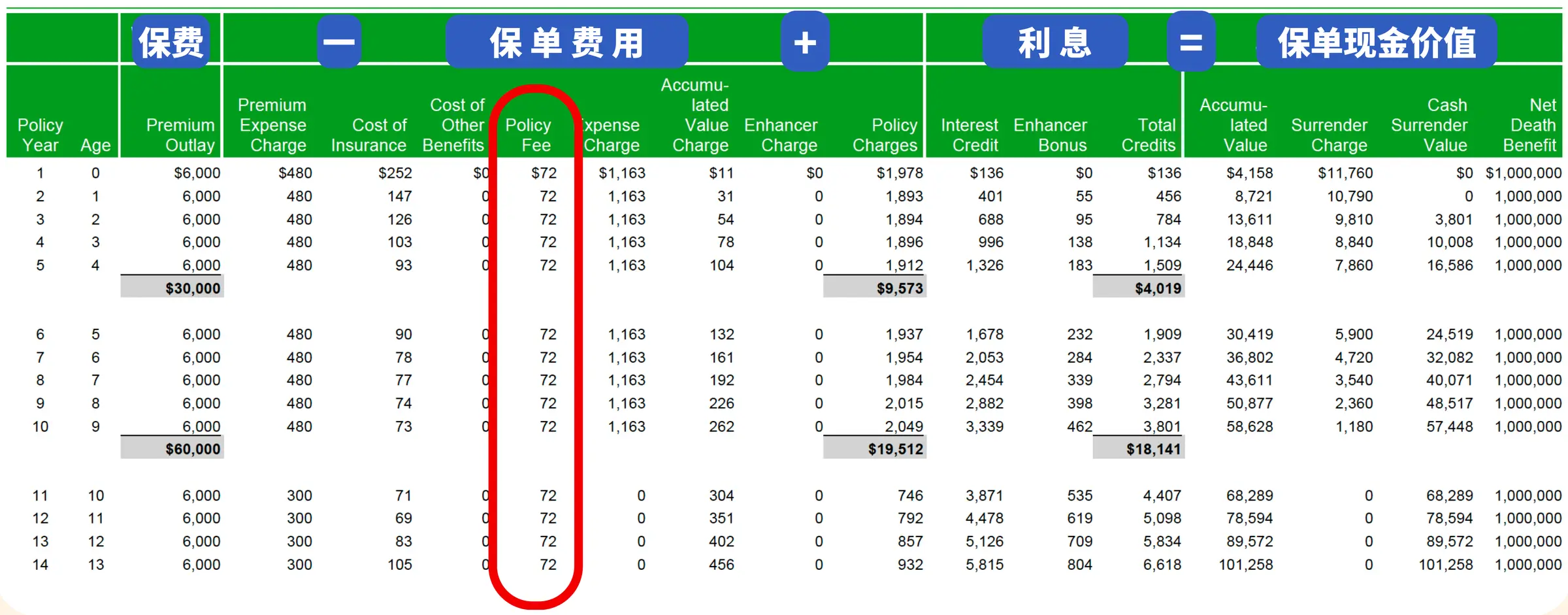
保费 − 保单费用 + 利息 = 现金价值
Premium − charges + interest = cash value
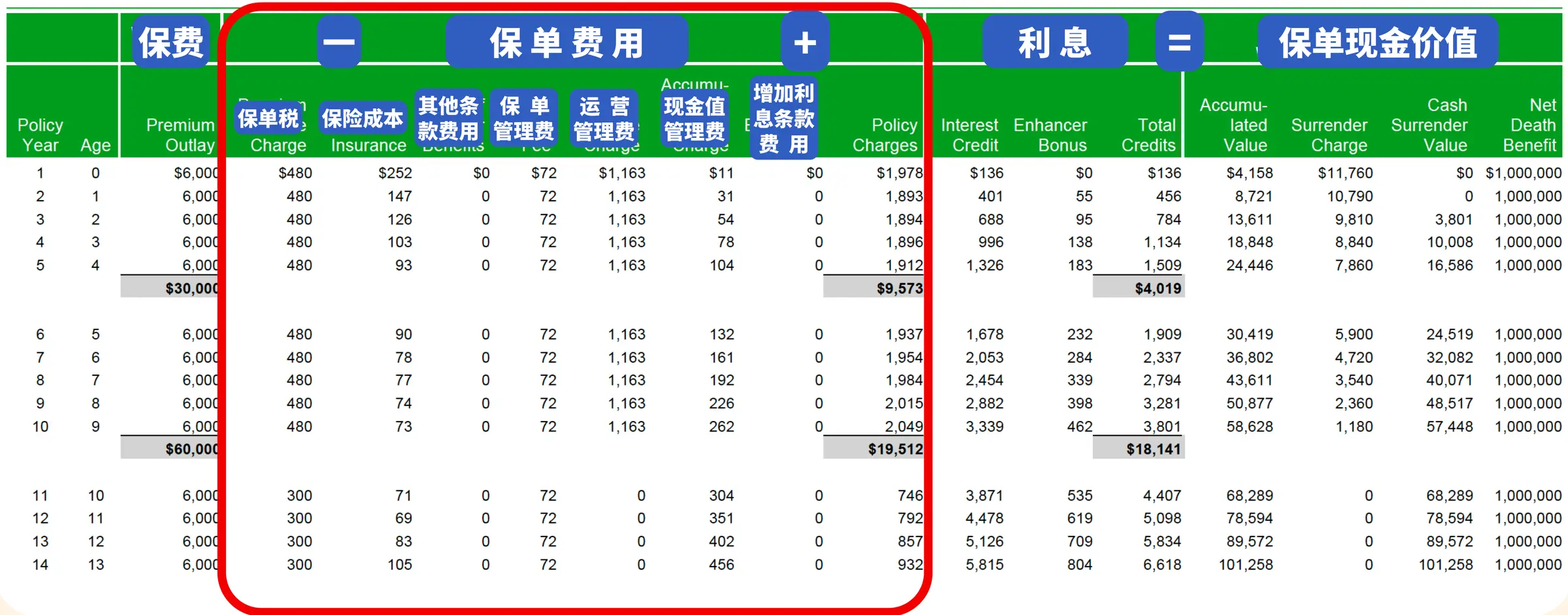
这一页讲的就是中间那一项。保单费用由六块组成, 下面逐个拆。前四项(保单税、运营管理费、保单管理费、现金值管理费)费率写在合同里,按固定规则算; 第五项保险成本是真正的大头,也是唯一会随年龄和净风险变化的;第六项看你开了哪些条款。
This page is about the middle term. Six components make up the charges. The first four (premium load, expense charge, policy fee, accumulated value charge) have rates written into the contract and follow fixed rules; the fifth, the cost of insurance, is the real weight and the only one that moves with age and the amount at risk; the sixth depends on which riders you turned on.
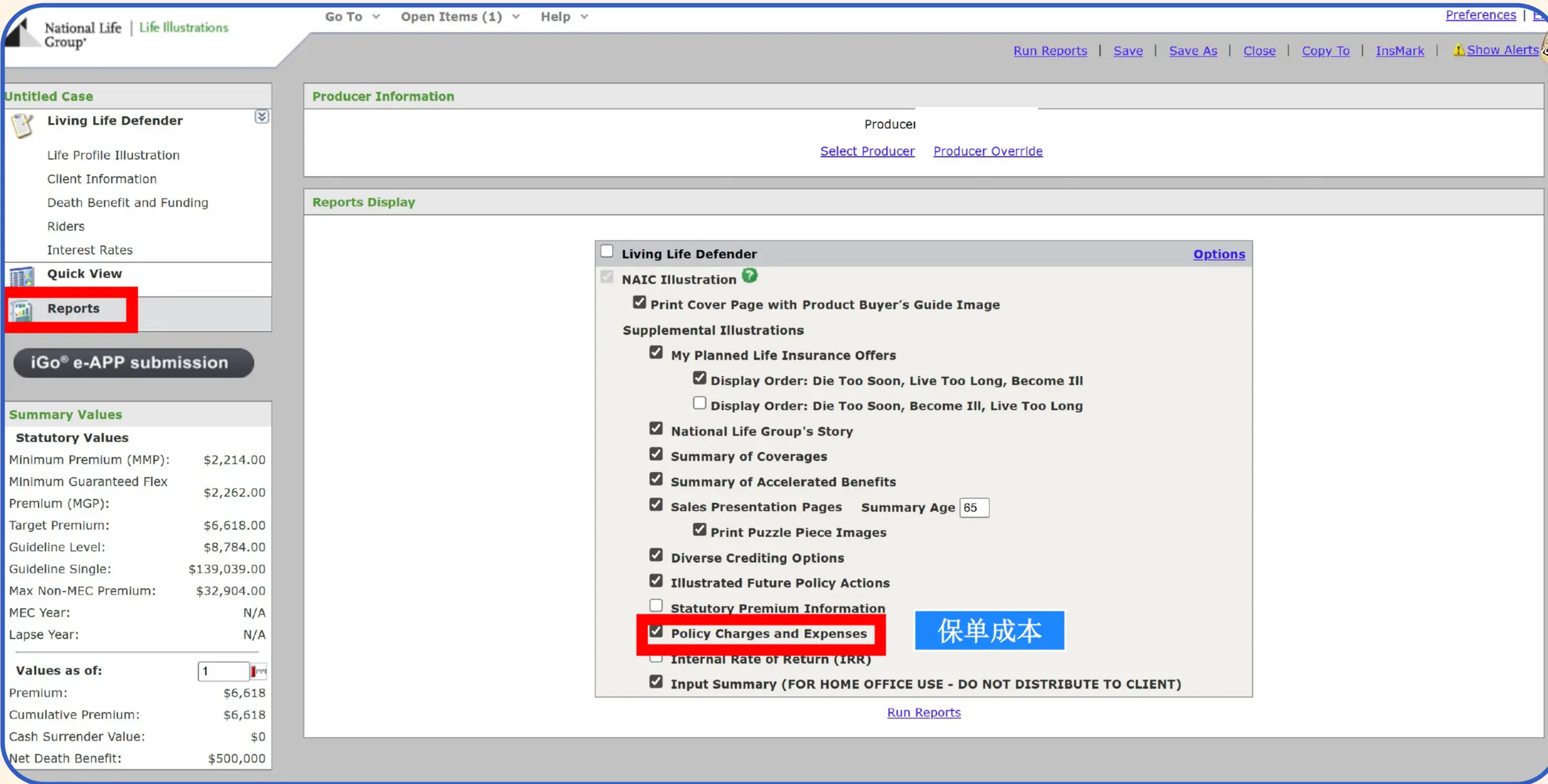
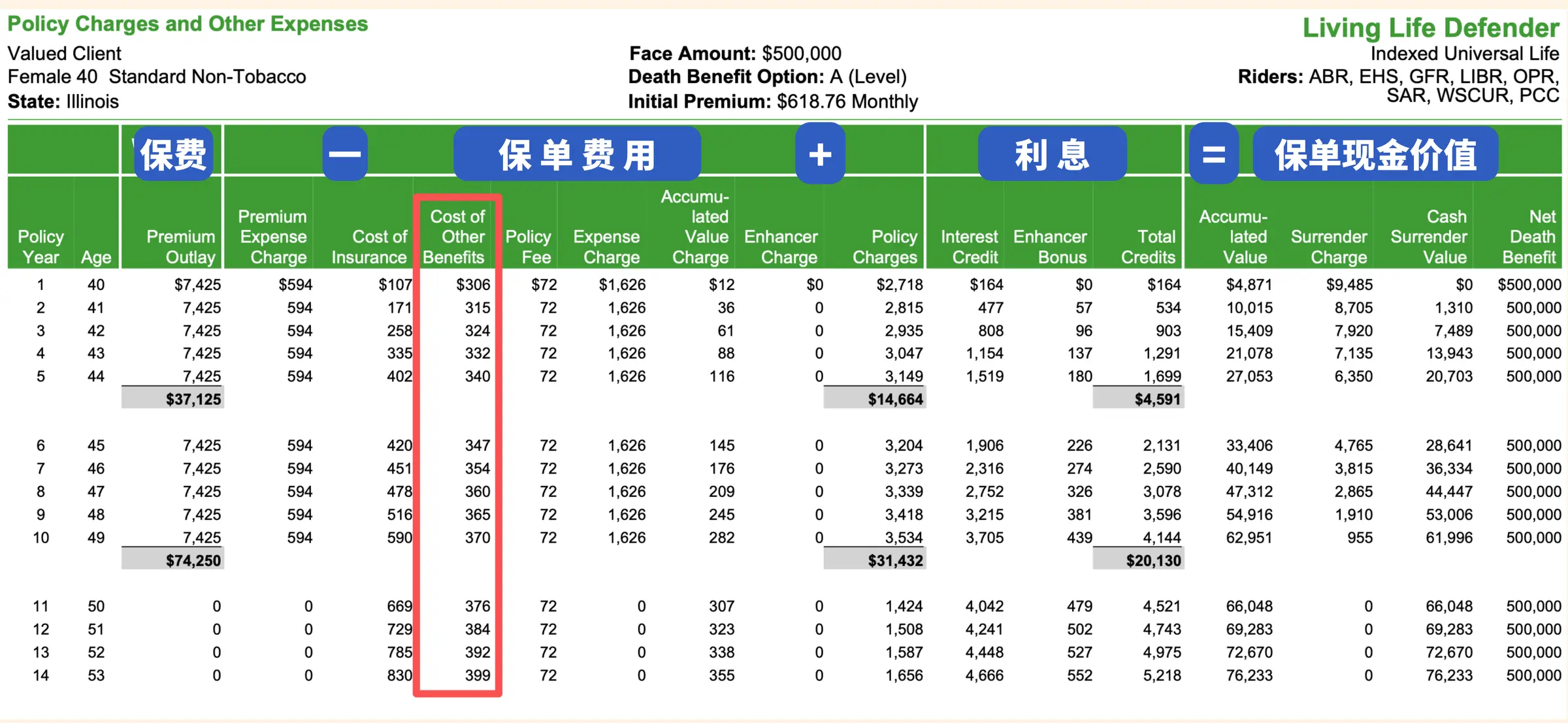
在哪里看:国家人寿的计划书软件里,案例做好以后点左边的 Reports, 在报告清单里勾上 Policy Charges and Expenses,再 Run Reports。打印出来的计划书会多出逐年的费用明细, 七栏(六项费用,条款费用里 Enhancer 单独一栏)、一年一行,最右边一栏是当年合计。这一页默认不打印,很多人从来没看过。
Where to see them: in National Life's illustration software, once the case is set up, click Reports on the left, tick Policy Charges and Expenses, and run the reports. The illustration then includes year-by-year charges: seven columns (the six charges, with the Enhancer charge in its own column), one row per year, and a total on the right. It isn't printed by default, so many people have never seen it.
3. 六项扣费3. The six charges
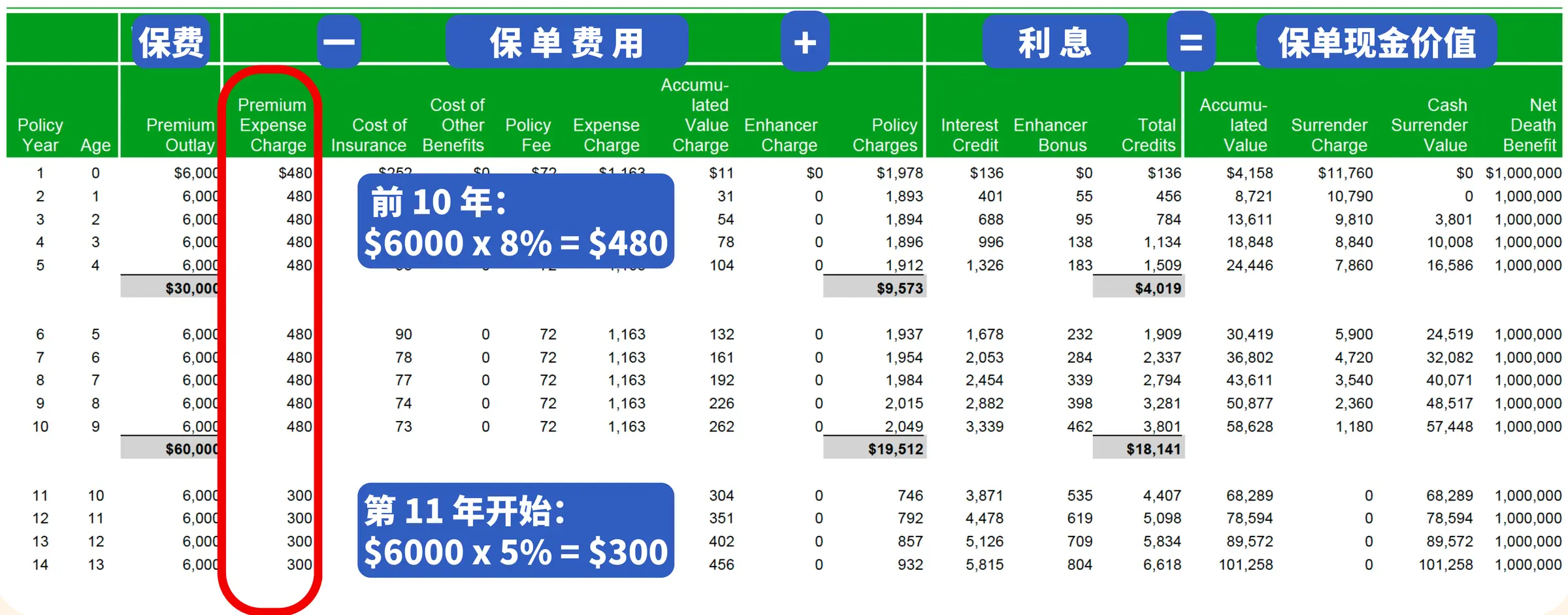
下面的例子大多来自同一份 LLD 计划书:0 岁男孩、标准非吸烟、保额 $100 万、保额不变、每月 $500(每年 $6,000)、加州。 第 1 年合计扣费 $1,978,第 10 年 $2,049,第 11 年一下子降到 $746,原因看完前两项就清楚了。
Most examples below come from one LLD illustration: a baby boy, standard non-tobacco, $1M face, level death benefit, $500 a month ($6,000 a year), California. Total charges are $1,978 in year 1 and $2,049 in year 10, then drop to $746 in year 11; the first two charges explain why.
一 · 保单税 Premium Expense Charge / Premium LoadOne · premium load
按保费收,进来一笔扣一笔。用来覆盖州保证金、初始佣金和保单设立成本。 LLD 是第 1–10 年 8%,第 11 年起 5%。每年 $6,000 的保费,前十年每年 $480,之后每年 $300。 不交保费的年份这一项就是 0。
Taken off each premium as it comes in. It covers state guaranty assessments, first-year commission, and the cost of putting the policy on the books. On LLD it's 8% in years 1–10 and 5% from year 11: on $6,000 a year, $480 a year for ten years, then $300. In a year with no premium it's zero.
二 · 运营管理费 Expense Charge / Per Unit ChargeTwo · per-unit expense charge
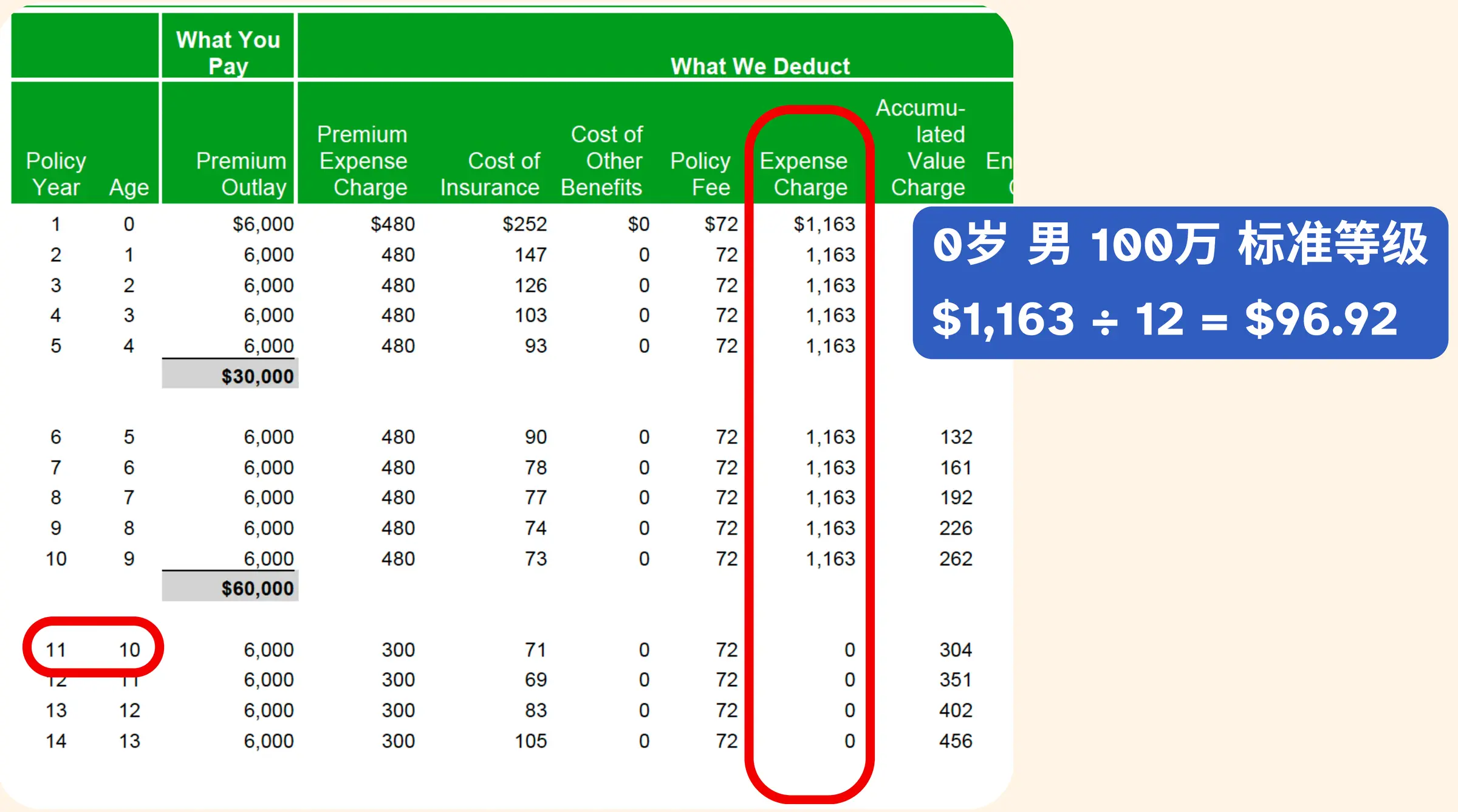
按每一千元保额收,费率看年龄、性别、保额、健康等级, LLD 只收 10 年,第 11 年起为 0。用来覆盖核保、体检、续约佣金、市场、合约、合规等开销。 0 岁男孩、$100 万、标准等级:每年 $1,163(每月 $96.92),十年合计 $11,630,以后不再收。 这一项是前十年费用高、第 11 年断崖式下降的主要原因。
Charged per thousand of face, at a rate set by age, sex, face amount, and underwriting class, and on LLD only for 10 years; from year 11 it's zero. It covers underwriting, the medical exam, renewal commission, marketing, contracting, and compliance. For the baby boy at $1M, standard class: $1,163 a year ($96.92 a month), $11,630 over ten years, and never again. It's the main reason costs are high for ten years and then fall off a cliff.
年龄的影响很大:同样是女性、$50 万保额、最优等级,40 岁每月 $135.40(一年 $1,624.80), 53 岁每月 $278.75(一年 $3,345)。晚 13 年,这一项约翻一倍。
Age matters a great deal: for the same woman with $500k of face in the best class, it's $135.40 a month ($1,624.80 a year) at 40 and $278.75 a month ($3,345 a year) at 53. Thirteen years later, the charge roughly doubles.
三 · 保单管理费 Policy FeeThree · policy fee
所有保单统一:$6/月,即 $72/年,终身收取。覆盖行政与保单维护。 这是六项里最简单的一项,也是最容易跟客户讲清楚的一项。
The same on every policy: $6 a month, $72 a year, for the life of the contract. It covers administration and maintenance, and it's the simplest line to explain.
四 · 现金值管理费 Accumulated Value ChargeFour · accumulated value charge
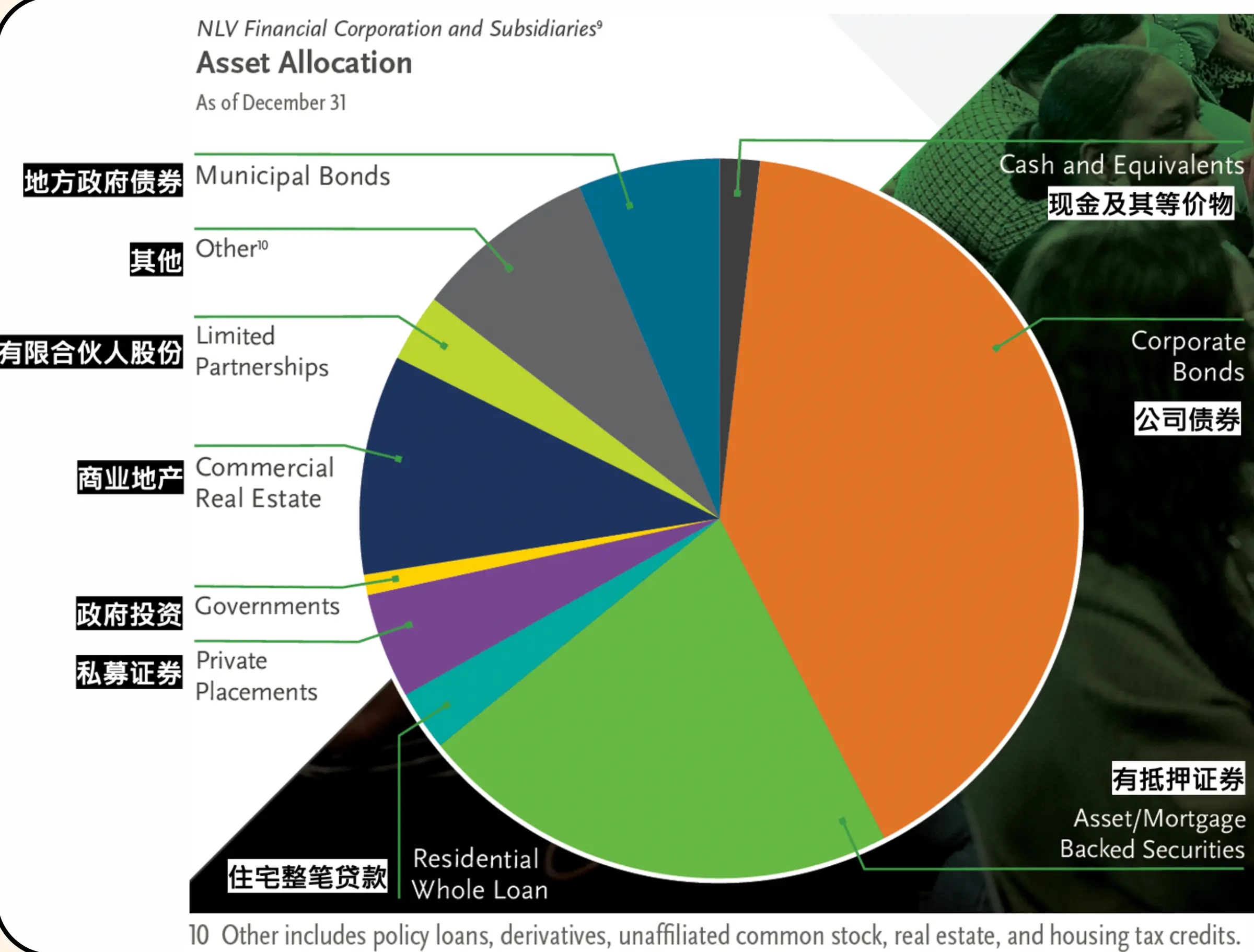
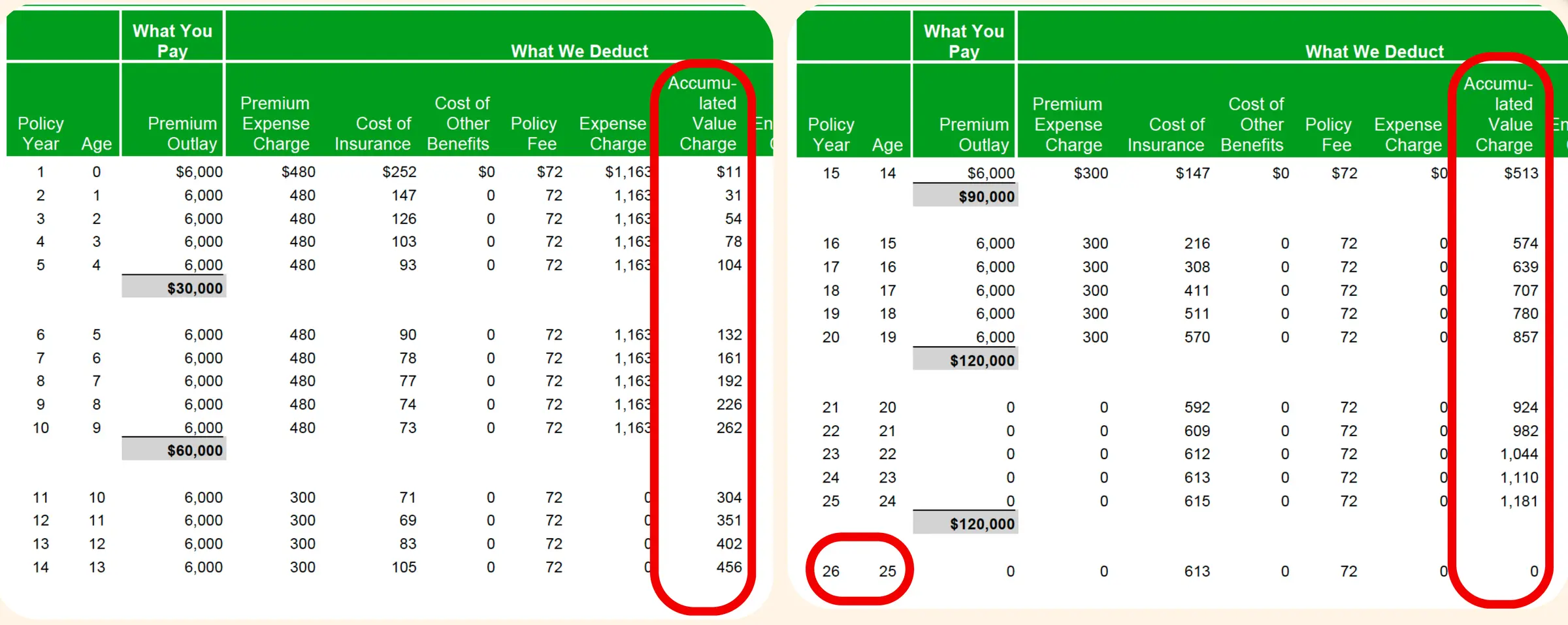
按现金值的百分比收,LLD 是每月 0.04%(一年 0.48%),只收 25 年, 第 26 年起为 0。它覆盖保险公司的投资与对冲成本:客户的钱主要放在公司债券、抵押证券这类固定收益资产里, 用其中的收益买期权,指数涨了按规则记利息,跌了最差记 0,这一整套运作的成本就从这一项出。 它的金额会逐年变大(0 岁男孩那份从第 1 年 $11 到第 25 年 $1,181),不是费率变了,是账户里的钱变多了。
A percentage of the accumulated value: on LLD 0.04% a month (0.48% a year), for 25 years only, zero from year 26. It covers the carrier's investment and hedging cost: the money sits mainly in fixed-income assets such as corporate bonds and mortgage-backed securities, part of the yield buys options, the index credit follows a formula on the way up and is floored at 0 on the way down, and running all of that is what this charge pays for. Its dollar amount grows (from $11 in year 1 to $1,181 in year 25 for the baby boy), not because the rate changes but because the account does.
它是每个月按当月现金值扣的,所以按年粗算时要用年初年末的平均: 第 6 年年初 $24,446、年末 $30,419,平均约 $27,430 × 0.48% ≈ $132,和计划书一致; 直接用年末的 $30,419 × 0.48% = $146 就算多了。精确到月的算法可以在对账单上验证: (上月末现金值 $3,713.52 − 当月保险成本 $20.67 − 当月其他费用 $162.30)× 0.04% = $1.41,和对账单那一格分毫不差。 注意它是在扣掉当月其他费用之后才算的。
It's deducted monthly on that month's value, so a yearly estimate should use the average of the start and end: year 6 starts at $24,446 and ends at $30,419, an average of about $27,430 × 0.48% ≈ $132, matching the illustration; using the year-end $30,419 × 0.48% = $146 overstates it. The exact monthly figure can be checked on a statement: (last month's ending value $3,713.52 − this month's cost of insurance $20.67 − this month's other charges $162.30) × 0.04% = $1.41, matching the statement to the cent. Note that it's computed after the month's other charges come out.
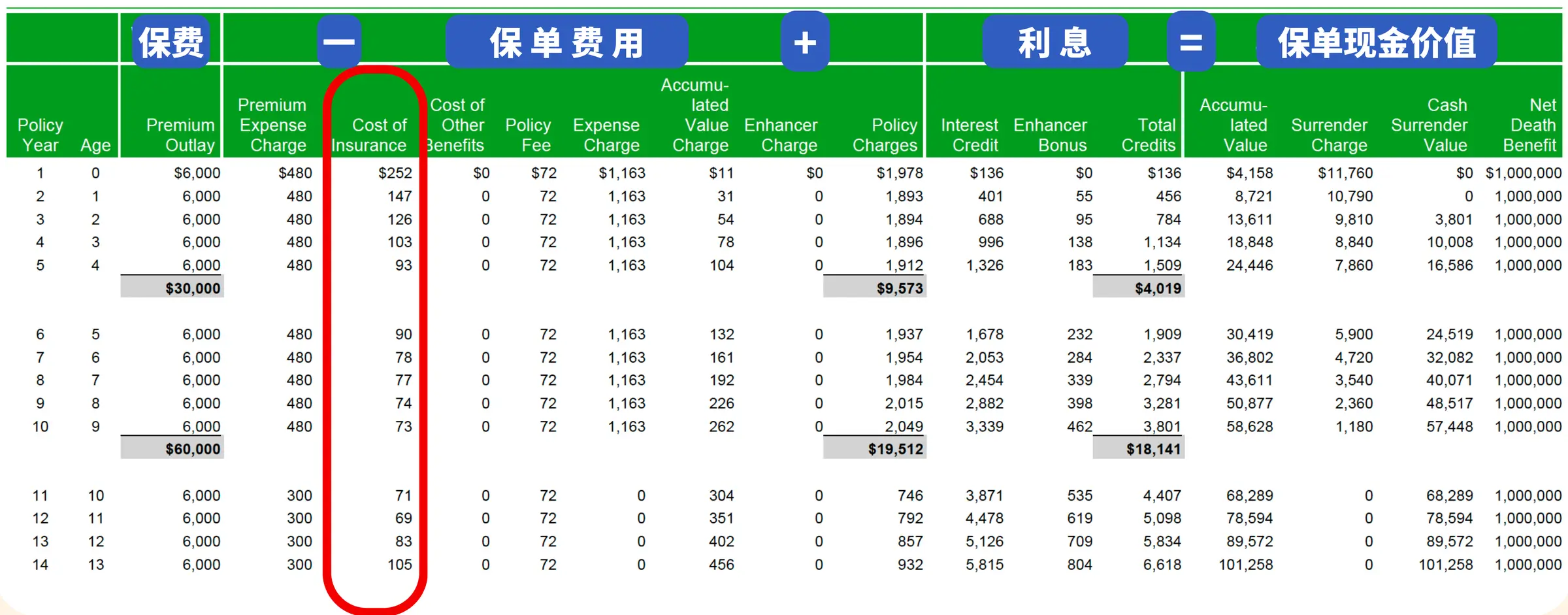
五 · 保险成本 Cost of Insurance(COI)Five · cost of insurance
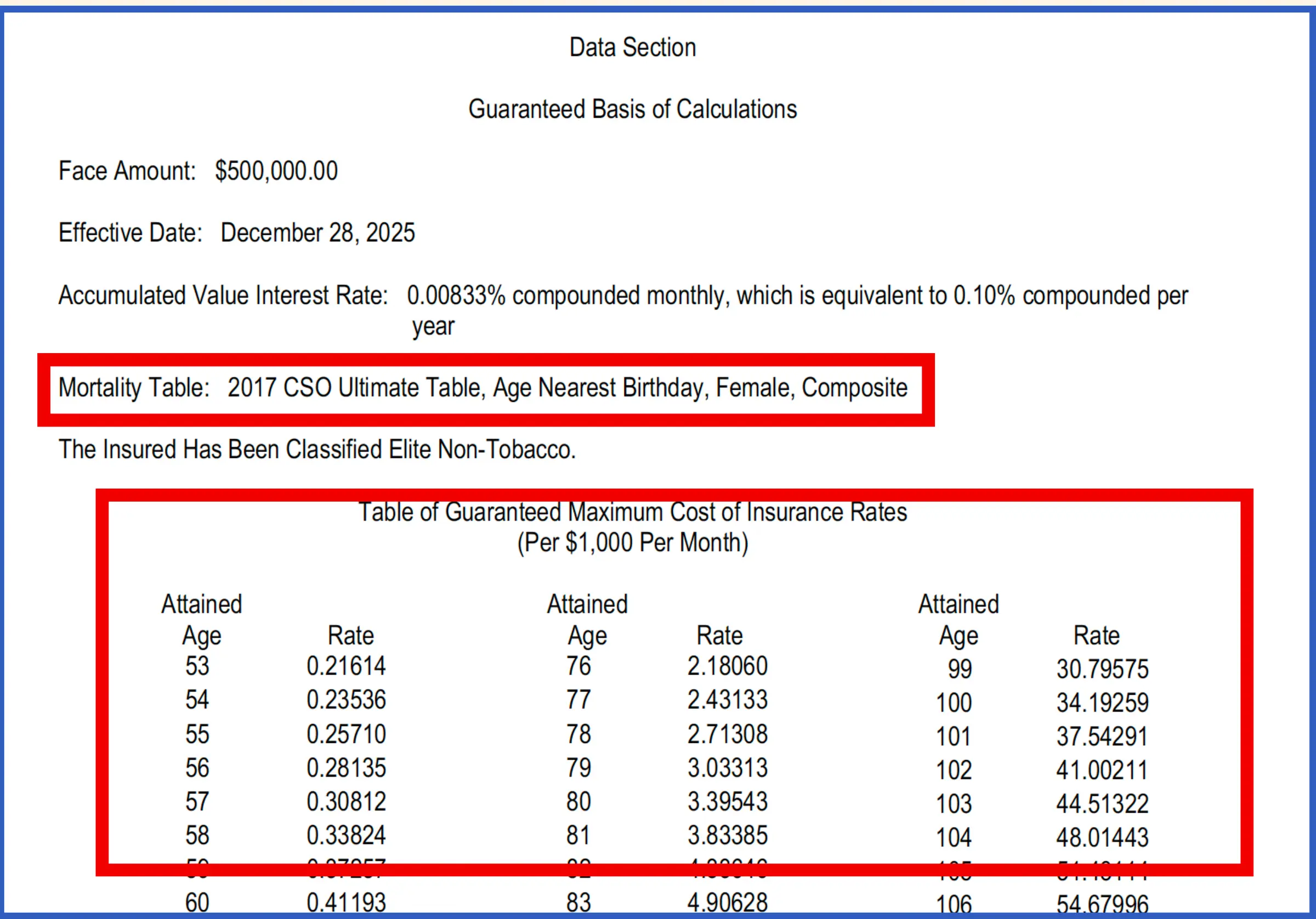
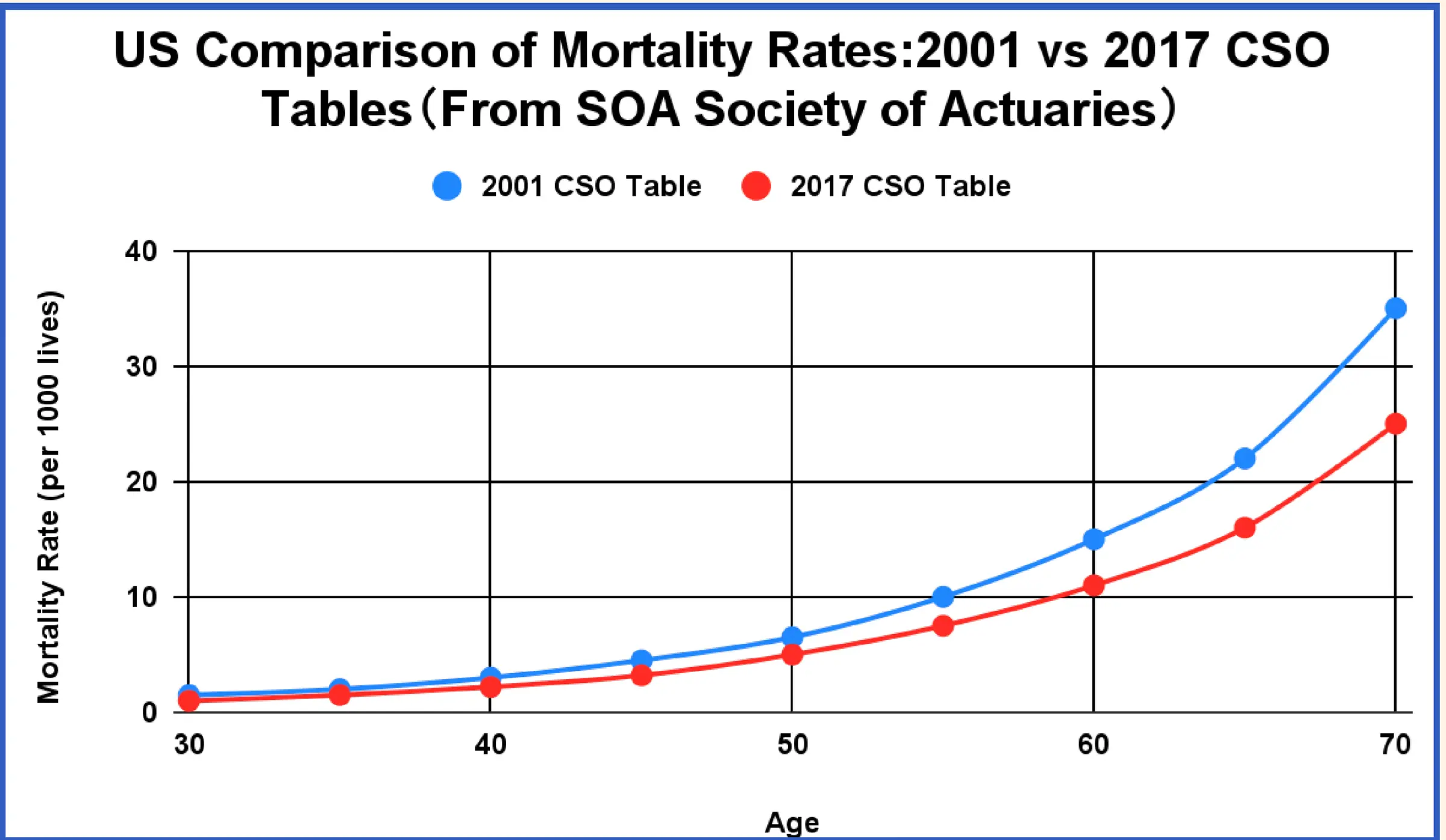
按年龄、性别、保额、健康等级定,用的是 2017 年的 CSO 死亡率表。 计划书的数据页(Data Section)里印着「保证最高保险成本费率」,每千元净风险每月多少,比如 53 岁 $0.216、83 岁 $4.91、 106 岁 $54.68,这是合同上限,实际收的是当前费率。2017 年表每个年龄的死亡率都比 2001 年表低, 背后是人活得更长:美国出生时平均寿命 1930 年 59.7 岁,到 2019 年 78.8 岁(CDC)。
Set by age, sex, face amount, and underwriting class, priced off the 2017 CSO mortality table. The Data Section prints the guaranteed maximum COI rates per thousand at risk per month, for example $0.216 at 53, $4.91 at 83 and $54.68 at 106; those are contractual ceilings, and current rates are what's actually charged. The 2017 table's death rates are below the 2001 table's at every age, because people live longer: US life expectancy at birth was 59.7 in 1930 and 78.8 in 2019 (CDC).
这一项是六项里的大头,也是唯一真正随时间变化的。下一节专门讲它, 因为它不一定随年龄一路涨,这是这一页最反直觉、也最有用的一点。
It's the heaviest of the six and the only one that genuinely moves over time. It gets its own section below, because it does not simply climb with age, which is the least intuitive and most useful idea on this page.
六 · 其他条款费用 Cost of Other BenefitsSix · rider charges
开了哪些条款就收哪些,没开就是 0。第 6 节列了 LLD 常用的六种和它们各自的费用。
Whatever riders are switched on; none, and it's zero. Section 6 lists the six common LLD riders and what each costs.
4. 净风险:为什么保险成本不一定越来越贵4. Net amount at risk: why COI need not keep rising
保额 − 现金价值 = 净风险(NAR)
Face amount − cash value = net amount at risk
保险公司真正要赔的,只有净风险那一块。保额里已经是你自己的钱的部分, 它不承担风险。保险成本 = 净风险 × 当年龄的每千元费率,所以:
The carrier is only ever on the hook for the net amount at risk. The part of the face amount that is already your own money carries no risk for them. The cost of insurance is the amount at risk times the rate per thousand for that age, so:
现金价值 ↑ → 净风险 ↓ → 保险成本 ↓
Cash value up → net amount at risk down → cost of insurance down
年龄增加确实会把保险成本往上推,但现金值增长会把它往下压。 两股力量互相抵消一部分。
Age pushes the cost up; growing cash value pushes it down. The two partly cancel.
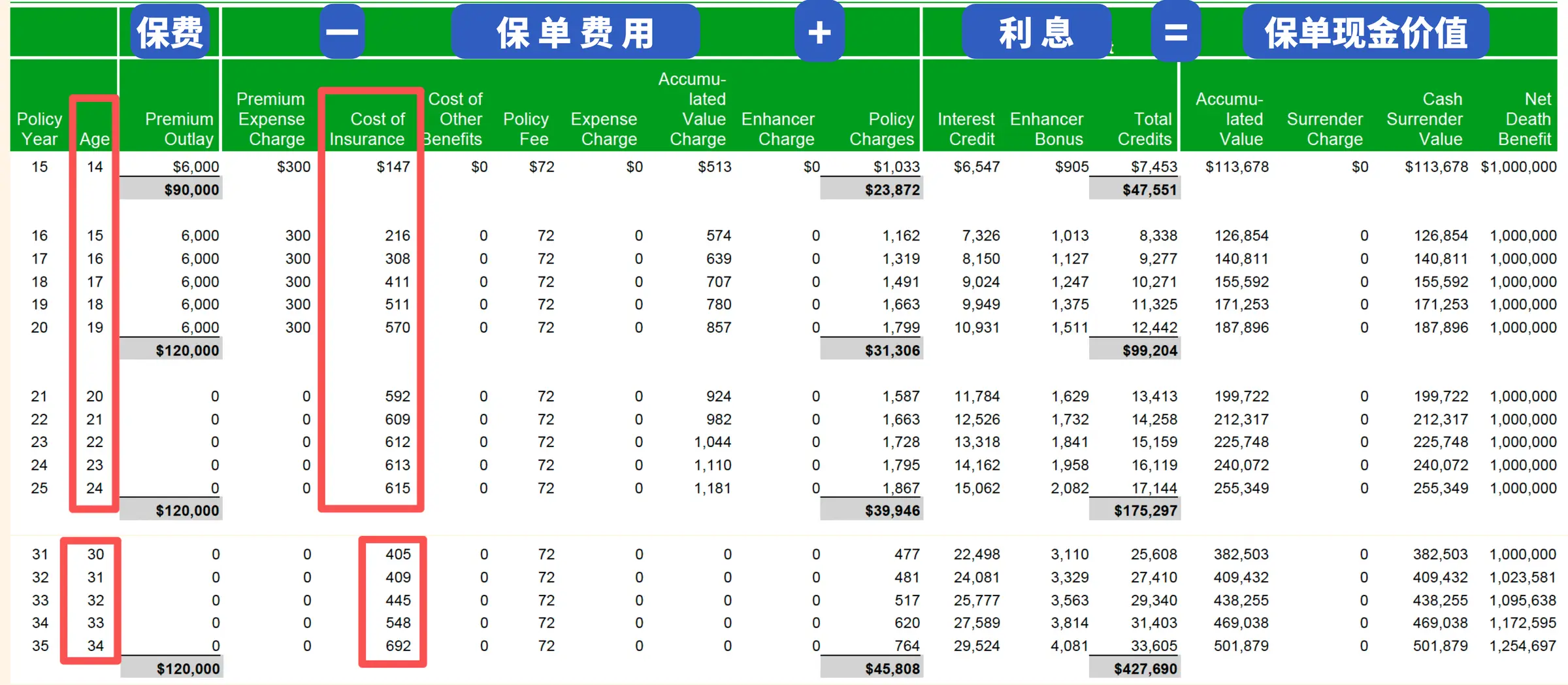
计划书上看得到:0 岁男孩那份,保险成本从第 1 年 $252 一路降到第 12 年 $69 (婴儿期死亡率本来就比幼儿期高,加上净风险在缩);24 岁一年 $615,30 岁反而只要 $405。 到了 30 多岁现金值相对保额太高,税法要求身故赔付跟着抬高,净风险不再缩,保险成本又随年龄往上走, 这也是计划书后段身故赔付会自己变大的原因。
You can see it in the illustration: for the baby boy, COI falls from $252 in year 1 to $69 in year 12 (infant mortality is higher than toddler mortality to begin with, and the amount at risk is shrinking); it's $615 a year at 24 and only $405 at 30. In the thirties the cash value gets large relative to the face, tax law requires the death benefit to rise with it, the amount at risk stops shrinking, and COI follows age upward again, which is also why the death benefit grows on its own late in an illustration.
案例:0 岁女宝,$100 万保障,演示 6.5%Example: female age 0, $1M, illustrated at 6.5%
同样的总保费($27,000),只改存钱的速度:
The same total premium ($27,000), changing only how fast it goes in:
| 保单年度Policy year | $150/月 × 15 年 现金值 → 净风险$150/mo × 15 yrs CV → NAR |
$450/月 × 5 年 现金值 → 净风险$450/mo × 5 yrs CV → NAR |
|---|---|---|
| 1 | $500 → $999.5k | $3,800 → $996.2k |
| 20 | $25k → $975k | $45k → $955k |
| 50 | $150k → $850k | $310k → $690k |
| 现金值追平保额CV reaches face | 第 81 年year 81 | 第 68 年year 68 |
总存钱一样,存得快的那份净风险降得快,保险成本也就更低。 这是"早买便宜"之外的第二个理由:除了投保年龄低,钱进去得快也有关系。 存得快也要在税法上限之内,不能让保单变成 MEC。
Same money in, but the faster schedule drops the net amount at risk faster, and with it the cost of insurance. That's a second reason beyond "buying young is cheaper": besides the issue age, the speed the money goes in matters too. Faster funding still has to stay within the tax-law limits so the policy doesn't become a MEC.
做计划书时以实际输出为准。
Use the actual illustration output when you run a case.
5. 保额不变 vs 保额增加5. Level vs increasing death benefit
保额不变 Level
Level
保额固定。现金值涨上去,净风险就一路往下走,保险成本跟着降。
The face amount is fixed. As cash value climbs, the net amount at risk falls all the way down, and the cost of insurance falls with it.
案例(0 岁女宝、$450/月存 6 年、6.5%): 第 50 年现金值 $41 万、净风险 $59 万;第 63 年现金值追平 $100 万保额。
Example (female age 0, $450/mo for six years, 6.5%): $410k of cash value and $590k at risk in year 50; cash value reaches the $1M face in year 63.
保额增加 Increasing
Increasing
保额 = 初始保额 + 现金价值。 所以净风险始终等于初始保额,永远不下降,保险成本因此一直更高。
Face amount = original face + cash value. So the net amount at risk stays at the original face and never falls, which keeps the cost of insurance permanently higher.
例:$120 万 = $100 万 + $20 万现金值, 净风险仍是 $100 万。
E.g. $1.2M = $1M + $200k of cash value, with $1M still at risk.
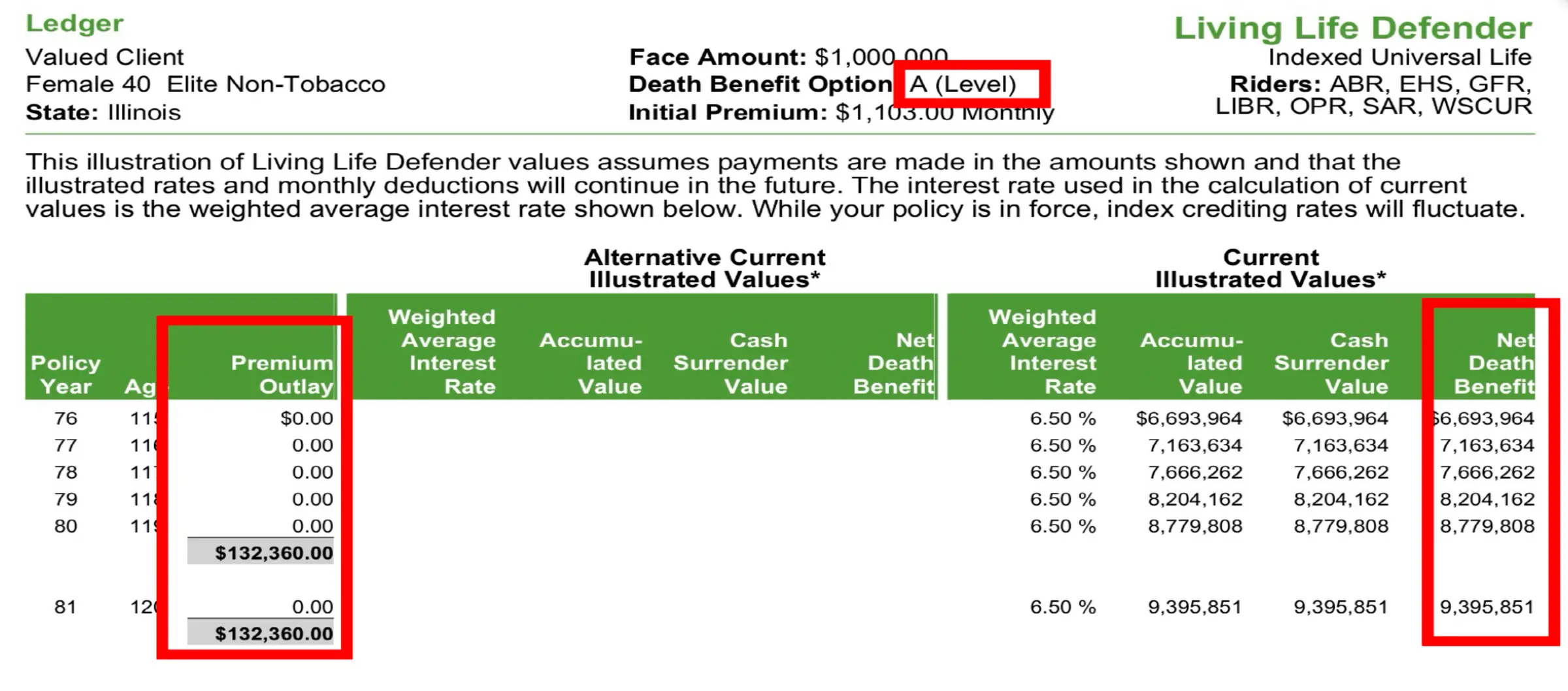
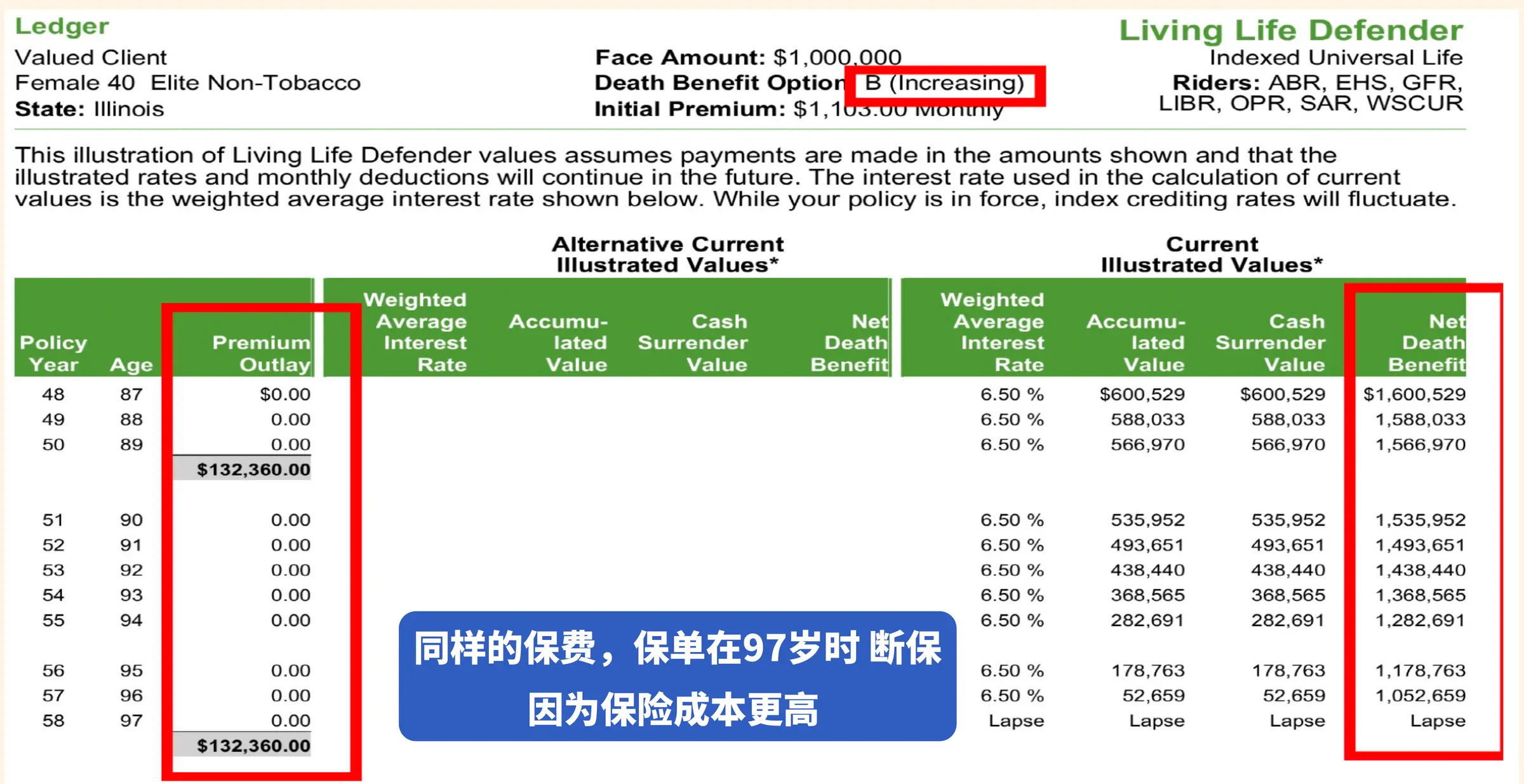
案例:40 岁女、$100 万保额、最优等级、6.5%、$13,236/年、存 10 年(共 $132,360)。 保额不变的那份一直演示到 120 岁;保额增加的那份 87 岁时现金值 $60 万、身故赔付 $160 万,之后逐年下降,在 97 岁断保, 因为 $100 万的净风险在八九十岁的费率下,保险成本比利息还多,把账户吃穿了。
The case: female 40, $1M, best class, 6.5%, $13,236 a year for ten years ($132,360). The level version is illustrated all the way to 120. The increasing version has $600k of cash value and a $1.6M death benefit at 87, then falls every year and lapses at age 97: $1M at risk at late-life rates costs more than the account earns, and eats it.
那为什么还会用保额增加?So why use increasing at all?
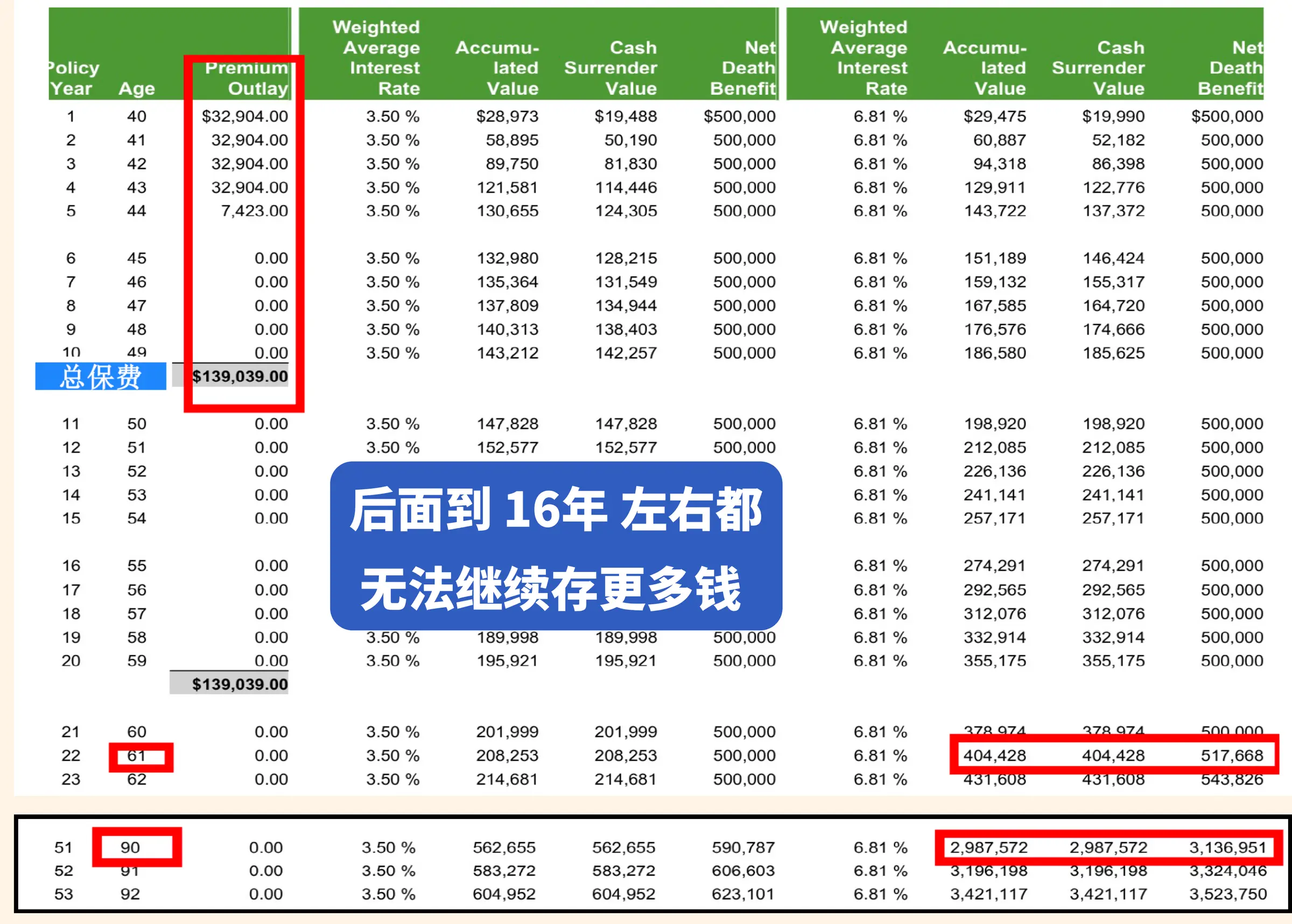
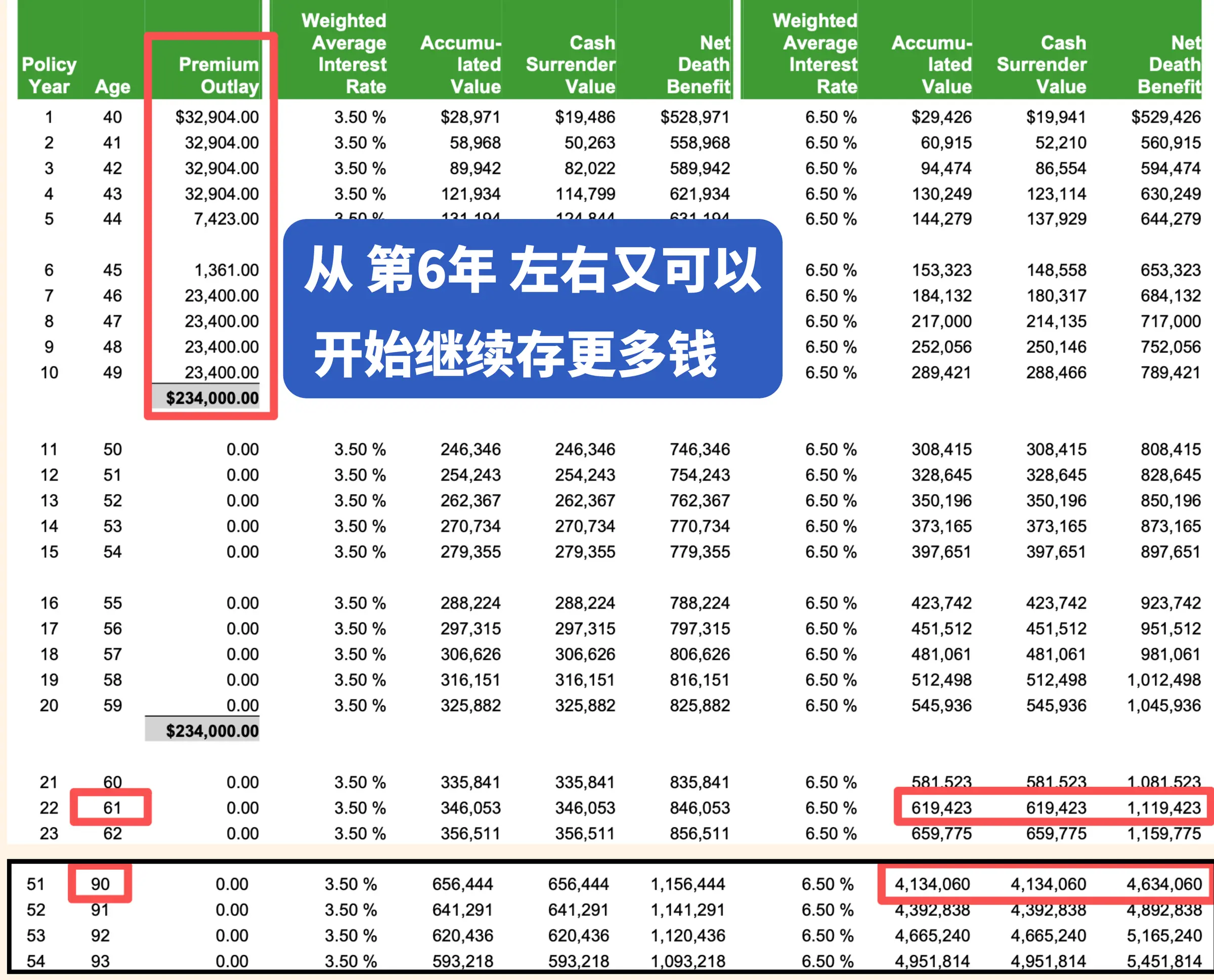
因为它能把可以存钱的空间撑开。税法对一张保单能存多少有上限, 累计上限取「最高单笔保费(Guideline Single)」和「最高平均保费(Guideline Level)× 年数」两者的较高者; 每年还不能超过不成为 MEC 的最高保费。保额增加会大幅提高最高平均保费。一个对照(40 岁女、$50 万保额、最优等级、6.5%):
Because it opens up room to fund. Tax law limits how much a policy can hold: the cumulative cap is the greater of the Guideline Single Premium and the Guideline Level Premium times the number of years, and each year must also stay under the maximum non-MEC premium. The increasing option raises the Guideline Level Premium sharply. A comparison (female 40, $500k, best class, 6.5%):
| 保额不变Level | 保额增加Increasing | |
|---|---|---|
| 最高平均保费(每年)Guideline Level Premium (a year) | $8,784 | $23,400 |
| 最高单笔保费Guideline Single Premium | $139,039 | $139,039 |
| 每年最高保费(不成为 MEC)Max non-MEC premium (a year) | $32,904 | $32,904 |
| 5 年存满 $139,039 之后After $139,039 in five years | 到第 16 年左右都没法再多存No more until about year 16 | 第 6 年起又能继续存(第 6 年 $1,361,第 7–10 年每年 $23,400)Funding resumes in year 6 ($1,361, then $23,400 a year in years 7–10) |
两份计划书十年分别存了 $139,039 和 $234,000,演示利率一栏也不完全相同(6.81% 与 6.50%), 所以后面的现金值差距主要来自多存的钱,这个对照只用来看「还能不能继续存」。
Over ten years the two illustrations take $139,039 and $234,000, and their illustrated rate columns differ (6.81% and 6.50%), so the later cash value gap mostly reflects the extra money; use this comparison only for whether more can go in.
- 只有客户明确要求、或者需要快速存进更多保费时才用保额增加。
- Use increasing only when the client asks for it or you need to get more premium in quickly.
- 开始取钱时必须切换回保额不变,否则保险成本会一直压着账户。
- Switch back to level before income starts, or the cost of insurance keeps grinding the account down.
- 切换需要经纪人操作,不会自动发生。 这一条最要紧。忘了切,就是上面那个 97 岁断保的案例。
- The switch is a manual action by the agent. It does not happen by itself. This is the one that matters most: forgetting it is exactly the lapse-at-97 case above.
6. 六种条款及其费用6. Six riders and what they cost
条款费用都记在计划书的 Cost of Other Benefits 一栏(Enhancer 单独一栏),按月从现金值里扣, 停交保费以后照样扣。条款不是越多越好,按客户的需要选。下面的金额都是各自案例的数字,每张保单略有不同。
Rider charges appear in the Cost of Other Benefits column (the Enhancer has its own column) and come out of cash value monthly, continuing after premiums stop. More riders isn't better; choose by what the client needs. The amounts below come from each case's illustration and vary by policy.
| 条款Rider | 作用与费用What it does, what it costs |
|---|---|
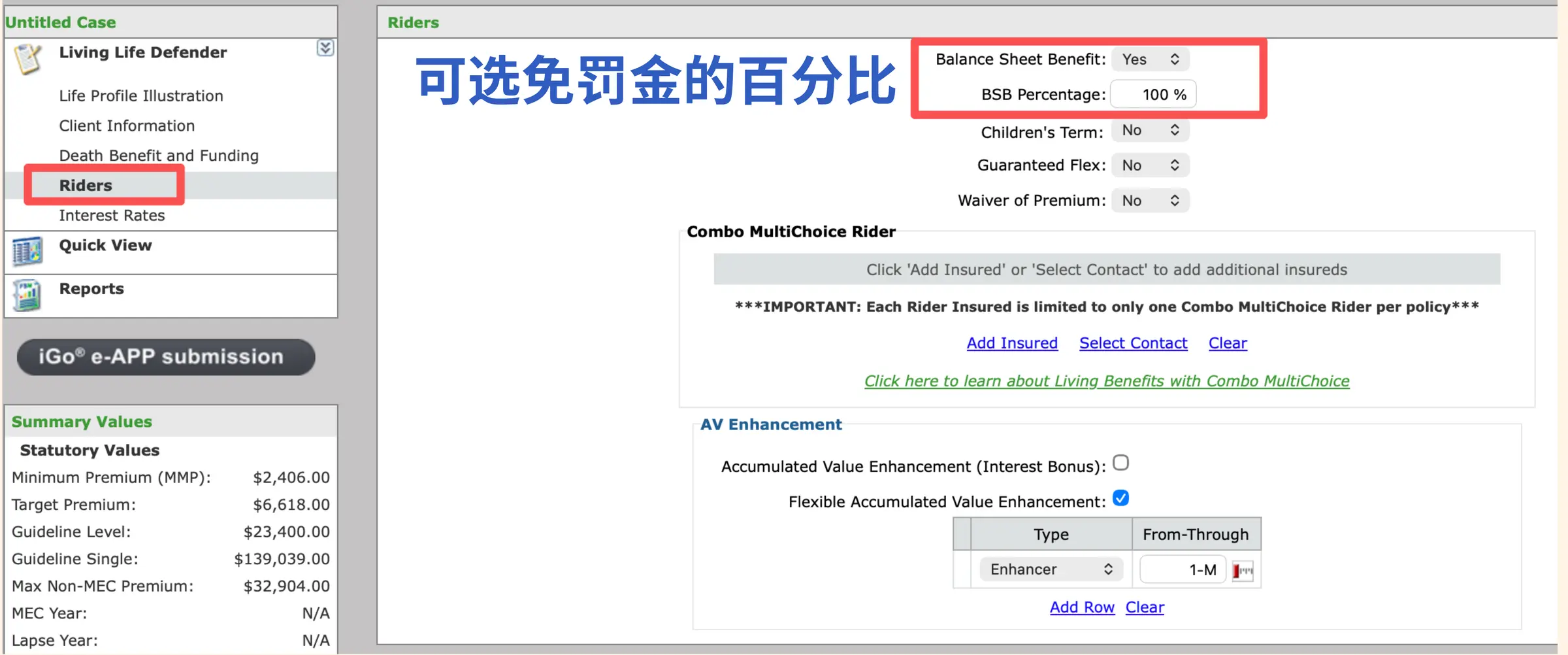
| 退保免罚金 BSBBalance Sheet Benefit | 按选定的百分比免掉退保费用,开 100% 时第 1 年起退保现金值 = 现金值。例:100% 约 $15.05/月 = $180.60/年,只在有退保费用的前十年收。40 岁、每年 $32,904 的案例,第 1 年退保现金值从 $19,943 变成 $29,241,现金值少 $187Waives the chosen share of the surrender charge; at 100%, surrender value equals accumulated value from year 1. Example: 100% at about $15.05 a month ($180.60 a year), charged only during the first ten years while there's a surrender charge. In a case funding $32,904 a year at 40, year-1 surrender value goes from $19,943 to $29,241, with $187 less accumulated value |
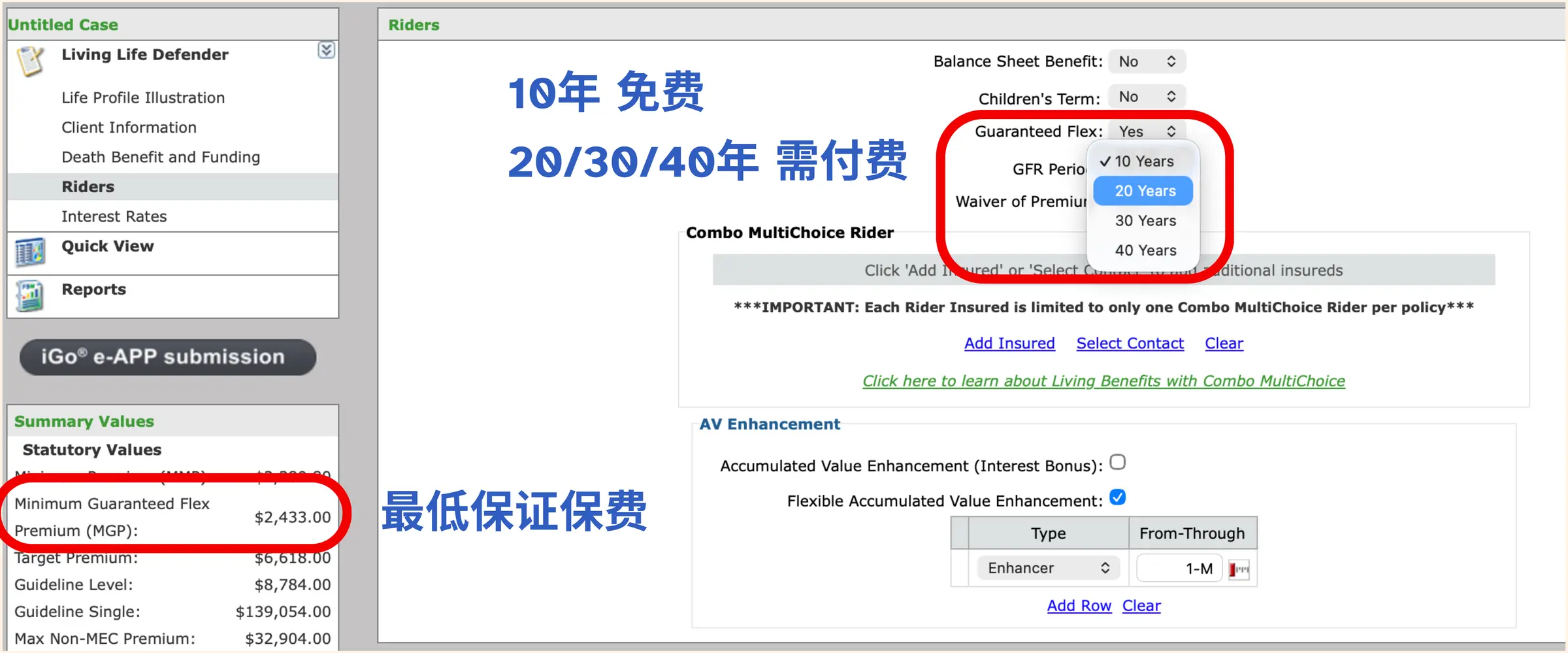
| 保证期条款 GFRGuaranteed Flex Rider | PFA 专属。交够最低保证保费(MGP),保证期内现金值不够扣也不失效。10 年免费;20/30/40 年付费,例:40 年 $12.50/月 = $150/年。不能说成「保证不断保」PFA only. Pay the minimum guaranteed flex premium (MGP) and the policy stays in force through the period even if cash value falls short. 10 years is free; 20, 30 or 40 years is paid, e.g. 40 years at $12.50 a month ($150 a year). Never call it "guaranteed no-lapse" |
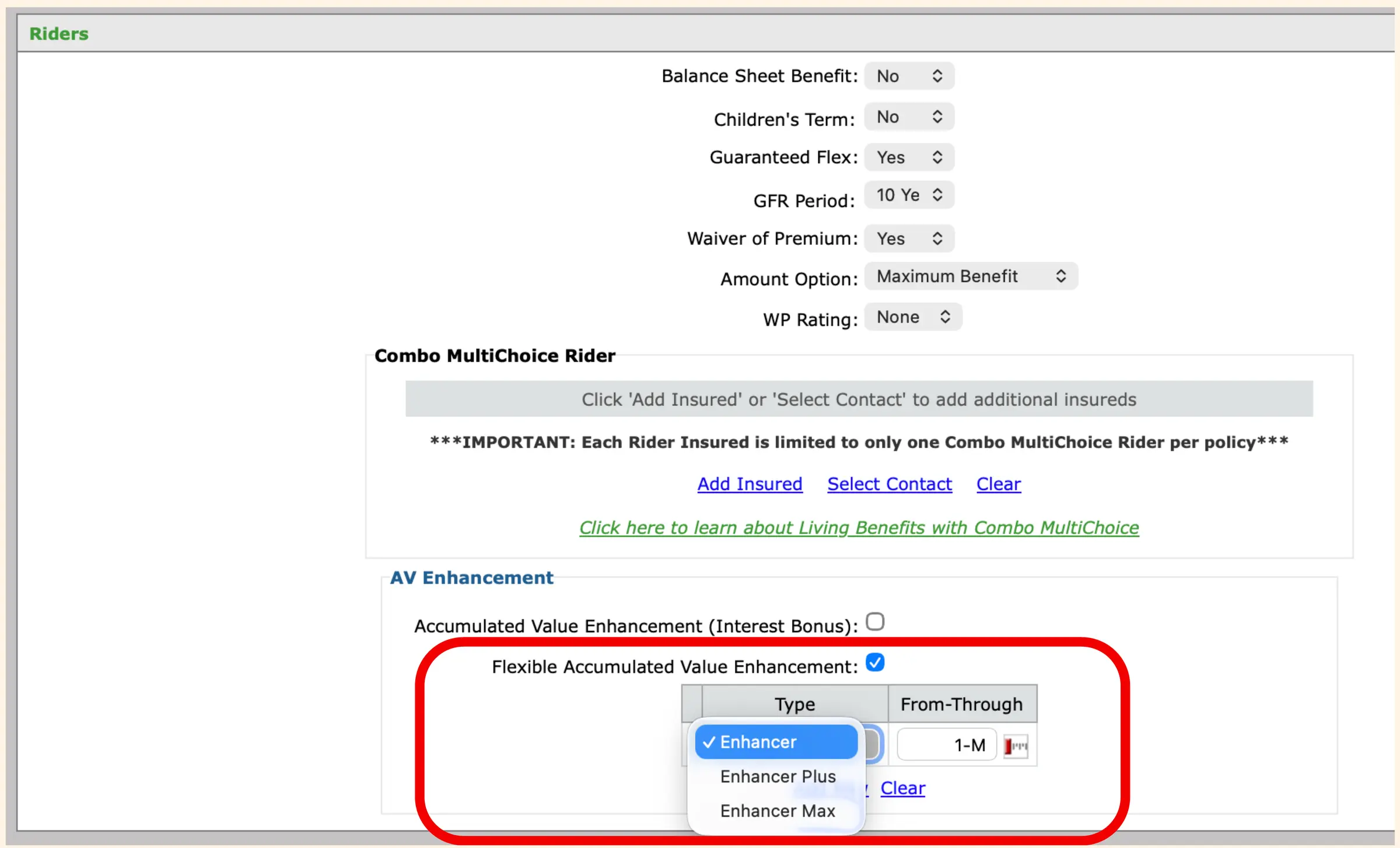
| 增加利息 EnhancerEnhancers | PFA 专属,保额低于 $100 万也能开。给当年记的利息加成:Enhancer 不收费(加成 15%,最多 0.85%);Plus 每年 1%(45%,最多 2.5%);Max 第 1–19 年 3%、20–29 年 2%、30 年起 1%(第 2–20 年 95%,最多 6%)。费用固定,加成不固定,记 0 的年份照扣。例:$82,388 × 3% ≈ $2,471,计划书 $2,474,差在按月扣PFA only, available below $1M of face. Adds a bonus to the year's credit: Enhancer is free (15%, up to 0.85%); Plus 1% a year (45%, up to 2.5%); Max 3% in years 1–19, 2% in 20–29, 1% from 30 (95% up to 6% in years 2–20). The charge is fixed, the bonus is not; it still comes out in a 0% year. Example: $82,388 × 3% ≈ $2,471, shown as $2,474 because it's taken monthly |
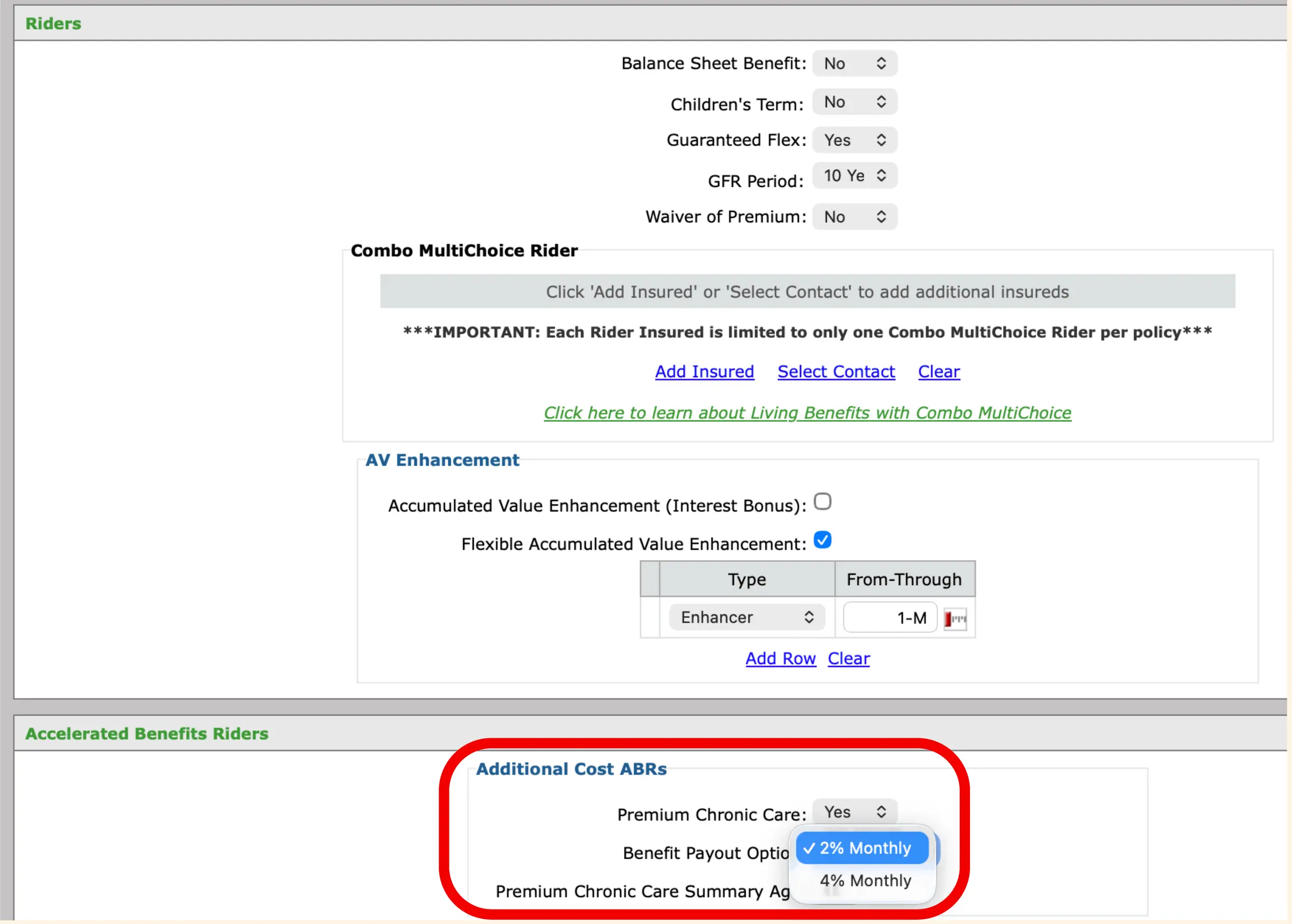
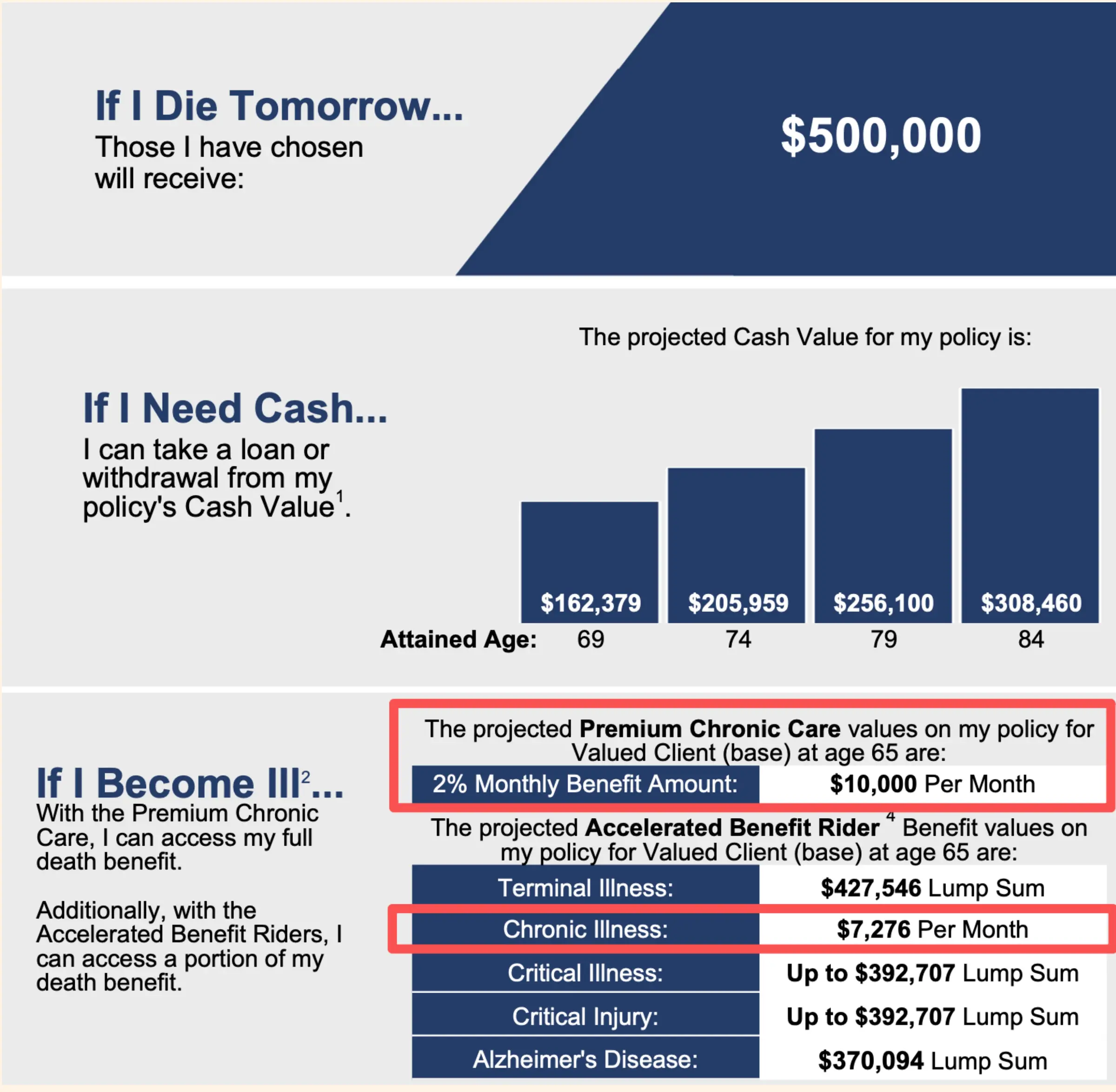
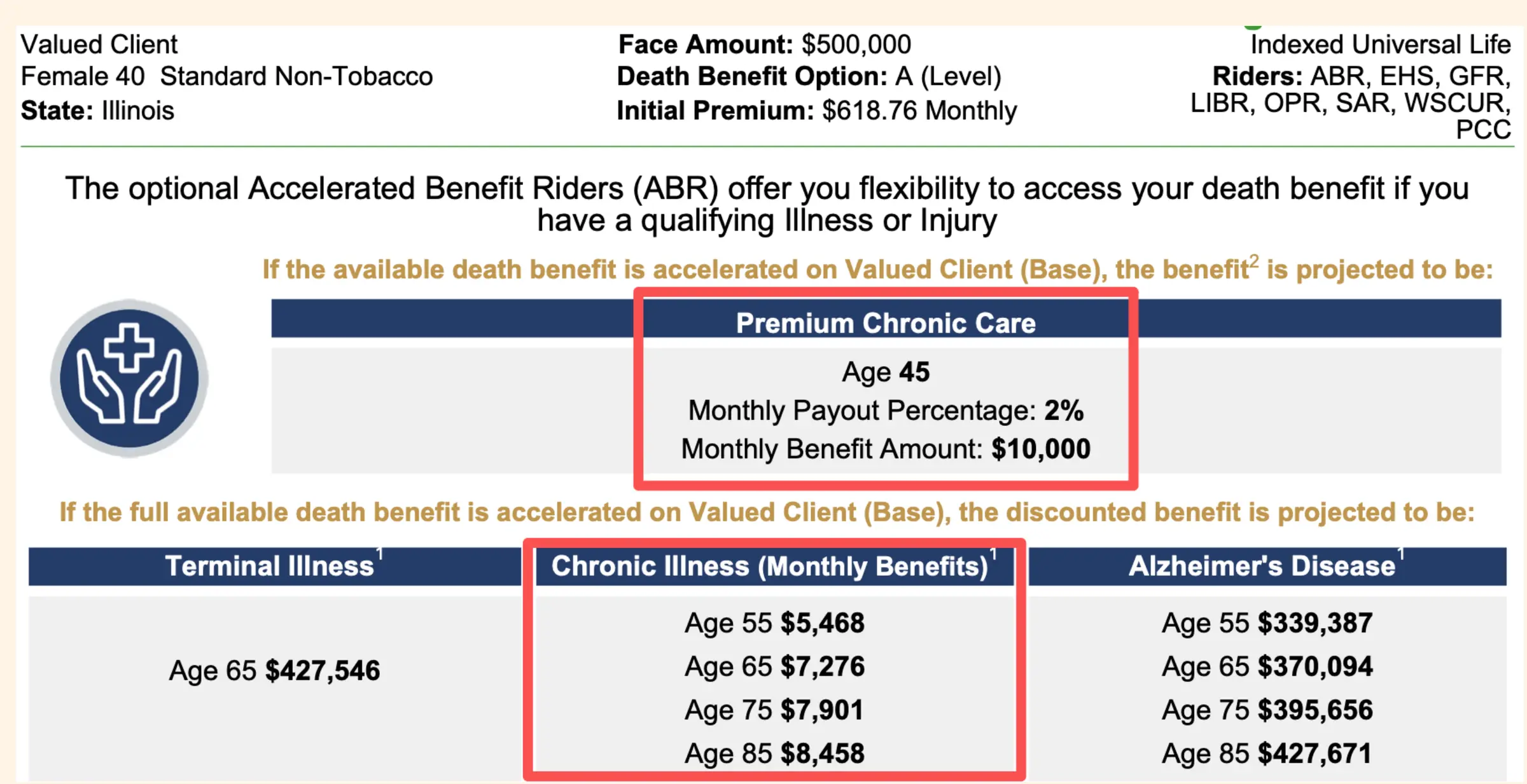
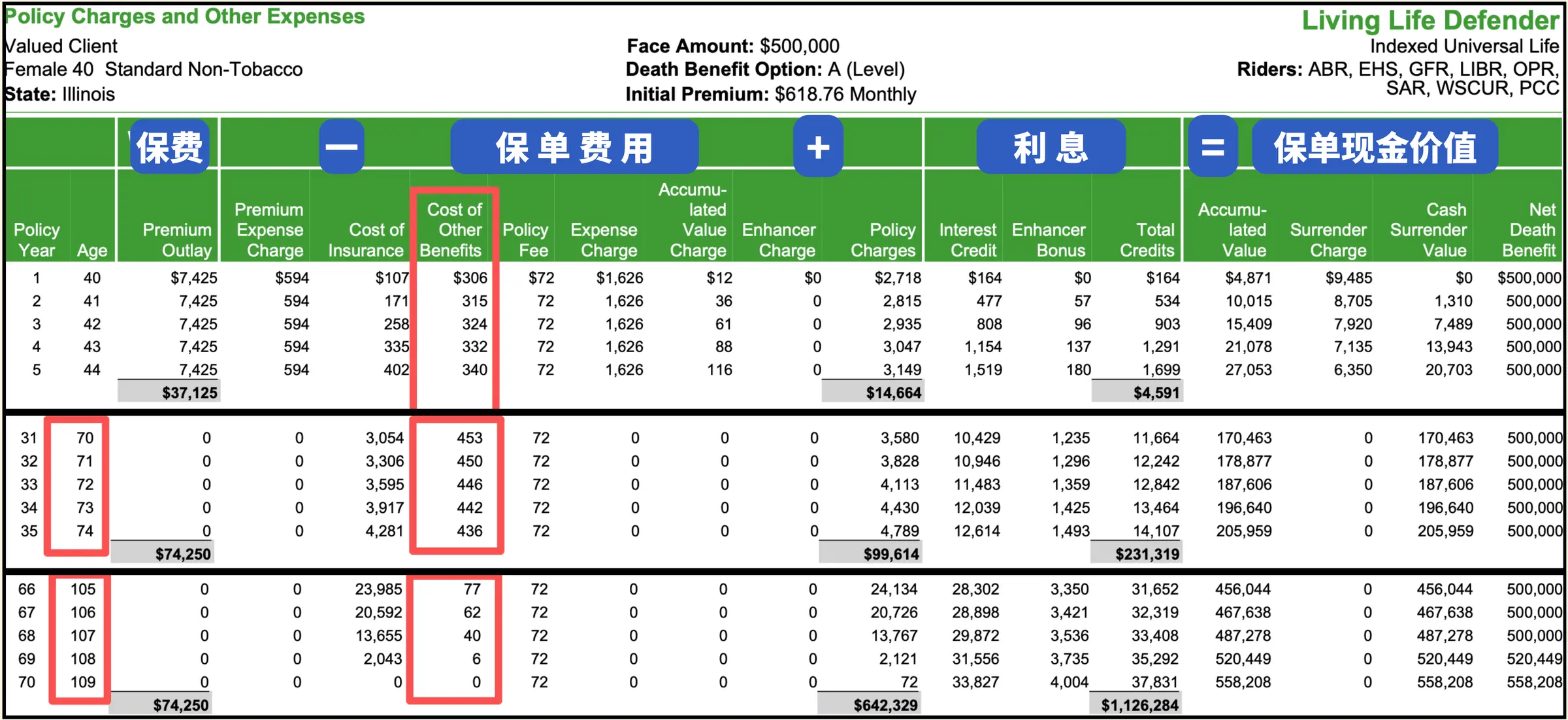
| 高级护理 PCCPremium Chronic Care | 加州和纽约暂时没有。比免费的慢性疾病条款:额度 $300 万(免费条款所有生前福利合计 $150 万)、按保额 2% 或 4% 每月给付不折现、无等待期,投保年龄 18–75 岁。例:$50 万 × 2% = $1 万/月;× 4% = $2 万/月(可能受 IRS 金额限制)。40 岁女、$50 万的案例,费用第 1 年 $306、第 14 年 $399,70 多岁仍有四百多,到 105 岁后降到几十元,因为净风险在缩Not currently available in CA or NY. Against the free chronic rider: a $3M cap (the free rider shares $1.5M across all living benefits), 2% or 4% of face a month undiscounted, no waiting period, issue ages 18–75. Example: $500k × 2% = $10k a month, × 4% = $20k (may be limited by the IRS per diem). For a 40-year-old woman at $500k, the charge is $306 in year 1 and $399 in year 14, still over $400 in her seventies, and down to double digits after 105 as the amount at risk shrinks |
| 残疾免保费 WOPWaiver of Premium | 完全残疾时豁免。四档可选:月度扣费(行政费 + COI)、最低保费、最高赔付(最高平均保费)、指定金额。例:40 岁女、最高赔付档 $724/年,交费停了也照收到 59 岁,该条款 60 岁失效,费用随之停止Waives on total disability. Four levels: monthly deductions (admin + COI), minimum premium, maximum benefit (guideline level premium), or a specified amount. Example: female 40, maximum benefit at $724 a year, charged to 59 even after premiums stop; the rider ends at 60 and so does the charge |
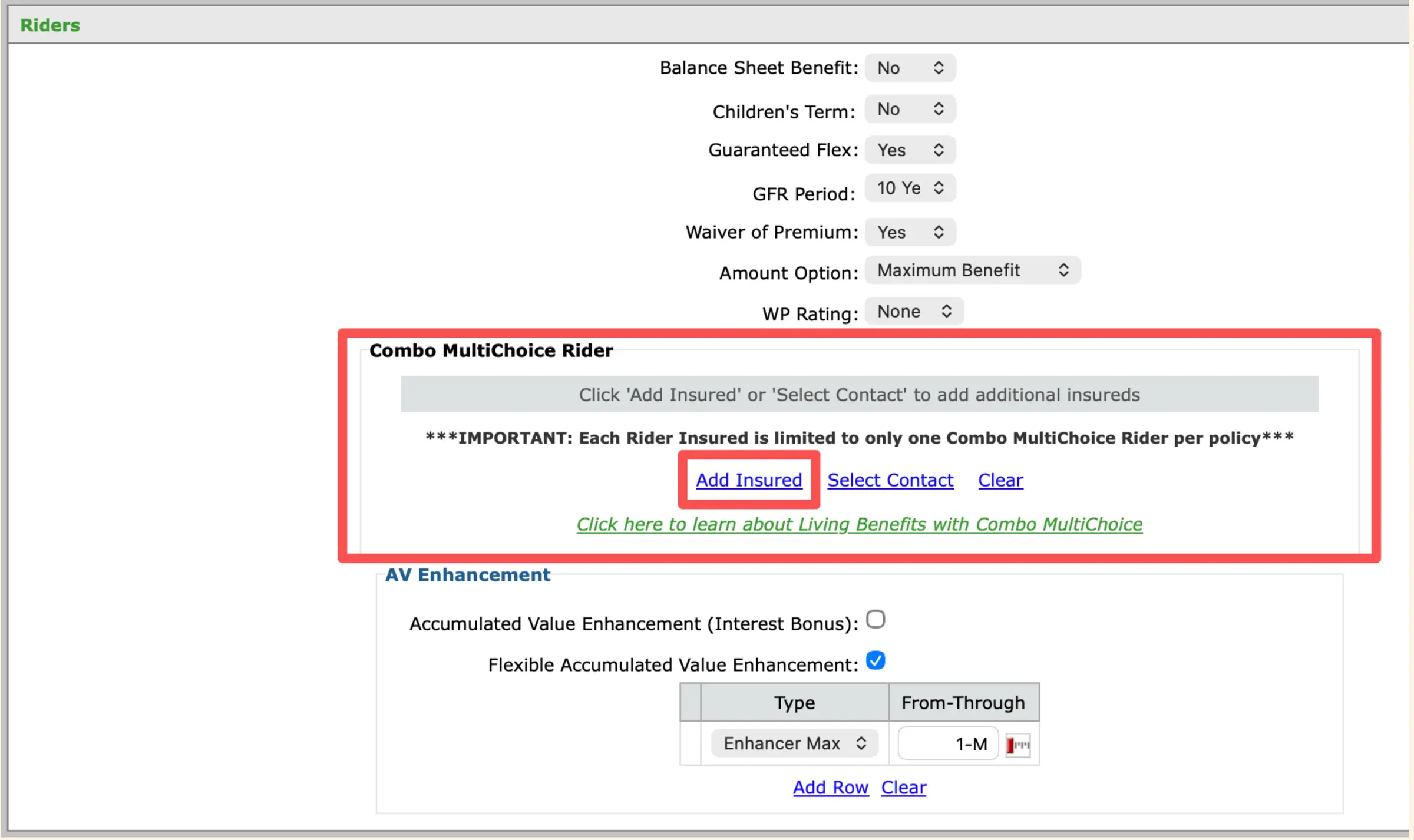
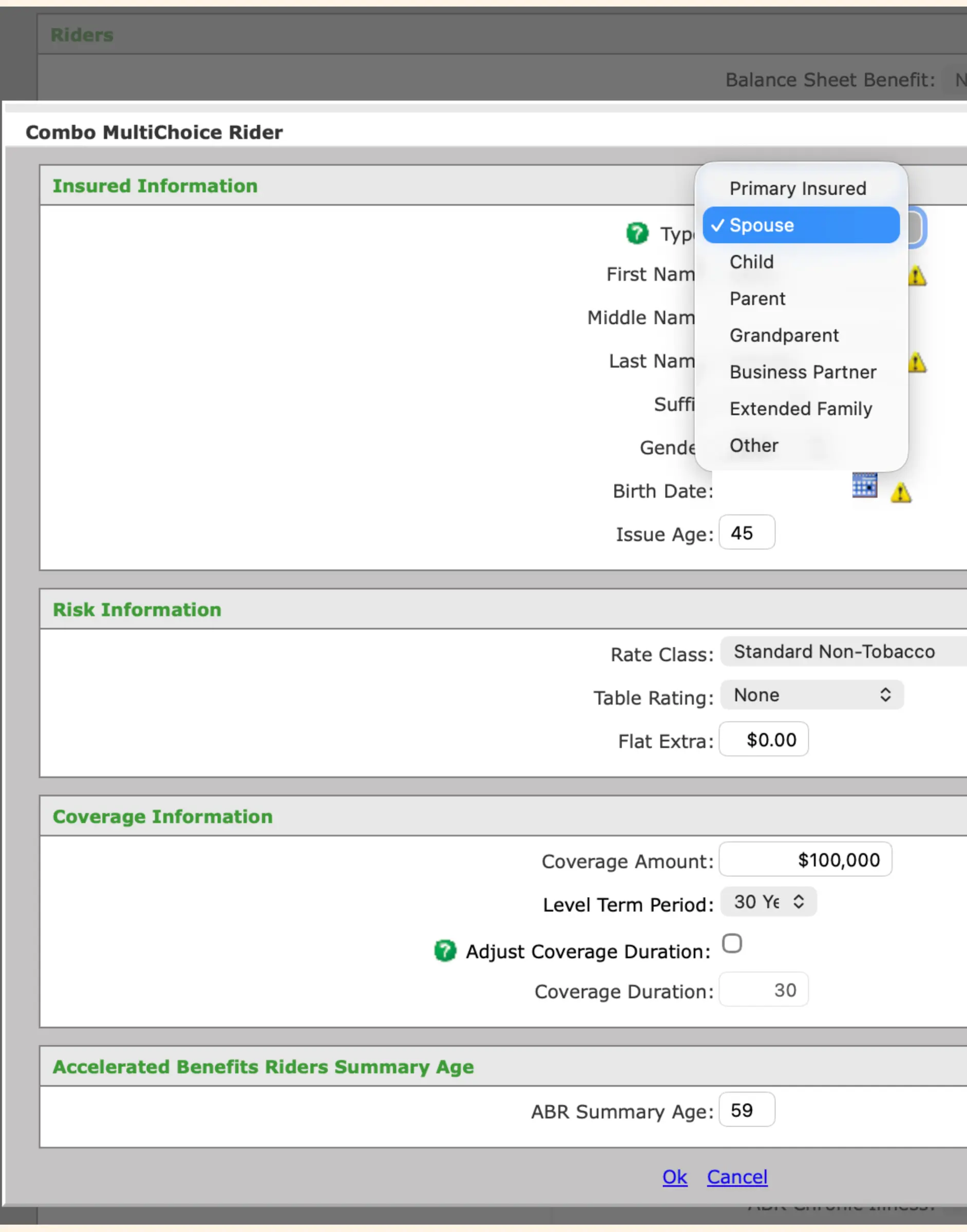
| 附加消费险 CMCCombo MultiChoice | PFA 专属。在同一张 IUL 上给自己、配偶、孩子、父母、祖父母、孙辈、生意伙伴、亲戚或其他人加 20 或 30 年定期,每人每张保单限一个,需单独核保。例:35 岁女、总保障 $100 万:$100 万 IUL $555/月;$50 万 IUL + $50 万 20 年 CMC $309/月;$50 万 IUL + 单独 $50 万 20 年定期 $312/月(单独 $50 万 IUL $271/月)PFA only. Adds 20- or 30-year term on the same IUL for the insured, a spouse, children, parents, grandparents, grandchildren, a business partner, relatives or others; one per person per policy, underwritten separately. Example: female 35, $1M of total cover: $1M IUL $555 a month; $500k IUL + $500k 20-year CMC $309; $500k IUL + separate $500k 20-year term $312 ($500k IUL alone $271) |
7. 七个常见问题,七个答法7. Seven common questions, seven answers
"人寿保险有费用,不划算""There are charges, so it's a bad deal"
"对,保险确实有费用,就像车子有油费、房子有地税。任何金融产品都有成本,只是形式不一样。 费用是为了让保障和现金值长期运转。万一事情发生,理赔的金额可能是你付出费用的几十上百倍。"
"It does, the same way a car has fuel and a house has property tax. Every financial product has a cost; they just take different shapes. The charges are what keeps the protection and the cash value running. And if something happens, the claim can be tens or hundreds of times what you paid in charges."
"利息为 0 的年份,保单不就被费用吃掉了?""In a 0% year, don't the charges eat it?"
"对,市场为零的时候费用照扣,现金值可能会减少。但市场跌的时候,指数部分最差记 0%,不会跟着倒扣, 所以只会被费用慢慢扣,不会像股票那样大跌。只要设计合理,长期还是有增长空间。"
"Yes. The charges still come out and the cash value can dip. But when the market falls, the index side credits 0% at worst and isn't marked down with it, so it grinds rather than crashes the way equities can. Designed properly, it still has room to grow over a long horizon."
"就像买房子:有时候房价不涨,但地税、水电、物业费照样要交。房子还在那儿,不会消失。"
"It's like owning a house. Some years the price doesn't move, but you still pay property tax, utilities, and HOA. The house is still there."
不说「IUL 不会亏本金」:指数部分不亏,但保单费用照扣,早期现金值会低于已缴保费。
Don't say "an IUL never loses principal": the index side doesn't go negative, but policy charges still come out, and early cash value is below the premiums paid.
"费用以后会不会涨?""Will the charges go up?"
分两类讲:固定费用(月费、管理费)按合同里的费率收,运营管理费十年、现金值管理费二十五年就结束。 保险成本会随年龄自然变高,所有保险都一样。但因为你存的钱和利息也越来越多, 保险公司真正要赔的净风险越来越少,所以不一定真的会变多,设计得好可以一直比较稳定。 合同里另有保证最高费率,公司在保证范围内有调整的权利,客户追问时照实讲。
Split it in two. The fixed charges (the monthly fee, the administrative charges) follow the contract's rates, and the expense charge ends after ten years, the accumulated value charge after 25. The cost of insurance does rise with age, as it does on any policy, but the money and interest building up mean the carrier's net amount at risk keeps shrinking, so the actual charge need not go up; designed well, it can stay fairly steady. The contract also states guaranteed maximum rates within which the insurer may adjust; if the client presses, say so.
"IUL 的费用很高""IUL is expensive"
"我知道很多人这么说,他们只是还没有像你一样愿意坐下来了解。IUL 的费用并不高, 只是它把每一项都写得特别透明,反而给人一种'费用很多'的错觉。很多金融产品,比如基金、股票账户、终身寿险, 费用是算在产品里面的,不会一项一项列给你看。IUL 把所有成本摊开,像餐厅菜单一样明码标价。 透明不等于贵。"讲完当场打开他那份计划书的费用页,把六项指给他看。
"A lot of people say that. They haven't sat down and looked the way you're doing now. The charges aren't high. They're itemized, which makes them look numerous. With funds, brokerage accounts, whole life, the costs are built into the product rather than listed line by line. An IUL prints the menu with prices. Transparent is not the same as expensive." Then open the charges page of their own illustration and point out the six lines.
"通过 PFA 买,会不会更贵?""Is it more expensive through PFA?"
"我能理解你的顾虑。PFA 是国家人寿最大的代理商,国家人寿专门给 PFA 设计了一款 IUL,Living Life Defender。 同一家公司承保、同样的核保,保费和费用都写在计划书里,可以一项一项对。而且有几项条款不另收费,比如 10 年的保证期条款、Enhancer 基础档。" 比喻可以用:就像在大卖场买同一个牌子的奶粉,同样的东西,包装更大,还附送奶瓶和奶嘴。
"I understand the concern. PFA is National Life's largest agency, and National Life designed an IUL specifically for PFA, Living Life Defender. Same insurer, same underwriting, and the premium and every charge are in the illustration to check line by line. Several riders carry no extra charge, such as the 10-year guarantee rider and the base Enhancer." An analogy that works: it's like buying the same brand of formula at a warehouse store, the same product in a bigger pack, with a bottle and pacifiers thrown in.
不说「更便宜」(没有可以核实的对比),不贬低其他代理商或公司(加州 §790.03 禁止), 不拿「转了多少别家保单」当卖点。
Don't say "cheaper" (there's no verifiable comparison), don't disparage other agencies or carriers (prohibited in California under §790.03), and never use replaced policies as a selling point.
"听说 IUL 以后要补钱""I hear you have to put more money in later"
分情况。设计合理、交的钱够、账户增长稳定,一般就不需要额外补。 只有在极端情况下,也就是前期交太少、市场很多年没增长、又取了太多现金值,才可能需要。 所以这是设计不好或使用不当才会出现的问题。即使设计得好,市场和费率也可能和演示不一样,所以每年都要一起检视。
It depends. Funded properly, with steady growth, generally no. It happens in the extreme case: underfunded early, several flat years, and too much taken out. That's a design or usage problem, not a product problem. Even a well-designed policy can meet markets and rates unlike the illustration, which is why we review it together every year.
"就像种树:一开始浇水够、施肥足,树自己就长大结果子。 如果一开始浇得太少,还老是摘果子不施肥,树可能就长不动了。"
"Like a tree. Water and feed it early and it grows and fruits on its own. Underwater it, then keep picking fruit without feeding it, and it stalls."
"三四十岁买和五六十岁买,差别大吗?""Does buying at 35 versus 55 really matter?"
差别很大。30、40 岁风险低,保险成本便宜,现金值累积更快。 50、60 岁风险高,保险成本贵,账户增长空间被吃掉一大块。合同里的数字就是证据: 同样 $50 万、最优等级的女性,运营管理费 40 岁每月 $135.40,53 岁每月 $278.75。
A lot. At 35 the mortality charge is low and cash value builds faster. At 55 the charge is high and takes a real bite out of the account's room to grow. The contract's numbers prove it: for the same woman at $500k in the best class, the expense charge is $135.40 a month at 40 and $278.75 at 53.
"就像买房:30、40 岁买相当于房价还低,未来空间大; 50、60 岁才出手,不仅更贵,还错过了很多增值的时间。"不说「再不买就晚了」来催单。
"Like buying property. Buy earlier and you're in at a lower price with more runway. Wait and you pay more and miss the growth." Don't push with "it'll be too late."
8. 在自己的对账单上把这六项找出来8. Finding the six charges on your own statement
这一节是让你自己去验的: 打开你自己那张保单的对账单, 把六项扣费一项一项对出来。做过一次,你跟客户讲费用的时候就不再是背的。
This section is for checking it yourself: open the statement for your own policy and find each of the six charges on it. Do it once and you stop reciting the cost conversation and start knowing it.
在哪儿看
Where to look
National Life Group 的手机 App,或者 Agent Portal 里的 年度对账单(Annual Statement)。 找「Policy Transactions Summary by Policy Month」那一段,扣费在那里逐月、一项一栏地列出来, 没有汇总成一个数。
The National Life Group app, or the annual statement in the agent portal. Look for the Policy Transactions Summary by Policy Month. The charges are itemised there month by month, one column each, not rolled into a single figure.
先对哪三项
Start with three
最容易对上的三项:保单管理费(每月固定 $6)、 保单税(保费 × 固定百分比,一交保费就出现,$500 的保费扣 $40)、 现金值管理费((上月末现金值 − 当月保险成本 − 当月其他费用)× 0.04%)。 这三项算出来的数会和账单上分毫不差。
The three that reconcile cleanly: the policy fee ($6 flat each month), the premium load (a fixed percentage, appearing the moment a premium lands; $40 on a $500 premium), and the accumulated value charge ((last month's ending value − this month's COI − this month's other charges) × 0.04%). Your arithmetic on these will match the statement to the cent.
对完之后算一个比值:当期扣费总额 ÷ 当期保费。 下面是同一张保单两个不同缴费额的例子:
Then work out one ratio: total charges in the period ÷ premium in the period. Here it is at two different funding levels on the same policy:
| 当期扣费Charges | 当期保费Premium | 比值Ratio |
|---|---|---|
| $444.88 | $2,737.74 | 16.2% |
| $178.07 | $1,095.79 | 16.25% |
两个数字几乎一样,这才是这个练习的意义: 扣费是按规则按比例算出来的,不是保险公司想收多少收多少。 客户问「你们到底扣了我多少」,你可以当场打开他的对账单, 把六行指给他看,再把这个比值算给他,这比任何解释都管用。
The two come out nearly identical, and that is the whole point: the charges are computed from rules and scale with the policy; the carrier isn't deciding what to take. When a client asks what they're actually being charged, open their statement, point at the six lines, and work the ratio in front of them. Nothing you could say does as much.
三件事要说清楚。第一,它只是这张保单这一期的数, 换年份、换年龄、换产品、换缴费节奏,它都会变, 所以不能说成「我们的费率是 16%」。第二, 它不是基金的费用率,两者不能并排比: 这里面最大的一块是保险成本,是在买死亡保障,基金里没有这一项。第三, 不要把自己或客户的对账单截图发出去。上面有保单号、 姓名和金额,属于客户的非公开个人信息。
Three things. First, it is this policy in this period. Change the year, the age, the product or the funding pattern and it moves, so it can never be stated as "our fee is 16%". Second, it is not a fund expense ratio and doesn't line up against one: the largest component here is the cost of insurance, which is buying a death benefit, and a fund has no such line. Third, don't screenshot a statement, yours or a client's. It carries a policy number, a name and balances: that is a client's non-public personal information.
9. 一页总结9. One-page summary
- 保费 − 保单费用 + 利息 = 现金价值,全部讨论都在中间那一项。
- Premium − charges + interest = cash value. Everything is about the middle term.
- 六项:保单税、运营管理费、保单管理费、现金值管理费、保险成本、条款费用。运营管理费收 10 年,现金值管理费收 25 年。
- Six of them: premium load, per-unit expense, policy fee, accumulated value charge, cost of insurance, rider charges. The expense charge runs 10 years, the accumulated value charge 25.
- 保额 − 现金价值 = 净风险。现金值越高,净风险越低,保险成本越低。
- Face − cash value = net amount at risk. More cash value, less at risk, lower cost of insurance.
- 存得越快,净风险降得越快,总保费一样也是如此。
- Faster funding drops the risk faster, even at the same total premium.
- 保额增加撑开了可存空间,但净风险永不下降;取钱前必须人工切回保额不变。
- Increasing opens funding room but never lowers the risk; switch back to level manually before income starts.
- 条款按需要选,停交保费以后条款费用照样扣。
- Choose riders by need; rider charges continue after premiums stop.
- 面对"费用高"的质疑:先承认有费用,再讲透明度。看得见的费用不一定贵。
- On "it's expensive": concede the charges, then talk about visibility. Visible isn't the same as costly.
内部培训资料,仅供签约经纪人使用,不可转发给客户。 文中费率与算例对应成稿时的国家人寿 Living Life Defender 费率表和计划书,可能已经改版; 演示利率不是保证,也不是预测;产品条款、费用与演示数字一律以承保公司当期资料和实际计划书为准,不构成任何收益承诺。
Internal training material for contracted agents; not for forwarding to clients. Rates and worked examples reflect National Life's Living Life Defender schedule and illustrations at the time of writing and may have been revised. Illustrated rates are neither guaranteed nor a forecast. Terms, charges, and illustrated values always come from the carrier's current material and the actual illustration, and are not a promise of any result.