



一、这不是税务或法律意见。涉及 FATCA、7702、MEC、遗产税、 FBAR 的个案,必须转介持牌的跨境税务师或律师。你可以讲概念,不能替客户下结论。
One: this is not tax or legal advice. Any live case touching FATCA, §7702, MEC, estate tax, or FBAR goes to a licensed cross-border tax professional or attorney. You can explain the concepts; you cannot conclude for the client.
二、所有数字都有时效。数据年份已尽量标注。 免税额、税率、市场份额、公司排名每年都变。
Two: everything here ages. Years are noted where known. Exemptions, rates, market shares, and rankings all move annually.
三、执业地域。 你持有的是美国的州执照。招揽行为必须发生在你有执照的辖区内, 不要在你没有执照的地方招揽。第 7 节的 Nexus 规则解决的是"客户能不能买", 不解决"你能在哪里卖",这是两件事。
Three: where you may solicit. Your licence is a US state licence. Solicitation has to happen where you are licensed: do not solicit in a jurisdiction where you are not. The Nexus rules in section 7 answer whether a client may buy; they do not answer where you may sell. Two different questions.
培训录像Training recording
Raymond,2026-06-30,约 1 小时 40 分钟。本页按这次培训整理, 录像里口头说的数字如果和本页不一致,以本页为准。
Raymond, 30 June 2026, about 1 hour 40 minutes. This page is written up from that session; where a figure said on the recording differs from this page, use the page.
一页速览One-page snapshot
| 维度Dimension | 中国内地Mainland China | 香港Hong Kong | 美国United States |
|---|---|---|---|
| 市场历史Market age | 40 多年40-odd years | 160 多年160-odd years | 260 多年260-odd years |
| 公司数量Carriers | 寿险 93 家93 life | 159 家(含非寿险)159 (all lines) | 寿险 + 健康险 727 家727 life and health |
| 市场集中度Concentration | 前 3 家约占 40%+Top 3 hold 40%+ | 约 10 家才够一半~10 to reach half | 分散Dispersed |
| 寿险成本Cost of cover | 约美国的 5–6 倍~5–6× the US | 约美国的 3 倍~3× the US | 最低Lowest |
| 计价币种Currency | 不可外汇计价RMB only | 可用美元USD available | 美元USD |
| 预期收益Assumed return | 2–3.5%2–3.5% | 3.5–5.5%3.5–5.5% | 3.5–7.5%3.5–7.5% |
| 产品种类Product shelf | 少Narrow | 较多Broader | 繁多Widest |
| 重疾保障Critical illness | 单独买重疾险Separate CI policy | 单独买,多为分红型Separate, mostly participating | 生前福利条款并入寿险Living benefit riders on the life policy |
| 核保Underwriting | 简单Light | 严格Strict | 非常严格Strictest |
| 健康问题回溯Health lookback | 多为 6 个月–2 年Mostly 6 months–2 years | 多为 3–7 年Mostly 3–7 years | 多为 5–10 年Mostly 5–10 years |
| 争议期Contestability | 2 年2 years | 1–2 年1–2 years | 最多 2 年2 years max |
| 免责条款Exclusions | 多Many | 较少Fewer | 少Fewest |
1. 为什么美国保费最便宜1. Why US premiums are the lowest
粗略地说,美国 ≈ 香港的 1/3、内地的 1/5–1/6。 这个比例不一定精确,但总体趋势成立。 倍数本身不要紧,底下的三个原因才是你能讲给客户听的东西。
Roughly, the US costs one-third of Hong Kong and one-fifth to one-sixth of the mainland. The ratio may not be exact, but the direction holds. The ratio isn't the point. The three reasons underneath it are what you can actually explain.
① 预定费率低,因为竞争够激烈
① Lower loadings, because competition is real
预定费率是公司对自身成本的预测(销售、行政、运营)。 美国有 727 家人寿/健康保险公司在抢同一批客户, 不调费率就抢不到;中港各自只有约百家,且香港市场高度集中在少数外资巨头手里, 不必靠降价抢客户。
The loading is the carrier's own cost forecast (distribution, administration, operations). The US has 727 life and health carriers competing for the same buyers, so pricing has to move. Each of the other two has roughly a hundred, and Hong Kong's is concentrated in a handful of foreign groups that don't need to cut price to win.
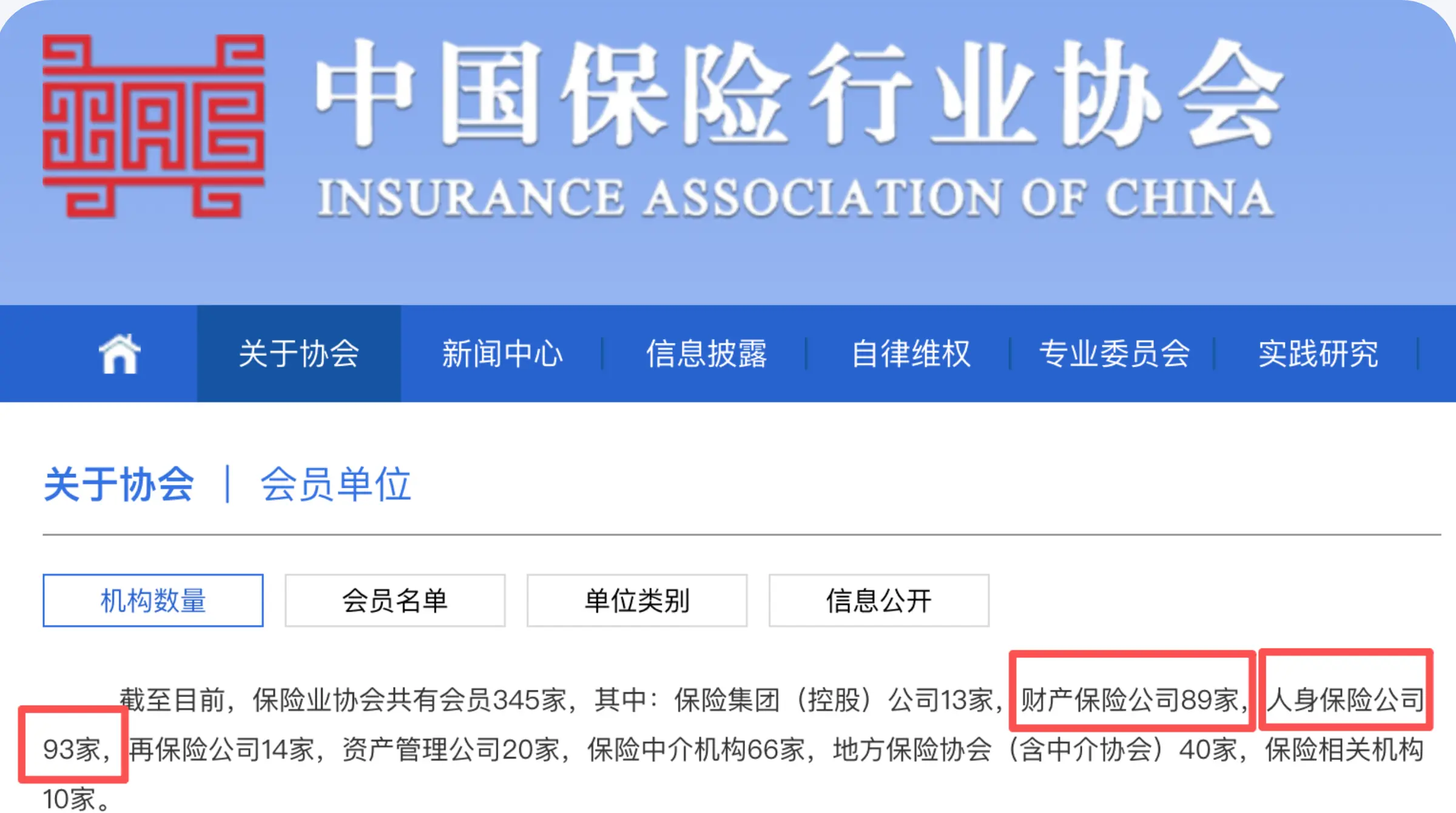
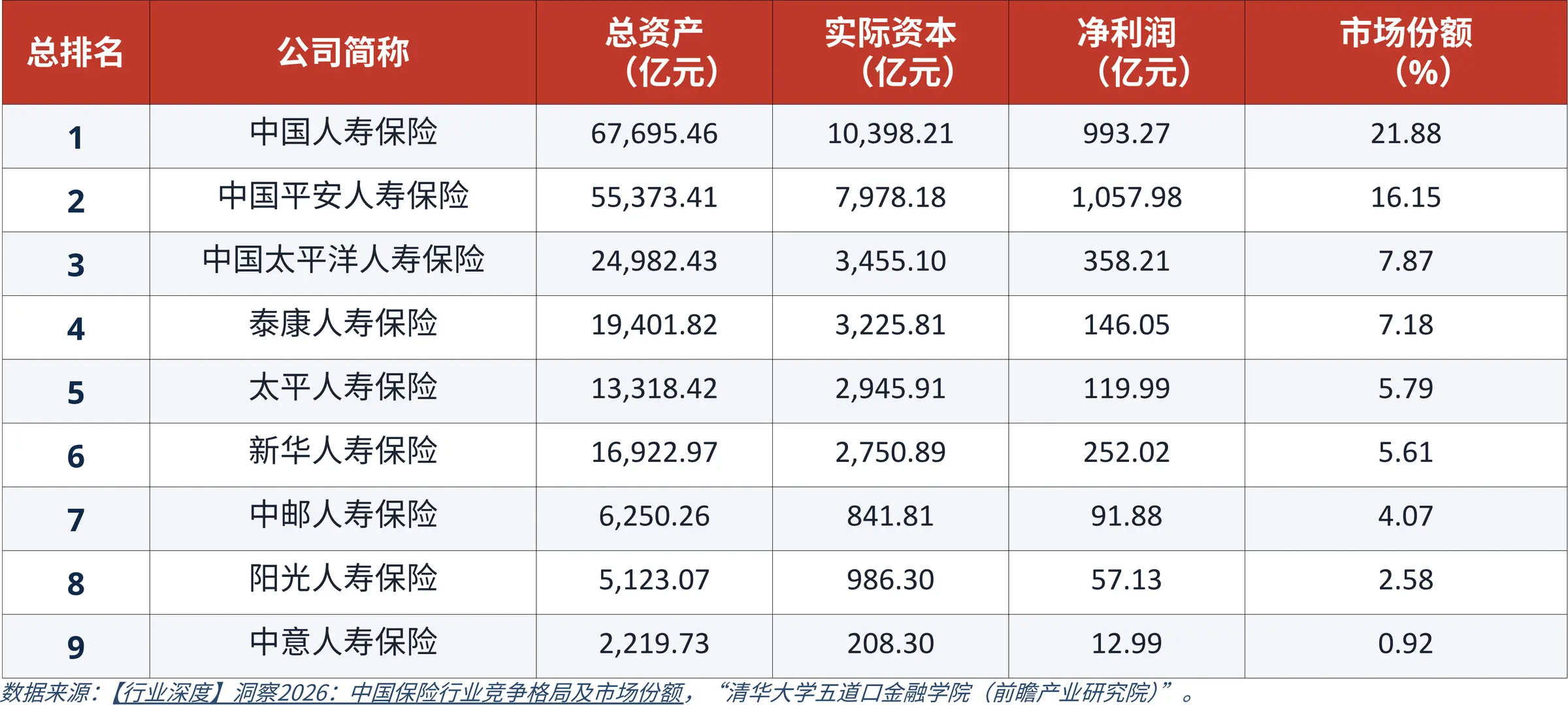
- 内地:寿险公司 93 家、财产险公司 89 家。2025 年中国人寿一家占约 21.8%, 加上平安、太平洋,前三家约占 四成以上。
- Mainland: 93 life and 89 property carriers. In 2025 China Life alone held about 21.8%; with Ping An and CPIC, the top three hold over 40%.
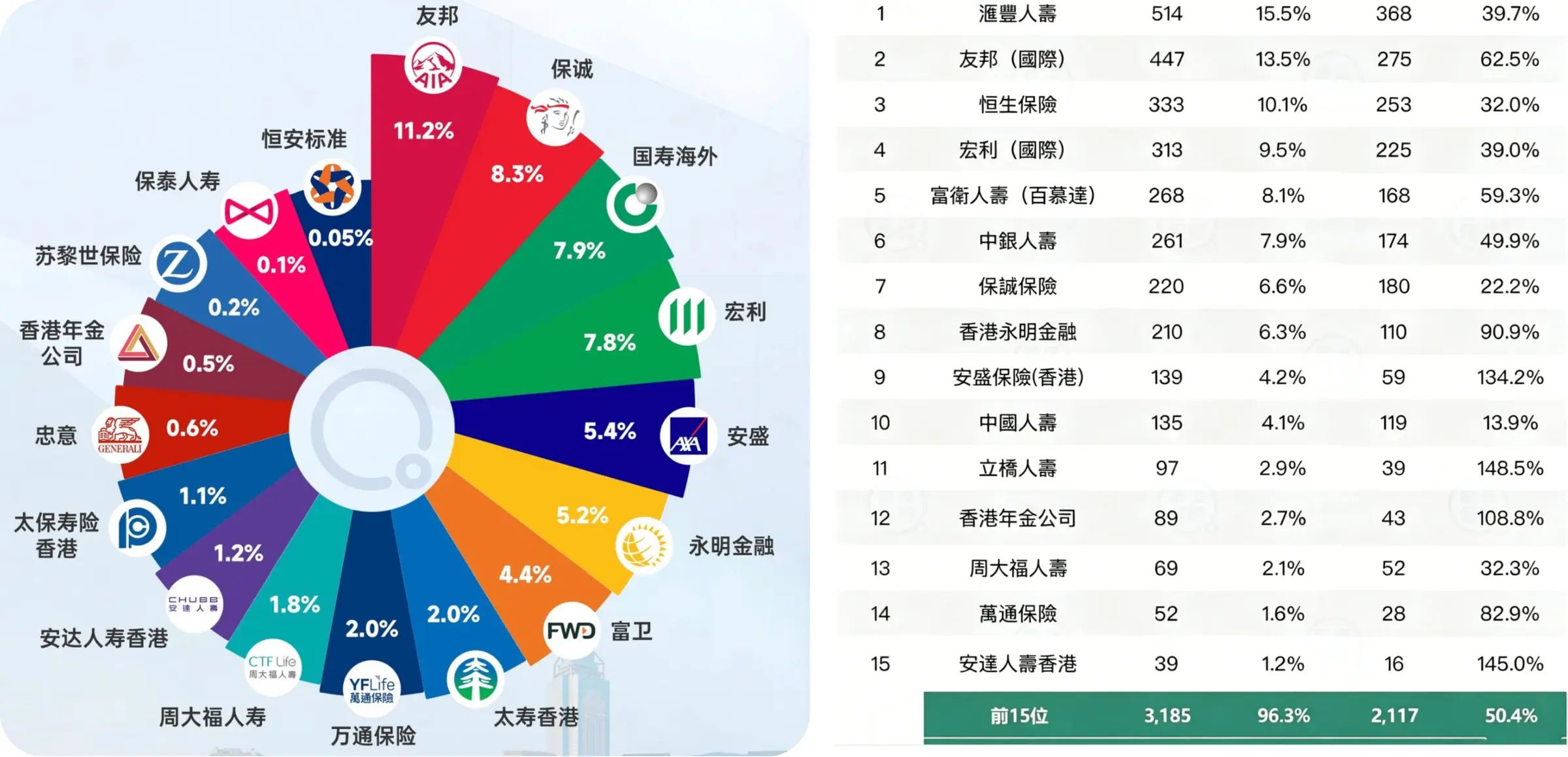
- 香港:截至 2025 年底 159 家保险公司、1,477 家代理机构、约 8.3 万名持牌人士。 按有效业务保费,友邦第一,约占 11.2%;约 10 家合起来才到一半,前 15 家合计约 96%。 新单这几年汇丰人寿、恒生保险增长较快。
- Hong Kong: at end-2025, 159 insurers, 1,477 agencies, and about 83,000 licensed individuals. By in-force premium AIA leads with about 11.2%; it takes about ten carriers to reach half, and the top fifteen hold about 96%. HSBC Life and Hang Seng have grown fastest in new business recently.
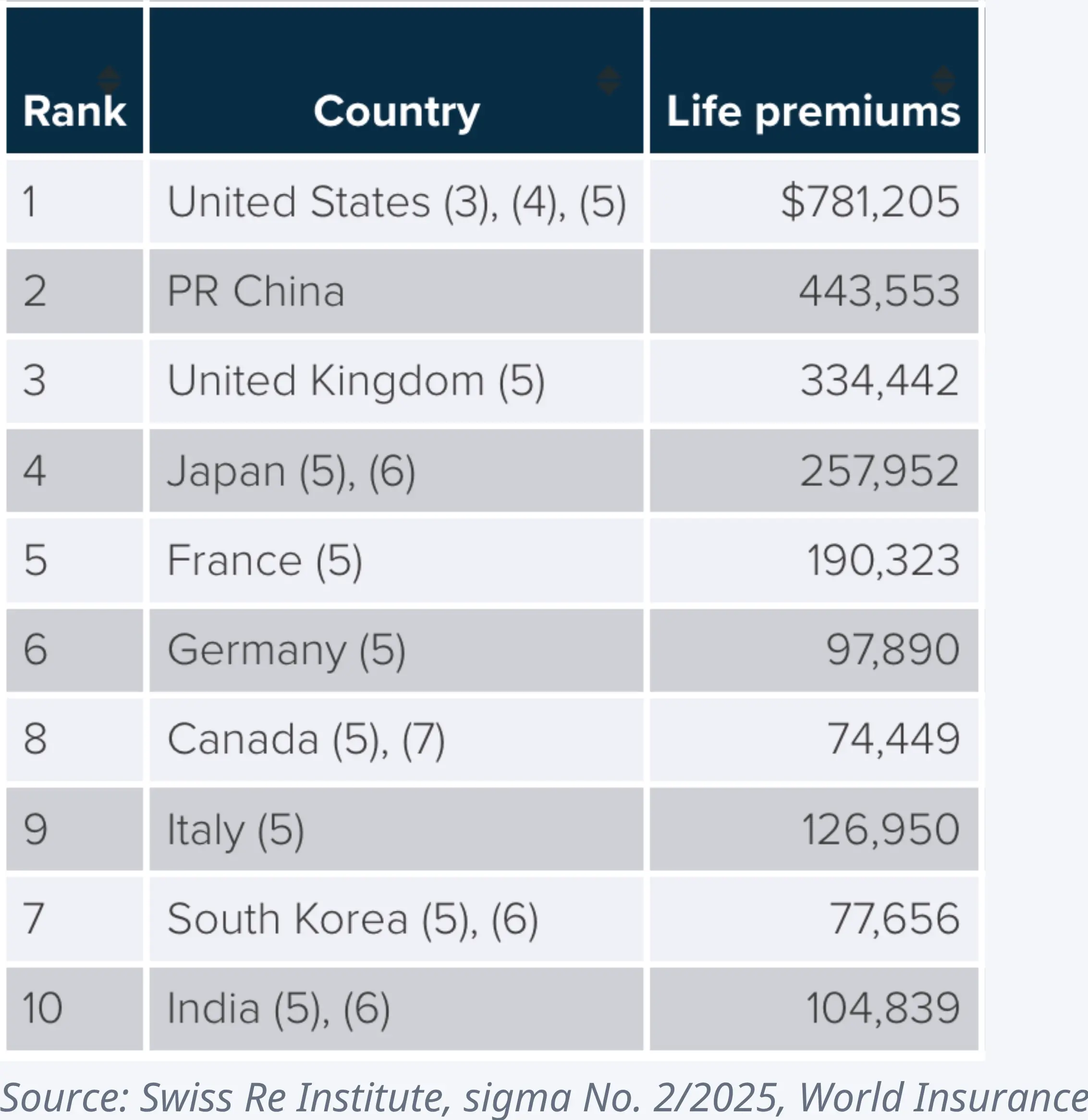
- 美国:寿险保费约占全球寿险保费的 24.4%; 算上财产、意外险,美国保费约占全球的 44.8%。
- United States: about 24.4% of the world's life premium, and about 44.8% of all premium once property and casualty are included.
② 预期利率高,因为经济与市场更深
② A higher assumed rate, because the market is deeper
预期利率是定价时假设的年收益率。利率越高,保费可以定得越低。 内地寿险预定利率长期被定在 2.5%,到 2013 年 8 月才上调到 3.5%。
The assumed rate is what the carrier presumes it can earn. The higher it is, the lower the premium can be. The mainland's assumed rate sat at 2.5% for years and only rose to 3.5% in August 2013.
这也是内地客户去香港买保险的一个主要动机:换成美元计价, 给人民币资产加一层汇率上的分散。
It is also a main reason mainland clients buy in Hong Kong: a USD-denominated policy, which spreads the currency risk on RMB assets.
别和 AG 49 混淆:AG 49(2020-11-25 生效的修订版) 管的是 IUL 的演示利率,不是预期利率,也不是保单真实回报率。
Don't confuse this with AG 49 (the revision effective 25 Nov 2020), which governs an IUL's illustrated rate, not the pricing assumption and not the actual return.
③ 死亡率低,因为美国人更长寿
③ Lower mortality, because people live longer
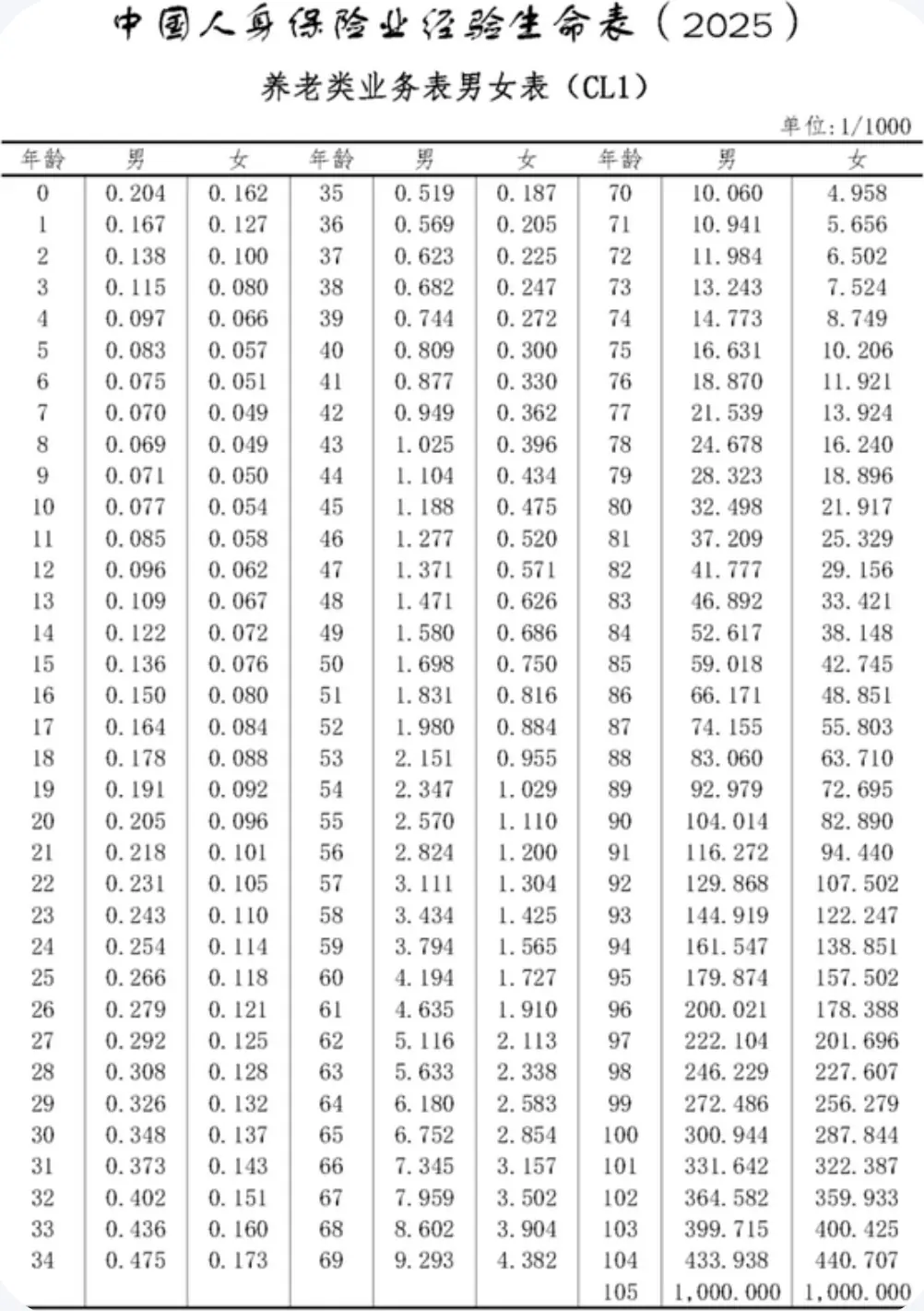
生命表列出某年龄的人一年内死亡的概率。核心规律: 人活得越久,保费越低。理赔越晚,公司这笔钱能投资的时间越长。 生命表的最长寿命:内地与香港 100–105 岁,美国 120 岁。
A mortality table gives the probability of death within a year at each age. The rule: the longer people live, the cheaper cover gets: a later claim means the carrier holds and invests the money for longer. Terminal ages in the tables: 100–105 in the mainland and Hong Kong, 120 in the US.
用一个简化公式就能把第三点算给客户看:
保费 = 死亡率 × 保额 ÷ (1 + 3%),只考虑死亡率这一项。
40 岁男性 $100 万定期寿:以内地为基准 $1,
香港约 $0.71,美国约 $0.52。
The third point reduces to one formula you can run in front of a client:
premium = mortality × face ÷ (1 + 3%), mortality only. For a male 40 with $1M of
term: index the mainland at $1, Hong Kong is about $0.71,
the US about $0.52.
仅凭死亡率这一项,美国保费就已经约是内地的一半、香港的七成。 另外两个原因还没算进去。
On mortality alone, the US is already about half the mainland and seventy percent of Hong Kong, before the other two reasons are counted at all.
2. 三地监管:谁在替保单把关2. Who regulates what
中国内地
Mainland China
1980 年恢复保险代理业务,1992 年友邦把个人代理销售模式带进来。 监管较严,受内地法律保护。市场结构集中,前几家就吃掉大半份额, 这也是费率降不下来的原因之一。
Agency business resumed in 1980; AIA brought the individual-agent model in 1992. Regulation is tight and mainland law applies. The market is concentrated: a handful of carriers hold most of it, which is part of why pricing doesn't fall.
香港
Hong Kong
奉行自由主义、长期依赖行业自律。 保监局(IA)2016 年才开始监管。 外资公司注册地多在开曼/百慕大,合同可能受注册地法律调整, 这一条对将来要打官司的客户很重要。
A liberal regime that leaned on self-regulation for a long time; the Insurance Authority only began supervising in 2016. Many carriers are incorporated in Cayman or Bermuda, so the contract may be governed by that jurisdiction's law, which matters a great deal if it ever comes to a dispute.
最大的友邦(AIA)1919 年在上海成立,原是美国 AIG 旗下公司; 2008 年 AIG 接受政府救助后被要求出售海外业务,友邦由此独立。
The largest, AIA, was founded in Shanghai in 1919 as part of the US group AIG; after AIG's 2008 government rescue it had to sell overseas businesses, and AIA became independent.
美国
United States
各州各有保险法,监管严格。 不允许保险公司虚报保单回报率招揽客户(AG 49 就是干这个的)。 各州设有保障协会,公司必须设立专门赔付账户并接受季度审计。
Every state has its own insurance code and supervision is strict. Carriers may not overstate illustrated returns to attract business; that's what AG 49 exists for. State guaranty associations sit behind it, and carriers must hold dedicated reserves subject to quarterly audit.
美国寿险公司出问题时不走普通破产程序,而是由州保险厅接管;被收购时,收购方须承担原有赔付责任; 各州还有保障协会(guaranty association)兜底。但保障协会的赔付有上限(各州不同), 历史上也确有寿险公司倒闭。
A US life carrier in trouble goes into state receivership rather than ordinary bankruptcy; an acquirer assumes the existing obligations; and every state has a guaranty association behind it. But guaranty association coverage is capped (the cap varies by state), and US life carriers have failed before.
州一级监管还有一个你会碰到的后果:保险公司想在生前福利里加一种疾病, 要在各州分别报批,不是改一次就全国生效。所以同一个产品在不同州的条款可能不一样, 比如国家人寿在纽约州的重疾清单,培训时比其他州的 13 项还少 6 项。 给纽约客户讲生前福利,先查纽约版条款。
State-level regulation has a consequence you will run into: to add a condition to a living benefit rider, a carrier has to file it state by state; one change does not go national. The same product can therefore read differently by state. National Life's New York critical illness list, at the time of the training, had six fewer conditions than the thirteen elsewhere. For a New York client, check the New York contract first.
产品货架:三地各卖什么The shelf: what each market sells
| 市场Market | 主力产品Main products |
|---|---|
| 内地Mainland | 定期寿险、终身寿险、储蓄型寿险;重疾险另买Term, whole life, and savings life; critical illness bought separately |
| 香港Hong Kong | 分红型长期储蓄险、高端医疗险、分红型终身重疾险Participating long-term savings, high-end medical, and participating whole-life critical illness |
| 美国United States | 定期、分红终身寿、万能(UL)、保证型万能(GUL)、投资型万能(VUL)、指数型万能(IUL); 重疾、慢性病、末期疾病多以生前福利条款放进同一张寿险保单Term, participating whole life, UL, guaranteed UL, variable UL, and indexed UL; critical, chronic, and terminal illness mostly sit in the same life policy as living benefit riders |
3. 内地 vs 香港3. Mainland versus Hong Kong
| 香港保险Hong Kong | 内地保险Mainland | |
|---|---|---|
| 投保渠道Where you buy | 必须到香港投保Must be signed in Hong Kong | 线上/线下均可Online or offline |
| 购买成本Cost | 相对较高Higher | 相对较低Lower |
| 法律保护Governing law | 香港法律;处理理赔纠纷成本高Hong Kong law; disputes are expensive to pursue | 内地法律Mainland law |
| 理赔范围Claim geography | 全球理赔Worldwide | 多限内地医院,部分产品含海外医疗;有的保单连境外身故都不赔,看合同Mostly mainland hospitals, some add overseas; some won't even pay a death abroad, so read the contract |
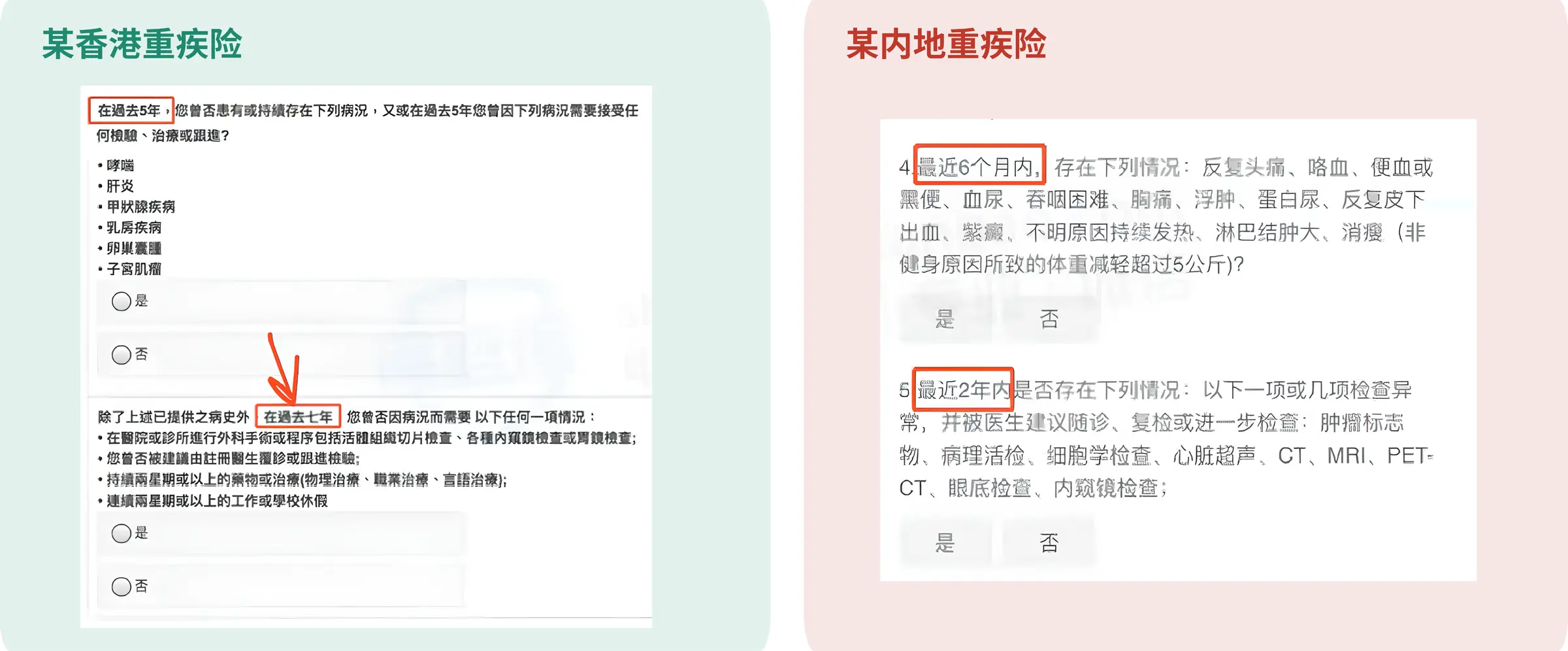
| 健康告知Health disclosure | 更严,回溯期更长(重疾险常问过去 5 年、7 年)Stricter, with a longer lookback (CI forms often ask about 5 or 7 years) | 相对宽松(常问过去 6 个月、2 年)Lighter (often 6 months or 2 years) |
| 保单币种Currency | 美元/港币USD or HKD | 人民币RMB |
回溯期越长 = 告知义务越重 = 核保越严。 香港更严,意味着"如实告知"在香港保单上是更硬的义务: 客户当年随口带过的既往症,出险时会被翻出来。
A longer lookback means a heavier disclosure duty and stricter underwriting. Hong Kong is stricter, so full disclosure is a harder obligation there: a condition the client waved off at application will be found at claim.
美国更进一步,申请表常问过去 10 年。客户抱怨美国保险"怎么这么难买"时, 可以这样解释:进门越严,出门越宽,买的时候把事情查清楚,理赔时就少有可争的地方。
The US goes further, with application questions that often reach back ten years. When a client complains that US cover is hard to get, that is the explanation: strict on the way in, easy on the way out. What gets settled at application can't be argued over at claim.
免责条款:内地 8 条,美港各 1–2 条Exclusions: eight versus one or two
内地(8 条)
Mainland (eight categories)
投保人或受益人对被保险人的故意行为;被保险人故意犯罪、拒捕、故意自伤; 服用吸食注射毒品;生效或最后复效起 2 年内自杀;酒后驾驶、无证驾驶; 患艾滋或感染期间;战争、军事行动、暴乱;核爆炸、辐射、污染。
Intentional acts by the owner or beneficiary; the insured's intentional crime, resisting arrest, or self-harm; narcotics; suicide within two years of issue or last reinstatement; driving drunk or unlicensed; HIV/AIDS; war, military action, or riot; and nuclear or radiological events.
美国 / 香港
US and Hong Kong
竞争压力下逐年减少。美国大部分公司只剩一条:2 年内不可自杀 (以保单为准)。香港:生效或复效起 1 年内自杀只退已缴保费; 战争叛乱、非付费空中航行等仅影响重疾保障。
Competition has stripped these back over the years. Most US carriers are down to one: suicide within two years (per contract). Hong Kong refunds premium only on suicide within a year of issue or reinstatement, and war/rebellion or non-fare-paying aviation affect the critical illness benefit only.
内地保单理赔,有三个结构性问题值得你记住:
Three structural issues on mainland claims are worth carrying:
- 重疾定义的"对名"问题:合同里写的是笼统的概念, 医院确诊的是具体病名,两边对不上就可能被拒。
- Matching the diagnosis to the definition: the contract names a broad category, the hospital names a specific disease, and a mismatch can defeat the claim.
- 复效会重启告知义务:断缴后复效, 复效那一刻的健康状况要重新告知,复效本身可能成为后来拒赔的理由。
- Reinstatement restarts disclosure: health is re-declared at the moment of reinstatement, and the reinstatement itself can become the ground for denial.
- "承保容易、理赔麻烦":核保越松,出险时的调查就越细。 这正是下一节"严进宽出"的反面。
- Easy in, hard out: the lighter the underwriting, the more thorough the investigation at claim. The mirror image of the next section.
收益对照:两组数字,和它们的限定条件Returns: two comparisons, and their caveats
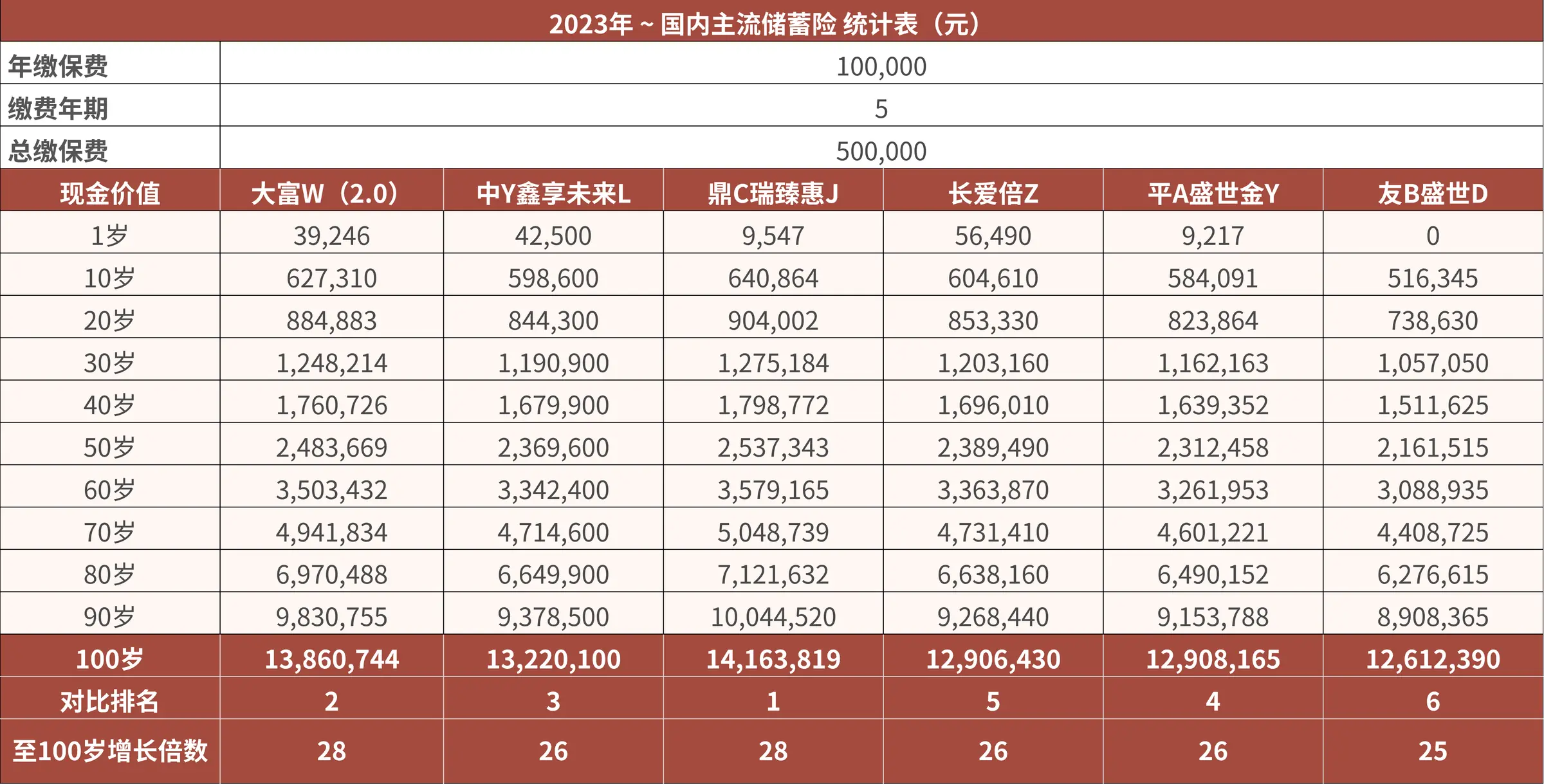
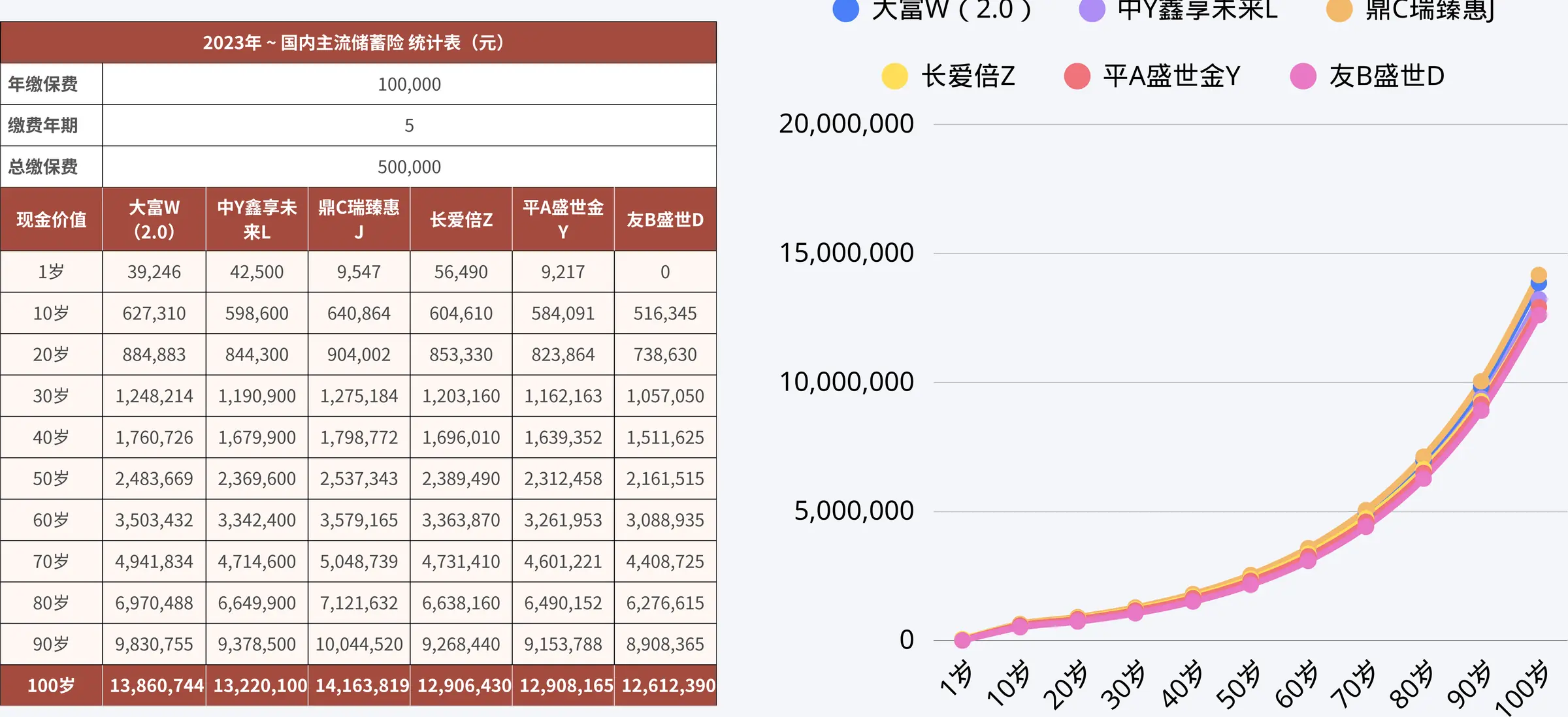
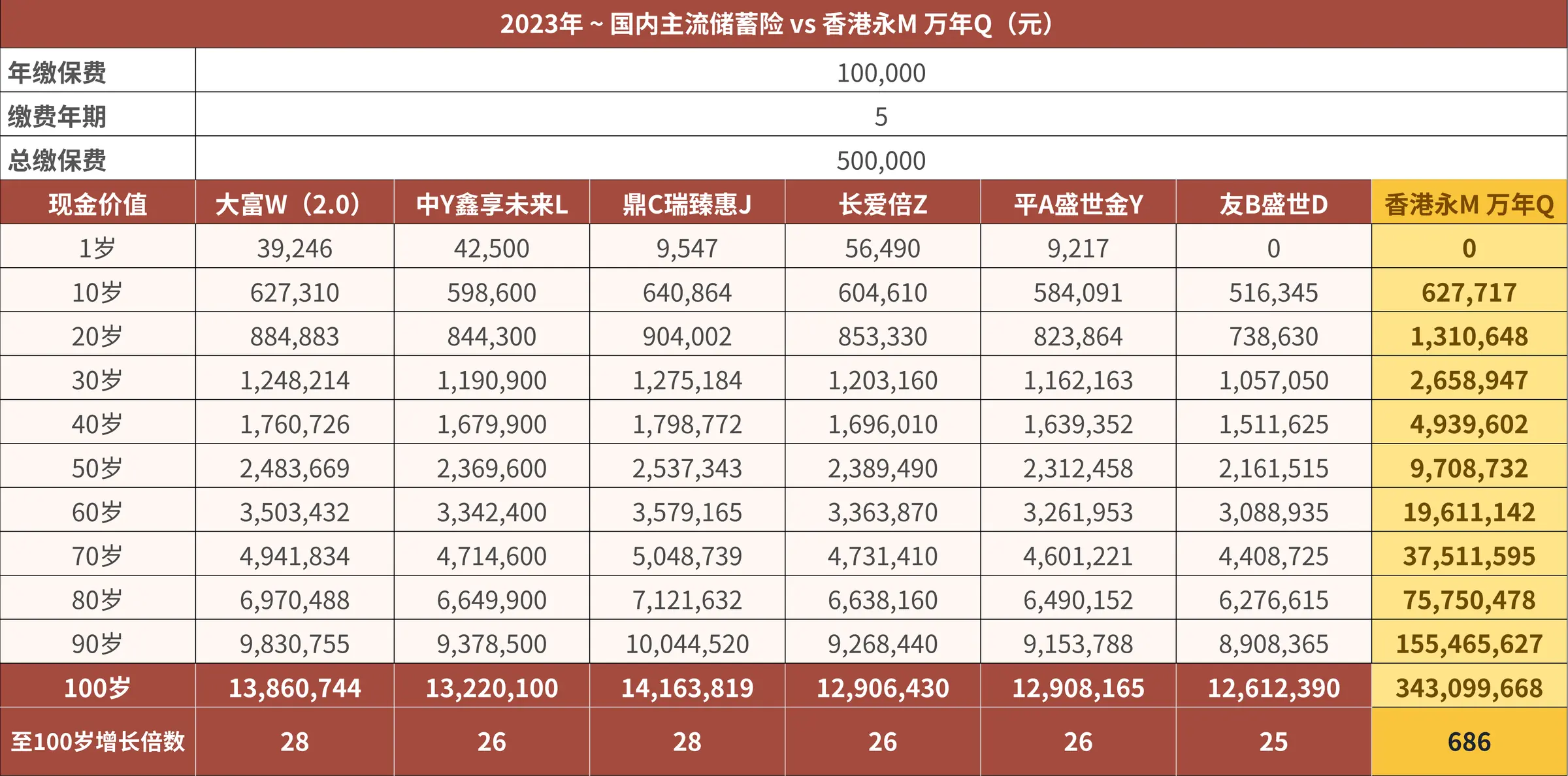
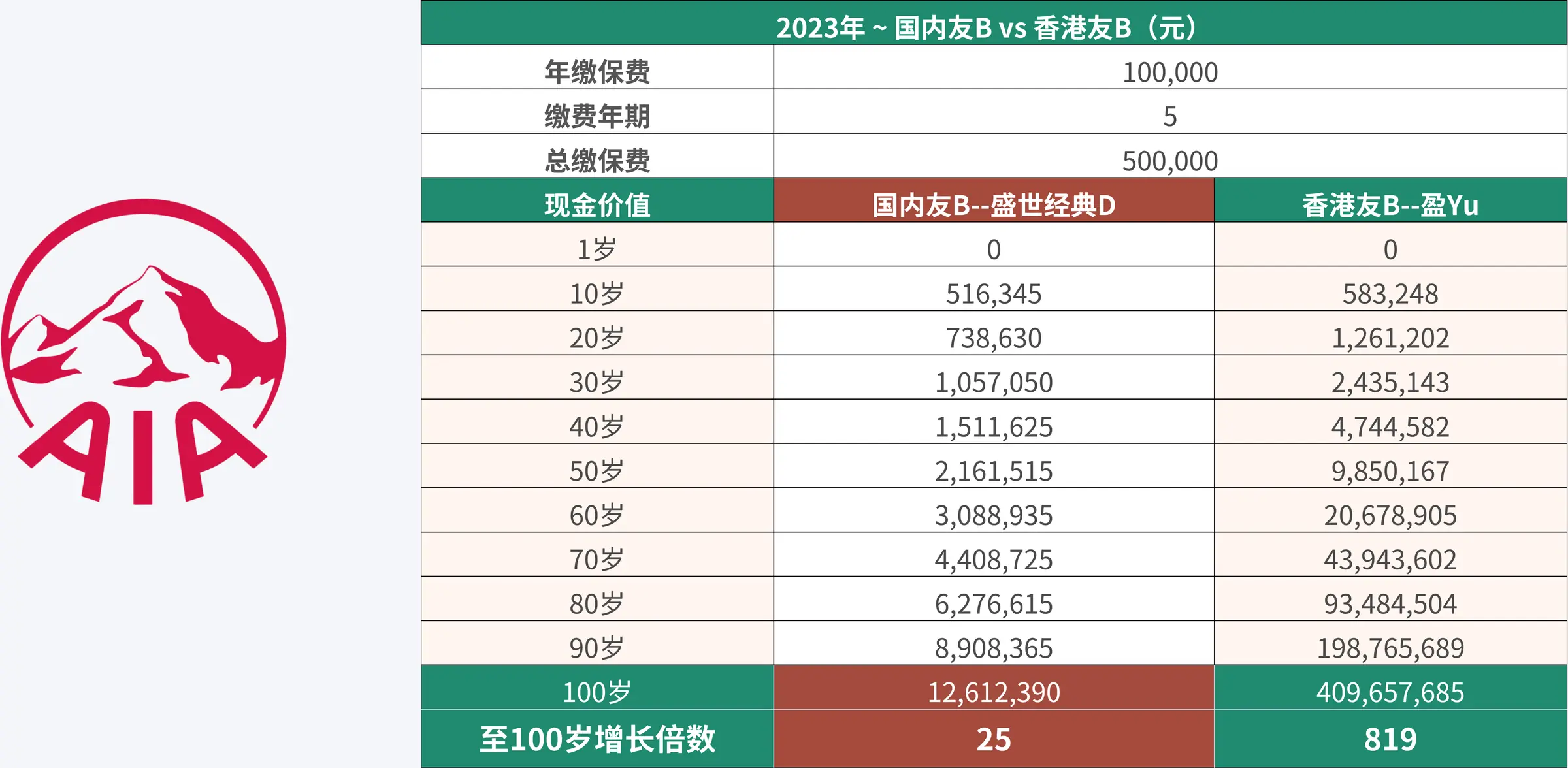
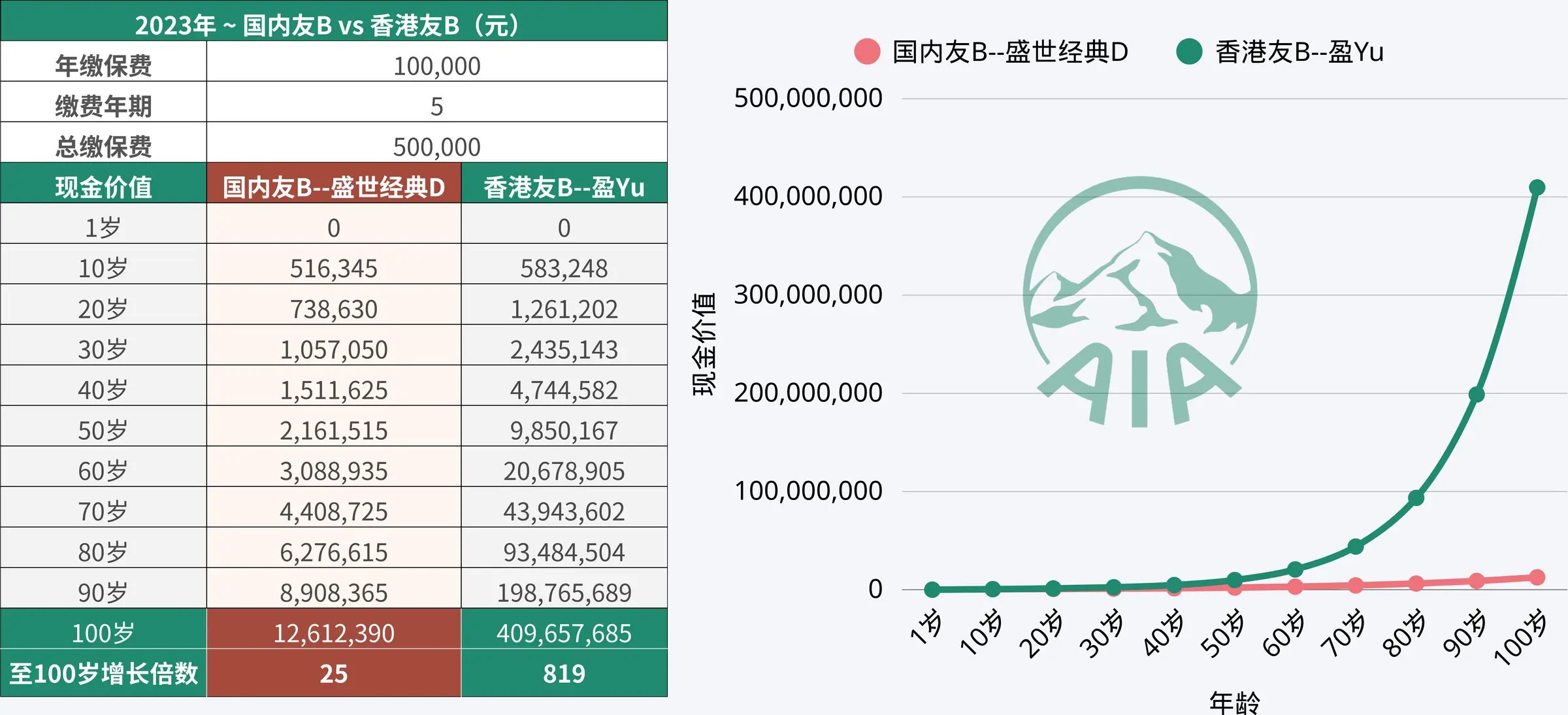
看两组对照,口径都是人民币年缴 10 万 × 5 年,总缴 50 万,演示到 100 岁:
Two comparisons, both at RMB 100k a year for five years (500k total), illustrated to age 100:
| 对照Comparison | 内地Mainland | 香港Hong Kong |
|---|---|---|
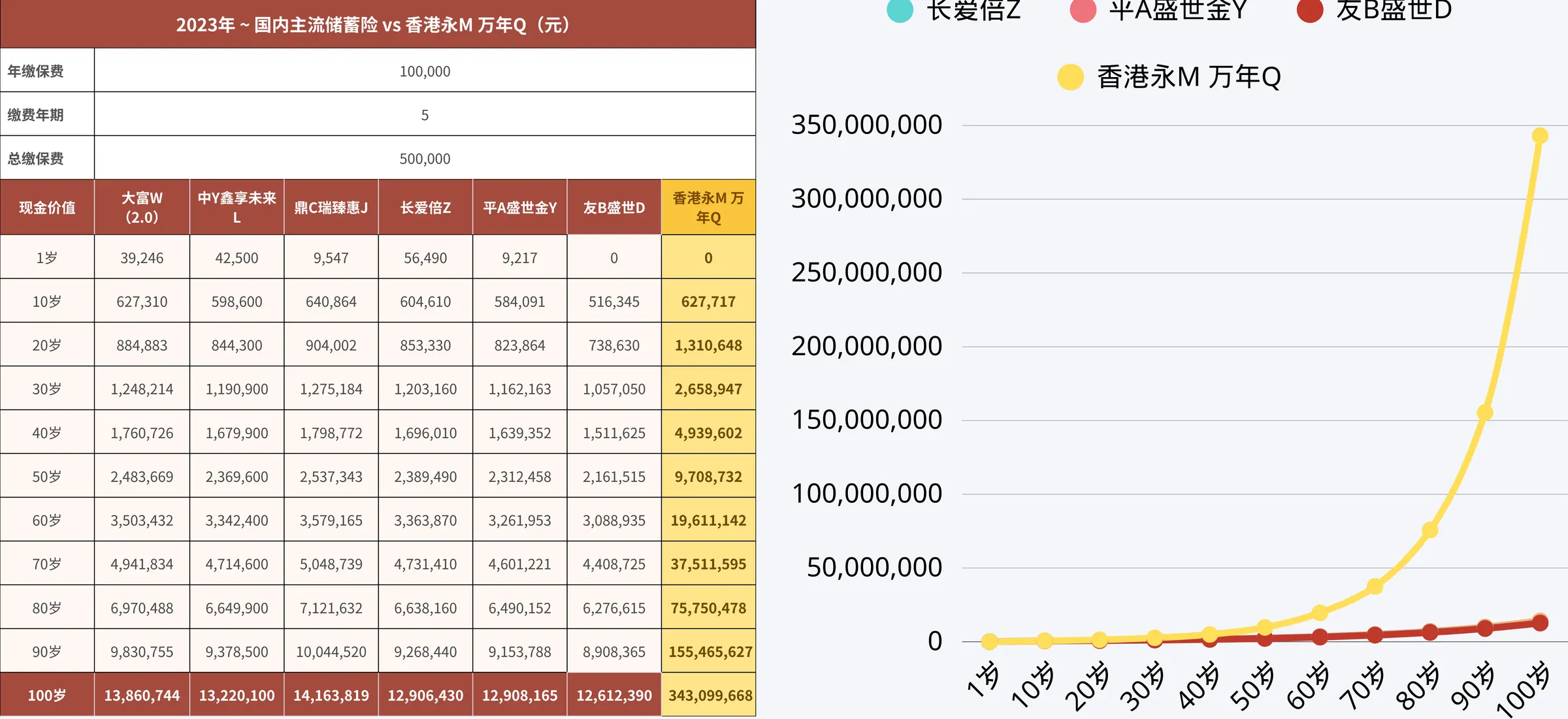
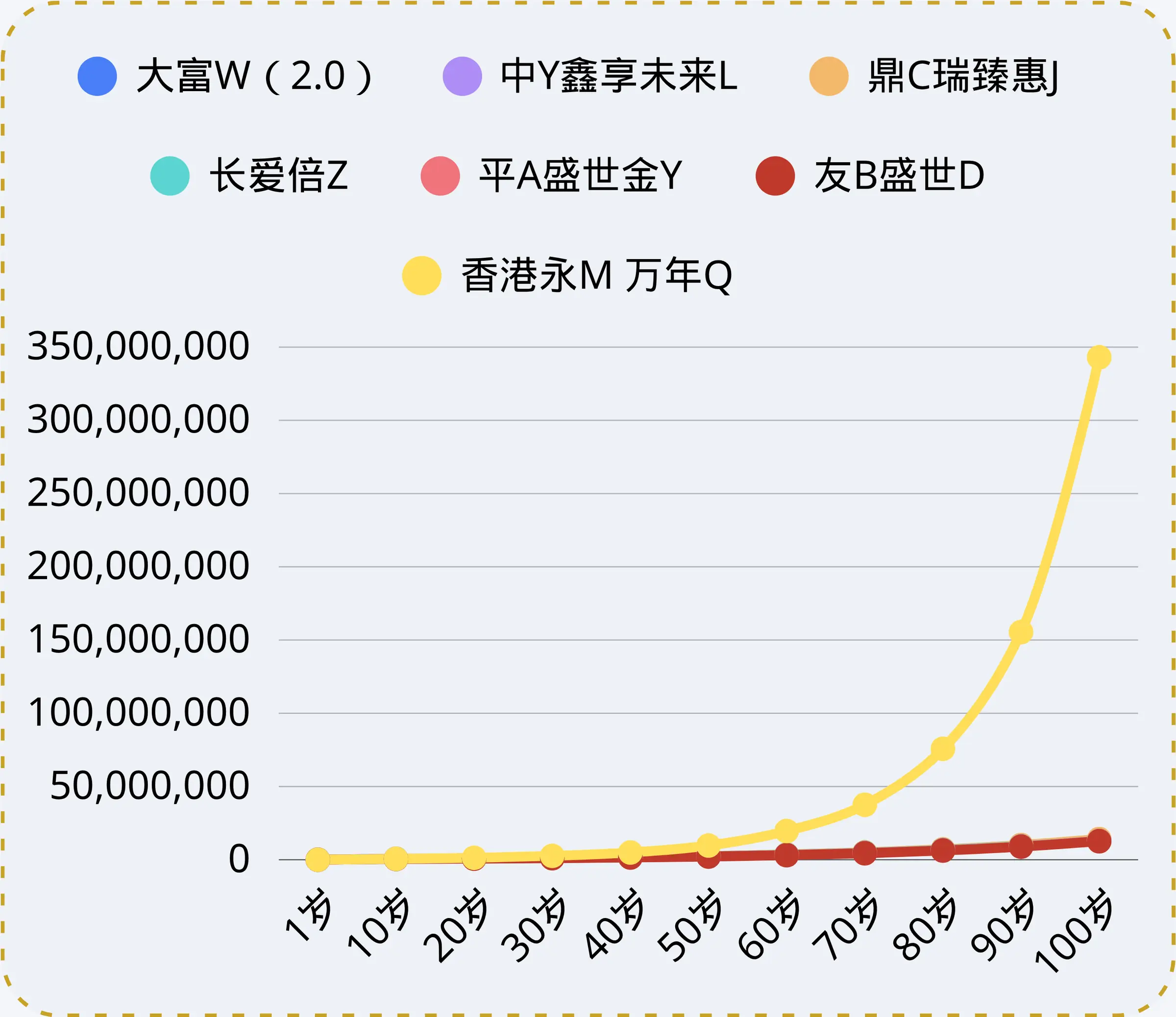
| 内地 6 大储蓄产品 vs 香港永明「万年青」(2023 年数据)Six mainland savings products vs Sun Life Hong Kong's "万年青" plan (2023 data) | 约 1,300 万(25–28 倍)~13M (25–28×) | 约 3.4 亿(686 倍)~340M (686×) |
| 同是友邦:内地版 vs 香港「盈御」(2023 年数据)Both AIA: mainland product vs Hong Kong "盈御" (2023 data) | 约 1,260 万(25 倍)~12.6M (25×) | 约 4.1 亿(819 倍)~410M (819×) |
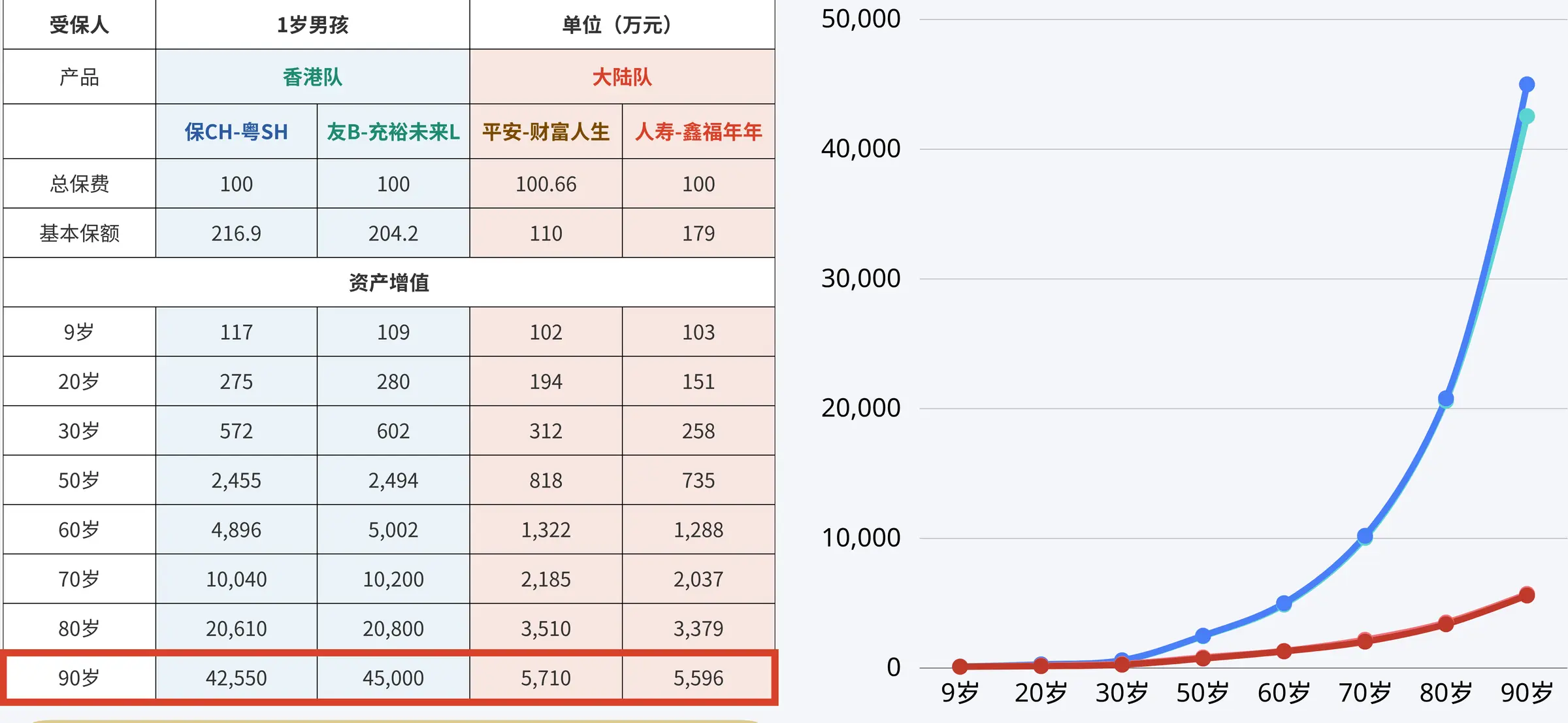
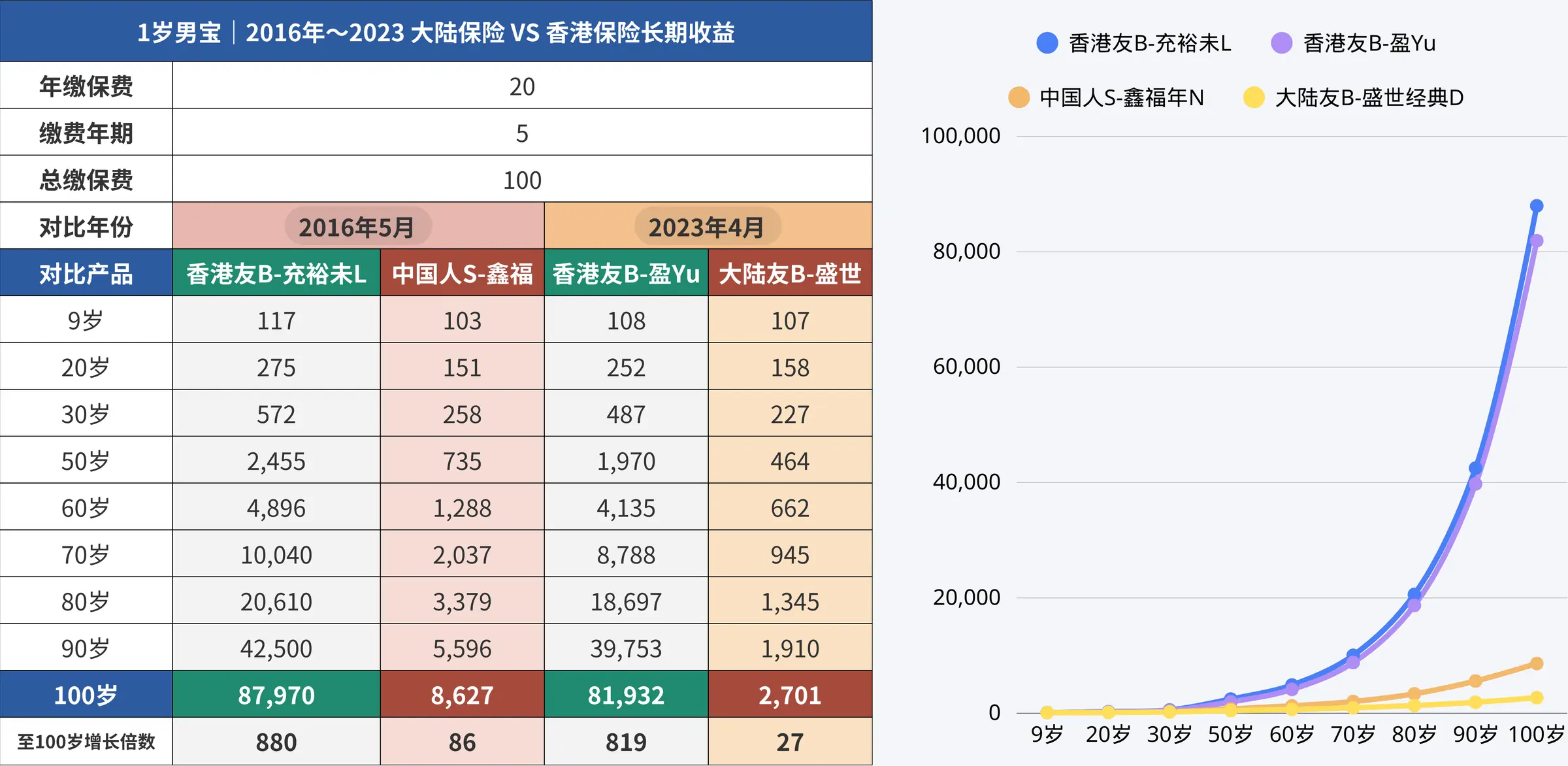
单位:人民币,演示值。另有一组一岁男孩、年缴 20 万 × 5 年的对照,方向一致:2016 年那组(香港保诚 vs 中国人寿)到 90 岁,香港约是内地的 7.5–8 倍;2023 年那组到 100 岁,友邦「盈御」约 819 倍,友邦内地版约 27 倍,相差约 30 倍。
RMB, illustrated values. A separate comparison for a one-year-old boy at RMB 200k a year for five years points the same way: in the 2016 figures Hong Kong is about 7.5–8× the mainland at age 90; in the 2023 figures, at age 100, AIA's Hong Kong "盈御" plan reaches about 819× against about 27× for AIA's mainland product, a gap of roughly 30×.
结论方向是香港的长期演示值显著高于内地, 这也解释了为什么内地高净值客户一了解香港储蓄险就会去买。
The direction is that Hong Kong's long-run illustrated values are much higher, which is why mainland high-net-worth clients who look at Hong Kong savings policies tend to buy them.
686 倍、819 倍这一类数字,不要拿去给客户看。理由有三条,你自己也要清楚:
Figures like 686× or 819×: don't put them in front of a client. Three reasons, and you should be clear on them yourself:
- 那是演示值,不是保证值。香港分红险的分红不保证, 实际派发率逐年公布,历史上有过不达标的情况。
- It's illustrated, not guaranteed. Hong Kong participating dividends are not guaranteed; fulfilment ratios are published annually and have missed before.
- 算到 100 岁是 60–70 年的复利外推, 假设利率差一点点,末端的倍数就差出几倍。
- Age 100 is sixty or seventy years of compounding extrapolated, so a small difference in the assumed rate becomes a multiple at the far end.
- 对将来要在美国报税的客户,这笔钱的税务处理可能完全不同,见第 5 节。 演示值再漂亮,被 MEC 一卡就全变了。
- For a client who will file US taxes, the treatment may be entirely different (see section 5). A beautiful illustration means little if MEC catches it.
内地客户在香港买什么,以及 2016 年的转折What mainland clients buy in Hong Kong, and the 2016 turn
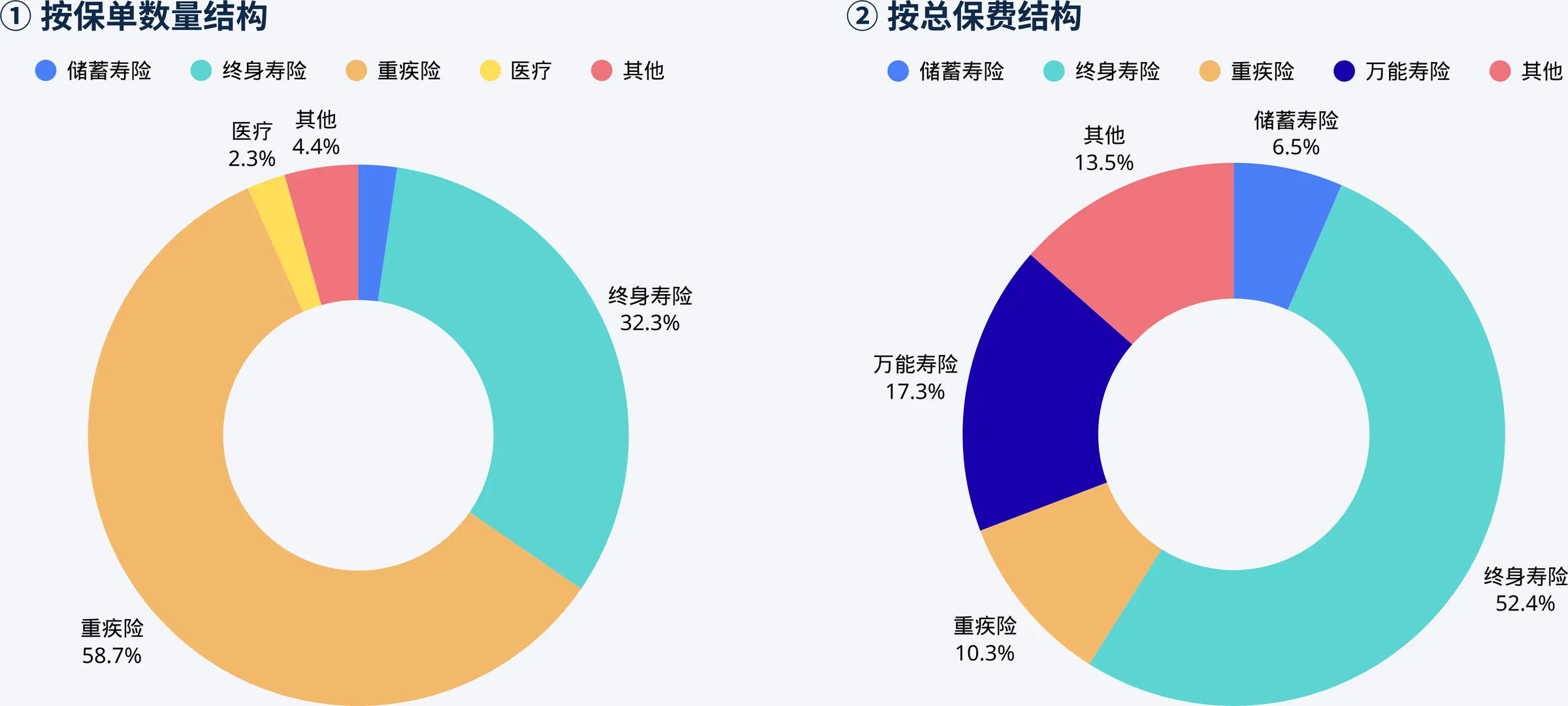
按 2024 年数据:按保单件数,内地访客买得最多的是重疾险; 按保费,约 52% 进了终身寿险,终身寿、储蓄寿险、万能寿险三类合计近八成。 也就是说,钱主要是冲着储蓄去的,重疾险件数多但单价低。
On 2024 data: by policy count, mainland visitors mostly buy critical illness cover; by premium, about 52% goes into whole life, and whole life, savings life, and universal life together take nearly 80%. The money is going to savings; critical illness sells in volume but at low premium.
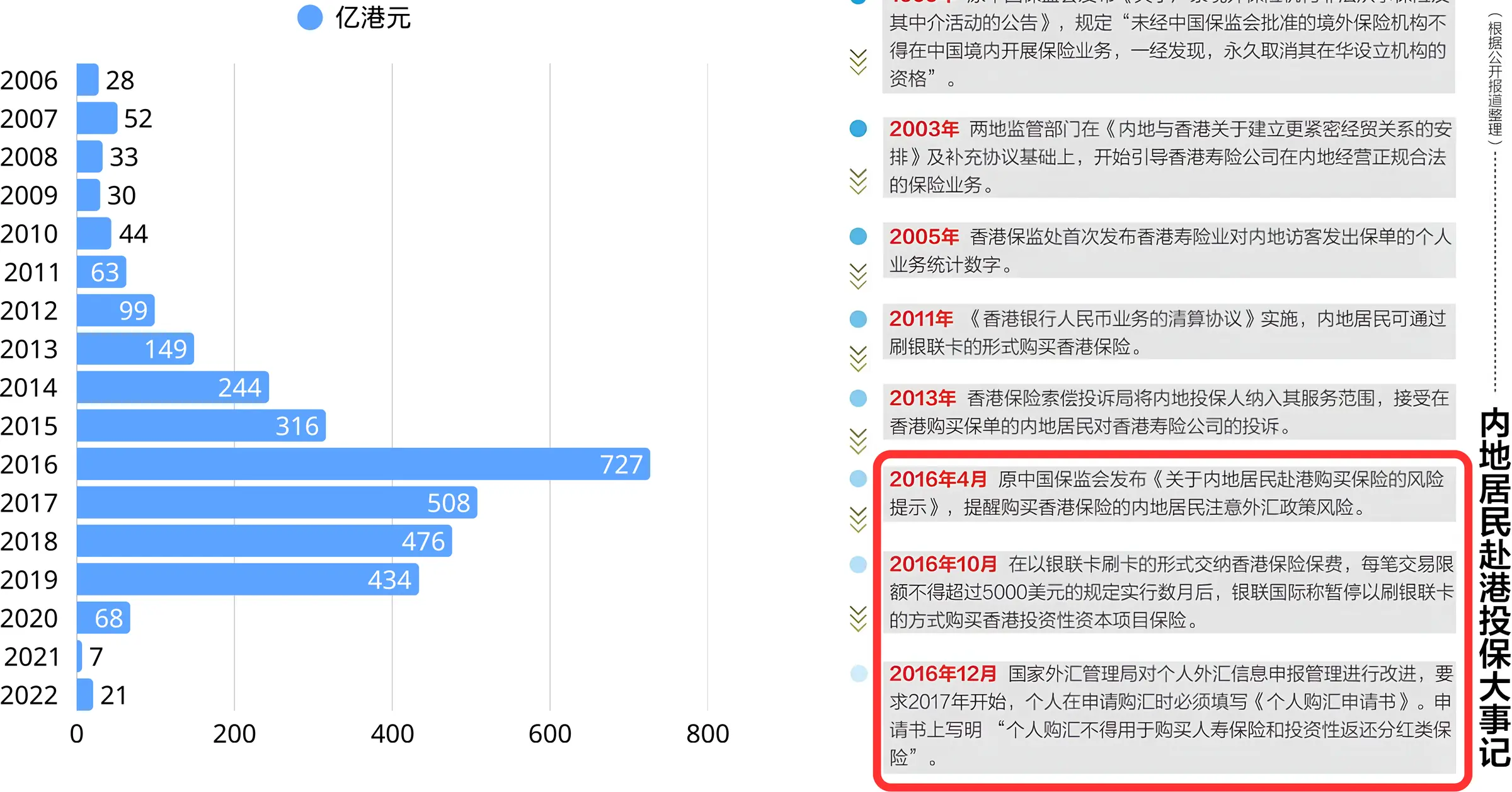
| 时间When | 事件What happened |
|---|---|
| 1992 | 友邦把个人代理模式带进内地,香港保险开始进入内地客户视野AIA brings the agency model to the mainland; Hong Kong insurance enters mainland buyers' view |
| 2001 | 内地居民可以刷银联卡交香港保单保费Mainland residents can pay Hong Kong premiums by UnionPay card |
| 2006 | 内地访客新单保费约 28 亿港元Mainland visitor new premium about HK$2.8B |
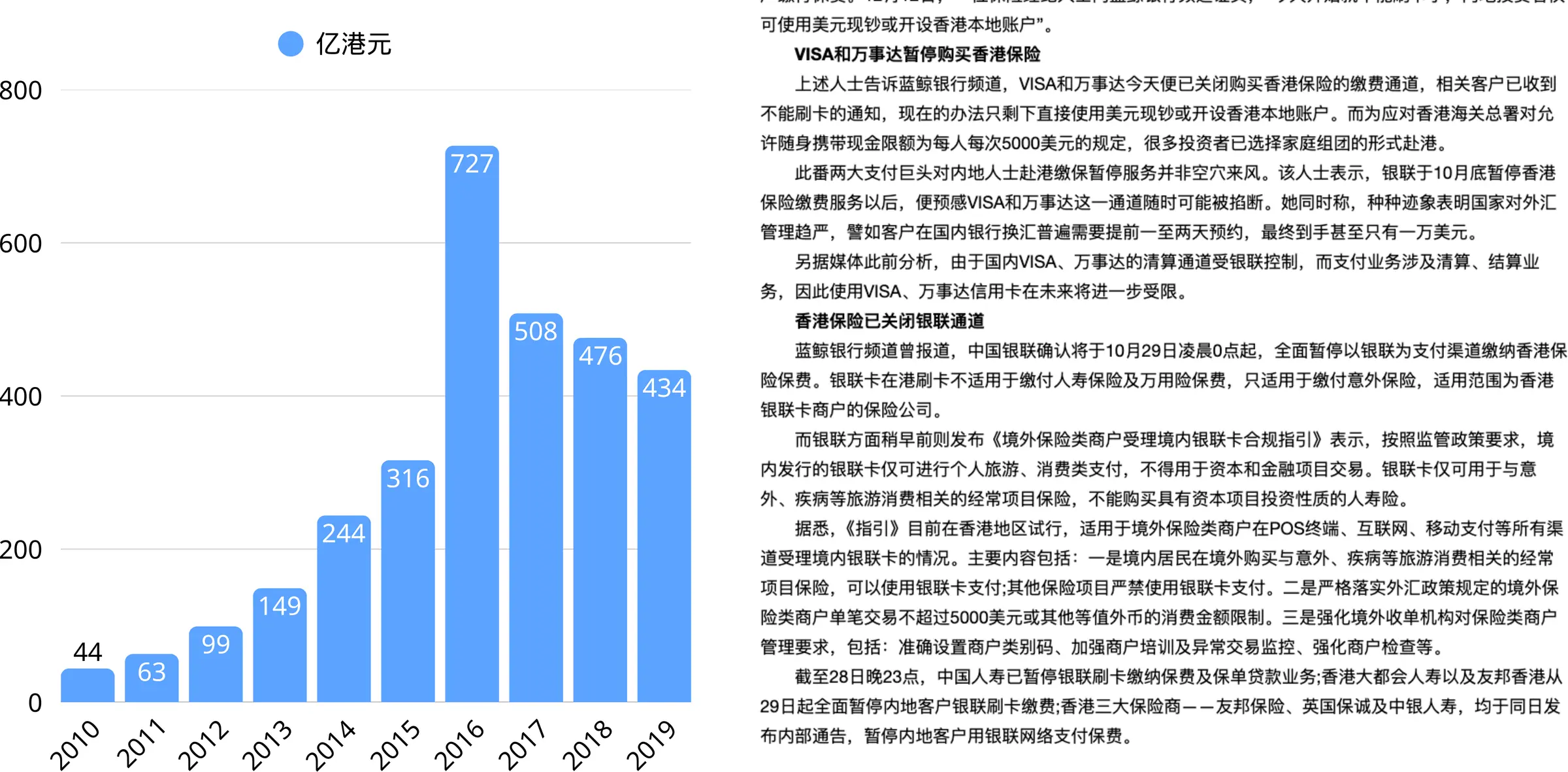
| 2016 | 达到高峰,约 727 亿港元。4 月,原保监会发布风险提示; 10 月,银联卡买香港保险每笔限额 5,000 美元,投资型、分红型保单也不能再用银联卡刷; 年底收紧购汇,个人购汇申请须声明不得用于购买境外人寿保险和投资型保险The peak, about HK$72.7B. In April the regulator issued a risk warning; in October UnionPay payments for Hong Kong insurance were capped at US$5,000 per transaction and investment-type and participating policies could no longer be paid that way; at year end, individual FX purchases had to declare the funds were not for offshore life or investment-type insurance |
| 2017–2022 | 逐年下滑,再遇上疫情,2021–2022 年低到约 21 亿港元Steady decline, then the pandemic; about HK$2.1B at the 2021–22 low |
通道收紧之后,一部分有美元配置需求的客户把目光转向了美国, 这也是你现在会遇到越来越多"手上有香港保单"客户的背景。
Once that channel narrowed, some clients looking for USD assets turned to the US, which is why you now meet more and more clients who already hold a Hong Kong policy.
4. 香港 vs 美国:同样保费买到多少4. Hong Kong versus the US, at the same premium
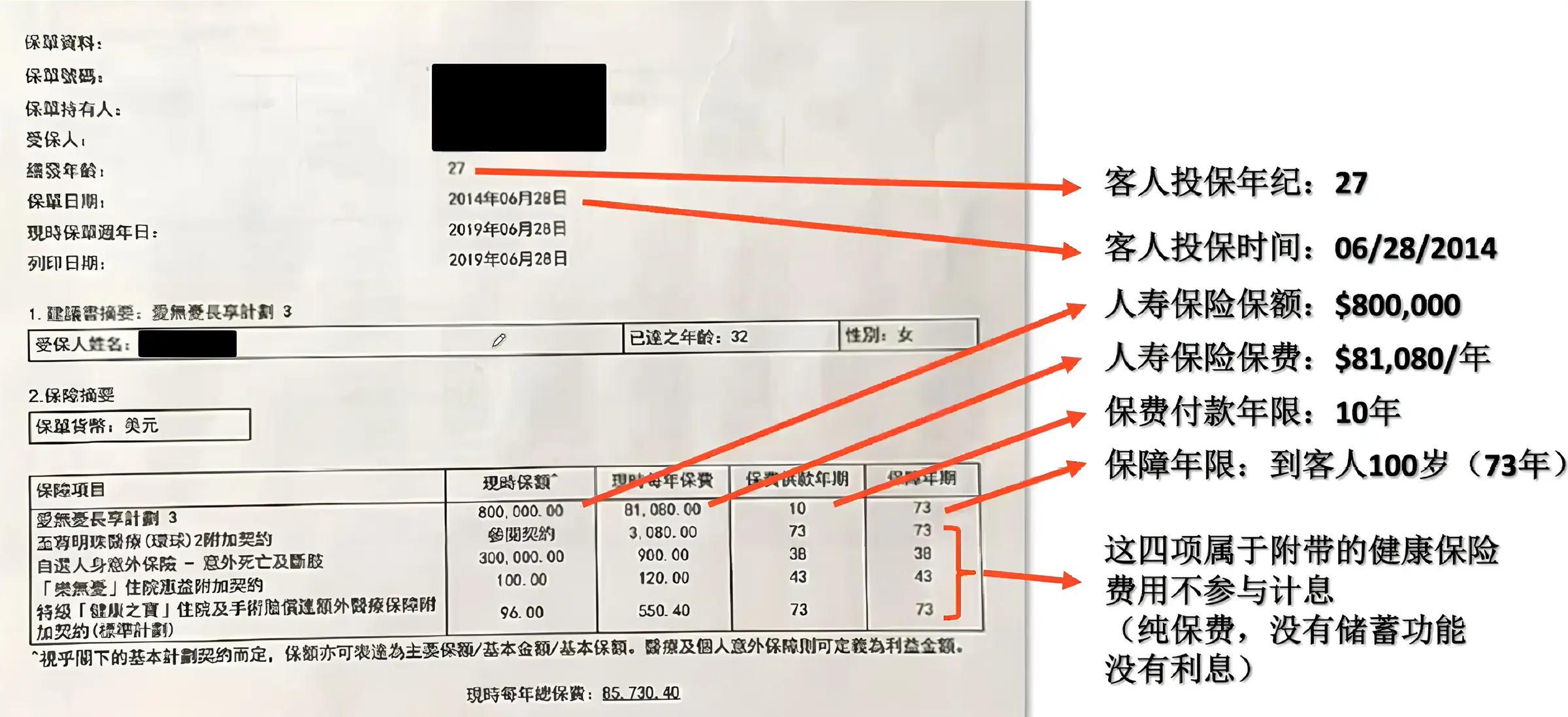
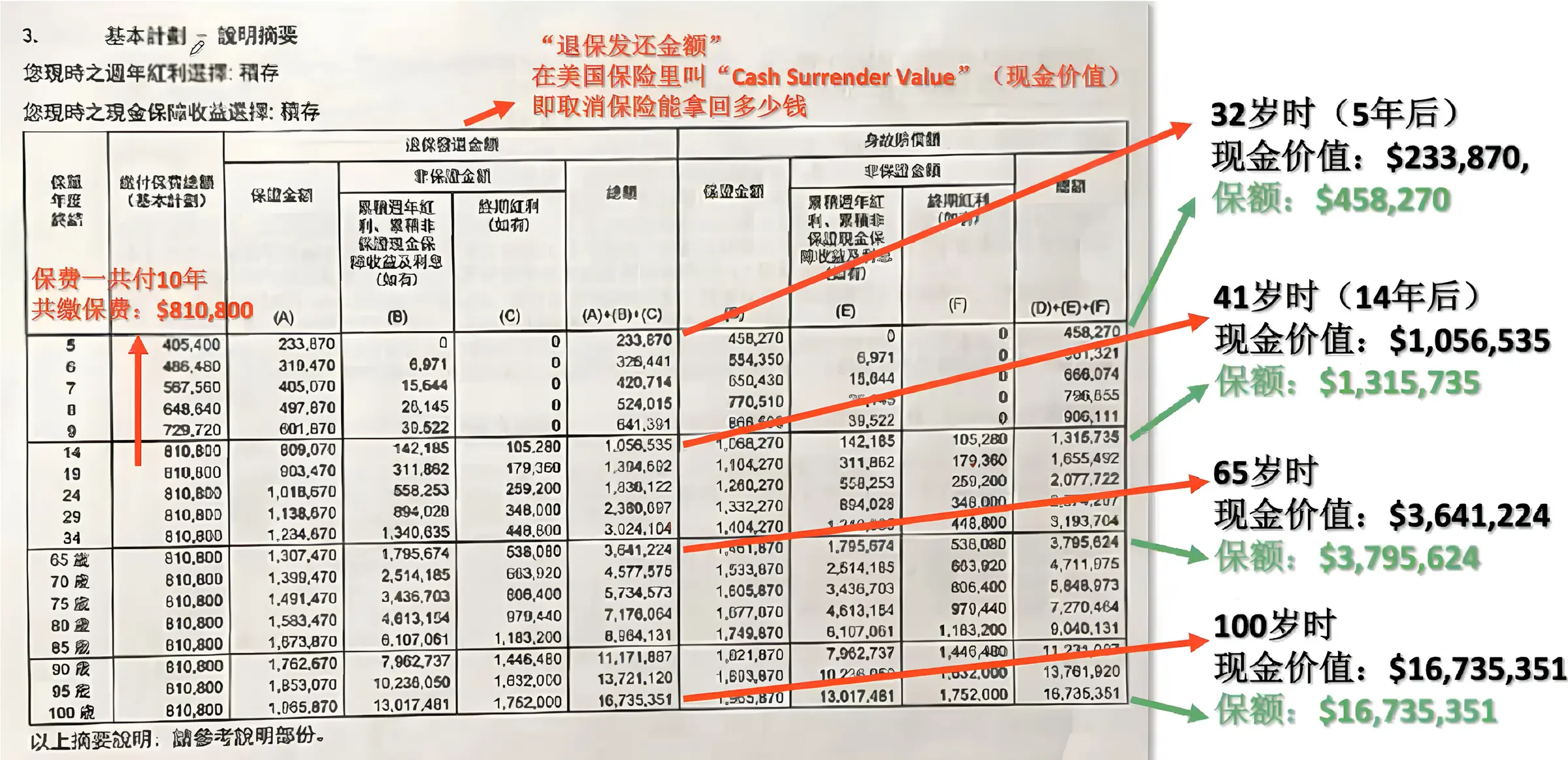
拿两地各自的龙头做一组同保费对照。客人 27 岁女性, 保费完全一样:
Here are the two market leaders at an identical premium. The client is a 27-year-old woman:
| 香港(分红储蓄型)Hong Kong (participating savings) | 美国(IUL)US (IUL) | |
|---|---|---|
| 年缴 × 年限Annual × years | $81,080 × 10 | $81,080 × 10 |
| 总保费Total premium | $810,800 | $810,800 |
| 开单时保额Initial face | $800,000 | $9,400,000 |
| 32 岁 现金值 / 保额Age 32 · CV / face | $233,870 / $458,270 | $402,264 / $9,400,000 |
| 41 岁 现金值 / 保额Age 41 · CV / face | $1,056,535 / $1,315,735 | $1,345,942 / $9,400,000 |
| 65 岁 现金值 / 保额Age 65 · CV / face | $3,641,224 / $3,795,624 | $7,318,538 / $9,400,000 |
| 100 岁 现金值Age 100 · CV | $16,735,351 | $92,463,346 |
11.75 倍的保额差是真的,但两个产品的设计目标本来就不同。 香港那份是分红储蓄型,它的目标是现金值,保额只是附带; 美国这份是IUL 做最大保额。拿储蓄产品的保额去比保障产品的保额, 结论必然悬殊。
The 11.75× difference in face amount is real, but the two products were built for different jobs. The Hong Kong contract is a participating savings policy: cash value is the point and the face amount comes along. The US one is an IUL configured for face. Comparing a savings product's death benefit to a protection product's will always look lopsided.
诚实的讲法是:"同样的钱,如果你要的是保障,美国这边能买到的保障多得多; 如果你要的是现金值,我们再调一份以现金值为目标的方案来比。" 两份都调出来给客户看,比只给一组数字有说服力得多,也经得起对方经纪人反问。
The honest framing: "For the same money, if what you want is protection, the US side buys far more of it. If what you want is cash value, let me run a cash-value-oriented design and compare that." Showing both stands up better than showing one, and survives the other agent's rebuttal.
注意两边 100 岁的现金值也差了 5.5 倍,这一项是同口径的,比保额那一项更有说服力。 但它同样是演示值,前面第 3 节的三条限定全部适用。
Note that cash value at 100 also differs by about 5.5×, and that one is like-for-like, a stronger argument than the face amount. It is still an illustrated value, and all three caveats from section 3 apply.
客户手上已经有这张香港保单怎么办When the client already holds that Hong Kong policy
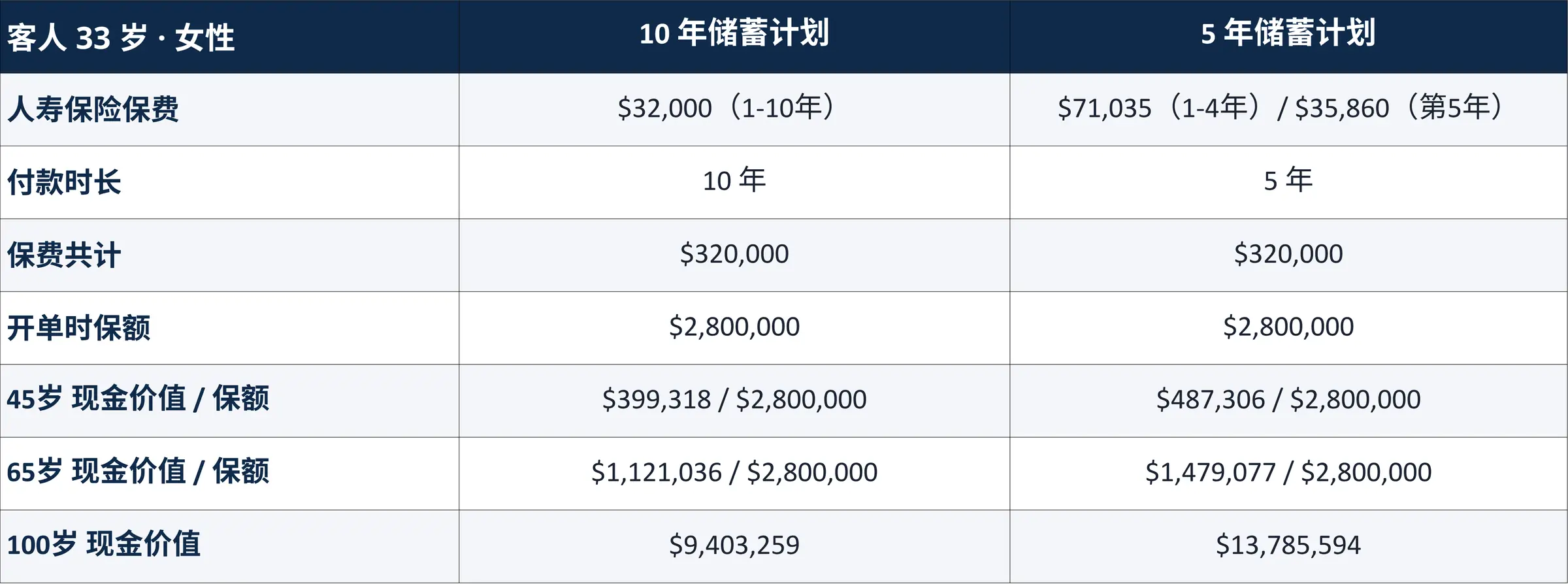
培训里拿同一张保单做了一个转换算例:第 6 年时客户已缴约 $48.6 万, 退保可拿回约 $32.6 万。把约 $32 万放进国家人寿的 IUL(演示值):
The training ran a conversion on the same policy. By year six the client has paid about $486,000 and could surrender for about $326,000. Moving roughly $320,000 into a National Life IUL (illustrated):
| 放法Funding | 保额Face | 100 岁现金值CV at 100 |
|---|---|---|
| 留在香港原保单Keep the Hong Kong policy | $800,000(随现金值增长) (grows with CV) | 见上表See above |
| $32,000 × 10 | $2,800,000 | 约 $900 万~$9M |
| $64,000 × 5 | $2,800,000 | 约 $1,300 万~$13M |
这个方向可以跟客户谈,但不是退保再买这么简单:
The direction is worth discussing, but it is not as simple as surrender and rebuy:
- 退保是实打实的损失,交了 $48.6 万拿回 $32.6 万。先让客户看清这一笔。
- Surrender is a real loss: $486,000 in, $326,000 out. Make sure the client sees that first.
- 先拿到美国保单,再动香港保单。新保单要按当时的年龄和健康重新核保, 还要满足第 7 节的投保条件。
- Get the US policy issued before touching the Hong Kong one. The new policy is underwritten at the client's age and health at that point, and must meet the eligibility rules in section 7.
- 两边的数字都是演示值,要把两份方案并排给客户看,做法参照 保单替换。
- Both sides are illustrated values; show the two side by side, as in Policy Replacement.
- 客户如果要在美国报税,第 5 节的税务问题往往才是真正逼他做决定的原因。
- For a client who files US taxes, the tax issues in section 5 are often what actually forces the decision.
5. 税务:这一节才是重点5. Tax: this is the section that matters
前面四节都是铺垫。如果客户已经移民、正在办身份、或者孩子将来要在美国报税, 手上那张香港或内地保单的问题不是"收益低",而是"美国税法根本不把它当保险"。
The first four sections set this up. If the client has emigrated, is in process, or has children who will file US returns, the problem with their Hong Kong or mainland policy isn't a lower return. It's that US tax law may not treat it as life insurance at all.
CRS 和 FATCA:信息往哪里报CRS and FATCA: where the information goes
CRS:中国 / 香港走的
CRS: China and Hong Kong
中国自 2018 年 9 月 1 日启动。香港、澳门、澳洲、新西兰等地的金融账户信息, 会通过 CRS 自动交换回中国税务机关,包括保单信息。
China switched on from 1 September 2018. Financial account information in Hong Kong, Macau, Australia, New Zealand and elsewhere is automatically exchanged back to the Chinese tax authority, policies included.
FATCA:美国走的
FATCA: the US
美国从一开始就没加入 CRS,走自己的 FATCA。 FATCA 要求全球金融机构(含保险公司)向美国通报美国人的海外金融资料; 反过来,在美国开的账户信息不会通过 CRS 交换给中国。
The US never joined CRS and runs FATCA instead. FATCA requires financial institutions worldwide (insurers included) to report US persons' offshore accounts to the IRS. In the other direction, US-held accounts are not exchanged out through CRS.
所以一旦客户或孩子拿到绿卡或公民身份,就多了一位"亲戚":IRS, 而且它关心的是全球资产,不只是美国境内的。
So the moment a client or their child takes a green card or citizenship, they acquire a new relative, the IRS, and it is interested in worldwide assets, not just US ones.
CRS 这几年查得越来越实,2.0 版本也在推进。培训里提到,已经有客户因为香港、新加坡保单里的大额资产, 回内地后被税务机关约谈补税。
CRS enforcement keeps tightening, and version 2.0 is on the way. The training mentioned clients with large balances in Hong Kong or Singapore policies being called in by mainland tax authorities to pay back tax.
讲 CRS 和 FATCA 的区别,是为了让客户看清信息往哪里报,不是帮客户躲中国的税。 客户在中国有纳税义务,就要自己履行。不要把美国讲成"避税天堂",也不要承诺"买了美国保单国内就查不到"。
The point of explaining CRS versus FATCA is to show where information is reported, not to help a client avoid Chinese tax. A client with Chinese tax obligations has to meet them. Don't describe the US as a tax haven, and never promise that a US policy is invisible back home.
收入税:香港保单的分红在美国算境外收入Income tax: Hong Kong dividends are foreign income
成为美国税务居民之后按全球收入报税,香港保单的分红属于境外收入, 要申报,可能要交税。住在加州的高收入家庭,联邦加州合计的边际税率可以到 50% 左右 (联邦最高档 2026 年夫妻合报约从 $77 万起)。所以拿钱之前要先算清楚,到手到底剩多少。 同样的钱放在符合规定的美国寿险里,可以通过保单贷款免税取用。前提是保单符合下面两道测试(§7702、不是 MEC),而且保单不失效;贷款有利息,会减少现金值和身故赔偿。
Once a client is a US tax resident they report worldwide income, and Hong Kong policy dividends are foreign income: reportable and possibly taxable. For a high-earning California household, the combined federal and state marginal rate can reach around 50% (the top federal bracket for joint filers starts around $770,000 in 2026). Work out what actually reaches the client before any withdrawal. The same money in a compliant US policy can come out tax-free through policy loans, provided the policy passes the two tests below (§7702, not a MEC) and stays in force. Loans accrue interest and reduce the cash value and death benefit.
7702 与 MEC:两道可能把香港保单挡在门外的测试§7702 and MEC: two tests an offshore policy can fail
| 测试Test | 通不过会怎样What failing it means |
|---|---|
| IRC §7702 CVAT,或 GPT + 现金值走廊测试CVAT, or GPT plus the corridor test |
符合才被视为人寿保险、才享身故理赔免收入税。某些香港产品的现金值与保额比例超出美国规定, 在美国税法看根本不算人寿保险:没有税务递延,每年要征税,身故理赔也可能被征税。 Pass and it counts as life insurance, with the death benefit free of income tax. Some Hong Kong products carry a cash-value-to-face ratio outside the US limits, so US tax law doesn't see life insurance at all: no deferral, annual taxation, and the death benefit may be taxable too. |
| MEC §7702A 的 7-pay testThe §7702A seven-pay test |
保费缴得太快太多就会被归为 MEC。后果:除身故理赔外,任何保单增长在领取或保单贷款时都要征税 (FIFO 变 LIFO,先取利息再取本金),而且 59½ 岁前动用还有额外 10% 罚款。 Fund it too fast and it becomes a modified endowment contract. Then every dollar of growth is taxable on withdrawal or loan (LIFO instead of FIFO, so interest comes out first), and there's a 10% penalty before 59½. |
这两道测试都是冲着"把大笔钱塞进保单避税"来的:§7702 是 1984 年立的, MEC 规则(§7702A)是 1988 年加的。现在一张保单能放多少钱,基本由保额决定。
Both tests exist to stop large sums being parked in policies to avoid tax: §7702 dates from 1984 and the MEC rules (§7702A) from 1988. How much a policy can hold is now largely set by its face amount.
客户买了一张香港保单,年缴人民币 75 万,经纪人说可以做养老规划、还能解决将来移民美国后的遗产税问题。 结果移民之后发现:现金值超过 $25 万必须如实申报; 保单的现金值与保额比例不符合美国规范,构成 MEC; 于是除身故理赔外,任何增长在领取时都要缴税,59½ 岁前动用还要罚 10%。
A client buys a Hong Kong policy at RMB 750,000 a year on the promise that it will fund retirement and solve US estate tax later. After emigrating they find that cash value above $250,000 must be reported, that the policy's cash-value-to-face ratio falls outside US rules and it is a MEC, and that consequently everything except the death benefit is taxed on withdrawal, with a 10% penalty before 59½.
这张保单最后剩下的唯一用途,就是等身故理赔, 而同样的保障,香港的价格还比美国贵 2–3 倍。多花了钱,没换来任何税务优势。
The only use left is the death benefit, for which they paid two or three times the US price. More money, and none of the tax treatment they were promised.
遗产税:非美国人的免税额只有 $6 万Estate tax: $60,000 for a non-resident
- 中国内地:有讨论,目前不征。香港:2006 年后不征。
- Mainland China: discussed, not levied. Hong Kong: abolished after 2006.
- 美国公民 / 税务居民:全部资产(含海外)超过免税额的部分征税, 最高 40%。2026 年免税额为 $1,500 万。这个数字每年调整,用前必查。
- US citizens and tax residents: worldwide assets above the exemption are taxed at up to 40%. The 2026 exemption is $15M. It is adjusted annually; verify before quoting.
- 非美国公民、非美国遗产税居民:只要在美国境内拥有资产, 超过 $6 万免税额的部分就要征,最高 40%,须申报 Form 706-NA。
- Non-citizens who aren't US estate-tax residents: US-situs assets above a $60,000 exemption are taxed at up to 40%, reported on Form 706-NA.
美国人寿保险的身故赔偿,受益人收到不需再交所得税; 但如果总资产超过免税额,保额本身可能被计入遗产。 降低遗产税最常见的做法是不可撤销人寿保险信托(ILIT)+ 人寿保险, 结构见八种切入点的资产传承一节。
A US death benefit reaches the beneficiary free of income tax, but if the estate exceeds the exemption the death benefit itself can be included in it. The standard structure for managing that is an irrevocable life insurance trust plus the policy (see the legacy section of Eight Ways In).
还有两笔容易漏掉的Two more that get missed
- 外国保险保费消费税(IRC §4371):美国纳税人向外国保险公司缴保费, 可能触发:人寿、健康、意外与年金通常按保费 1%,财产与责任险通常 4%, 通常以 Form 720 按季申报。
- The foreign insurance excise tax (IRC §4371): a US taxpayer paying premium to a foreign insurer may owe 1% on life, health, accident and annuity premiums, or 4% on property and casualty, typically filed quarterly on Form 720.
- 海外账户申报:有现金值的外国寿险或年金,可能需要申报 FBAR(所有外国金融账户全年合计最高余额超过 $10,000) 和/或 Form 8938(门槛依报税身份与是否居住海外而不同)。 非故意的 FBAR 违规按每份年度报告罚;故意违规可能面临高额民事罚款及刑事责任。 Form 8938 漏报通常先罚 $10,000,收到通知后持续不补报,追加罚款最高 $50,000。
- Offshore account reporting: a foreign policy or annuity with cash value may require an FBAR (aggregate foreign account balances over $10,000 at any point in the year) and/or Form 8938 (thresholds vary with filing status and residence). Non-wilful FBAR violations are penalised per annual report; wilful ones carry substantial civil penalties and potential criminal exposure. A missed Form 8938 generally starts at $10,000, rising to $50,000 if it isn't cured after notice.
这一整节你能做的,是让客户意识到问题存在,然后转介给持牌的跨境税务师。 你不能替客户判断他那张保单算不算 MEC、要不要报 FBAR, 那需要看合同全文和他的完整报税情况。讲到这一步就交棒。
What you can do here is make the client aware the problem exists, then hand them to a licensed cross-border tax professional. You cannot determine whether their policy is a MEC or whether they owe an FBAR; that takes the full contract and their complete filing picture. Take it to that point and hand off.
6. 美国寿险的另外几个理由6. The other reasons for US cover
培训里把"为什么在美国配置"归成六点:安全、保费、债务隔离、税务、严进宽出、指数险。 保费和税务前面已经讲过,下面是另外四点,以及每一点讲的时候的边界。
The training groups the case for US cover into six points: safety, cost, creditor protection, tax, strict-in/easy-out, and indexed products. Cost and tax are covered above; here are the other four, with the limits on how to present each.
① 安全:制度成熟,有多层兜底
① Safety: a mature system with layers behind it
260 多年的市场、州级监管、季度审计、州保障协会,出问题时由州保险厅接管、收购方承接保单。 讲的时候说"多层保障",不要说"不会倒闭"或"比银行安全"。保障协会有上限,第 2 节讲过。
A 260-year market, state regulation, quarterly audits, state guaranty associations, and receivership with an acquirer assuming the policies. Say "several layers of protection," not "can't fail" or "safer than a bank". Guaranty coverage is capped, as section 2 says.
② 债务隔离:现金值受州法保护,但各州差很多
② Creditor protection: state law, and states differ a lot
很多州的法律让寿险现金值在诉讼、破产时不被债权人拿走,所以有人把它当成和信托并列的资产保护工具。 但保护程度由州法决定:有的州几乎全额保护,有的州只保护一小部分; 有意逃避已知债务的转移也不受保护。对比内地:动用司法豁免时要证明资金来源清白,涉及刑事案件的仍可能被查封。 具体能保护多少,让客户问律师。
Many states shield life insurance cash value from creditors in lawsuits and bankruptcy, which is why some people use it alongside trusts for asset protection. But the extent is set by state law: some states protect nearly all of it, others only a small amount, and transfers made to dodge known debts are not protected. By contrast, on the mainland an exemption requires proving the funds are clean, and policies can still be frozen in criminal cases. How much is protected is a question for the client's attorney.
③ 严进宽出:核保最严,理赔最省事
③ Strict in, easy out
美国问 5–10 年的病史,香港 3–7 年,内地 6 个月–2 年。进门时查清楚了, 理赔时通常就是填表、交医疗资料。前提是投保时如实告知,否则 2 年争议期内照样会被查。
The US asks about 5–10 years of history, Hong Kong 3–7, the mainland 6 months to 2. With the case settled at application, a claim is usually forms and medical records. That assumes full disclosure; otherwise the two-year contestability window still applies.
④ 指数型万能险(IUL):美国的特色产品
④ Indexed UL: a distinctly US product
IUL 的钱不直接进股市,保险公司只是参照标普 500 等指数给保单计息, 指数跌时有保底(通常 0%),所以现金值不会因为股市下跌而亏损,但每年的保单成本照扣。 美国的主要指数有近百年、公开可查的历史,这是香港、内地做不出同类产品的原因之一。
IUL money does not go into the market; the carrier credits interest by reference to an index such as the S&P 500, with a floor (usually 0%) when the index falls. Cash value doesn't lose to a market drop, but policy charges are still deducted. The major US indexes have close to a century of public history, one reason Hong Kong and the mainland have no equivalent.
培训里说的"长期 6–7%"是历史回看,不是承诺。 给客户看的演示利率受 AG 49 限制,实际计息看上限、参与率和当年指数表现。
The "6–7% over the long run" in the training is a historical lookback, not a promise. Illustrated rates are limited by AG 49, and actual crediting depends on caps, participation rates, and each year's index.
7. 在美国买的条件7. Who can actually buy
不是谁都能买。产品是按美国人口定价的,核保的核心是"可核保性 Insurability": 没有美国身份、也和美国没有较强资产联系的人,承保不了, 因为没有资产就意味着将来没有税务负担,也就没有买这张保单的理由。 香港没有这道门槛,很多产品是专为内地客户量身定制的。
Not everyone. The products are priced for a US population, and underwriting turns on insurability: without US status or a substantial asset connection to the US, the case won't be written, because no US assets means no future US tax liability, and therefore no reason for the policy. Hong Kong has no such gate, and much of its shelf is built specifically for mainland buyers.
谁算"外国人 Foreign National"Who counts as a foreign national
以国家人寿的口径为例,按居住国与在美居留的永久性衡量:
Using National Life's definition, measured by country of residence and the permanence of US presence:
- 连续 12 个月内在美境外停留超过 4 个月者,视为外国人 (包括旅居海外的美国公民)。
- More than four months outside the US in any rolling twelve months counts as a foreign national, including US citizens living abroad.
反过来,过去 12 个月在美国合计住满 8 个月、预期会继续住下去、并且有社安号或 ITIN 的人, 国家人寿按美国居民处理,所有产品都能买,包括定期险。看的是居住事实,不是身份: 所以常被问到的"没有社安号能不能买",有 ITIN 的可以申请;递件前和核保确认身份证件与报税要求。 详细规则见《外籍人士投保》。
Conversely, someone who has spent eight of the last twelve months in the US, expects to stay, and has a Social Security number or ITIN is treated as a US resident by National Life and can buy every product, term included. Residence counts, not status: so the common question "can I buy without a Social Security number" is answered yes, with an ITIN; confirm ID and tax documentation with underwriting before submitting. Full rules are in Foreign Nationals.
判断顺序:先看是否住满 8 个月;不满,再看下面的 Nexus 六选一。
Order of the check: first the eight months; if not met, then the six Nexus options below.
与美国的连接 Nexus:六选一Nexus: any one of six
① 在美拥有不动产
① US real property
② 在美拥有企业
② A US business
③ 与居美的美国公民结婚
③ Married to a US citizen resident in the US
④ F 签证学生(有效签证 + 财务依据)
④ An F-visa student (valid visa plus financial justification)
⑤ 美国资产至少 $100,000(有文件、在美国至少放了 3 个月)
⑤ US assets of at least $100,000 (documented, held in the US at least three months)
⑥ 持 EB-5 签证
⑥ An EB-5 visa
保额与产品规则Face amount and product rules
| 最低保额Minimum face | $500,000 |
| 最高保额(18–70 岁)Maximum face (ages 18–70) | $30,000,000 |
| 最高保额(71–75 岁)Maximum face (ages 71–75) | $20,000,000 |
| F 签证学生上限F-visa student cap | $2,000,000 |
- 外国人不能买定期寿险,只能买 IUL 等永久型产品;不收未成年人。
- Foreign nationals cannot buy term, only permanent products such as IUL; no minors.
- 18–70 岁最多到 Table 4(200%);71–75 岁只接受标准体或更好。 持有人可以是被保险人本人、美国居民、美国 ILIT 或美国企业。
- Ages 18–70 can be rated up to Table 4 (200%); ages 71–75 Standard or better only. The owner can be the insured, a US resident, a US ILIT, or a US business.
- 保费必须从持有人或被保险人名下的美国银行账户支付,不收现金等价物。
- Premium must come from a US bank account in the owner's or insured's name; no cash equivalents.
- 按国家分级 A / B / C / D / E:C 类个案审核,走 Facultative Reinsurance(临时分保); D、E 类国家不提供承保。中国大陆、香港、澳门、台湾目前是 A 类。
- Countries are graded A to E: Class C is reviewed case by case through facultative reinsurance, and D and E are not written. Mainland China, Hong Kong, Macau and Taiwan are currently Class A.
身份规则、保额上限与国家分级都会改版, 递件前查承保公司当期的 Foreign National 指引。
Status rules, limits, and country grades are all revised; check the carrier's current foreign national guidelines before submitting.
8. 最容易讲混的五对概念8. Five pairs people mix up
| 这一对The pair | 差在哪The difference |
|---|---|
| 预定费率 ↔ 预定利率Loading ↔ assumed rate | 费率是公司的成本预测(越低保费越便宜);利率是给客户的回报假设(越高保费越便宜)。两个都往下压保费,方向却相反。The loading is the carrier's cost forecast (lower means cheaper); the assumed rate is the return assumption (higher means cheaper). Both cut the premium, from opposite directions. |
| CRS ↔ FATCACRS ↔ FATCA | CRS 是中港走的,信息交换回中国;FATCA 是美国走的,美国没加入 CRS,境内账户信息不外报。CRS is what China and Hong Kong use, reporting back to China. FATCA is the US system, and the US never joined CRS, so US-held accounts aren't reported out. |
| 7702 ↔ MEC§7702 ↔ MEC | 7702 决定算不算保险;MEC 是已经算保险了,但钱放太满太快,于是失去提款的税务优势。§7702 decides whether it is insurance at all. MEC means it is insurance, but was funded too fast, so the withdrawal treatment is lost. |
| 现金价值 ↔ 保额Cash value ↔ face amount | 现金价值是你活着能取或能贷的钱;保额是人走后赔给受益人的钱。Cash value is what you can take or borrow while alive. The face amount is what the beneficiary receives after. |
| 争议期 ↔ 免责条款Contestability ↔ exclusions | 争议期是投保后 1–2 年内公司可以回头查"当初告知"(内地 2 年、香港 1–2 年、美国最多 2 年);免责条款是合同写死的"这些情形不赔",与时间无关。Contestability is the one-to-two-year window to go back and check the application (two years on the mainland, one to two in Hong Kong, at most two in the US). Exclusions are the situations the contract never covers, regardless of time. |
9. 一页总结9. One-page summary
- 美国保费最低,原因是竞争、经济深度、寿命三件事,不是营销话术。仅死亡率一项就已经拉开一半。
- US premiums are lowest because of competition, market depth, and longevity, not marketing. Mortality alone accounts for about half the gap.
- 香港 2016 年才开始监管,且多数公司注册在开曼/百慕大,合同可能受注册地法律调整。
- Hong Kong only began supervision in 2016, and most carriers are incorporated in Cayman or Bermuda, so another jurisdiction's law may govern.
- 内地免责 8 条、美港各 1–2 条;核保越松,理赔时查得越细。
- Eight exclusion categories in the mainland against one or two; the lighter the underwriting, the harder the claim investigation.
- 同保费对照里 11.75 倍的保额差是产品类型的差别,不要当成公司的差别去讲。
- The 11.75× face difference is a difference in product type, not in company. Don't present it as the latter.
- 税务才是重点:7702 决定算不算保险,MEC 决定能不能免税取用,$6 万是非美国人的遗产税免税额,还有 §4371 消费税与 FBAR / 8938 的申报义务。
- Tax is the point: §7702 decides whether it's insurance, MEC decides whether withdrawals are tax-free, $60,000 is the non-resident estate exemption, and there's the §4371 excise plus FBAR and Form 8938 reporting.
- 2016 年内地收紧银联和购汇之后,香港新单大幅下滑,手上有香港保单的客户会越来越多。 转到美国可以谈,但先出新单再动旧单,并把退保损失摆在台面上。
- Since the 2016 UnionPay and FX curbs, Hong Kong new business has fallen sharply, so you will meet more clients who already hold a Hong Kong policy. A move to the US can be discussed, but issue the new policy before touching the old one, and put the surrender loss on the table.
- CRS / FATCA 讲的是信息往哪里报,不是帮客户躲中国的税。
- CRS and FATCA are about where information is reported, not a way to avoid Chinese tax.
- 在美国买有身份与 Nexus 的门槛:先看过去 12 个月是否住满 8 个月,不满再看 Nexus 六选一; 外国人不能买定期,保费必须来自美国银行账户,D、E 级国家不承保。
- Buying in the US has a status and Nexus gate: first check eight of the last twelve months, then the six Nexus options; foreign nationals can't buy term, premium must come from a US bank account, and D/E-graded countries aren't written.
- 讲到税务就交棒。让客户意识到问题存在是你的价值;替他下结论不是。
- Hand off at tax. Making the client aware is your value. Concluding for them isn't.
内部培训资料,仅供签约经纪人使用,不可转发给客户。 本页不构成法律、税务或会计意见,涉及个案一律转介持牌专业人士。 文中免税额、税率、市场数据、公司排名、承保规则均为成稿时的数值,逐年变动; 演示值非保证值,历史表现不预示未来结果。本页不构成对任何国家、公司或产品的推荐或贬低。
Internal training material for contracted agents; not for forwarding to clients. Nothing here is legal, tax, or accounting advice; refer live cases to a licensed professional. Exemptions, rates, market data, rankings, and underwriting rules were current when this page was written and change annually. Illustrated values are not guaranteed, and past performance does not indicate future results. Nothing here recommends against any country, company, or product.