




本页所有保费、资产、市值、条款额度都是成稿时的数值。保费报价随年龄、健康等级、产品改版逐年变动; 条款可得性因产品与州而异,一切以保单合同和当期计划书为准。 任何要讲给客户听的对比,都必须现场调两份当期计划书, 不要拿这一页的数字直接报。
Every premium, asset figure, market value, and rider limit here was current when this page was written. Quotes move with age, underwriting class, and product revisions; rider availability varies by product and state, and the contract governs. Any comparison you take to a client needs two current illustrations pulled on the spot. Don't quote off this page.
1. 为什么终身寿的代理人普遍很自信1. Why whole life agents carry themselves the way they do
理解对手,比贬低对手有用。他们的自信有来源,而且大部分是真的:
Understanding them beats dismissing them. The confidence has sources, and most of them are real:
- 高保费产品:单均保费高,佣金可观。
- A high-premium product: big average case size, and commission to match.
- "唯一真保险"的包装:把终身寿包装成唯一正统的形态。
- The "only real insurance" framing: whole life positioned as the only legitimate form.
- 顾问身份:靠 SIE / Series 6·7 / 63·65·66 以财富顾问身份展业。
- An advisor identity: the SIE and Series licenses become the basis for calling themselves wealth advisors.
- 公司品牌:百年大公司的光环。
- The brand: a century-old name behind them.
- 强者生存:高淘汰率筛掉了一批人,留下来的都经过了考验。
- Survivorship: a high washout rate means whoever is still standing is really good.
大公司怎么招人How the big firms recruit
连纽约人寿这样的百年大公司也一样要招人。它的一则团队招募启事很典型,自称「世界财富 500 强第 73 位、全美最大的互惠人寿公司」, 卖点是工作时间灵活、能学到美国金融市场的知识、付出和回报成正比、公司出钱考 SIE、Series 6、Series 63 等牌照; 要求是基本的英文听说读写、金融数学统计类专业最佳(不硬性要求学历)、自律、熟悉电脑办公软件、需要合法身份报税(暂不支持 OPT)。
Even a century-old giant like New York Life recruits. One of its team-recruiting posts is typical, describing itself as "No. 73 on the Fortune 500 and the largest mutual life insurer in the US." The pitch: flexible hours, learning the US financial markets, reward in proportion to effort, and company-paid licensing such as the SIE, Series 6 and Series 63. The requirements: working English, ideally a finance, maths or statistics background (no hard degree requirement), self-discipline, office software skills, and legal status to file taxes (no OPT for now).
以 Northwestern Mutual 为例,入职要走五步:在线申请 → Zoom 视频面试 → 面对面面试 → 推荐人与考牌要求 → 完成 Project 200。 三轮面试加推荐人,营造的是「层层筛选才进得来」的精英感,这种仪式感会变成代理人的自我认同。
Northwestern Mutual is a good example. Joining takes five steps: an online application, a Zoom interview, a face-to-face interview, referrals and licensing, then Project 200. Three interviews and a referral create a sense of being hand-picked, and that ritual becomes part of how the agent sees themselves.
Project 200 与它的天花板Project 200, and its ceiling
大公司入职前要求列出 200 个你认识的人:亲戚、同学、前同事、 朋友邻居、社群教会,任何有联系方式的人。这就是你的第一批"市场"。 名单是一张表,要填姓名、性别、大约年龄、婚姻状况、电话、邮箱、雇主、职位、大约收入等栏位。
Before onboarding, big firms ask for a list of 200 people you know: family, classmates, former colleagues, friends, neighbours, congregation. Anyone whose number you have. That is your first "market." The list is a spreadsheet: name, gender, approximate age, marital status, phone, email, employer, job title, approximate income and so on.
这件事的含义值得想清楚:你的"市场"就是你的人脉。 人脉用完,业绩往往就见顶,大公司的高淘汰率就是这么来的。 所以后面《从破冰到邀约》里陌生市场那一节, 决定的是你能不能做长。
Worth thinking through: your "market" is your address book. When the list runs out, production peaks, and that is where the washout rate comes from. So the cold-market section in Breaking the Ice is the part that decides whether you last.
牌照路径The licensing paths
FINRA 是美国金融业监管局,受 SEC 监督的自律机构,管证券从业资格考试(SIE、Series 6、Series 7 等;Series 63、65、66 是各州证券监管协会 NASAA 的考试,由 FINRA 代为组织), 监管券商与注册代表。想卖证券类产品必须先过它的牌照。两条路径:
FINRA is the self-regulatory body under the SEC that administers the securities exams (the SIE, Series 6, Series 7 and others; Series 63, 65 and 66 are NASAA exams that FINRA delivers) and oversees broker-dealers and registered representatives. Selling securities products requires going through it. Two paths:
保险型金融顾问
Insurance-side advisor
SIE + 人寿健康意外险牌照 + Series 6 + Series 63。 可销售共同基金、变额年金、变额寿险(VUL)。
SIE, a life/health/accident licence, Series 6 and Series 63. Sells mutual funds, variable annuities, and variable universal life.
全能型金融顾问
Full advisor
SIE + Series 7 + Series 66。可销售股票、债券、ETF、共同基金, 并可提供投资顾问服务。(Series 66 相当于 63 + 65 合并。)
SIE, Series 7 and Series 66. Sells equities, bonds, ETFs and funds, and can give advisory services. (Series 66 combines 63 and 65.)
路径 B 本身不含保险牌照,要卖变额年金、变额寿险,还得另考人寿保险牌照。
Path B carries no insurance licence of its own; selling variable annuities or variable life also takes a life insurance licence.
两条路径里出现的五张证券牌照:
The five securities licences behind those two paths:
| 牌照Licence | 是什么What it is | 能做什么What it allows |
|---|---|---|
| Series 6 | 允许销售有限类别的证券产品Limited-category securities | 共同基金、变额年金、变额寿险(VUL)等Mutual funds, variable annuities, variable life (VUL) |
| Series 7 | 允许销售范围更广的证券产品General securities | 股票、债券、期权、共同基金、ETF、变额年金、变额寿险等Stocks, bonds, options, funds, ETFs, variable annuities and life |
| Series 63 | 州层面对证券销售人员的法律合规要求State-law exam for securities agents | 通常搭配 Series 6 或 7,注册为州层面的 securities agentPaired with Series 6 or 7 to register as a state securities agent |
| Series 65 | 注册为投资顾问代表(IAR)Investment adviser representative (IAR) | 提供投资建议与收费型顾问服务Investment advice and fee-based advisory work |
| Series 66 | 相当于把 Series 63 和 65 合并Combines Series 63 and 65 | 通常与 Series 7 配套,同时满足证券代理人和投资顾问代表的州法要求Usually paired with Series 7 to meet both state requirements |
顺带分清一件事:Whole Life、IUL、定期这类固定型寿险归各州保险局管,考州保险牌照就能卖; 变额寿险、变额年金的现金价值直接投在证券市场里,同时属于证券,必须有 FINRA 牌照。 所以卖 IUL 不需要证券牌照,卖 VUL 需要。
One distinction worth keeping straight: fixed life insurance such as whole life, IUL and term is regulated by each state's insurance department and needs only a state insurance licence. Variable life and variable annuities invest the cash value directly in securities, so they are securities as well and require FINRA licensing. That is why an IUL needs no securities licence and a VUL does.
专属经纪人、独立经纪人和 PFA 在产品范围、培训和佣金结构上的对照, 挪到了佣金比例与晋升阶梯第六节。
The captive vs independent vs PFA comparison (products, training, compensation) now lives in section 6 of Commission Ladder.
2. 公司更大,就更好吗2. Does a bigger company mean a better one?
终身寿公司的资产确实更大,原因有四个,而且每一个都和客户多交了钱有关:
Whole life carriers really are larger. Four reasons, and every one of them traces back to clients paying more:
- 高保费 → 高现金沉淀:客户每年缴的钱远高于纯保障成本,差额沉淀在公司账上。
- High premium, high retained cash: the annual premium far exceeds the pure cost of protection, and the difference sits on the company's balance sheet.
- 长期持有:终身保单一拿几十年,资金长期留存。
- Long holding periods: a whole life policy is held for decades.
- 历史悠久:很多公司经营上百年,长期累积出庞大规模。
- Age: a century or more of compounding.
- 一般账户投资:保费投入债券等一般账户,资产持续增值。
- General account investing: premiums go into bonds and the general account, and keep growing.
同样 $100 万保额,保费差多少The same $1M of coverage, priced three ways
案例:男性,40 岁,$100 万保额,标准不吸烟体(SNT)。
The case: male, age 40, $1M face, standard non-tobacco.
| 产品Product | 年缴 × 年限Annual × years | 总保费Total premium |
|---|---|---|
| New York Life | $28,230 × 20 | $564,600 |
| NLG Total Secure | $19,522 × 20 | $390,440 |
| NLG Living Life Defender | $10,800 × 20 | $216,000 |
最贵与最便宜相差 $348,600,超过 2.6 倍。
The spread between highest and lowest is $348,600, more than 2.6×.
这组数字是成稿时的报价。保费随年龄、健康等级、产品改版逐年变动, 而且不同产品的保障结构本身就不同。同样 $100 万,条款、现金值、灵活度都不一样, 单看保费是片面的。要在客户面前用,现场调当期计划书。
These were the quotes when this page was written. Premiums move with age, class, and product revisions, and the three products aren't structured the same. The same $1M carries different riders, cash value, and flexibility, so premium alone is only part of the picture. To use this with a client, pull the current illustrations.
大不等于永远大Big isn't forever
拿诺基亚做个类比:2000 年巅峰市值约 $2,500 亿, 2007 年 iPhone 问世那年约 $1,500 亿,到 2025 年约 $267 亿, 25 年蒸发约 90%。当年没人相信它会跌下神坛。
Take Nokia: about $250B at its 2000 peak, about $150B in 2007 when the iPhone launched, and about $26.7B by 2025, roughly 90% gone in twenty-five years. Nobody believed it at the time either.
行业在怎么变How the industry has moved
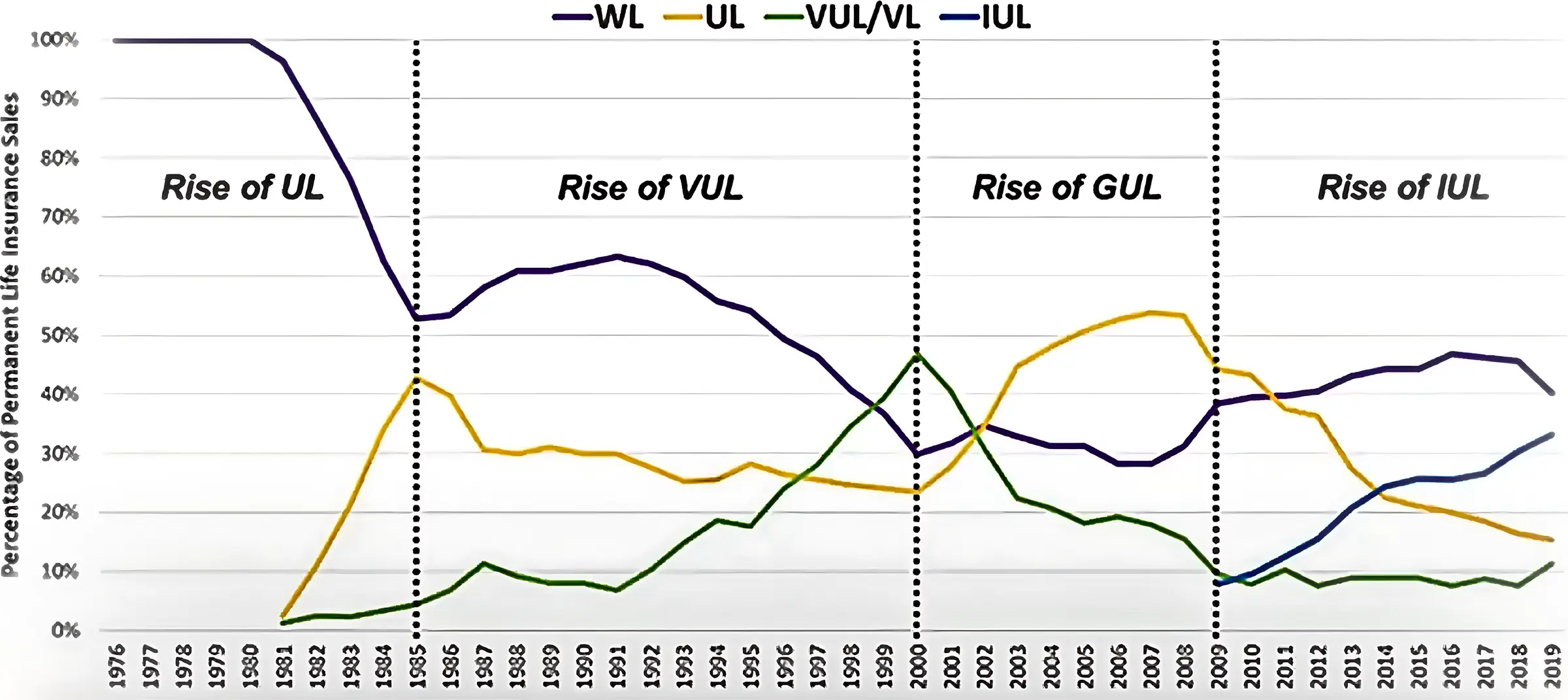
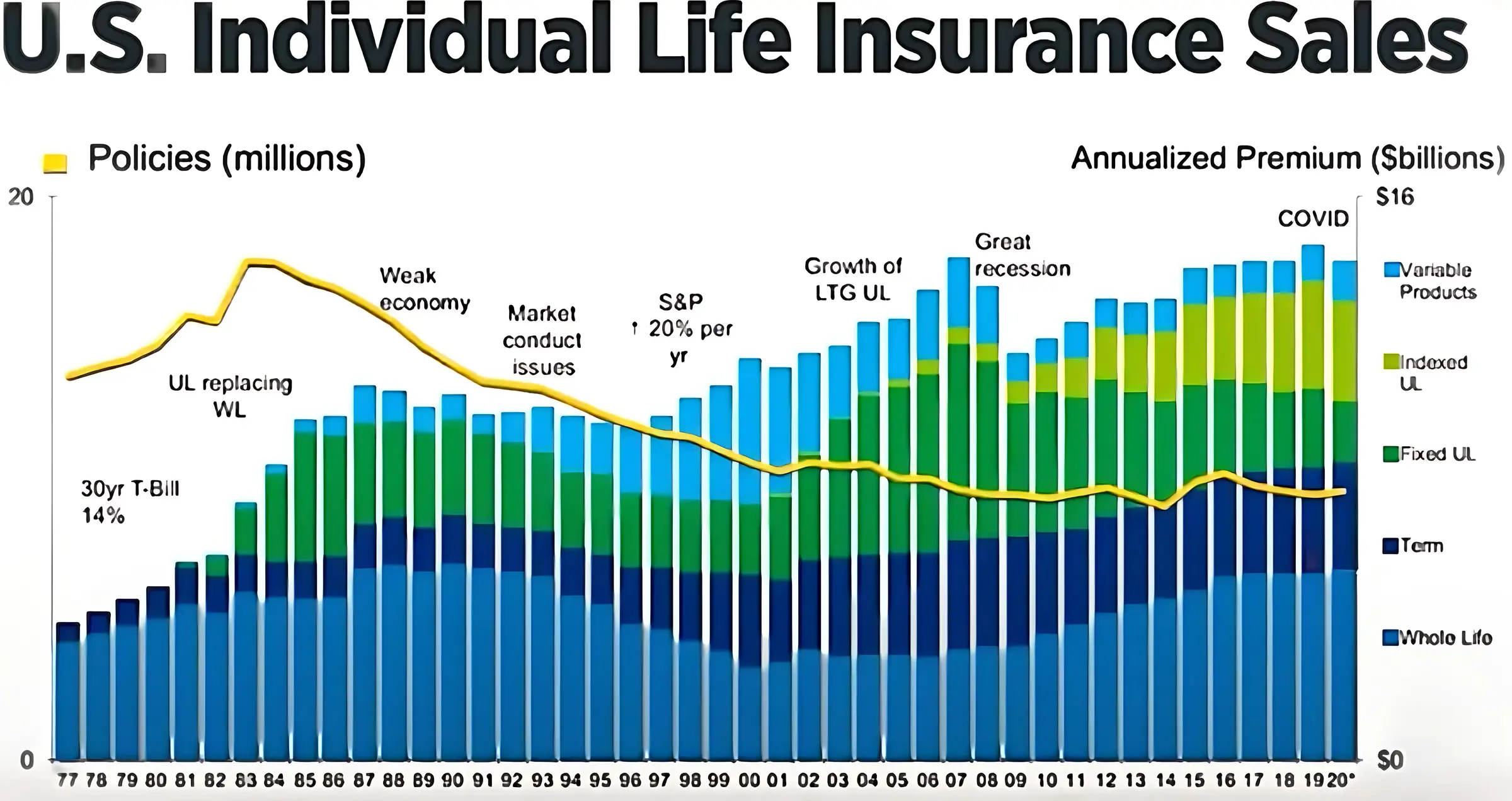
寿险产品本身一直在迭代:定期寿险 1583 年、终身寿险 1762 年、 万能寿险 1979 年、变额万能 1985 年、指数型万能 1997 年(详见寿险的演进)。 1976 年永久型寿险的销售几乎全是终身寿,之后依次经历了万能、变额万能、保证型万能和指数型万能各自兴起的阶段,终身寿的占比在 2000 年前后降到约三成,2009 年后回升到四成上下。 最近三年 LIMRA 的数字是这样的:
Life insurance products keep evolving: term in 1583, whole life in 1762, universal life in 1979, variable UL in 1985, indexed UL in 1997 (more in How Life Insurance Evolved). In 1976 permanent sales were almost all whole life; since then UL, variable UL, guaranteed UL and indexed UL have each had their rise. Whole life's share bottomed at about 30% around 2000 and has recovered to around 40% since 2009. LIMRA's figures for the last three years:
| 产品Product | 全年年化保费增长Annualized premium, full-year change | 按保费的市场份额Market share by premium | ||||
|---|---|---|---|---|---|---|
| 2022 | 2023 | 2024 | 2022 | 2023 | 2024 | |
| 指数型万能 IULIndexed UL | +13% | −4% | +4% | 25% | 24% | 24% |
| 终身寿 WLWhole life | −5% | +1% | −4% | 38% | 39% | 36% |
| 定期 TermTerm | −5% | +5% | +1% | 19% | 19% | 19% |
| 变额万能 VULVariable UL | +8% | +8% | +15% | 11% | 12% | 14% |
| 固定万能 FULFixed UL | −17% | −3% | +7% | 7% | 6% | 7% |
同期保单件数:IUL 三年分别 +11%、+19%、+10%;终身寿 −13%、+2%、−2%。 终身寿按保费仍是最大的一类,IUL 稳定在四分之一左右,而且件数年年在涨。
Policy counts over the same years: IUL +11%, +19% and +10%; whole life −13%, +2% and −2%. Whole life is still the largest category by premium, while IUL holds steady at about a quarter and its policy count rises every year.
来源:LIMRA《U.S. Retail Life Insurance Sales》2022、2023、2024 年第四季度报告(2022 年份额为行业估计)。
Source: LIMRA, U.S. Retail Life Insurance Sales, fourth-quarter reports for 2022, 2023 and 2024 (2022 shares are industry estimates).
市场份额的事实是:市场是分散的,没有哪家垄断,不同产品类别的领跑者各不相同。 终身寿巨头在终身寿这一类里领先,那是他们的主场;在 IUL 和指数年金上,领跑的是另一批专精公司(如 NLG、AIG)。
On market share the fact is: the market is fragmented, nobody dominates, and each product category has its own leaders. The whole life giants lead in whole life, their home ground. In IUL and indexed annuities, a different set of specialists leads (NLG and AIG, for example).
所以客户该问的不是"谁家最大", 而是"在我需要的这类产品上,谁做得最好"。 这是整个第 2 节唯一需要客户记住的一句话。
So the question isn't "who's biggest" but "who is best at the thing I actually need." If a client remembers one line from this section, that's the one.
3. 终身寿的条款,到底保什么3. What whole life's riders actually cover
伤残保费豁免 DWPDisability waiver of premium
被保人在条款生效期间完全伤残时豁免全部保费。三个细节客户通常不知道:
Waives the premium on total disability. Three details clients usually don't know:
- 全残须连续至少 6 个月才能申请。
- Total disability must run at least six consecutive months before you can claim.
- 理赔批准前,保费仍须照常缴纳。
- Premiums remain due until the claim is approved.
- 60 岁前致残:整个伤残期间豁免,持续到 65 岁后无需再缴。 60 岁后致残:仅豁免 65 岁前到期的保费。
- Disabled before 60: waived throughout, and nothing further due after 65. Disabled after 60: only premiums due before 65 are waived.
"完全伤残"的定义分四档:前 2 年是无法从事本职工作的核心任务; 2 年之后变成依其训练与经验无法从事任何合理职业; 未成年人是因伤病无法上学;严重情形包括双目失明,或双手/双足/一手一足丧失功能。
"Total disability" is defined in four tiers: for the first two years, unable to perform the core duties of your own occupation; after two years, unable to perform any reasonable occupation given your training and experience; for minors, unable to attend school; and severe cases including loss of sight in both eyes, or loss of use of both hands, both feet, or one of each.
不予豁免的四类:条款生效前已存在的伤残;被保人 5 岁之前发生的; 自杀未遂、自残或精神失常导致的;战争、兵役或恐怖主义造成的。
Four exclusions: disability that predates the rider; disability occurring before age five; attempted suicide, self-inflicted injury, or insanity; and war, military service, or terrorism.
那个"重疾条款"其实不是重疾The "critical illness" rider usually isn't one
这是全篇最值得记住的一条。 传统终身寿内嵌的加速给付,绝大多数保的是末期疾病 Terminal Illness, 不是重大疾病 Critical Illness。
The single most useful line on this page. The accelerated benefit built into a traditional whole life policy is, in most cases, terminal illness, not critical illness.
- 触发条件:被诊断为末期疾病,预期寿命 ≤ 12 个月。
- Trigger: a terminal diagnosis with a life expectancy of twelve months or less.
- 上限:保额的 50%,且不超过 $250,000。
- Cap: 50% of the face amount and no more than $250,000.
- 性质:这是预支自己的身故金,不是额外多给的钱。
- Nature: it is an advance against your own death benefit, not additional money.
12 个月和 24 个月的定义差别很大,值得单独讲:
The twelve- versus twenty-four-month definition matters enough to call out on its own:
| 定义Definition | 实际意味着什么What it means in practice |
|---|---|
| 12 个月12 months | 癌症已广泛扩散、无法治愈,主要只能采取缓和医疗,门槛更高,更接近临终Cancer already widespread and incurable, with palliative care the main option. A higher bar, closer to the end |
| 24 个月24 months | 癌症虽已晚期,但仍对治疗有反应,门槛相对宽松,钱到手的时候还用得上Late-stage but still responding to treatment. A lower bar, and the money arrives while it can still be used |
生前福利对照Living benefits, side by side
传统终身寿
Traditional whole life
通常仅内嵌末期疾病(≤ 12 个月)。 重疾与慢性疾病通常需要另购,或者根本买不到。
Usually terminal illness only (twelve months or less). Critical and chronic illness are typically an extra purchase, or unavailable.
现代 IUL(以 NLG 为例)
A modern IUL (NLG here)
通常可附三类加速给付:末期、慢性、重大疾病。 NLG 的产品线附带 5 项生前福利。人还活着,钱就能用上。
Typically carries three accelerated benefits: terminal, chronic, and critical illness. NLG's line carries five living benefits. The money is usable while you're alive.
条款可得性与定义因产品、州而异,一切以保单合同为准。 五类条款的触发条件见生前福利。
Availability and definitions vary by product and state; the contract governs. The five triggers are in Living Benefits.
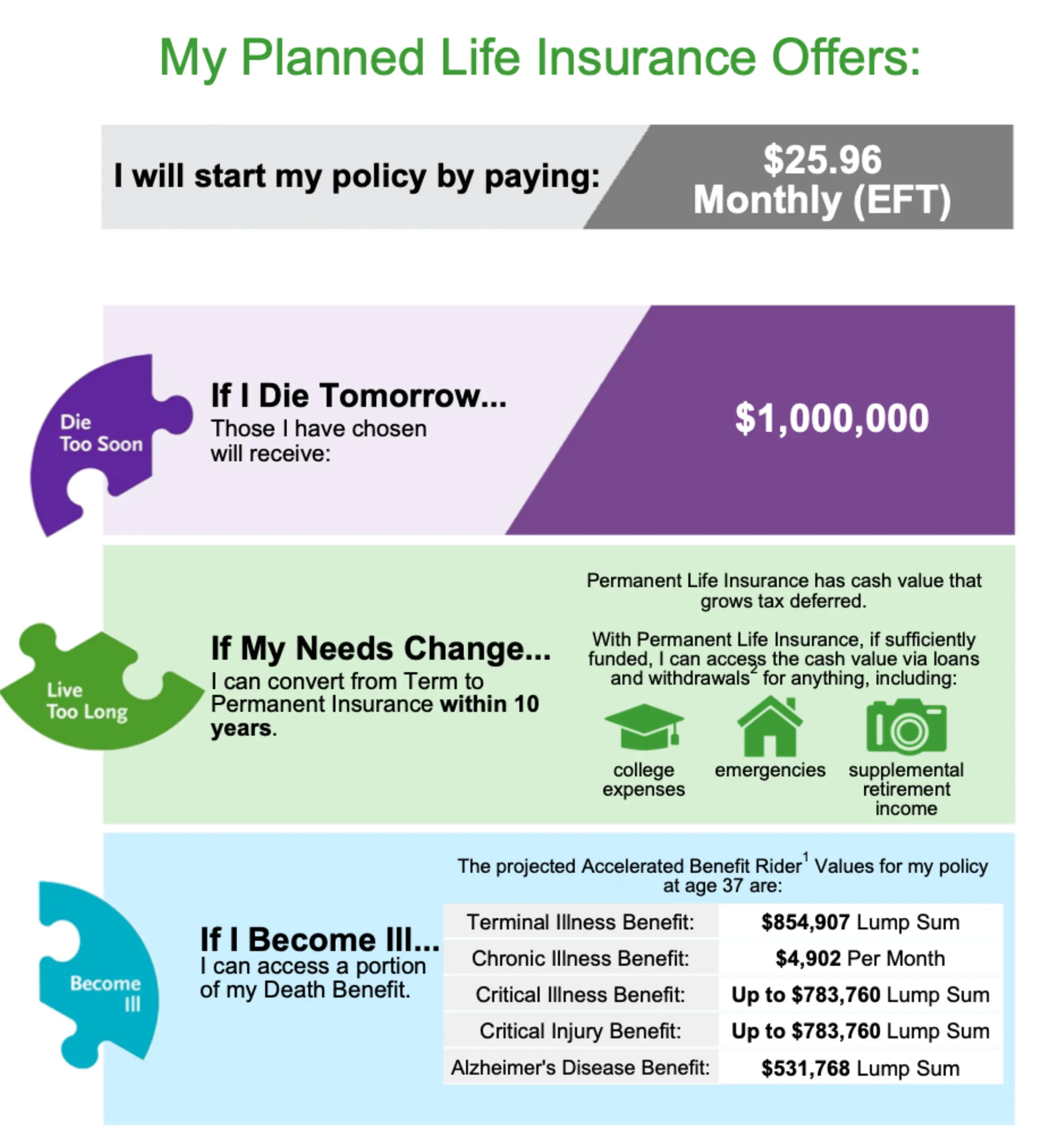
生前福利不只长在 IUL 上。一份定期寿险的计划书:月缴 $25.96,身故金 $1,000,000, 10 年内可以把定期转换成永久寿险;按 37 岁投保预估的加速给付值是末期疾病 $854,907(一次性)、慢性疾病每月 $4,902、 重大疾病最高 $783,760、重大伤害最高 $783,760、阿尔茨海默症 $531,768。这些都是预估值, 真到理赔时,金额由保险公司按病情、年龄和剩余寿命计算,是打折提前给付身故金。
Living benefits aren't only on IULs. A term life illustration: $25.96 a month for a $1,000,000 death benefit, convertible to permanent cover within 10 years. The projected accelerated benefit values for this policy at age 37: terminal illness $854,907 lump sum, chronic illness $4,902 a month, critical illness up to $783,760, critical injury up to $783,760, Alzheimer's disease $531,768. These are projections. At claim the carrier calculates the amount from the condition, age and remaining life expectancy; it is the death benefit paid early, at a discount.
还要分清豁免保费和给钱是两回事。网上有人分享,家人得了乳腺癌,手术加化疗放疗、一年多不能工作; 有人问她保单有没有附加豁免保费,她的回答是:「有啊,但是当真正遇到这种情况下,最需要的不是不交保费。」 细节我们无法核实,道理是对的:DWP 只是不用再交保费,生病那段日子手里有没有钱,要看有没有生前福利条款、条款怎么定义。
Also keep in mind that waiving the premium and paying out money are different things. Someone shared online that a family member had breast cancer, went through surgery, chemotherapy and radiation, and couldn't work for over a year. Asked whether her policy had a premium waiver, she answered: "It did, but when this actually happens, not paying premiums isn't what you need most." We can't verify the details, but the point stands: a DWP only stops the premiums. Whether there is money in hand while ill depends on whether there are living benefit riders and how they are defined.
| 公司Company | 总资产Assets | 给付Benefits paid | 给付 / 资产Benefits-to-assets |
|---|---|---|---|
| New York Life | $408.9B | $14.7B | 3.6% |
| Northwestern Mutual | $358.8B | $12.8B | 3.6% |
| National Life Group | $47.3B | $2.7B | 5.7% |
截至 2023 年 12 月 31 日。来源:New York Life 2023 年业绩公告(「分红 + 给付」$167 亿,减去分红 $20 亿)、 Northwestern Mutual 2023 年法定财务报表(给付保单持有人与受益人 $128.18 亿,不含分红 $73.7 亿)、 National Life Group《Financials at a Glance》2023 年末版(总资产不含未实现损益)。给付均不含分红,各公司口径略有不同。
As of 31 December 2023. Sources: New York Life's 2023 results release ($16.7 billion in dividends and benefits, less $2.0 billion of dividends); Northwestern Mutual's 2023 statutory statements ($12.818 billion in benefit payments to policyowners and beneficiaries, excluding $7.37 billion of dividends); National Life Group's year-end 2023 "Financials at a Glance" (total assets excluding unrealized gains and losses). Benefits exclude dividends; bases differ slightly.
把资产和福利放在一起看,结论是这样的: 公司资产庞大,靠的是客户多缴的高保费长期沉淀; 但真正回到客户手里的福利,往往附带6 个月等待、严格的全残定义、 末期门槛、50% 与 $250,000 双重上限。 公司账面上有多少钱,和条款对你有多好,是两件事。
Put the assets and the benefits next to each other and the conclusion is this: the balance sheet is large because clients overpaid into it for decades, while what comes back carries a six-month wait, a strict disability definition, a terminal threshold, and a 50%/$250,000 double cap. How much money the company holds and how good the contract is for you are two different questions.
4. 保证的代价4. What the guarantees cost
终身寿的三大保证是真的,而且有价值: 保证身故赔付、保证现金累积、保证平准保费。 问题不在它们是不是真的,在这三件事是怎么被付钱买下来的。
Whole life's three guarantees are real and worth something: a guaranteed death benefit, guaranteed cash accumulation, and a guaranteed level premium. The question isn't whether they're real. It's how they get paid for.
"保费不变"是怎么做到的How a level premium actually works
机制很简单:早年多收,存起来,补贴晚年。看一个算例:
The mechanism is simple: overcharge early, bank it, subsidize later. A worked example:
| 年龄Age | 月缴Monthly premium | 保险成本Cost of insurance | 差额去哪Where the difference goes |
|---|---|---|---|
| 30 | $1,000 | $300 | $700 累积为现金价值$700 builds cash value |
| 70 | $1,000 | $3,000 | 现金价值补上多出的 $2,000Cash value covers the extra $2,000 |
"保费不变"不是"成本不变", 是你提前替未来的自己买单。
A level premium doesn't mean a level cost. It means you prepaid for your future self.
保险成本的黑箱The black box
终身寿
Whole life
保险成本不单独披露,混在保费里。你知道总共交多少, 不知道其中多少是保障成本、多少是储蓄。
The cost of insurance isn't itemized; it's inside the premium. You know the total; you don't know the split between protection and savings.
IUL
IUL
每月单独列示,可查、可算。 六项扣费逐项拆解见保单费用。
Itemized monthly, checkable, calculable. All six charges are broken out in Policy Costs.
而且 IUL 的保险成本不一定随年龄一路涨:
COI =(身故赔付 − 现金价值)× 每千元费率。
现金价值涨上去,净风险就下来,保险成本跟着下来。以 $100 万保额为例:第 1 年现金价值 $500,净风险 $999,500;
第 50 年现金价值 $15 万,净风险 $85 万;第 81 年现金价值涨到 $100 万,净风险为 0。
年龄越大每千元费率越高,但净风险在缩小,两者可以相互抵消一部分,前提是现金价值健康增长。完整推导在
保单费用。
And an IUL's cost of insurance doesn't simply climb with age:
COI = (death benefit − cash value) × rate per thousand. As cash value rises the
net amount at risk falls, and the charge falls with it. Take a $1M face: in year 1 the cash value is $500 and the amount
at risk $999,500; in year 50 the cash value is $150,000 and the amount at risk $850,000; by year 81 the cash
value reaches $1M and the amount at risk is zero. The rate per thousand rises with age, but the shrinking amount at risk
offsets part of it, provided the cash value grows as it should. The full derivation is in
Policy Costs.
所有"保证"都有两个前提Every guarantee has two conditions
不管终身寿还是 IUL:
True of both:
- 保费必须按时缴纳。断缴并耗尽宽限期,保单失效,保证归零。
- Premiums have to be paid on time. Miss them, run out the grace period, and the policy lapses, and the guarantees go with it.
- 不能误用现金价值。过度提取或贷款会侵蚀账户,可能拖垮保单。
- The cash value can't be misused. Over-withdrawing or over-borrowing erodes the account and can bring the policy down.
宽限期是错过缴费之后、失效之前的缓冲,多数公司给 30–60 天, 视条款而定。宽限期结束仍未缴费:保单失效、保障停止,可能需要申请复效甚至重新提供可保性证明; 如果现金价值足够,有些保单会自动转为减额缴清,或用现金价值垫缴(自动保费贷款),这两项多见于终身寿。 IUL 通常是退保价值不够扣当月费用时才进入宽限期,具体以合同为准。
The grace period is the buffer between a missed payment and a lapse, typically 30 to 60 days, per the contract. Past it, coverage stops and reinstatement may require fresh evidence of insurability. If there's enough cash value, some contracts convert to reduced paid-up or advance the premium automatically; both are mostly whole life features. An IUL usually enters its grace period when the surrender value can't cover the month's charges; the contract governs.
5. IUL 会失效吗:三道防线5. Will an IUL lapse? Three lines of defense
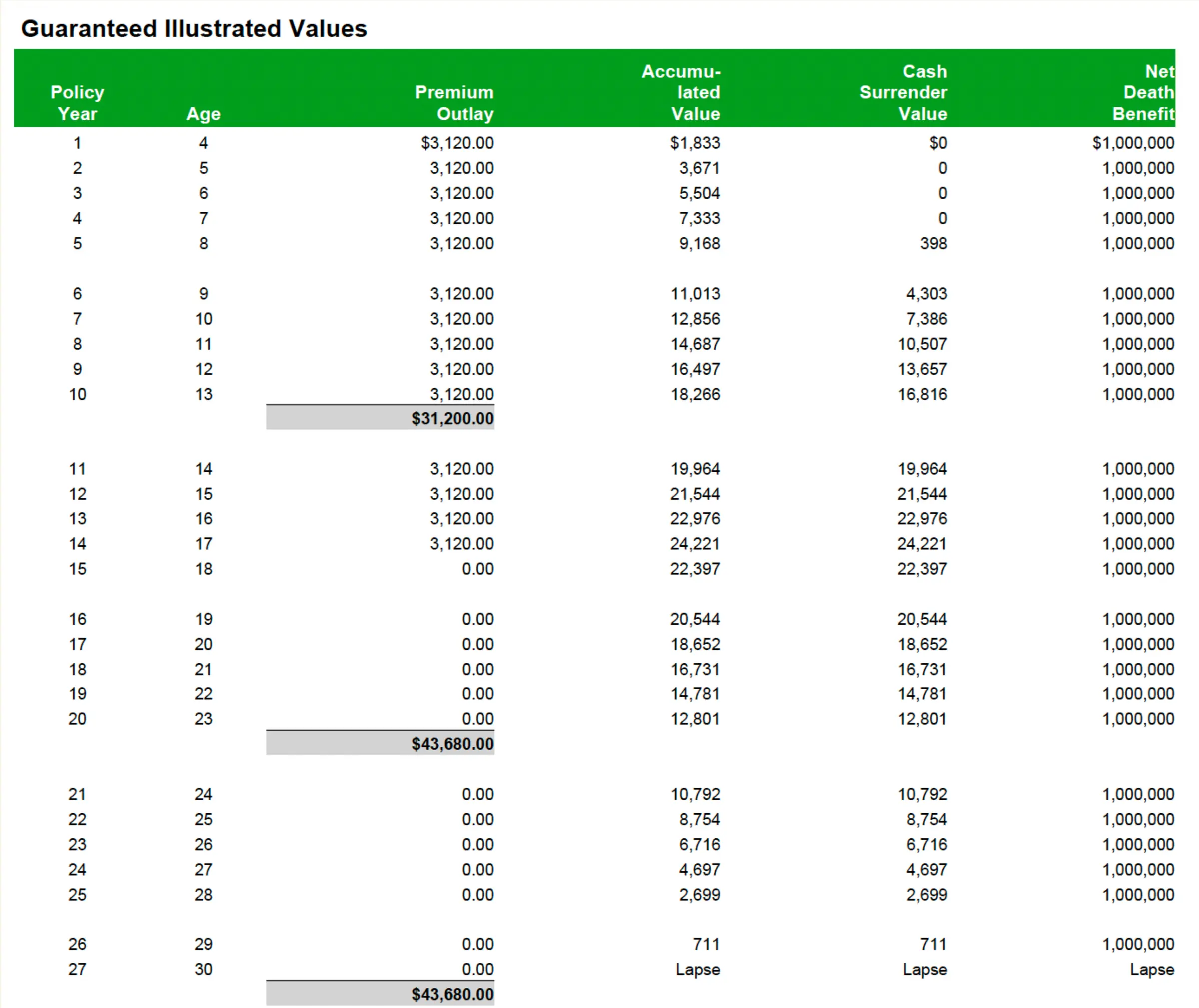
会,如果缴得不够。看一份 IUL 计划书的保证栏:4 岁孩子投保,保额 $100 万,每年 $3,120 交 14 年, 一共 $43,680,之后停缴。按保证栏的假设(最高扣费、最低记息),现金价值第 14 年最高到 $24,221, 之后被保险成本一年年吃掉,第 27 年、30 岁时失效。保证栏是最差情况,不是预期,但它说明了一件事: IUL 的安全靠设计和管理,不是买了就不用管。
It can, if it's underfunded. Look at the guaranteed column of one IUL illustration: a 4-year-old, $1M face, $3,120 a year for 14 years, $43,680 in all, then nothing. On guaranteed assumptions (maximum charges, minimum crediting) the cash value peaks at $24,221 in year 14, then the cost of insurance eats it year by year, and the policy lapses in year 27, at age 30. The guaranteed column is the worst case, not the expectation, but it makes the point: an IUL stays safe through design and management, not by itself.
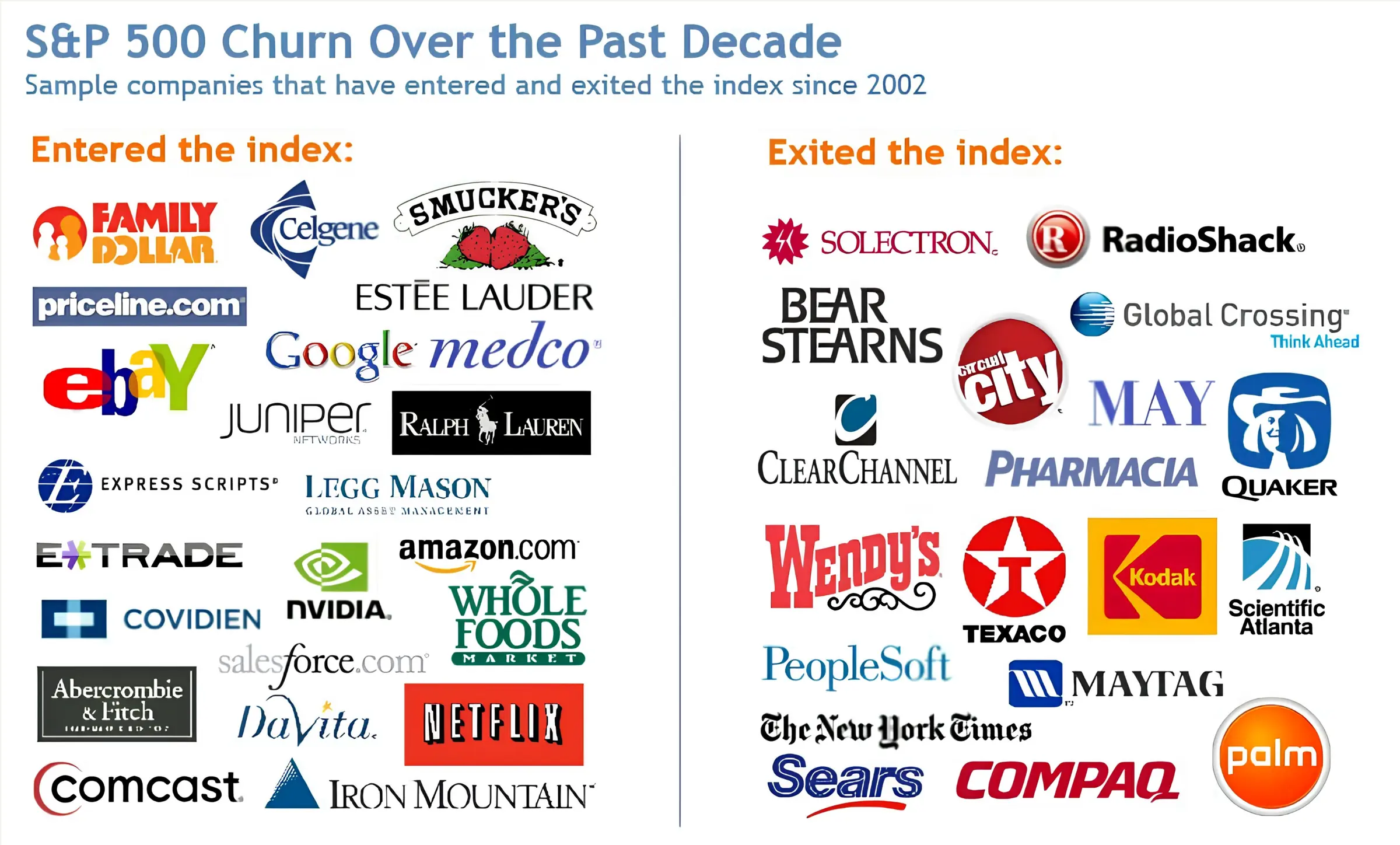
IUL 的增长挂钩 S&P 500 这类指数,钱并不直接投进股市。标普 500 本身也在不断换血:2002 年以来, Google、Amazon、NVIDIA、Netflix 这些公司进了指数,RadioShack、Bear Stearns、Kodak、Sears、Palm 这些被移了出去。 挂钩指数,等于挂钩一份不断更新的美国头部公司名单。
IUL growth is linked to an index such as the S&P 500; the money isn't invested in the market directly. And the S&P 500 keeps renewing itself: since 2002 Google, Amazon, NVIDIA and Netflix have come in, while RadioShack, Bear Stearns, Kodak, Sears and Palm have gone out. Linking to the index means linking to a list of leading US companies that keeps being refreshed.
① 0% 保底:防市场风险
① The 0% floor: market risk
市场下跌的年份记息 0%,不随指数亏损;各项扣费照扣,账户价值仍可能小幅下降。
A down year credits zero rather than following the index down; charges still come out, so the account value can still dip.
② 净风险随现金值下降:防成本风险
② A shrinking net amount at risk: cost risk
净风险缩小,长期的成本压力递减。
As the amount at risk shrinks, the long-run cost pressure eases.
③ 充足缴费 + 定期检视:防管理风险
③ Funding and review: management risk
按设计保费投入、避免过度借款、每年做保单年检。这一道是靠人,不是靠产品。
Fund it as designed, don't over-borrow, review it annually. This one is on people, not the product.
结论:设计合理、缴费充足、管理得当的 IUL,失效风险是可控的, 风险主要来自长期缴费不足或过度借款。注意这两条都是第三道防线的事。
Designed properly, funded adequately, and managed, an IUL's lapse risk is controllable. The risk comes from chronic underfunding or over-borrowing. Note that both of those live in the third line.
标普 500 连续下跌年份的统计,从 1921 年起算: 连续 4 年下跌 1 次(1929–32 大萧条)、连续 3 年 2 次(1939–41、2000–02)、连续 2 年 1 次(1973–74)。 而指数策略那一页引的是从 1957 年起算: 连续 3 年 1 次、连续 2 年 1 次。两组数字不矛盾,是起算年份不同。 对客户讲的时候把起算年份一起说出来,否则会被问住。
On consecutive down years in the S&P 500, counting from 1921: four in a row once (1929–32), three in a row twice (1939–41 and 2000–02), two in a row once (1973–74). Index Strategies quotes the count from 1957: three in a row once, two in a row once. They don't contradict each other; the start year differs. Say the start year out loud when you use either, or you'll get caught out.
6. 借出来的钱,还长不长6. Does borrowed money keep growing?
这是两类产品之间最具体、也最容易讲明白的一个差别。
The most concrete difference between the two, and the easiest to explain.
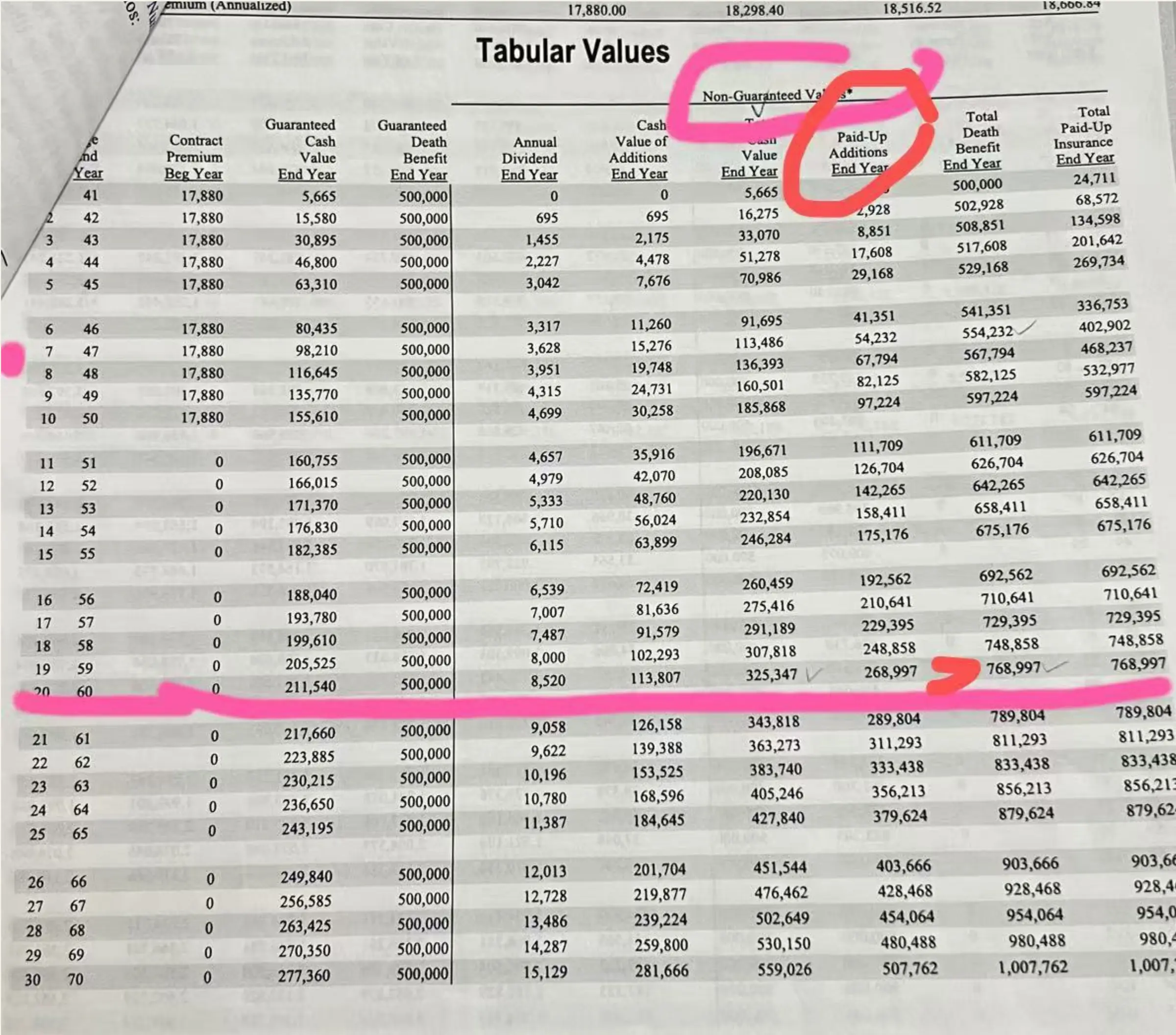
先看终身寿。一份合同的现金价值表:41 岁投保,保额 $500,000,年缴 $17,880 交 10 年(共 $178,800)。 到第 20 年、60 岁,含分红的现金价值 $325,347(其中保证部分 $211,540),总身故金 $768,997。 客户问代理人:「60 岁要用钱能取多少?」答案是 30 多万;「取了以后身故还有多少?」答案是 40 多万。 这笔账很直接:$768,997 − $325,347 ≈ $443,650。终身寿的现金价值能用,但取出多少,身故金就跟着少多少; 分红部分也不是保证的。
Start with whole life. One contract's table of values: issued at 41, $500,000 face, $17,880 a year for 10 years ($178,800 in all). In year 20, at 60, the cash value including dividends is $325,347 (of which $211,540 is guaranteed) and the total death benefit $768,997. The client asked the agent, "How much can I take at 60?" About $300,000-plus. "And if I die after that?" About $400,000-plus. The arithmetic is simple: $768,997 − $325,347 ≈ $443,650. Whole life cash value is usable, but whatever comes out comes off the death benefit, and the dividend part isn't guaranteed.
IUL · 可参与
IUL · participating
参与型贷款:借出来的那部分钱在保单里仍然继续按指数计息。 现金价值 $30 万,贷出 $20 万,保额从 $100 万降到 $80 万;贷款利率 5%, 指数那年记 +11%,净赚 6%;记 0%,净成本 5%。
标准贷款(Wash Loan):被贷部分按固定利率返还利息。 贷款利率 5.5%、返还 5.0%,保单前 10 年净成本 0.5%;第 11 年起返还利息与贷款利息相同,利差为 0。
Participating loan: the borrowed portion keeps crediting inside the policy. With $300,000 of cash value and $200,000 borrowed, the face drops from $1M to $800,000. At a 5% loan rate, an index year crediting +11% nets 6%; a year crediting 0% costs a net 5%.
Standard (wash) loan: the borrowed portion is credited at a fixed rate. Charged 5.5% and credited 5.0%, the net cost is 0.5% in policy years 1–10; from year 11 the credited rate equals the loan rate and the spread is zero.
终身寿 · 通常不参与
Whole life · usually not
借出去的那部分往往不再享受完整的分红或增长。 拿了就少长,鱼与熊掌难兼得。
The borrowed portion generally stops earning the full dividend or growth. Take it out and it grows less.
IUL:借钱的同时,钱还在涨。
终身寿:借了钱,那部分通常就少长或不长。
IUL: borrow it and it still grows.
Whole life: borrow it and that part usually grows less or not at all.
四种贷款方式的机制、利率和怎么选,见 保单贷款。
The four loan types, their rates, and how to choose are in Policy Loans.
7. 买定期、投资差额(BTID)7. Buy term and invest the difference (BTID)
「买定期、投资差额」(Buy Term and Invest the Difference,简称 BTID)的意思是: 保险只买便宜的定期寿险,把省下来的保费差额自己拿去投资,认为这样比买终身寿或 IUL 更划算。 这个说法的数学在某些条件下是成立的,问题在于那些条件现实中常常做不到。
"Buy term and invest the difference" (BTID) means buying only inexpensive term cover and investing the premium you save yourself, on the view that this beats whole life or an IUL. Under certain conditions the math holds; the trouble is that real life often doesn't meet those conditions.
一篇论文说了什么What the paper says
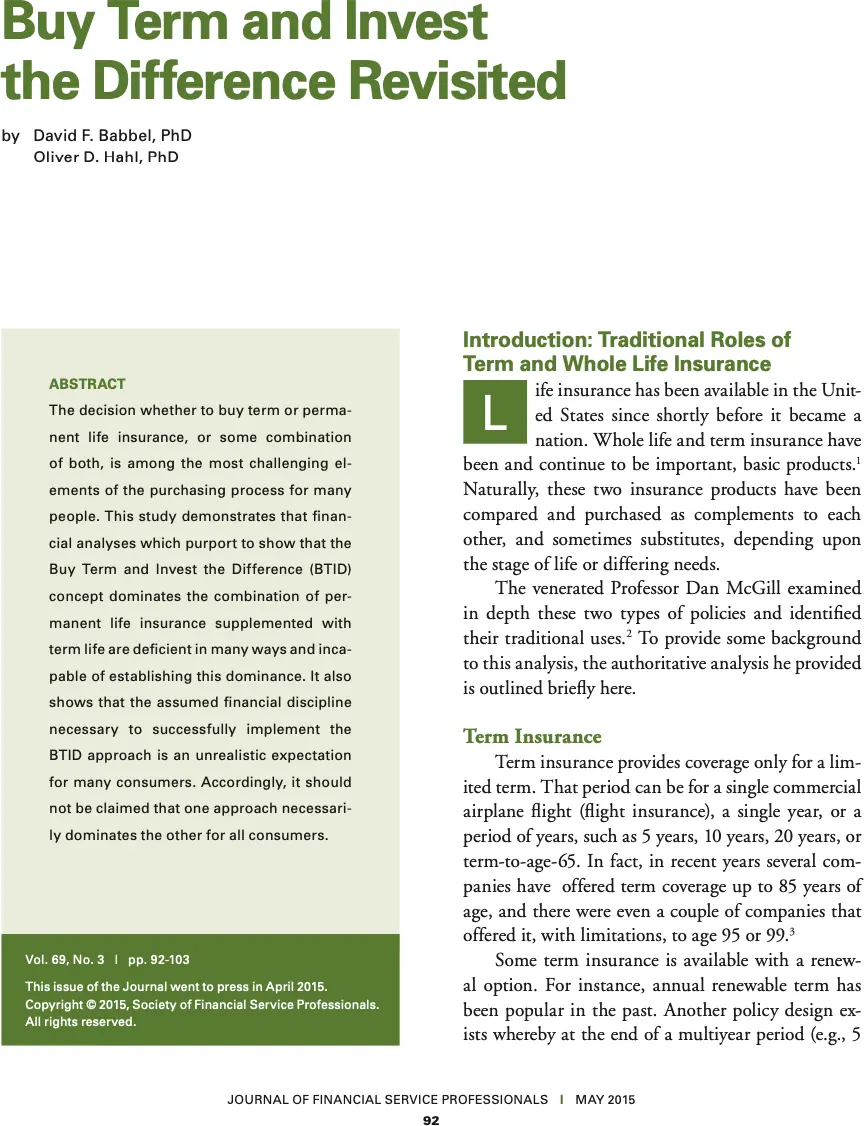
David F. Babbel(宾大沃顿商学院)与 Oliver D. Hahl(卡内基梅隆大学)的 《Buy Term and Invest the Difference Revisited》,发表在 Journal of Financial Service Professionals 2015 年 5 月(第 69 卷第 3 期,第 92–103 页)。摘要的结论有三层: 声称 BTID 在财务上占优的分析在很多方面有缺陷,证明不了这种优势; 成功执行 BTID 需要的理财纪律,对许多消费者来说是不现实的期待; 因此不能说哪一种做法对所有消费者都一定更好。
"Buy Term and Invest the Difference Revisited," by David F. Babbel (Wharton) and Oliver D. Hahl (Carnegie Mellon), appeared in the Journal of Financial Service Professionals in May 2015 (Vol. 69, No. 3, pp. 92–103). The abstract concludes in three steps: analyses claiming BTID dominates are deficient in many ways and can't establish that dominance; the financial discipline BTID requires is an unrealistic expectation for many consumers; and so it shouldn't be claimed that either approach necessarily beats the other for all consumers.
研究指出的两个问题The two problems the study points to
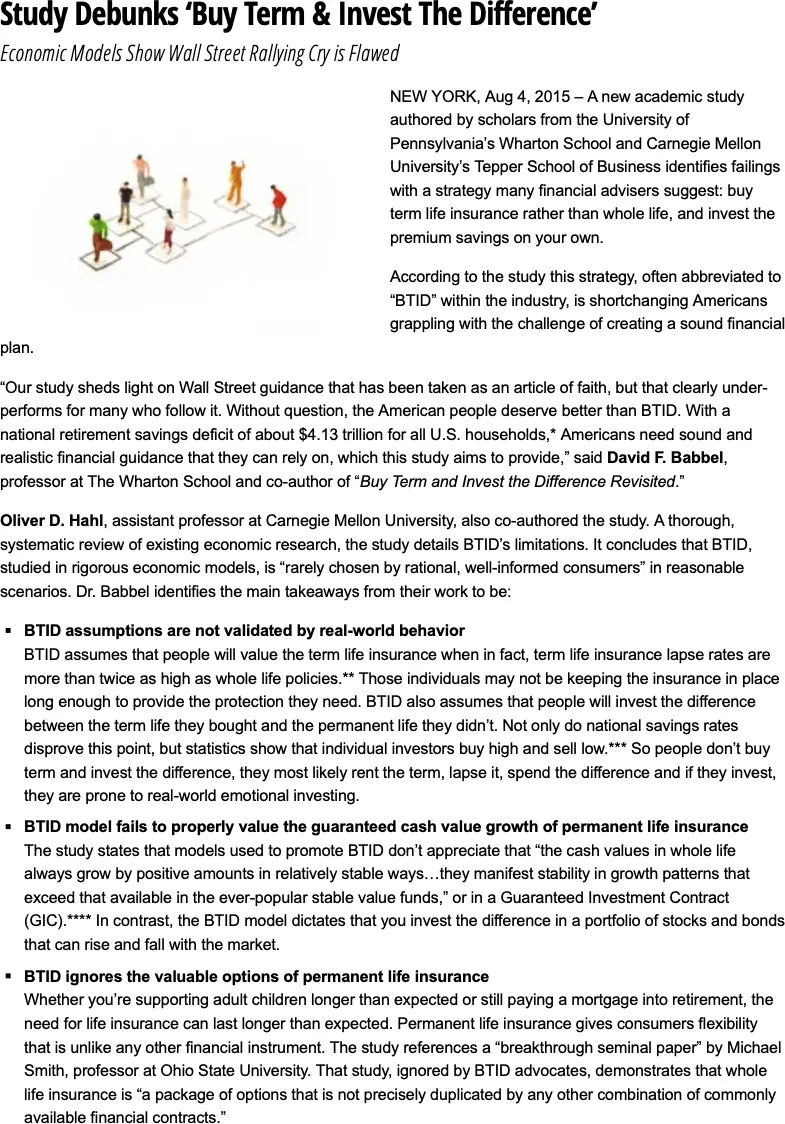
- 人们会把定期保险放弃。BTID 假设人们会一直保留那份定期,但研究引用的数据显示, 定期寿险的失效率是终身寿险的两倍多。保险没了,BTID 原本要配合的那一半,家庭保障,也就没了。
- People let the term go. BTID assumes the term policy is kept, but the data the study cites shows term lapse rates more than twice those of whole life. Once the cover is gone, the protection half of BTID is gone with it.
- 人们不会坚持把差额拿去投资。全国储蓄率本身就说明多数人没有存下来; 做了投资的人,统计上又常常高买低卖。用报道的话说:很多人是「租」了定期,让它失效,把差额花掉。
- People don't keep investing the difference. National savings rates alone show most people don't save it, and those who invest tend, statistically, to buy high and sell low. In the press report's words, people rent the term, lapse it, and spend the difference.
报道:《Study Debunks ‘Buy Term & Invest The Difference’》,2015 年 8 月 4 日。 据 InvestmentNews 2015 年的报道,这项研究有一部分经费来自 New York Life,引用时如实说明。
Press report: "Study Debunks 'Buy Term & Invest The Difference'," 4 August 2015. InvestmentNews reported in 2015 that the study was partly funded by New York Life; say so when you cite it.
一组对比演示表A pair of comparison illustrations
45 岁男性,每年 $63,786,交 20 年。A:$100 万 20 年定期 + 可抵税退休计划; B:国家人寿 Living Life 系列的 IUL,初始身故金 $100 万。原表的假设:退休计划收益率 5.50%, IUL 记息率 5.26%,所得税率前 20 年 0%、之后 30%。65 岁起两边每年都取 $143,505: A 在 77 岁取完(累计约 $177.5 万);B 在这组假设下一直取到 104 岁(累计约 $574 万), 但 84 岁时退保价值只剩 $52,766。
A 45-year-old man, $63,786 a year for 20 years. A: $1M of 20-year term plus a tax-deductible retirement plan. B: an IUL from National Life's Living Life line with a $1M initial death benefit. The table's assumptions: a 5.50% plan yield, 5.26% IUL crediting, and income tax at 0% for 20 years and 30% thereafter. From 65 both take $143,505 a year: A runs out at 77 (about $1.775M in total), while B, on these assumptions, keeps paying to 104 (about $5.74M in total), though its surrender value is down to $52,766 at 84.
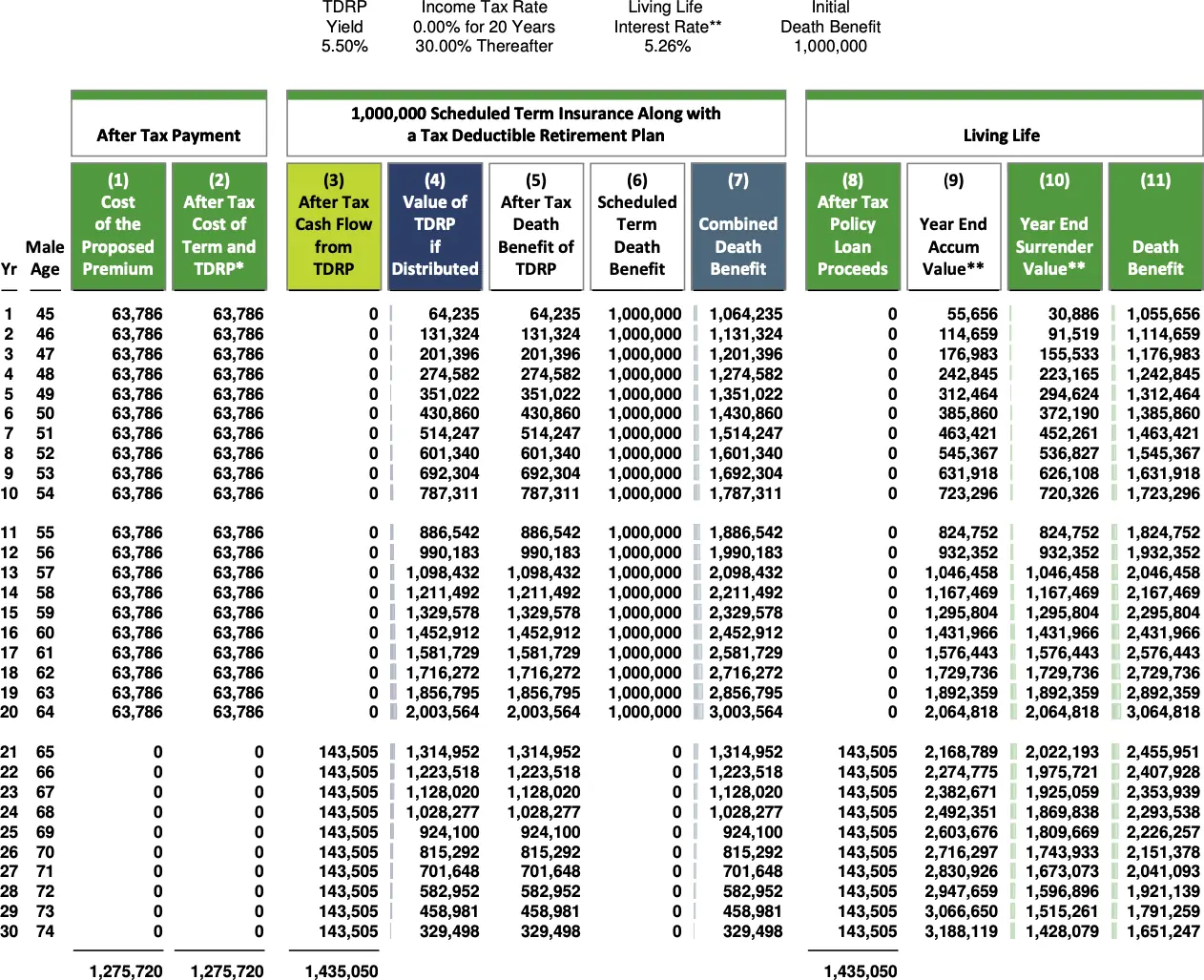
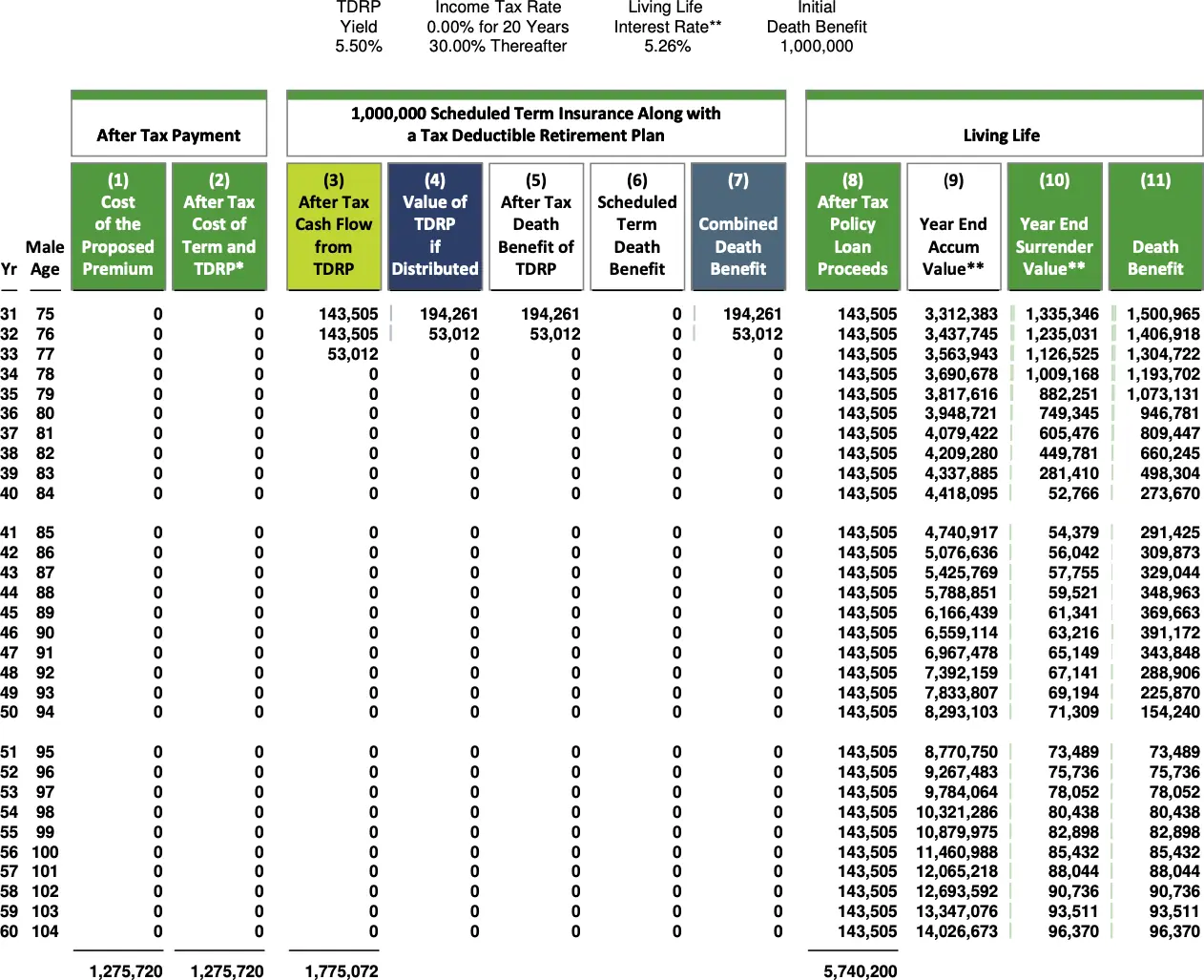
演示值,非保证。原表没有注明制作日期与来源,只作演示。
Illustrated values, not guaranteed. The original table carries no date or source and is used for demonstration only.
「前 20 年税率 0%」让退休计划的抵税不带来任何好处,取钱时却按 30% 交税,这一条对 B 有利; 换一组税率,两边的差距会变。IUL 不会每年刚好记 5.26%;实际记息低于假设或贷款利率更高时, B 可能在身故前失效,累积的贷款会变成应税收入。B 的贷款不交所得税,前提是保单一直有效到身故。
"0% tax for 20 years" makes the retirement plan's deduction worthless while withdrawals are taxed at 30%, which favours B; change the tax rates and the gap changes. An IUL won't credit exactly 5.26% every year; with lower crediting or higher loan rates, B could lapse before death and the accumulated loans would become taxable. B's loans are income-tax-free only if the policy stays in force until death.
不说「BTID 是骗局」,也不贬低客户现有的定期或卖定期的同业。问客户两个问题: 这份定期打算保到什么时候、到期后还要不要保障?省下的钱每个月自动投到哪里、过去有没有坚持? 答得出、做得到,BTID 对他可能就合适;答不出,再一起看有现金值的保单,并把 IUL 自己的条件 (按设计缴足、管住贷款、每年检视)一起讲清楚。
Don't call BTID a scam, and don't run down the client's existing term or agents who sell it. Ask two questions: how long will you keep this term, and will you need cover after it ends? Where does the saving go each month, automatically, and have you kept it up? If the client can answer and has done it, BTID may suit them. If not, look at a policy with cash value together, and spell out the IUL's own conditions too: fund it as designed, keep loans in check, review it every year.
8. 六个维度总对照8. The master comparison
| 维度Dimension | 终身寿 Whole LifeWhole Life | IUL |
|---|---|---|
| 保费Premium | 高且固定(强制储蓄)High and fixed (forced saving) | 灵活,可在区间内调整Flexible within a range |
| 保险成本Cost of insurance | 黑箱,不单独披露A black box, not itemized | 透明,且净风险可随现金值增长而下降Itemized, and the amount at risk can fall as cash value grows |
| 现金值增长Cash value growth | 合同保证的低速稳定增长Guaranteed, slow and steady | 挂钩指数:有封顶,有 0% 保底Index-linked: capped, with a 0% floor |
| 生前福利Living benefits | 通常仅末期疾病Usually terminal illness only | 可附末期 + 慢性 + 重疾三类Terminal, chronic, and critical |
| 保单贷款Policy loans | 通常非参与,借出部分少长或不长Usually non-participating; the borrowed part grows less or not at all | 可参与,边借边涨;也有标准贷款,第 11 年起利差为 0Can participate and keep growing; a standard loan's spread is zero from year 11 |
| 确定性Certainty | 三大保证Three core guarantees | 保证较少,靠三道防线:0% 保底、净风险下降、充足缴费与检视Fewer guarantees; three lines of defense: the 0% floor, a falling amount at risk, funding and review |
讲完对照,可以用住房子把三种保单收一下:定期像租房,保额高、保费低,有期限、没有现金价值; 终身寿像精装交付房,保证多、现金价值稳定累积,但保费高、可调空间小; IUL 像定制住宅,按需要设计和加条款,指数最差记 0%(费用照扣),很多设计下同样保费可做更高保额。 预算紧先租,能力到了再买,买的时候挑适合自己的那一种。
To close the comparison, housing works as an analogy: term is renting, high coverage at low cost, with an end date and no cash value; whole life is the finished home, many guarantees and steady cash value, but expensive and hard to adjust; IUL is the custom home, designed and ridered to need, with a 0% index floor (charges still apply) and often more coverage per premium dollar. Rent while money is tight, buy when you can, and buy the kind that fits.
不是用来证明终身寿是错的。要确定性、要强制储蓄、不想管任何事的客户, 终身寿是合适的。这张表是用来回答一个具体问题的: 为了那三个保证,客户多付了多少,换回来的条款又有多少限制。 把这个交换讲清楚,让客户自己选,这比你替他选更站得住。
Not to prove whole life is wrong. For a client who wants certainty, wants the saving to be compulsory, and doesn't want to manage anything, whole life fits. The table answers one specific question: what did those three guarantees cost, and what limits came attached to the riders? Lay the trade out and let them choose. That stands up better than choosing for them.
内部培训资料,仅供签约经纪人使用,不可转发给客户。 文中保费报价、资产与市值数据、条款额度均为成稿时的数值,会随时间变动; 条款可得性与定义因产品、州而异,一切以保单合同与当期计划书为准。 本页不构成对任何公司或产品的推荐或贬低,也不构成收益承诺。
Internal training material for contracted agents; not for forwarding to clients. Premium quotes, asset and market-value figures, and rider limits were current when this page was written and change over time; rider availability and definitions vary by product and state, and the contract and current illustration govern. Nothing here is a recommendation against any company or product, or a promise of any result.