
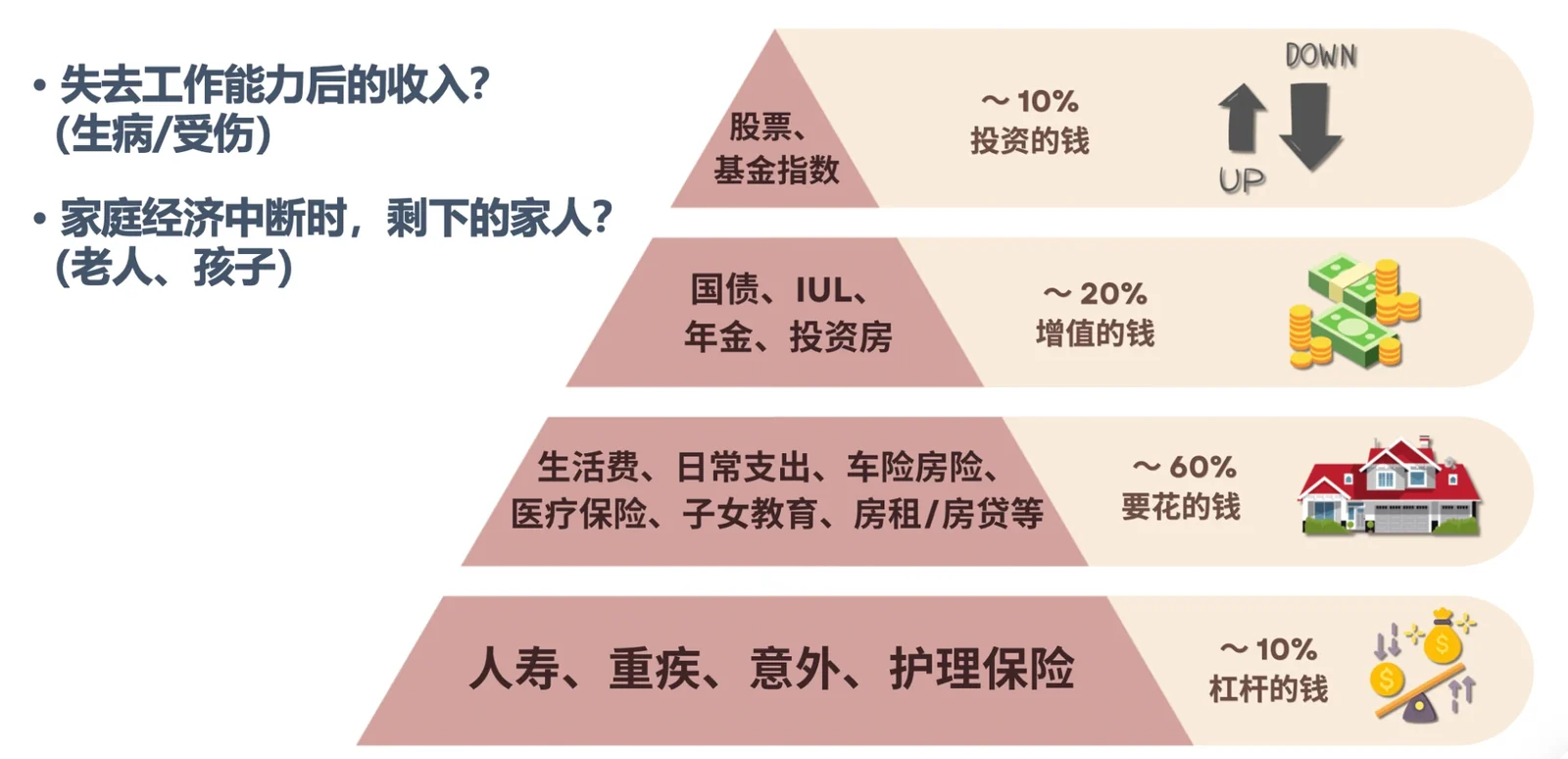
在谈任何产品之前,先回答两个问题:
Before any product comes up, answer two questions:
一、如果你失去了工作能力(生病或受伤),收入从哪里来?
1. If you lost the ability to work (through illness or injury), where would income come from?
二、如果家庭经济中断了,剩下的家人怎么办?(老人、孩子)
2. If the household's income stopped, what happens to the people who depend on it? (Parents, children.)
这两个问题的答案,决定了金字塔上每一层该配多少。 如果两个问题都回答不上来,那么现在还不是讨论"收益率"的时候。
The answers determine how much each layer of the pyramid needs. If neither question has an answer yet, it's not time to talk about rates of return.
金字塔的四层The four layers
一个家庭的钱,大致可以分成四层。从下往上看,因为地基在最下面:
A household's money falls roughly into four layers. Read them from the bottom up, because that's where the foundation is:
| 层Layer | 大致比例Rough share | 放什么What goes there |
|---|---|---|
| 投资的钱(顶层)Investing money (top) | ~10% | 股票、基金指数:有涨有跌,波动最大Stocks, index funds: they rise and fall, with the most volatility |
| 增值的钱Growth money | ~20% | 国债、IUL、年金、投资房:追求稳健增长Treasuries, IUL, annuities, rental property: steady growth |
| 要花的钱Spending money | ~60% | 生活费、日常支出、车险房险、医疗保险、子女教育、房租 / 房贷等Living costs, everyday spending, auto and home insurance, health insurance, schooling, rent or mortgage |
| 杠杆的钱(底层)Leverage money (base) | ~10% | 人寿、重疾、意外、护理保险:用一小部分钱撬动一大笔保障Life, critical illness, accident and long-term care cover: a small share that secures a large amount of protection |
这些比例是大致的经验分法,每个家庭不一样,不是给每个人的配置建议。 要看的是结构:底下那一层不稳,上面放得再漂亮也会塌。
These shares are rough rules of thumb that differ by household, not an allocation for everyone. What matters is the structure: if the base is weak, whatever sits on top can come down.
为什么顺序这么重要Why the order matters
保险做的是一笔交换:用确定的小损失,换掉不确定的大损失。 按这个逻辑,配置的顺序应该由"发生概率 × 损失规模 ÷ 自己能承受的程度"排列。 发生概率高、损失大、自己扛不住的,优先补。
Insurance is a trade: a small certain loss in exchange for a large uncertain one. By that logic, the order should follow probability × severity ÷ your ability to absorb it. Whatever is likely, expensive, and beyond your capacity to absorb comes first.
实际上大多数人的配置顺序是反过来的:先买了收益看起来最漂亮的那一层, 而医疗、伤残这些最基础的地方还空着。结果是钱花出去了,风险敞口还在原地。
In practice most people do it backwards: they buy the layer with the most attractive projected return while medical and disability coverage sit empty. The money is spent and the exposure hasn't moved.
这个缺口有多普遍?LIMRA 与 Life Happens 的《2019 Insurance Barometer Study》显示: 2019 年 57% 的美国成年人拥有人寿保险(43% 没有),而 66% 的人认为自己需要,中间差了 9 个百分点; 另有 17% 的人表示正在找理财顾问,约 4,200 万人。这是 2019 年的数据,引用时请带上年份。
How common is the gap? The 2019 Insurance Barometer Study by LIMRA and Life Happens found that in 2019, 57% of U.S. adults owned life insurance (43% did not), while 66% said they need it: a nine-point gap. Another 17% said they were looking for a financial advisor, about 42 million people. These are 2019 figures; quote the year when you use them.
八步走The eight steps
医疗保险
Health insurance
最基础的保障,看病报销。Covered California、雇主计划、白卡(Medicaid)等。 这一层不补,后面所有安排都可能被一次住院打乱。
The base layer, which pays the bills. Covered California, an employer plan, Medicaid. Without it, a single hospitalization can undo everything above it.
意外险
Accidental death coverage
意外身故后,家人怎么办?一次性赔偿一笔钱,替你把未尽的家庭责任 (房贷、子女教育、父母赡养)接下去。
If an accident is fatal, what happens to the family? A lump sum takes over the obligations you were carrying: the mortgage, the kids' education, aging parents.
重疾险
Critical illness
生大病时,收入断了怎么办?医疗保险报销的是治疗费, 但它不会补偿你停工期间损失的收入。重疾险一次性赔付,填的是这个洞。
If a serious illness stops your income, health insurance covers treatment but not the paycheck you stop earning. A critical illness benefit pays a lump sum to fill that gap.
伤残险
Disability
意外受伤(车祸、极限运动等)导致无法工作怎么办? 同样是一次性或分期赔偿,弥补收入损失。这一层被忽略的概率最高。
An injury (a car accident, a sport) that keeps you from working. Benefits replace the lost income. This is the most commonly skipped layer.
护理险
Long-term care
需要有人长期照顾看护(换膝关节、腿骨折长期卧床、中风后遗症)怎么办? 按年或按月领钱,弥补看护费用和家人因照顾而损失的收入。 很多人忽略了后半句:照顾者的收入损失往往比看护费本身更大。
Needing sustained care (a knee replacement, a broken hip, stroke after-effects). Benefits paid monthly or annually cover the cost of care and the income a family member loses providing it. That second part is usually larger than the care bill itself.
教育基金
Education funding
从这一层开始,重心从"防守"转向"进攻"。早存早滚利息, 为孩子未来上学、买房、创业甚至退休提前储备。
From here the emphasis shifts from defense to offense. Start early and let it compound, for school, a first home, a business, even their own retirement.
养老金
Retirement income
退休后钱不够怎么办?到点领钱,活多久领多久, 一直到 120 岁。这一层最大的风险是活得比钱久,收益低倒在其次。
What if the money runs out? Income that starts on schedule and continues for as long as you live, to age 120. The bigger risk here is outliving the money; a low return matters less.
信托
Trusts and legacy
如何给后代一个无忧的交接?财富传承、避免遗产纠纷与遗嘱认证程序, 把爱和保障按你的意愿留下去。
How does the handoff happen cleanly? Structuring the transfer, avoiding disputes and probate, and leaving things the way you intended.
哪些工具可以一次覆盖多层Which tools cover several layers at once
八层不一定要买八份产品。有些工具天然可以同时覆盖多层, 这也是为什么"先搞清楚结构、再选产品"比反过来效率高得多。
Eight layers don't require eight products. Some tools cover several at once, which is why understanding the structure first, then choosing the product, is far more efficient than the reverse.
| 工具Tool | 可以覆盖的层Layers covered |
|---|---|
| 带生前福利的 IULIUL with living benefits | 意外险、重疾险、伤残险(仅限条款列明的重大伤害)、护理险、教育基金、养老金,各覆盖一部分
第 2 层靠身故赔偿;第 3–5 层靠生前福利条款,只限条款列明的情形;第 6–7 层靠现金价值,能取多少不保证 Part of accident, critical illness, disability (listed critical injuries only), long-term care, education and retirement Layer 2 through the death benefit; layers 3–5 through living benefit riders, only for the situations they list; layers 6–7 through cash value, with no guarantee of how much comes out |
| 指数年金Indexed annuity | 养老金、护理险(部分产品在需要护理时收入翻倍)Retirement income, and long-term care where the contract doubles income for care |
| 定期寿险Term life | 意外险(在保障期内),成本最低Accidental death within the term, at the lowest cost |
| 医疗保险Health insurance | 医疗保险(第 1 层,不可替代)Layer 1 (nothing substitutes for it) |
"一张保单解决所有问题"是一种过度简化。生前福利条款覆盖的是特定的、 条款列明的情形,它的理赔条件、等待期和金额都有明确边界, 和独立的重疾险、长期护理险在保障范围上并不完全等价。 我们用金字塔这个框架,是为了帮你看清楚哪些层已经有了、哪些还空着, 不是为了论证某个产品无所不能。
"One policy solves everything" is an oversimplification. Living benefit riders cover specific, enumerated situations, with defined triggers, waiting periods, and limits. They are not equivalent in scope to standalone critical illness or long-term care policies. The pyramid is here to show which layers you already have and which are still open, not to argue that any one product does everything.
从哪里开始Where to start
先做一件很朴素的事:拿一张纸,把这八层列出来, 逐层写上"我现在有什么"和"如果这件事明天发生,我家能撑多久"。 八行字写完,该补哪里通常就很明显了。
Start with something plain: write the eight layers on a page, and next to each one note what you currently have and how long your household could hold out if that event happened tomorrow. Eight lines in, the gap is usually obvious.
本文仅供一般性财务教育使用,不构成保险、税务或投资建议;文中数字为说明性举例,具体保障与条款以保单为准。
General financial education only, not insurance, tax, or investment advice. Figures are illustrative; the policy governs.