
- 生前福利是什么What living benefits are
- 五类条款:触发条件与上限The five riders: triggers and caps
- 实际能拿到多少:打折理赔What actually arrives: the discount
- 五类额度是合并封顶The caps are aggregate
- 谁拿不到Who doesn't get it
- 以为能赔、其实不赔的十件事Ten things that aren't covered
- 理赔的税Tax on the claim
- 试管婴儿条款The fertility rider
- 理赔流程The claims process
- 背后的数据The data behind it
- 30 年演进史Thirty years of development
- 为什么很少有公司做得全Why so few carriers have the full set
原来这一页是一篇面向客户的介绍。现在它是内部培训页, 因为新增的内容(承保排除、理赔打折的算法、哪些事不赔、理赔流程) 本来就是讲给经纪人听的,不是讲给客户听的。
This page used to be a client-facing explainer. It is now internal training, because what's been added (underwriting exclusions, how the discount is computed, what isn't covered, the claims process) is material for agents, not for clients.
前两节仍然是可以直接讲给客户的版本; 从第三节「实际能拿到多少」开始是内部机制, 对客户只讲结论:提前拿到的一定少于保额,具体多少要等理赔时才算得出来。
The first two sections are still the version you can give a client directly. From section three onward it's internal mechanics. To a client, say only the conclusion: an accelerated payment is always less than the face amount, and the actual figure can only be computed at claim.
一、生前福利到底是什么1. What living benefits actually are
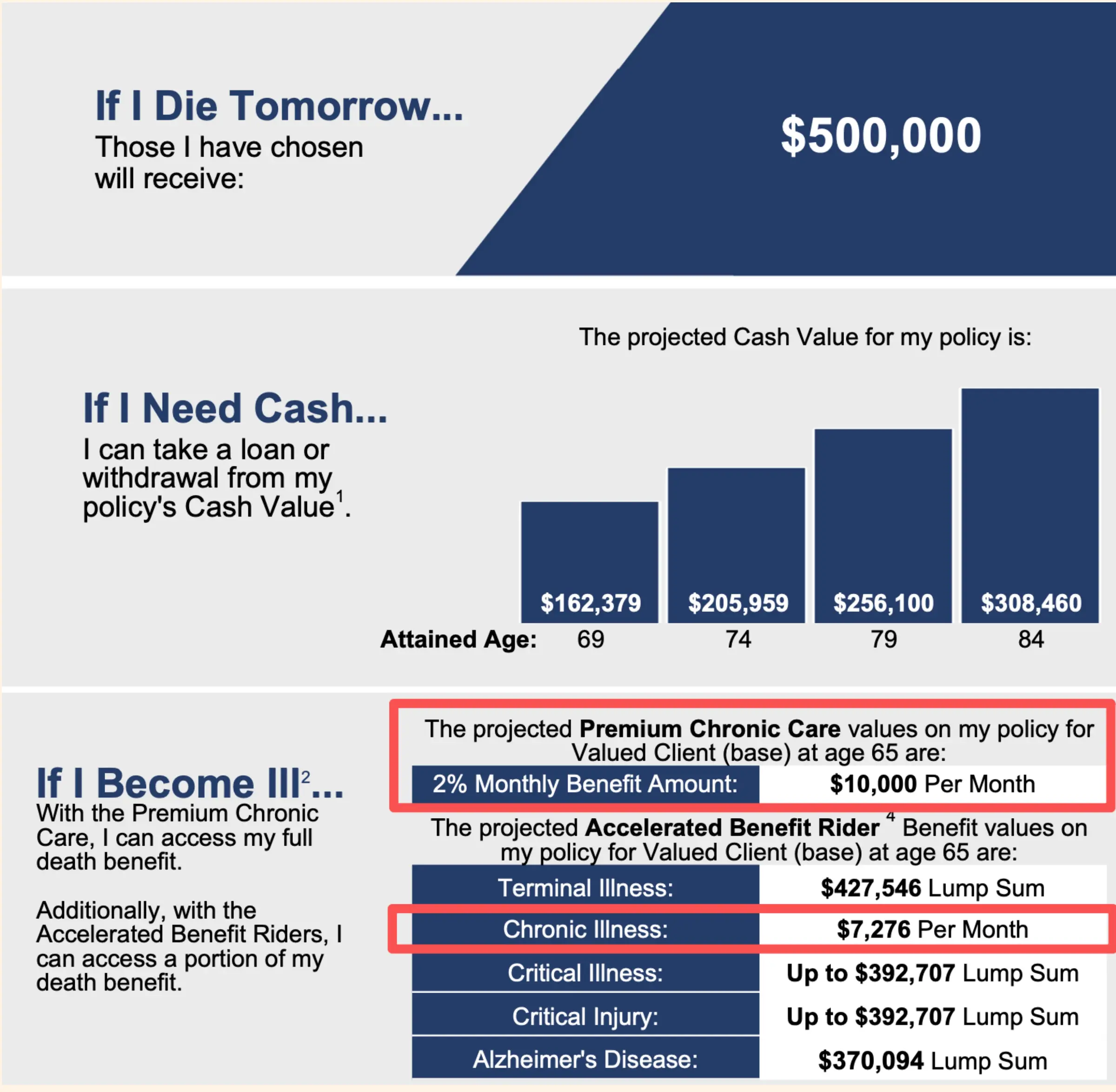
生前福利(Living Benefits / ABR,Accelerated Benefit Riders)是附加在人寿保单上的一组条款, 允许被保险人在还活着的时候,因特定健康状况提前支取一部分身故理赔金。 它不是另外买的一份重疾险,而是把原本只在身故时才兑现的保额, 打折提前兑现一部分。
Living benefits (accelerated benefit riders) let the insured draw part of the death benefit while still alive, triggered by specific health events. They are not a separate critical illness policy; they bring forward money that would otherwise be paid at death, at a discount.
| 医疗 / 健康保险Health insurance | 生前福利 ABRLiving benefits | |
|---|---|---|
| 怎么给钱How it pays | 报销制,不理赔现金Reimbursement, not cash | 理赔现金Cash |
| 给多少How much | 承担大部分医院相关费用,有自付额与自付上限Most of the hospital bill, subject to a deductible and an out-of-pocket maximum | 按保额提前打折兑现A discounted advance against the face amount |
| 能拿去干嘛What it can be used for | 只能抵医疗账单Only the medical bill | 无限制:购房、购车、生活开支、医疗、教育都可以No restriction: a house, a car, living costs, medical, education |
这张表就是整页最好用的一句开场:医疗保险付医院,生前福利付你。
That table is the best opening line on this page: health insurance pays the hospital; living benefits pay you.
生前福利不是长期护理险:这句话要这样讲Living benefits aren't long-term care insurance: say it this way
两者的区别见下表(加州要求向客户附上官方对比单张)。合规上同时规定:不能把慢性疾病 ABR 叫做 LTC、LTC 的替代品,或说它比 LTC 好, 要对比只能用公司批准的对比单张。
The difference is below (California requires the official comparison brochure to go to the client). Compliance rules add: never call the chronic ABR LTC, an alternative to LTC, or better than LTC; comparisons only via approved compliance flyers.
| 长期护理险(LTC)Long-term care insurance | 提前给付附约(ABR)Accelerated benefit rider | |
|---|---|---|
| 是什么What it is | 单独的健康险,不是寿险,没有身故金和现金值Standalone health coverage, not life insurance; no death benefit or cash value | 寿险保单上的附约,提前支取一部分身故金A rider on a life policy that advances part of the death benefit |
| 怎么给钱How it pays | 多为报销合格护理费用,要收据Usually reimburses qualified care expenses, with receipts | 符合条件即支付,不限用途,不需要收据Pays when the event is met; any use; no receipts |
| 不用会怎样If never used | 一般不退(不丧失价值选项要另外付钱)Generally lost (nonforfeiture costs extra) | 身故金照付给受益人The death benefit still goes to beneficiaries |
| 官方声明Official statement | ABR 不是长期护理险,也不能替代它;不属于加州 LTC Partnership 计划;不是 Medicare 补充险An ABR isn't long-term care insurance and doesn't replace it; it isn't part of the California LTC Partnership; it isn't a Medicare supplement | |
它也不是医疗险、失能险或 Medicare 的替代品:医疗险付大部分看病费用;ABR 在特定事件发生时给一笔钱,补上医疗险不管的开销,保额用完就结束。
Nor does it replace health, disability or Medicare coverage: health insurance covers most medical costs; an ABR pays on specific events to offset what health insurance doesn't, and ends when the face is used up.
二、五类条款:触发条件与上限2. The five riders: triggers and caps
| 条款Rider | 触发条件Trigger | 额度上限Cap |
|---|---|---|
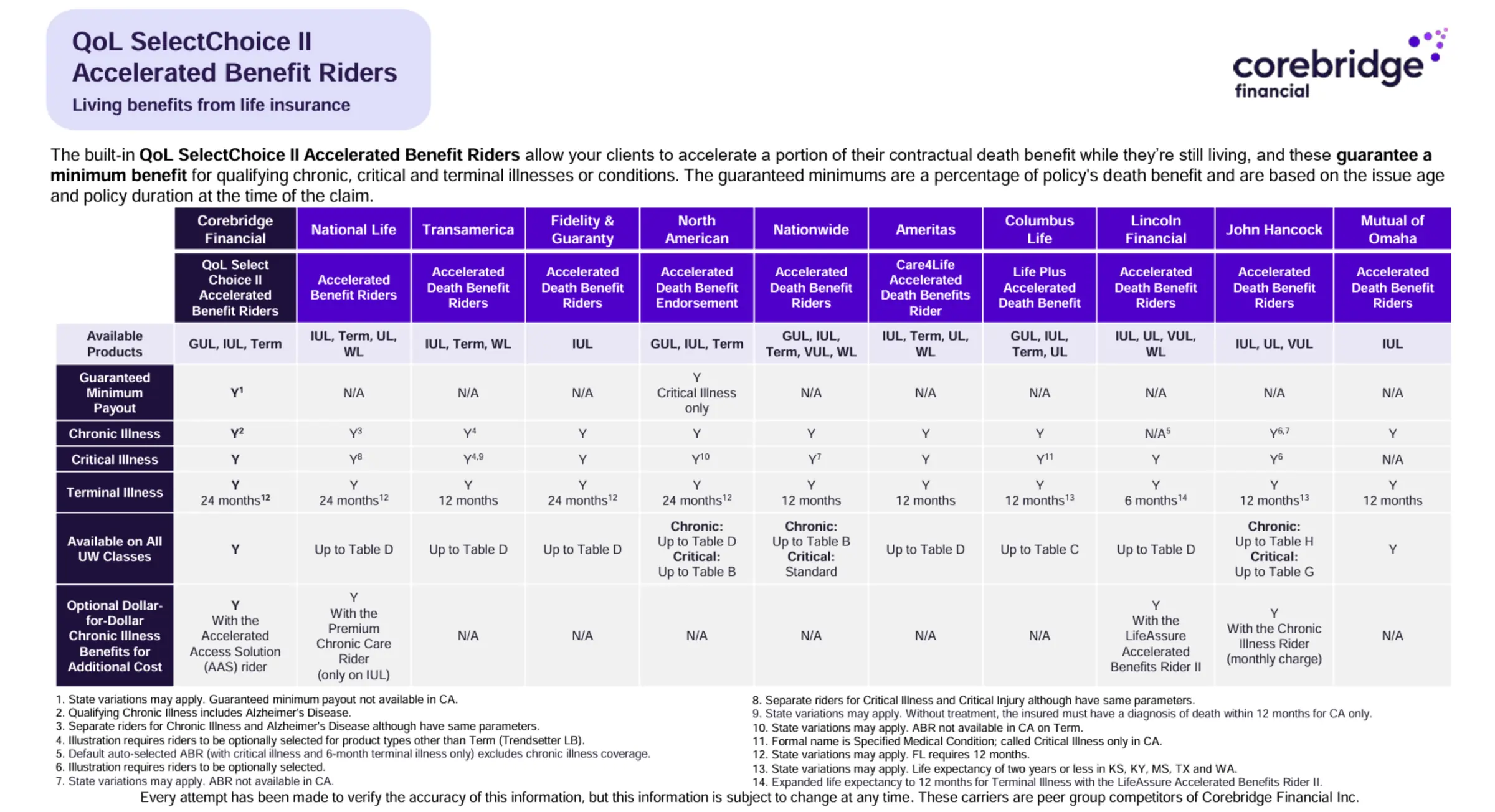
| 末期疾病Terminal | 医生诊断预期寿命在 24 个月以内 国家人寿是 24 个月;不少公司是 12 个月,比较时别默认一样A physician's diagnosis of 24 months or less National Life uses 24 months; many carriers use 12, so don't assume they match |
$1,500,000 |
| 慢性疾病 护理Chronic |
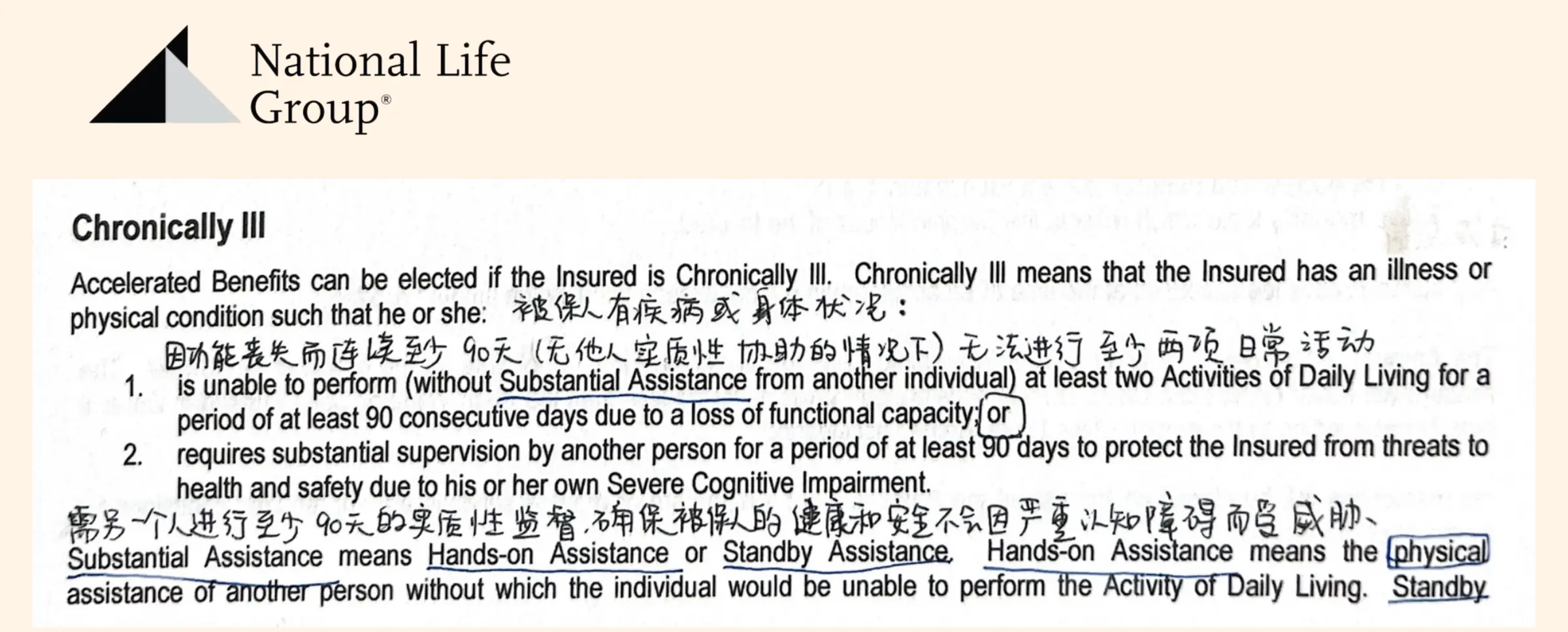
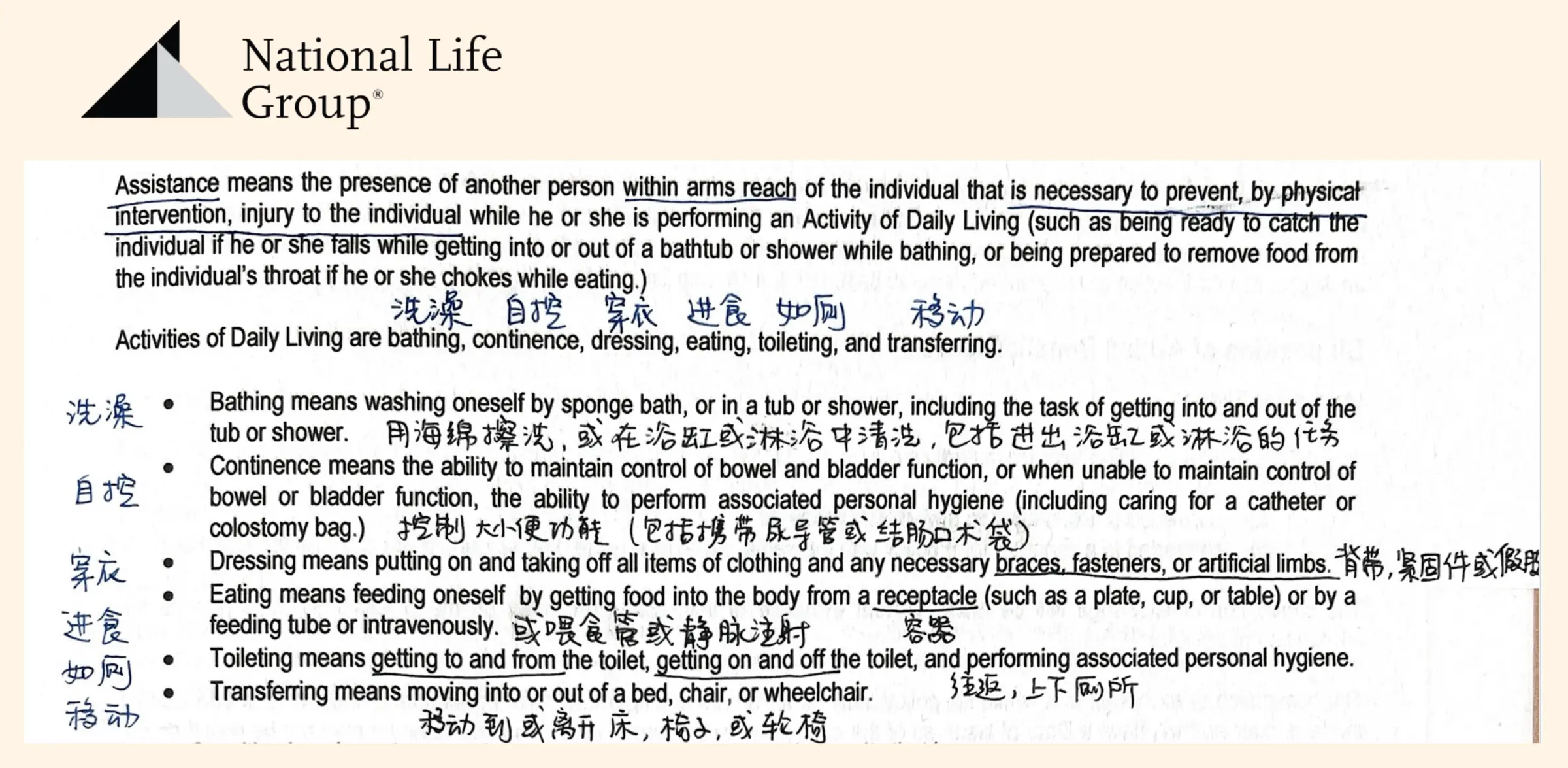
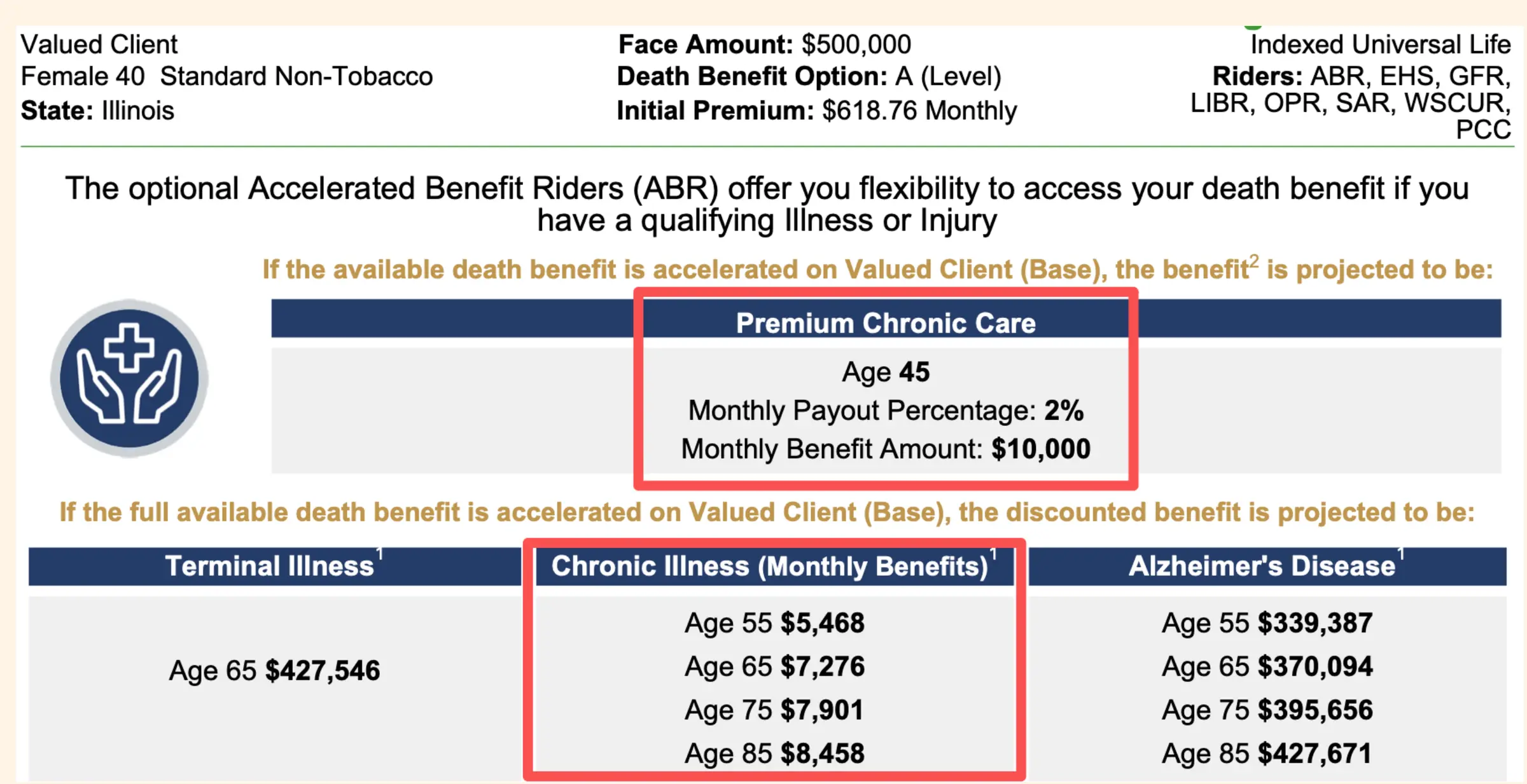
连续至少 90 天无法独立完成 6 项日常生活行为中的 2 项(洗澡、自控、穿衣、吃饭、如厕、移动);或认知障碍(需他人持续监督以防危及自身安全,短期或长期记忆受损、认不清人物地点时间、推理能力下降)At least 90 consecutive days unable to perform 2 of 6 activities of daily living (bathing, continence, dressing, eating, toileting, transferring) or cognitive impairment requiring continuous supervision for the insured's own safety | $1,500,000 每月最多提取面额的 2%,每次理赔一年Up to 2% of face per month, one year per claim |
| 阿兹海默Alzheimer's | 医生诊断阿兹海默症或路易体痴呆;MMSE 或同类测试低于 20 / 30 分,且至少两项认知功能测试确认临床损伤(定向力、学习与记忆、注意力与计算)A diagnosis of Alzheimer's or Lewy body dementia, an MMSE-type score below 20 out of 30, and clinical impairment confirmed in at least two cognitive domains (orientation, learning and memory, attention and calculation) | $1,500,000 最大投保年龄 60 岁Maximum issue age 60 |
| 重大疾病Critical illness | 13 项:癌症、心脏病发作、中风、失明、渐冻症 ALS、重大器官移植、终末期肾衰竭、主动脉移植手术、再生障碍性贫血、囊性纤维化、心脏瓣膜置换、运动神经元疾病、心脏骤停13 conditions: cancer, heart attack, stroke, blindness, ALS, major organ transplant, end-stage renal failure, aorta graft surgery, aplastic anemia, cystic fibrosis, heart valve replacement, motor neuron disease, sudden cardiac arrest | $1,000,000 |
| 重大伤害Critical injury | 4 项:非医疗诱发昏迷(连续 96 小时)、瘫痪(偏瘫/截瘫/四肢瘫痪)、严重烧伤(脸部或体表超过 30%)、创伤性脑损伤(非自残)4 conditions: non-medically induced coma lasting 96 hours, paralysis (hemi-, para-, or quadriplegia), severe burns covering the face or over 30% of the body, and traumatic brain injury not self-inflicted | $1,000,000 |
以 $100 万保额为例:末期疾病和阿兹海默的条款上限是 $150 万,重大疾病和重大伤害是 $100 万, 所以这张保单每一类最多都可以动用全部 $100 万保额;慢性疾病每月最多动用保额的 2%,即 $2 万保额,约 50 个月用完。 五类合并封顶(第四节),动用的保额还要打折(第三节): 实际金额由公司按病情、年龄、剩余寿命计算,签单时给不出。
On a $1M policy, for example: the terminal and Alzheimer's riders are capped at $1.5M and critical illness and critical injury at $1M, so each category can use up to the full $1M of face. The chronic rider uses at most 2% of face a month, $20,000 of face, and runs out in about 50 months. All five share one cap (section 4), and the face used is discounted (section 3): the carrier computes the amount from condition, age and life expectancy, so it can't be quoted at sale.
等待期是 30 天(慢性、阿兹海默、重疾、重伤四项都是 30 天); 90 天是慢性条款里「无法完成 2 项日常生活行为」需要持续的时长。 这是两个完全不同的钟。 这一页之前把它们合成了「等待期 90 天」,现在已改正。
The waiting period is 30 days for chronic, Alzheimer's, critical illness, and critical injury alike. The 90 days is how long the inability to perform two activities of daily living must persist under the chronic rider. They are two entirely different clocks. An earlier version of this page merged them into "a 90-day waiting period"; that's now corrected.
慢性 vs 阿兹海默:可以换,不用二选一到底Chronic versus Alzheimer's: you can switch
- 慢性疾病条款分期领取(每月 2%);阿兹海默条款一次性领取。
- The chronic rider pays in instalments (2% a month); the Alzheimer's rider pays a lump sum.
- 选了其中一项,不会取消另一项。可以先选慢性,之后改成阿兹海默;也可以先领一部分阿兹海默,之后再选慢性,前提是 ABR 额度尚未全额支付完。
- Choosing one doesn't cancel the other. A client can start on chronic and switch, or take part of the Alzheimer's benefit and then move to chronic, as long as the ABR allowance hasn't been fully paid out.
- 其他形式的痴呆不在阿兹海默条款范围内,包括酒精或有毒物质引起的脑损伤、中风相关或血管性痴呆、空间视觉能力障碍、语言功能障碍。
- Other dementias are excluded from the Alzheimer's rider, including alcohol- or toxin-induced brain injury, stroke-related and vascular dementia, visuospatial deficits, and language deficits.
条款原文的关键定义Key definitions from the contract
以下来自 LSW 附约条款原文(20805CA / 20806CA / 8095CA)。客户问「我这个算不算」,答案在这里,最终以理赔审核为准。
From the LSW rider contract text (20805CA / 20806CA / 8095CA). When a client asks "does mine count?", the answer is here, though claims review decides.
| 项目Condition | 要满足Must meet | 不算Excluded |
|---|---|---|
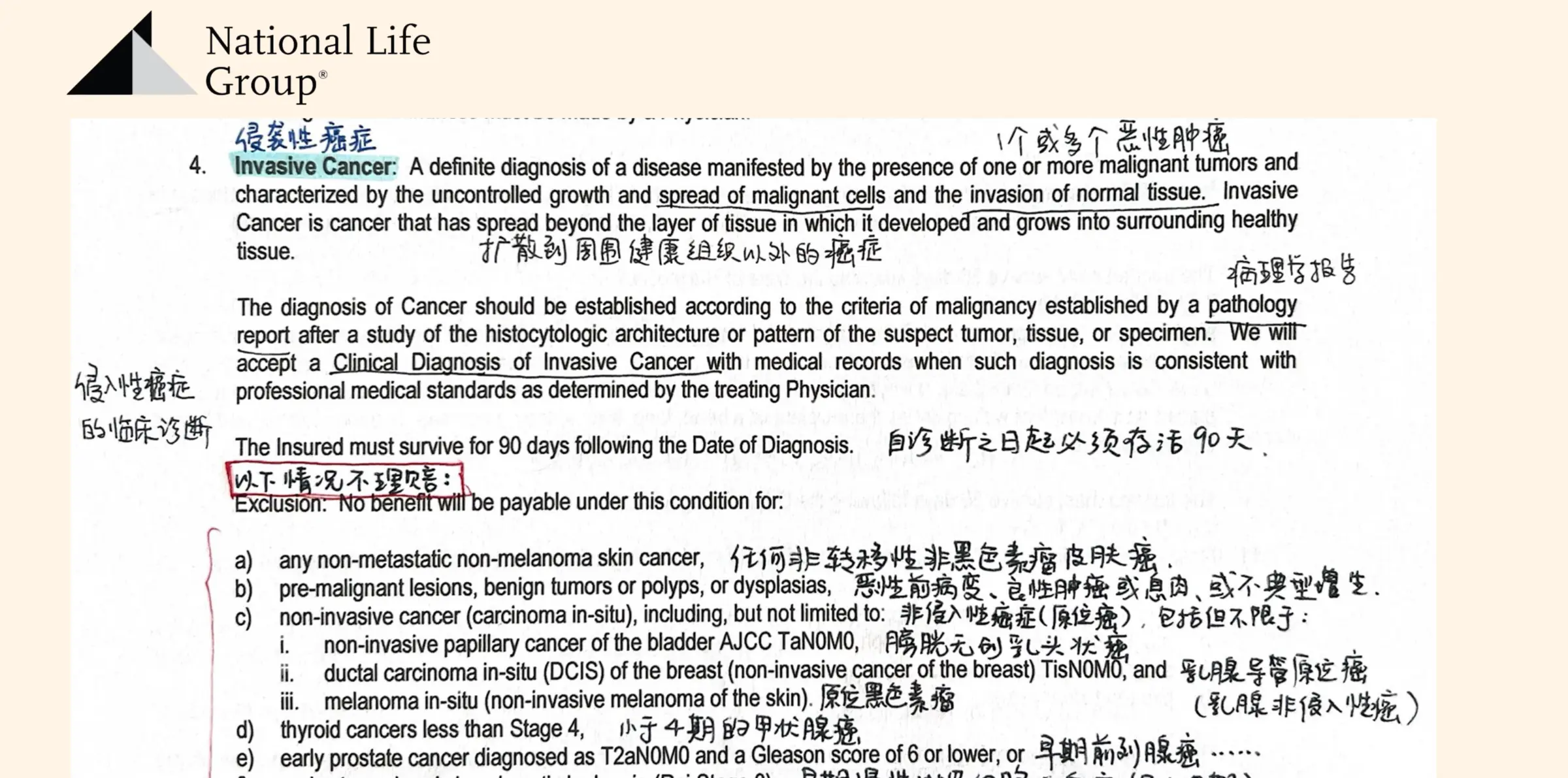
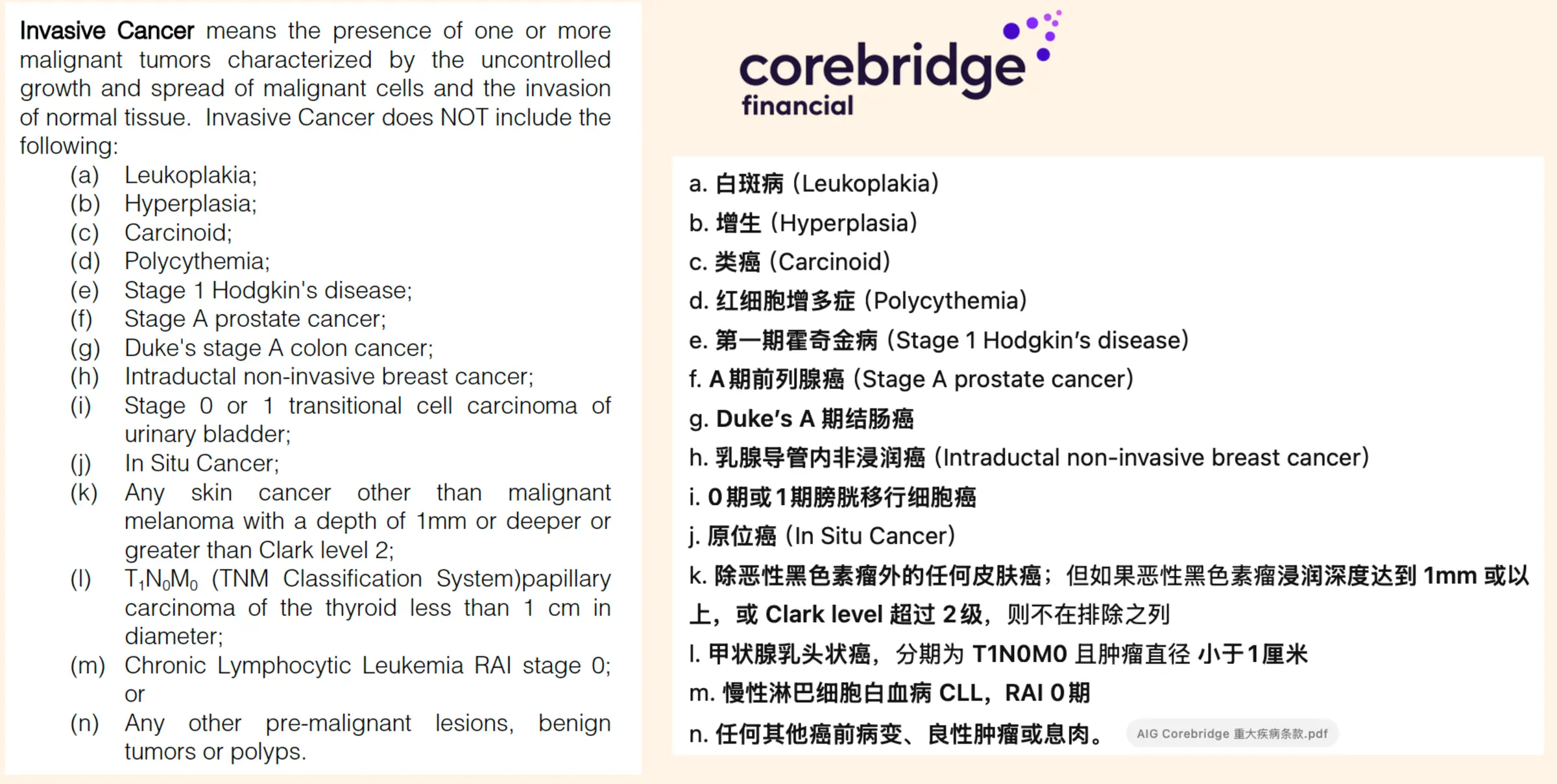
| 浸润性癌症Invasive cancer | 确诊后存活 90 天;接受有病历的临床诊断Survive 90 days after diagnosis; clinical diagnosis with records accepted | 未转移的非黑色素瘤皮肤癌;癌前病变、良性肿瘤、息肉;原位癌(含非浸润性乳头状膀胱癌、乳腺导管原位癌、原位黑色素瘤);4 期以下甲状腺癌;早期前列腺癌(T2aN0M0 且 Gleason ≤ 6);CLL Rai 0 期Non-metastatic non-melanoma skin cancer; pre-malignant, benign, polyps, dysplasia; carcinoma in situ (incl. non-invasive papillary bladder, DCIS, melanoma in situ); thyroid cancer below Stage 4; early prostate (T2aN0M0, Gleason ≤ 6); CLL Rai stage 0 |
| 心脏病发作Heart attack | 急性心梗诊断 + 至少一项:心电图改变、胸痛、影像、心肌标志物Acute MI diagnosis plus at least one of ECG changes, chest pain, imaging, cardiac markers | 心绞痛和其他急性冠脉综合征Angina and other acute coronary syndromes |
| 中风Stroke | 神经功能缺损持续至少 30 天 + 永久缺损或影像证据Neurological deficit lasting 30+ days plus permanent deficit or scan evidence | TIA(24 小时内恢复)、外伤引起、不符合定义的腔隙性梗塞、影像上的无症状中风TIA (<24 hours), trauma-caused, lacunar strokes not meeting the definition, silent strokes on imaging |
| 心脏骤停Sudden cardiac arrest | 需要复苏;之后植入 ICD/CRT-D、消融、手术或长期用药Required resuscitation, followed by ICD/CRT-D, ablation, surgery or long-term medication | 没有骤停就装起搏器/除颤器;酒精、药物或自残导致Pacemaker/defibrillator without an arrest; caused by alcohol, drugs or self-harm |
| 终末期肾衰End-stage renal failure | 双肾衰竭,需透析或移植;存活 90 天Both kidneys, needing dialysis or transplant; survive 90 days | |
| 重大器官移植Major organ transplant | 心、双肺、肝、双肾、胰、骨髓;已列入等待名单即可Heart, both lungs, liver, both kidneys, pancreas, bone marrow; being on the waiting list qualifies | |
| 失明Blindness | 双眼 20/200 或视野小于 20 度20/200 or a field under 20 degrees in both eyes | 多个州不作为重疾(CT IL KS MD MA MN NJ NY OH PA UT VA WA)Not a qualifier in several states (CT IL KS MD MA MN NJ NY OH PA UT VA WA) |
| 囊性纤维化Cystic fibrosis | 20 岁生日前确诊Diagnosed before age 20 | |
| 昏迷Coma | 至少 96 小时,Glasgow ≤ 4,需要生命维持,留下永久缺损96+ hours, Glasgow ≤ 4, on life support, permanent deficit | 医疗诱导;酒精或药物导致Medically induced; alcohol or drugs |
| 瘫痪Paralysis | 四肢瘫、截瘫、偏瘫持续 90 天且为永久Quadri-, para- or hemiplegia lasting 90 days and permanent | |
| 严重烧伤Severe burns | 三度烧伤占体表 30% 以上,或头面部 30% 以上;存活 30 天Third-degree burns over 30% of the body or 30% of face/head; survive 30 days | |
| 创伤性脑损伤Traumatic brain injury | 伤后 48 小时内 Glasgow ≤ 12 + CT 证据 + 永久缺损;存活 60 天Glasgow ≤ 12 within 48 hours, CT evidence, permanent deficit; survive 60 days | 轻度脑损伤、反复外伤、自伤Mild TBI, repetitive trauma, self-inflicted |
| 慢性疾病Chronic illness | 6 项日常生活行为中 2 项需要实质协助(亲手协助或在一臂之内的看护)连续 90 天,或严重认知障碍需实质监督 90 天;由医生、注册护士或持牌社工在申请前 12 个月内认证,认证人不能是持有人、被保险人或其直系亲属Substantial assistance (hands-on or standby within arm's reach) with 2 of 6 ADLs for 90 days, or severe cognitive impairment needing substantial supervision for 90 days; certified within 12 months before election by a physician, RN or licensed social worker who isn't the owner, insured or immediate family | 自杀未遂或自伤、战争、暴乱、恐怖行为、犯重罪;生效后 30 天内Attempted suicide or self-injury, war, riot, terrorism, committing a felony; within 30 days of issue |
其他重疾(ALS、运动神经元病、主动脉移植、再生障碍性贫血、心脏瓣膜置换)多数要求确诊后存活 30 天。存活期内可以先报案,期满后再付款,这样客户不会过早减少身故金。 申领时公司会报价,客户在 60 天内交回选择表;有受让人或不可撤销受益人要取得其同意;付款前被保险人身故,选择作废、照付身故金。加州慢性疾病每年上限为保额的 24% 与 $240,000 较低者。
Other critical illnesses (ALS, motor neuron disease, aorta graft, aplastic anemia, heart valve replacement) mostly require surviving 30 days. The claim can be filed during the survival period and paid after it, so the client doesn't cut the death benefit too early. The company quotes an amount and the election form comes back within 60 days; assignees and irrevocable beneficiaries must consent; if the insured dies before payment the election is cancelled and the death benefit paid. California's chronic annual cap is the lesser of 24% of coverage or $240,000.
Premium Chronic Care:付费、不打折的慢性疾病附约Premium Chronic Care: a paid, undiscounted chronic rider
2025 年 LLD 推出的新附约(加州、纽约不可用)。和免费的慢性疾病 ABR 用同样的触发条件,区别在钱:
New on LLD in 2025 (not available in California or New York). Same trigger as the free chronic ABR; the difference is the money:
| 慢性疾病 ABRChronic ABR | Premium Chronic Care | |
|---|---|---|
| 费用Cost | 不收费None | 额外收费Extra charge |
| 每人上限Per-insured cap | $1.5M(与其他 ABR 合并)$1.5M (shared with other ABRs) | $3M |
| 投保年龄Issue ages | 0–85 | 18–75 |
| 怎么付Payout | 每月最多 2%,打折Up to 2% a month, discounted | 投保时选每月 2% 或 4%,一元对一元不打折(4% 以后可降为 2%,不能反向)2% or 4% a month chosen at issue, dollar for dollar (4% can later drop to 2%, not the reverse) |
| 等待期Waiting period | 30 天30 days | 无None |
| 共同点Both | 受 IRS 每日上限约束;每年重新认证;不能和退休金计划、Gap Protector 或 CMC 同用Subject to the IRS per diem; annual recertification; not with pension plans, Gap Protector or CMC | |
一个假设例子:55 岁女性、标准非吸烟、保额 $294,700,57 岁时符合慢性条件:Premium Chronic Care 2% 每月约 $5,894,免费 ABR 约 $2,915。
A hypothetical: a 55-year-old standard non-tobacco woman with $294,700 of coverage qualifies at 57: Premium Chronic Care at 2% pays about $5,894 a month versus about $2,915 from the free ABR.
三、实际能拿到多少:打折理赔3. What actually arrives: the discount
这是整页最重要的一节,也是理赔那天唯一会被客户质问的一件事。 保险公司提前把钱付给你,所以要贴现, 你拿到的一定少于你动用的那部分保额。
This is the most important section on the page, and the only thing a client will ever argue about at claim. The carrier is paying early, so the amount is discounted, and what arrives is always less than the face amount consumed.
一个完整的真实算例One complete worked example
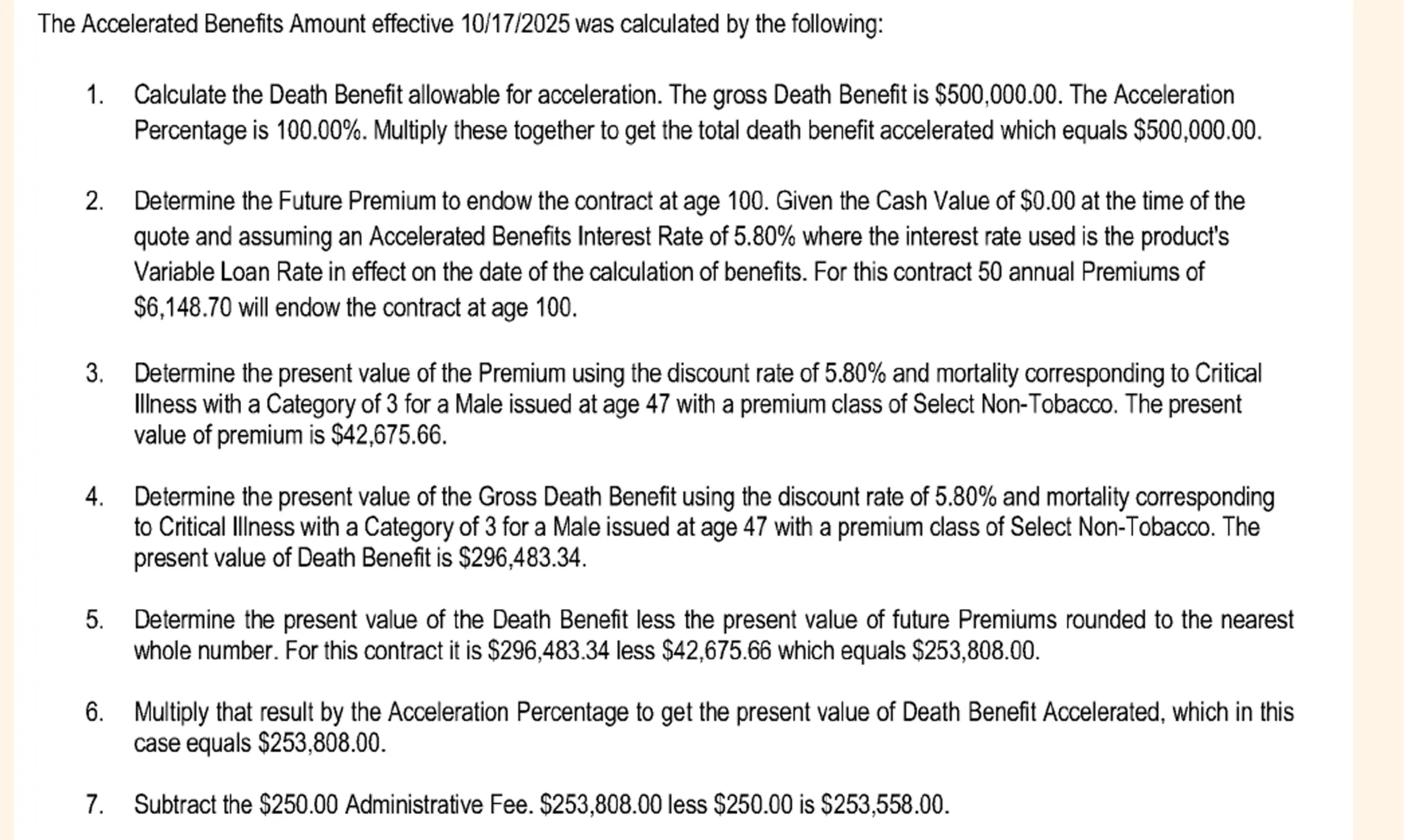
47 岁男性,$500,000 保额,重大疾病 Category 3(重度),Select Non-Tobacco, 保单现金值 $5,487.46,贴现率 5.80%,选择 100% 加速:
A 47-year-old male, $500,000 of face, critical illness at Category 3 (severe), Select Non-Tobacco, cash value of $5,487.46, a 5.80% discount rate, accelerating 100%:
| 可加速的死亡赔付Death benefit available to accelerate | $500,000 |
| 按 5.80% + Cat 3 死亡率折现Discounted at 5.80% plus the Cat 3 mortality assumption | $296,483 |
| 减去未来保费的现值Less the present value of future premiums | − $42,676 → $253,808 |
| × 加速比例 100%× 100% acceleration | $253,808(选 50% 则减半)$253,808 (at 50% it halves) |
| 减去 $250 手续费Less the $250 administrative fee | $253,558 |
| 实际到手比例Percentage actually received | 50.7% |
这里可以反推一下:从贴现率可以倒算出保险公司模型里的预期寿命。 $500,000 ÷ 1.058ⁿ = $296,483 → n ≈ 9.3 年, 也就是说 NLG 的模型认为这位 47 岁的客户大约在 56 岁前后过世。
You can work this backwards: the discount rate implies the carrier's assumed life expectancy. $500,000 ÷ 1.058ⁿ = $296,483 gives n ≈ 9.3 years: the model expects this 47-year-old to die around 56.
这个反推的用处是: 它让你能向客户解释「为什么是 50% 而不是 85%」。 不是公司抠,是因为模型认为他还能活九年多,九年的钱现在给,当然要折现。
Why it's useful: it lets you explain to a client why the answer is 50% rather than 85%. It isn't the carrier being stingy; the model expects another nine years, and nine years of money paid today is discounted accordingly.
四笔真实理赔,比例正好说明问题Four real claims, and what the ratios show
| 情形Case | 保额Face | 理赔Paid | 比例Ratio |
|---|---|---|---|
| 40 岁男性,猝死Male, 40, sudden death | $1,000,000 | 身故全额Full death benefit | 100% |
| 37 岁女性,直肠癌 2 期Female, 37, stage 2 rectal cancer | $500,000 | $250,000 | 50.0% |
| 50 岁男性,舌癌 3 期Male, 50, stage 3 tongue cancer | $500,000 | $256,000 | 51.2% |
| 62 岁女性,轻微中风Female, 62, minor stroke | $300,000 | $86,000 | 28.7% |
2024–2025 年的四笔实际理赔。
Four actual claims from 2024–2025.
最后一行才是要讲慢的那一行:「轻微中风」只拿到 28.7%,不到前两笔的六成。 原因不是年龄(62 岁其实应该拿得更多),而是病情不重、预期寿命长,所以折得狠。 这一行把「病越重拿越多」这个反直觉的机制讲得很清楚, 而且它同时是一个必须提前给客户打的预防针。
The last row is the one to slow down on: the minor stroke paid 28.7%, barely six-tenths of the other two. Not because of age (at 62 you would expect more) but because the condition wasn't severe, so life expectancy stayed long and the discount was deep. That single row explains the counterintuitive mechanism clearly, and it's also the expectation you have to set before the claim, not after.
反过来看晚期的例子(幻灯片第 39 页,团队培训中分享的更早几笔,已匿名):宫颈癌 $50 万保额理赔 $266,199(53.2%); 乳腺癌 $50 万保额理赔 $42 万;50 岁女性肺癌 4 期,$100 万保额理赔 $82 万,都是八成多。 2020 年还有一张 $100 万整的重疾理赔支票,因为重疾单次理赔最高 $100 万;保额更大的客户只动用够封顶的那部分保额,其余保额继续有效。
Now the late-stage side (slide 39, earlier cases shared in team training, anonymized): cervical cancer on a $500,000 face paid $266,199 (53.2%); breast cancer on $500,000 paid $420,000, and a 50-year-old woman with stage 4 lung cancer and a $1 million face received $820,000, both over 80%. A 2020 critical illness check was for exactly $1 million, because a critical illness claim pays at most $1 million at a time; with a larger face, only enough is accelerated to reach the cap and the rest stays in force.
什么情况折得少,什么情况折得狠What makes the discount smaller or larger
赔付高(折现较低)
Pays more (smaller discount)
疾病导致较快死亡|年龄较大的被保人|终身型保单|持续缴费稳定| 保单已生效多年|已高额供款(over-funded)
A condition that shortens life sharply · an older insured · a permanent policy · premiums paid consistently · a policy in force for years · an over-funded contract
赔付低(折现较高)
Pays less (larger discount)
疾病可治愈或可长期存活|年龄较小的被保人|定期寿险|缴费不稳定| 保单生效时间短|现金值低(under-funded)
A treatable or survivable condition · a younger insured · term coverage · irregular premiums · a policy only recently issued · an under-funded contract with low cash value
归纳成三条,设计保单时你真正能影响的只有其中一条: ① 病情严重程度(决定预期寿命,你影响不了)、 ② 现金值高低(现金越多折扣越小,这一条你能影响)、 ③ 贴现率(挂钩浮动贷款利率,利率上行就拿得少,你也影响不了)。
Three factors, and only one of them is in your hands at design time: severity, which drives life expectancy and which you can't influence; cash value, where more means a smaller discount, and this one you can influence; and the discount rate, which tracks the variable loan rate, so a rising-rate environment pays less.
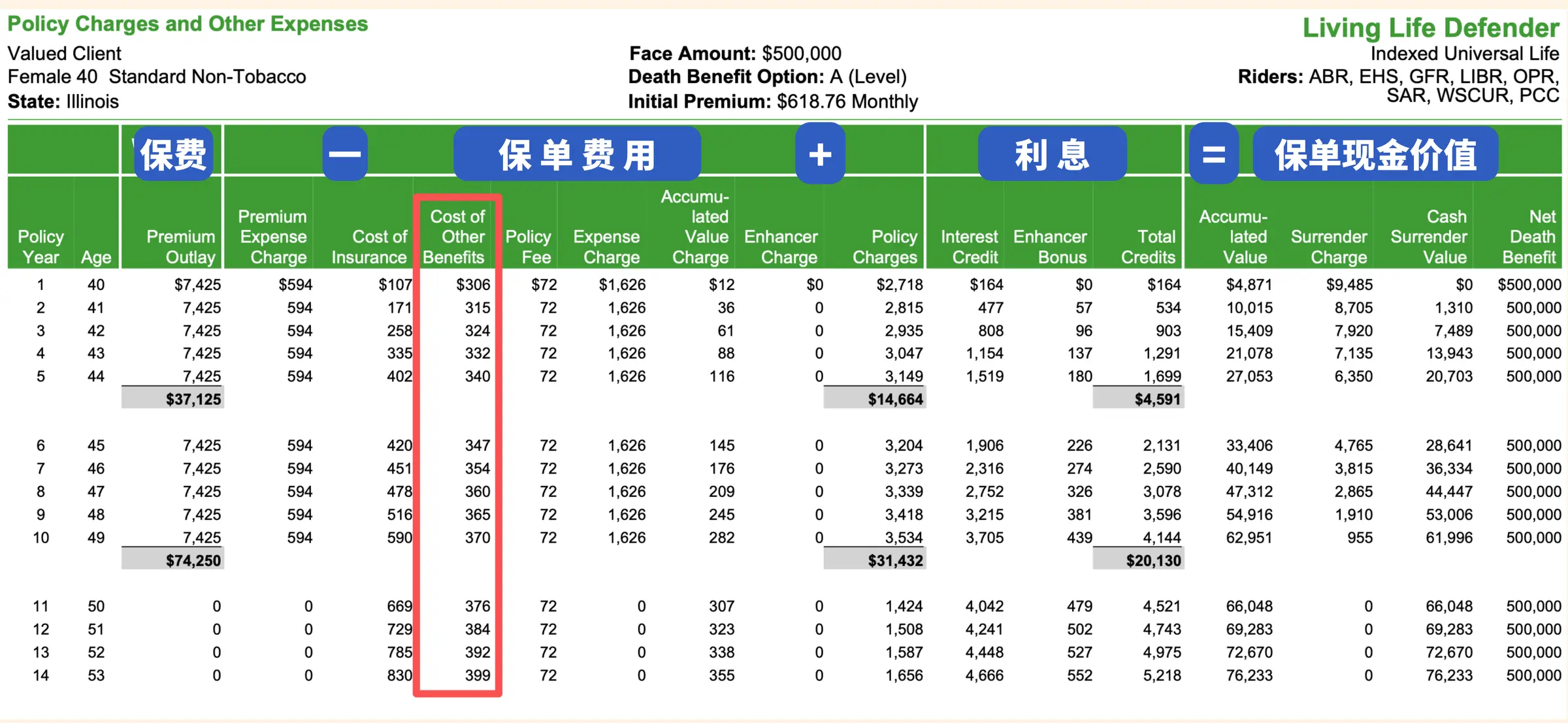
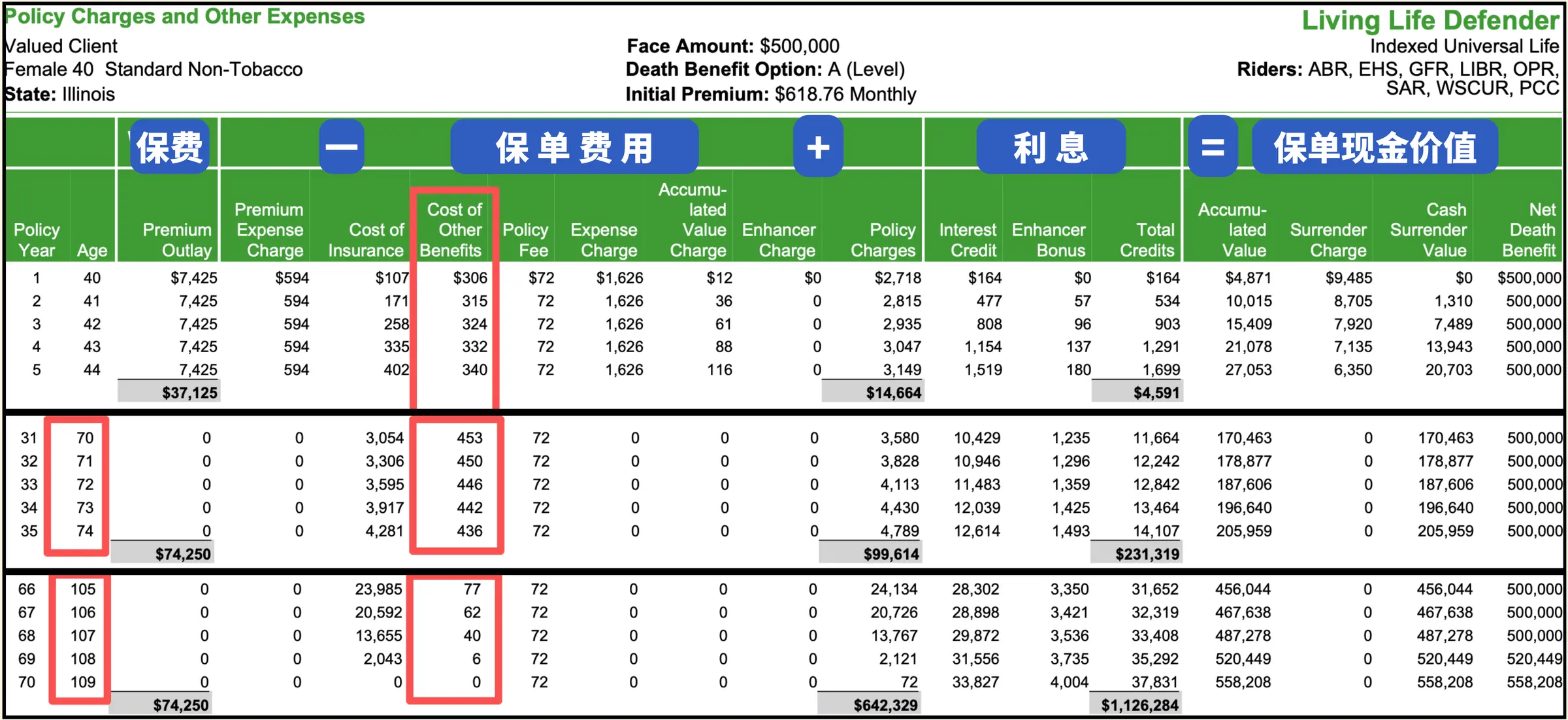
所以「足额供款」除了关系退休现金流,还直接决定生前福利理赔那天的数字。 这是把保单费用那一页和这一页连起来的那根线: 一张长期供款不足的保单,不只是现金值长得慢,是出事那天少拿一大笔。
So funding the policy properly isn't only about retirement cash flow; it directly sets the number on the day a living benefit is claimed. That's the thread connecting this page to Policy Costs: an under-funded policy doesn't just accumulate slowly, it pays materially less on the day it matters.
折现的几个关键参数The discount's key inputs
- 公式:按调整后预期寿命计算的身故金现值 − 剩余保费现值(终身险按交到 100 岁的最低保费,定期险按交到 95 岁、平准期后按 ART)− 手续费 − 贷款。
- Formula: present value of the death benefit over adjusted life expectancy − present value of remaining premiums (permanent: minimum premium to 100; term: to 95, ART after the level period) − fees − loans.
- 折现率:培训资料列的是终身险 3.5%、定期险 5%,并注明会调整;上面那笔 2025 年的真实理赔用的是 5.80%,挂钩保单的浮动贷款利率。所以不要背固定数字:利率越高,折得越多;同样的诊断,定期险拿到的比例通常更低。
- Discount rate: the training material lists 3.5% for permanent and 5% for term, subject to change; the real 2025 claim above used 5.80%, tied to the policy's variable loan rate. So don't quote a fixed figure: the higher the rate, the deeper the discount, and the same diagnosis usually pays a smaller share on term.
- 贷款按比例扣:有 $2,000 贷款、提前给付 30%,就扣 $600。
- Loans come off proportionally: a $2,000 loan with a 30% acceleration deducts $600.
- 慢性疾病的节奏:每月提前 2% 保额,再打折(假设 $200,000 × 2% = $4,000 → 实付约 $2,700);全部领完约 50 个月。客户可以选低于 2% 拉长时间。 NL 纸本保单受 IRS 每日上限约束(2025 年 $153,300);LSW 当前做法可超过每日上限,每年最多提前 $360,000 保额,超过部分要能证明护理开支才免税。
- Chronic pacing: 2% of face a month, then discounted (hypothetically $200,000 × 2% = $4,000 → about $2,700 paid); fully used in about 50 months. Clients can choose less than 2% to stretch it. NL policies are limited to the IRS per diem ($153,300 for 2025); LSW's current practice can exceed it, up to $360,000 of face a year, with the excess tax-free only if care costs are documented.
- 一个匿名案例:41 岁女性,2017 年投保 $500,000 终身寿,确诊转移性肺癌,身故金 $532,000 全额提前,现值 $295,291 减 $250 手续费 = $295,041,约 55%。
- An anonymised case: a 41-year-old woman, $500,000 WL issued 2017, metastatic lung cancer; the full $532,000 death benefit accelerated to a present value of $295,291 less a $250 fee = $295,041, about 55%.
设计上的取舍:保额定得太大、保费交得太少,生前福利和日后收入都会变少;多交(接近上限)的保单,生前福利也更强。
The design trade-off: too much face for the premium means smaller living benefits and less future income; well-funded policies deliver stronger living benefits too.
四、五类额度是合并封顶,不是各算各的4. The caps are aggregate, not additive
客户最常见的误解,而且是我们讲错造成的: 「我有 $150 万 Terminal + $150 万 Chronic + $150 万 Alzheimer's + $100 万 Critical Illness + $100 万 Critical Injury,所以一共能拿 $650 万?」错。
The misunderstanding clients have most often, and one we create: "$1.5M terminal plus $1.5M chronic plus $1.5M Alzheimer's plus $1M critical illness plus $1M critical injury, so $6.5M in total?" No.
五大项是 Aggregate Cap(合并封顶),五项加起来最多 $150 万。举个例子: 一张 $400 万的保单,客户先申请重大疾病,理赔 $75 万;因为是打折提前付,这 $75 万动用了 $200 万保额,面额降到 $200 万; 后来变成末期疾病,最多再拿 $75 万,不是 $150 万:$150 万是几项合起来的总上限,已经用掉了 $75 万。 剩下的保额和合并的总上限,哪个先碰到就停在哪。
The five share one aggregate cap: $1.5M across all five. An example: on a $4M policy the client first claims critical illness and receives $750,000; paid early at a discount, that $750,000 uses $2M of face, dropping the face to $2M; later becoming terminally ill, they can take another $750,000 at most, not $1.5M: $1.5M is the combined ceiling and $750,000 of it is used. The remaining face and the combined ceiling both apply, and whichever is reached first stops it.
这一条必须在成交前讲。理赔那天才发现,客户会认为你骗了他, 而且从他的角度看,他是对的。
Say this before the sale. Discovered at claim, the client will believe you misled them, and from where they sit, they'd be right.
五、谁拿不到:承保阶段就定了5. Who doesn't get it: decided at underwriting
| 情况Situation | 结果Result |
|---|---|
| 曾经心脏病发作 / 癌症康复A prior heart attack or cancer recovery | 拿不到 重大疾病 ABR(其他 ABR 仍可)No critical illness ABR; the others remain available |
| 有伤残历史 / 慢性背痛A disability history or chronic back pain | 拿不到 慢性疾病 ABRNo chronic illness ABR |
| 次标准体 ≥ Table 4 / Express Standard 2Substandard rated at Table 4 or above, or Express Standard 2 | 只能拿末期疾病 ABRTerminal ABR only |
| 评级 ≥ 200% / Express Non-Tobacco 2Rated at 200% or above, or Express Non-Tobacco 2 | 拿不到 阿兹海默条款No Alzheimer's rider |
| 多被保人保单里有一位不合格A multi-insured policy where one insured doesn't qualify | 其他被保人也拿不到 ABRNone of the insureds get the ABR |
最后一行按保守的理解:任何一位被保人不合格,全体都拿不到 ABR。做多保人方案时逐一核对。
Read the last row strictly: if any insured doesn't qualify, none of them get the ABR. Check each insured when designing a multi-life case.
客户必须如实回答 medical form 上的所有问题。 保单生效两年内的理赔会被 contestability 复核, 撒谎被发现 = 条款被撤销(rescind)。 隐瞒换来的保单,恰恰在最需要它的那一天失效。
The client must answer every question on the medical form truthfully. A claim within the first two years goes through contestability review, and a misstatement discovered there means the rider is rescinded. A policy bought by omission fails on precisely the day it's needed.
六、客户常以为能赔、其实不赔的十件事6. Ten things clients assume are covered and aren't
这些是医疗保险该管的事。ABR 只赔「重大 + 长期 + 救命」级别。
These belong to health insurance. ABR pays only at the serious, long-term, life-threatening level.
| 1 手指骨折A broken finger | 6 手肘骨折A broken elbow |
| 2 脚踝 / 脚趾骨折A broken ankle or toe | 7 关节 / 膝盖疼痛Joint or knee pain |
| 3 背痛Back pain | 8 疝气修复Hernia repair |
| 4 子宫切除术A hysterectomy | 9 胆囊切除Gall bladder removal |
| 5 怀孕及产后恢复Pregnancy and postpartum recovery | 10 子宫肌瘤切除Fibroid removal |
注意第 2 项和第 3 项。这一页早先的版本写过 「摔断腿长期卧床、换了膝关节都可能符合慢性条款」。 单纯的骨折和关节疼痛不赔。 慢性条款赔的不是「受了伤」,是连续 90 天以上失去两项生活自理能力。 一次骨折如果真的导致九十天无法自行洗澡和穿衣,那符合的是那个条件, 不是「骨折」本身。这两句话在客户听来差别很大。
Note items 2 and 3. An earlier version of this page said a broken leg or a knee replacement "could qualify" under the chronic rider. A fracture or joint pain on its own does not. The chronic rider doesn't pay for an injury; it pays for losing two activities of daily living for more than 90 consecutive days. If a fracture genuinely leaves someone unable to bathe and dress themselves for ninety days, it's that condition being met, not the fracture. To a client those two sentences sound very different.
慢性理赔为什么会被拒:一个对照案例Why a chronic claim gets denied
下面是一个同一位客户、两张保单、两种结果的案例。 (客户是北加州的一位巴士司机,姓名已略去;时间线见上面幻灯片第 9 页。这里要讲的是机制,不是某一家公司。)
Here is a case of one client, two policies, and two different outcomes. (The client is a bus driver in Northern California; the name is omitted, and the timeline is on slide 9 above. The point is the mechanism, not any particular company.)
赔了的那一张
The one that paid
$110 万保额,慢性疾病条款(免费附带)。 一年可动用面额 2% × 12 = 24%,即 $26.4 万; 用这 $26.4 万的面额额度,实际提前拿到 $112,182, 剩余保额 $83.6 万。
$1.1M of face with the chronic rider included at no cost. A year's allowance is 2% × 12 = 24%, or $264,000 of face; that $264,000 of face produced an actual advance of $112,182, leaving $836,000 of coverage.
$112,182 ÷ $264,000 ≈ 42.5%,又是一次明显的折现。
$112,182 ÷ $264,000 ≈ 42.5%: the discount again.
被拒的那一张
The one that didn't
同一个人,Nationwide 的付费长期护理附加险。拒赔理由:
Same person, Nationwide's paid long-term care rider. The stated reasons:
没有依照医嘱持续治疗|没有服药|医生建议注射治疗但未执行| 缺乏完整的治疗记录可供追踪
Treatment wasn't continued as prescribed · medication wasn't taken · a recommended injection therapy wasn't carried out · there was no complete treatment record to follow
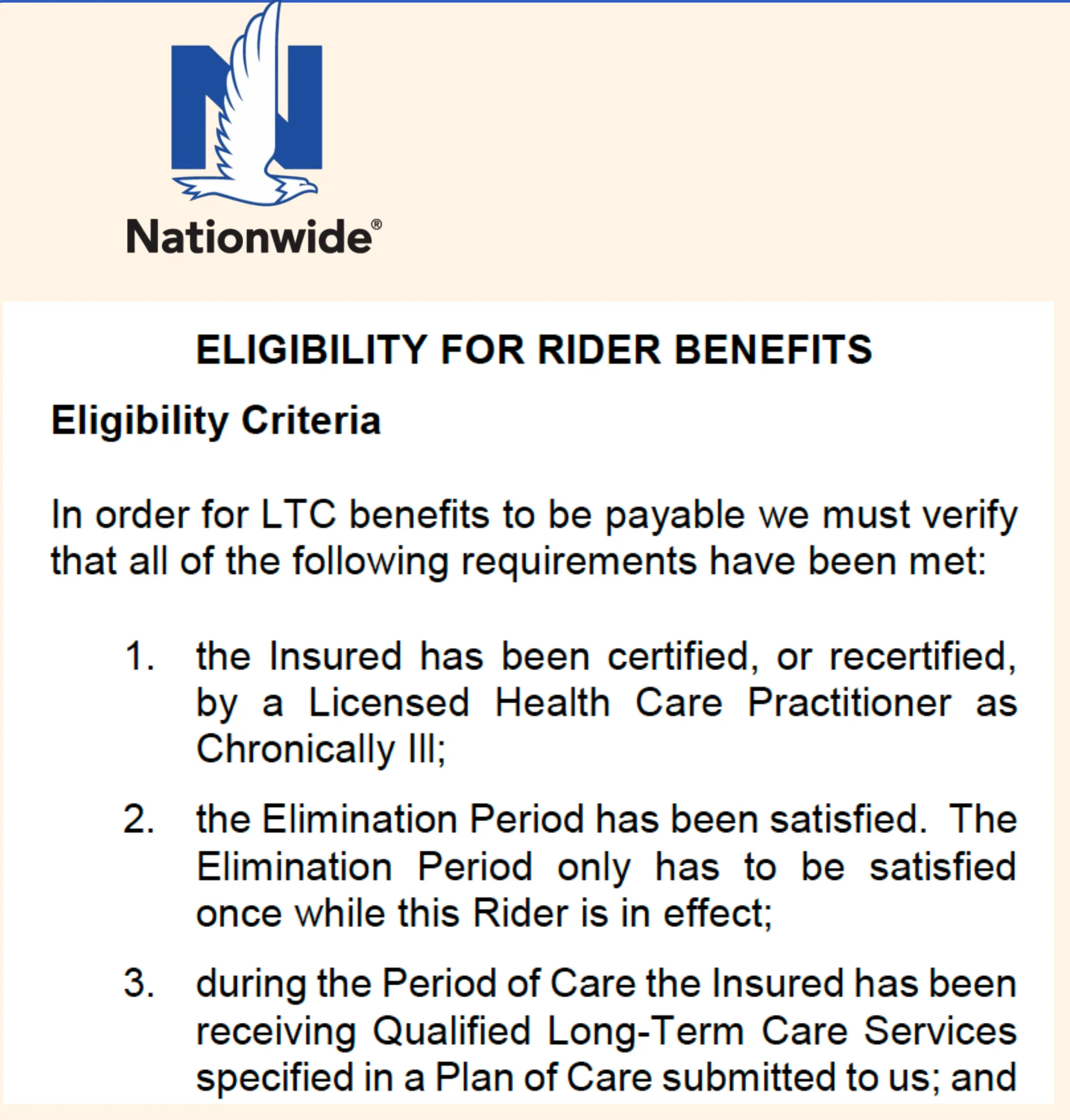
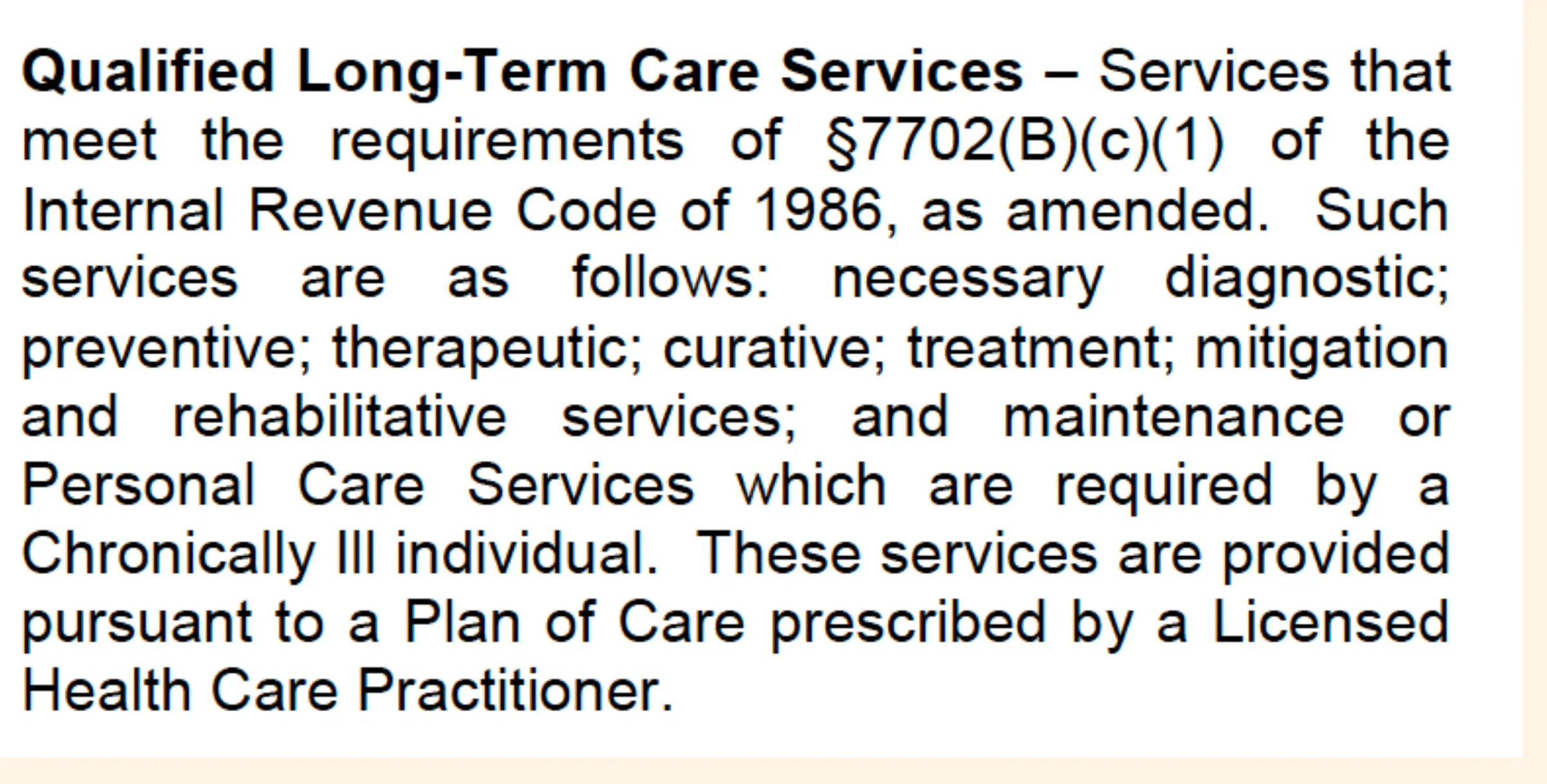
这个案例的教训不在「哪家公司好」,在条款里那句话: 在护理期间内,必须确实按照医生制定的护理计划,持续接受合格的长期护理服务。 「合格长期护理服务」有明确定义,见美国税法 IRC §7702B(c)(1), 包括必要的诊断、预防、治疗、康复、缓解病情、维护性与个人护理服务。
The lesson isn't which carrier is better; it's the contract language: during the care period the insured must actually follow the physician's plan of care and continue receiving qualified long-term care services. "Qualified" is defined in IRC §7702B(c)(1), covering necessary diagnostic, preventive, therapeutic, rehabilitative, palliative, maintenance, and personal care services.
对我们的意思很具体:理赔不是填表填得好就能过,是病历要撑得住。 客户一开始申请慢性理赔,就要提醒他按医嘱做、并且留下记录。 这句话该在理赔开始的第一天说,不是被拒之后说。
What that means for us is concrete: a claim isn't won on the form, it's won on the medical record. The moment a client starts a chronic claim, tell them to follow the plan and keep the documentation, on day one, not after a denial.
七、理赔的税7. Tax on the claim
| 个人持有、个人收款Individually owned and paid | 公司持有、公司收款Business owned and paid | |
|---|---|---|
| 末期疾病Terminal | 通常符合 §101(g),免税(会收到 1099-LTC)Usually qualifies under §101(g): tax-free (a 1099-LTC is issued) | 通常不符合 §101(g),需进一步计算应税金额Usually outside §101(g): taxable amount to be worked out |
| 慢性疾病Chronic | 符合条件时免税,受 LTC 规则及 per diem 上限约束Tax-free when qualified, subject to LTC rules and the per diem | 通常不符合 §101(g),需进一步计算应税金额Usually outside §101(g): taxable amount to be worked out |
| 阿兹海默 / 认知障碍Alzheimer's / cognitive impairment | 按慢性疾病规则判断Follows the chronic illness rules | 按慢性疾病规则及 §101(g)(5) 判断Chronic illness rules and §101(g)(5) |
| 重大疾病Critical illness | 取决于条款结构、付款原因和保费来源Depends on rider structure, reason for payment and who paid premiums | 取决于条款结构、收款人、税基和商业关系Depends on rider structure, payee, basis and business relationship |
| 重大伤害Critical injury | 取决于 §104 / §105 及合同结构Depends on §104 / §105 and contract structure | 取决于收款人与合同性质,不能一概而论Depends on payee and contract; no single answer |
「公司持有」那一整列值得单独讲一次。 很多企业主客户会顺手把保单挂在公司名下(为了保费的税务处理), 结果把一笔本来免税的理赔变成了应税收入。 持有人是谁,要在投保之前跟客户的会计师确认,不是理赔时才发现。
The business-owned column deserves its own conversation. Owners routinely put a policy in the company's name for the premium treatment, and in doing so turn a tax-free benefit into taxable income. Who owns the contract has to be settled with the client's accountant before the policy is issued, not discovered at claim.
慢性理赔超过 IRS per diem 上限的部分,必须提交护理费用证明才免税。 2026 年的上限是 $156,950 / 年 = $13,079 / 月 = $430 / 天。
Chronic payments above the IRS per diem limit are tax-free only with proof of care costs. The 2026 limit is $156,950 a year, or $13,079 a month, $430 a day.
per diem 每年按通胀调整,用之前查 IRS 当年公告。
The per diem is indexed annually; check the IRS figure for the year in question before quoting it.
八、试管婴儿条款:免费,而且很少有人讲8. The fertility rider: free, and rarely mentioned
所有 NLG 保单自动免费携带 Fertility Journey Rider。覆盖: 人工授精、辅助生殖技术 ART、试管婴儿 IVF、输卵管腹腔镜手术、子宫镜检查与治疗。
Every NLG policy carries the Fertility Journey Rider automatically, at no cost. It covers artificial insemination, assisted reproductive technology, IVF, laparoscopic tubal surgery, and hysteroscopic diagnosis and treatment.
- 给付方式是一次性的 accumulation value 信用 = 3 倍最低/保证月保费,自动加进现金值。
- It pays as a one-time accumulation value credit equal to three times the minimum or guaranteed monthly premium, added straight to cash value.
- 2 年等待期。
- A two-year waiting period.
- 不影响 ABR 的任何额度,它不占合并封顶。
- It doesn't touch any ABR allowance; it sits outside the aggregate cap.
对育龄客户,这是一个成本为零的加分项。 但要说准:它给的是现金值的一笔信用,不是报销 IVF 的费用, 三倍最低月保费通常不是一个大数字。讲成「保险公司帮你出试管婴儿的钱」就讲错了。
For clients of childbearing age it's a zero-cost extra. But state it precisely: it's a credit to cash value, not reimbursement of IVF costs, and three times the minimum monthly premium is usually not a large sum. "The insurer pays for your IVF" is wrong.
九、理赔流程9. The claims process
| 1 | 提出理赔:电话 800-732-8939(按 1 转英文),或发邮件到 claims@nationallife.com;也可从 nationallife.com 的 Contact Claims 页面提交Open the claim: call 800-732-8939 (press 1 for English) or email claims@nationallife.com; the Contact Claims page on nationallife.com also works |
| 2 | 填写初步理赔表格Complete the initial claim form |
| 3 | 填写医生信息表格Complete the physician's statement |
| 4 | 其他辅助信息(不一定需要)Supporting documentation, if requested |
| 5 | 签回确认理赔金额表格Sign and return the benefit amount confirmation |
有一个实际案例,从提出理赔到收到支票约七周, 而受伤到提出理赔隔了约三个月。后面那三个月正是慢性条款 90 天条件在走。 跟客户讲时间预期,这两段要分开讲:等 90 天是条款要求,不是公司拖延。
In one actual case, roughly seven weeks passed from filing to the cheque, with about three months between the injury and the filing, and those three months are the chronic rider's 90-day condition running. When setting a client's expectations, separate the two: the 90 days is the contract, not the carrier being slow.
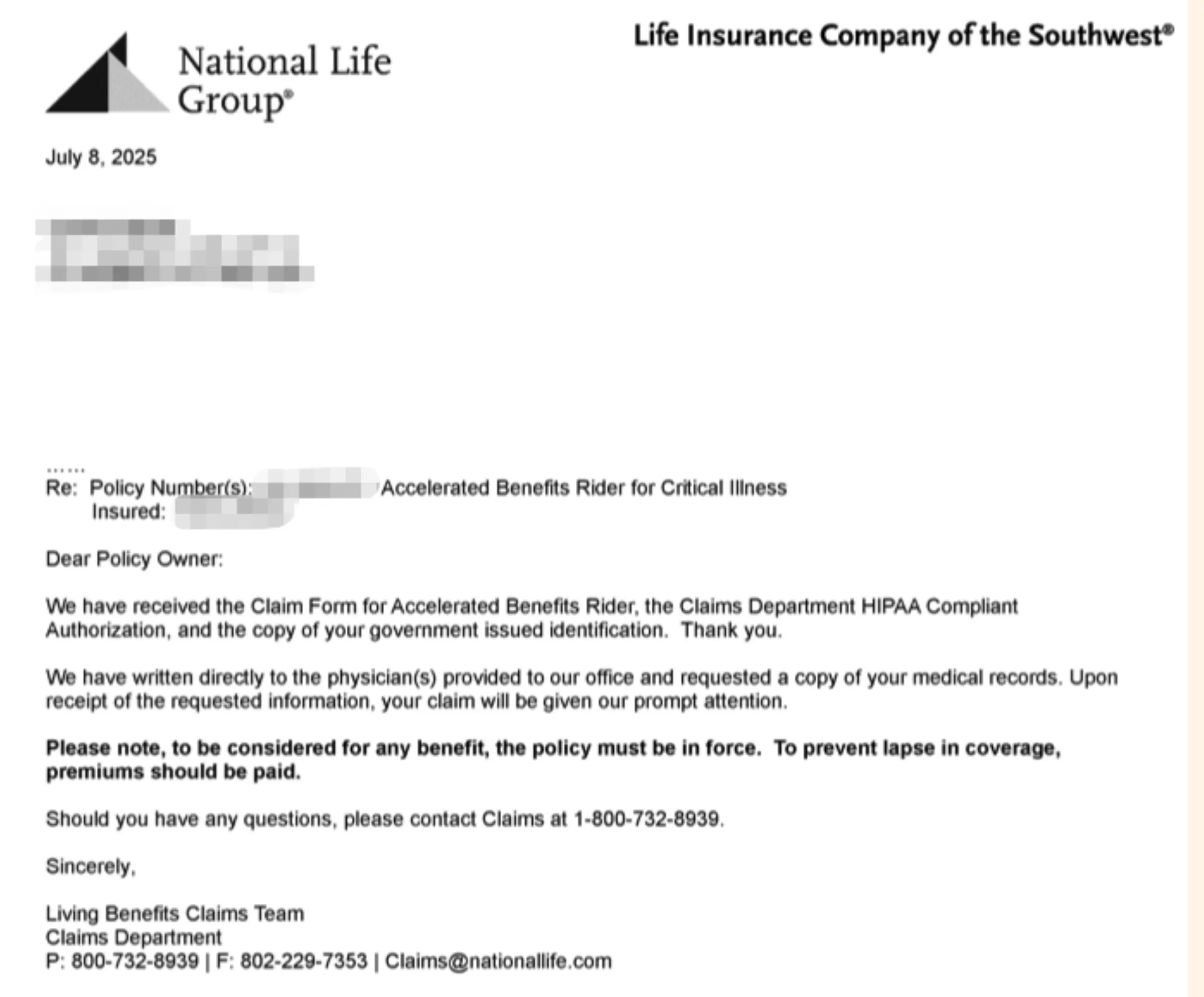
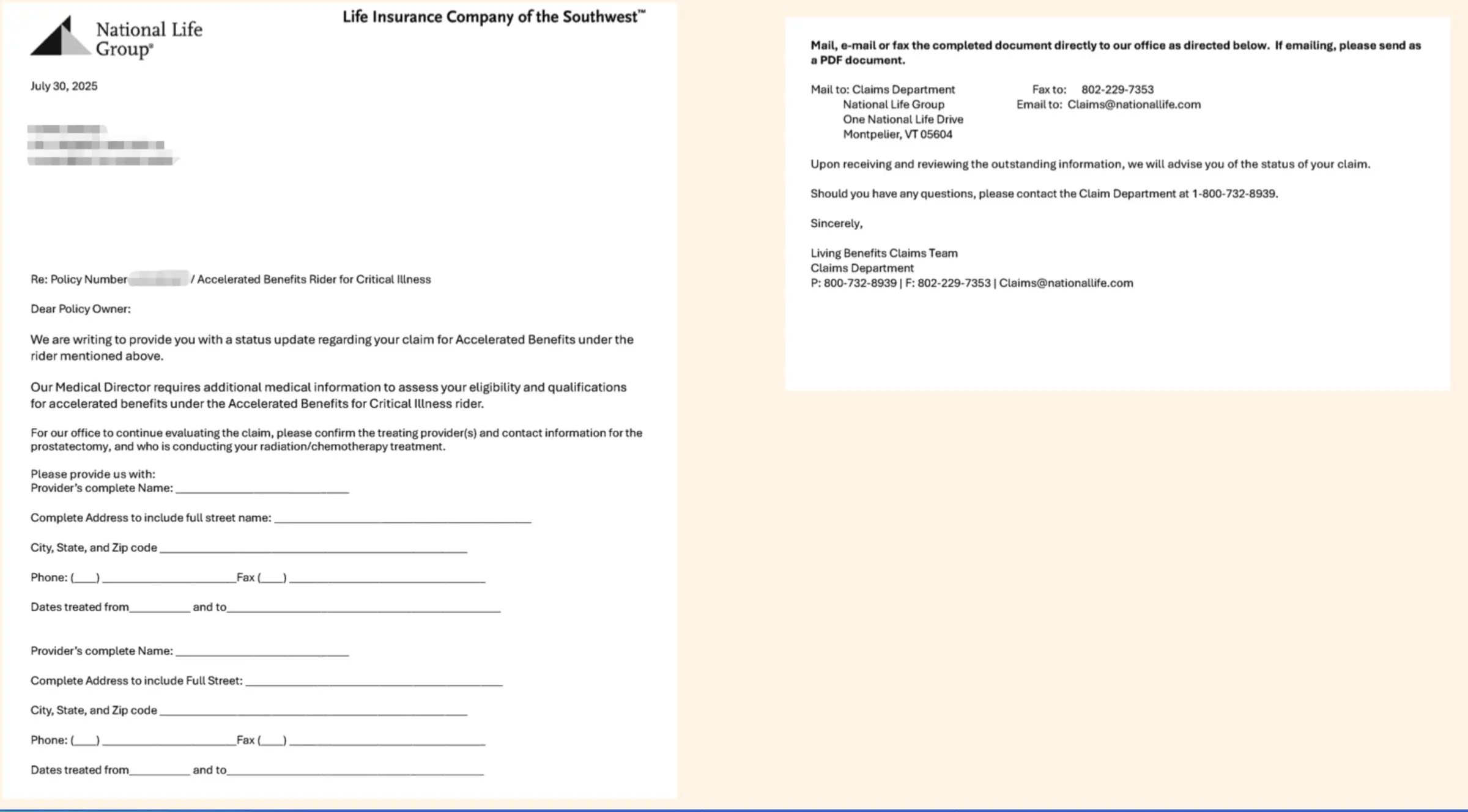
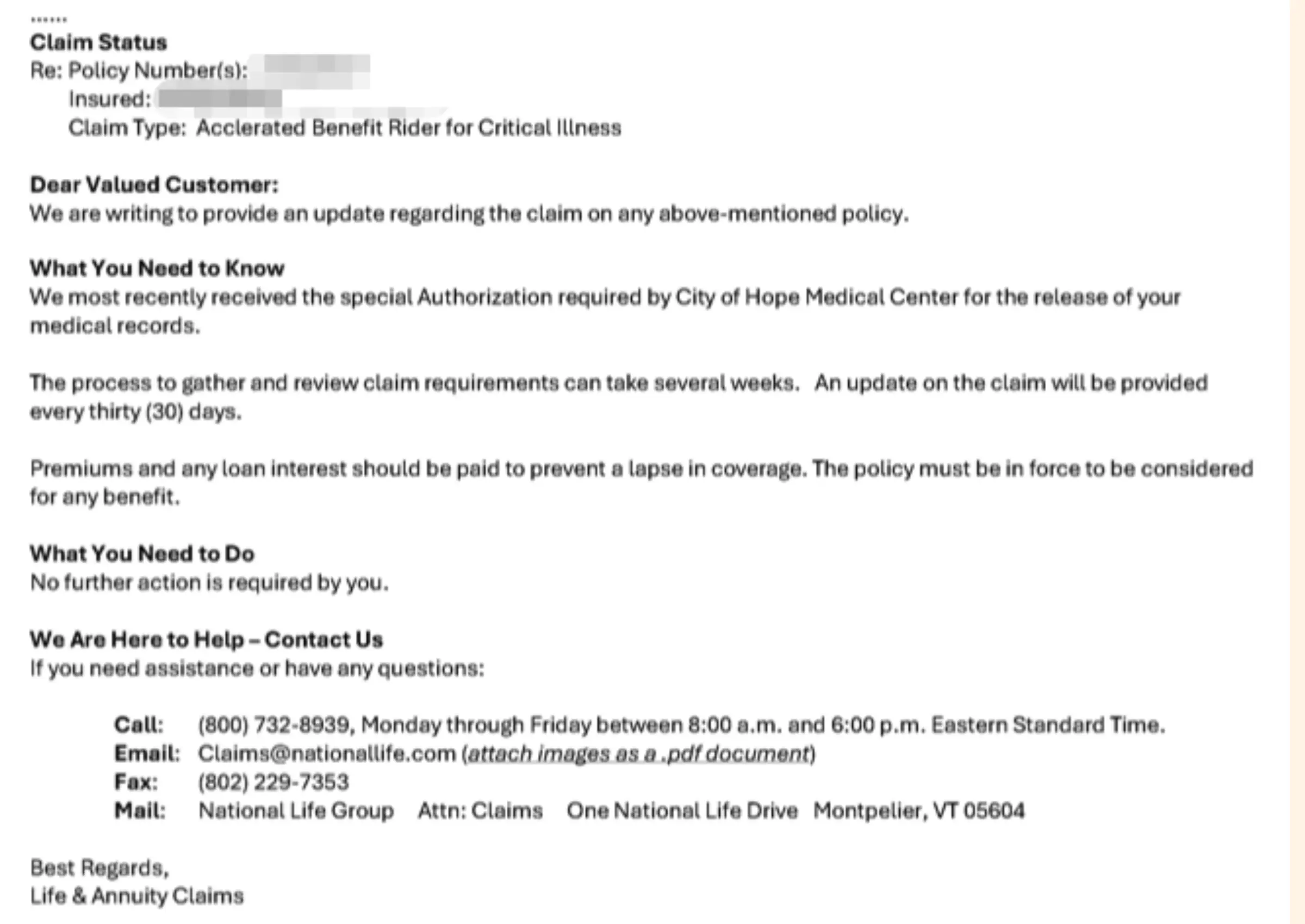
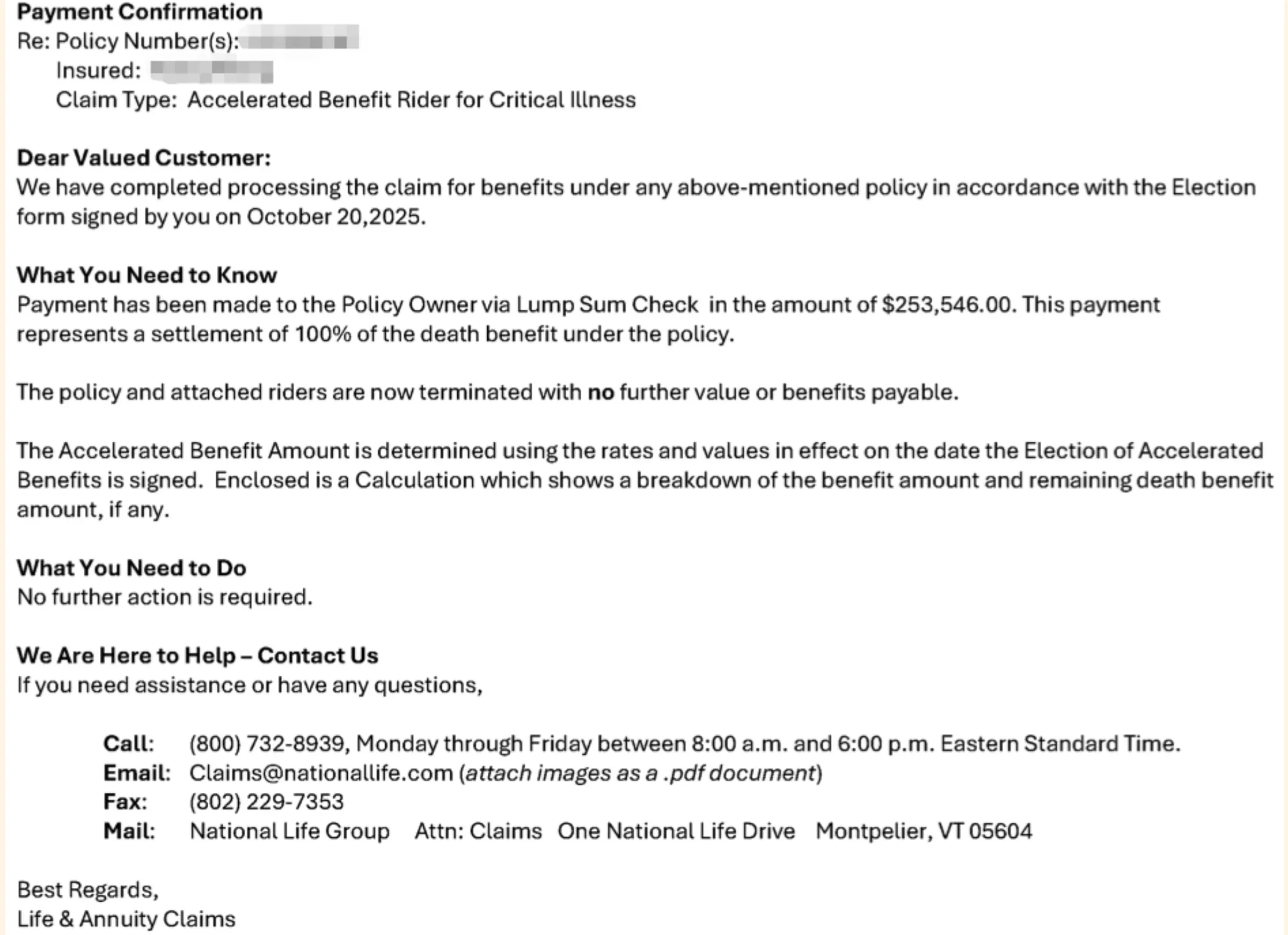
另一个重疾案例(幻灯片第 41–45 页的五份原件):2025 年 7 月 8 日确认收到理赔表,10 月 20 日签选择表, 前后约三个半月,中间要等医院放病历。客户选了加速 100%,支票 $253,546, 保单和附加条款随之终止,家人以后不会再有身故金。加速多少,要在签选择表之前和客户、家人一起想清楚; 金额按签字那天的利率和保单价值计算。
Another, a critical illness case (the five documents on slides 41–45): the claim form was acknowledged on July 8, 2025 and the election signed on October 20, about three and a half months including the wait for hospital records. The client chose to accelerate 100% and received $253,546, after which the policy and riders terminated and no death benefit remains for the family. Decide how much to accelerate with the client and family before the election is signed; the amount uses the rates and policy values on the signing date.
理赔前后要提醒客户的九件事Nine things to tell clients around a claim
- 送单时就确认签单后没有新的就医或诊断,两年可抗辩期内的理赔会被重点审查,附约可能被撤销。
- At delivery, confirm there have been no new doctor visits or diagnoses since signing; claims in the two-year contestable period get extra review and the rider can be rescinded.
- 医疗授权书不等于财务授权书。要趁头脑清楚先签财务持久授权书,特别是担心失智的客户;否则只能走法院监护。
- A medical POA isn't a financial POA. Sign a durable financial POA while capable (especially clients worried about dementia), or it's court guardianship.
- 理赔要时间:调病历可能要半年以上。不符合条件就不要申请。
- Claims take time: records can take six months or more. Don't apply if the conditions aren't met.
- 付款时保单必须有效:卖给保单贴现公司就没有生前福利了(国家人寿禁止经纪人招揽保单贴现)。
- The policy must be in force at payment: sold to a life settlement, the benefits are gone (National Life bars agents from soliciting settlements).
- 定期险保费要继续交;终身险可以用现金值扣,但有失效风险。
- Term premiums must continue; permanent policies can draw on cash value but risk lapsing.
- 生前福利一般不适用于在美国境外的理赔,理赔时需要美国执业医生。
- Living benefits generally don't apply to claims outside the US; a US-licensed physician is needed at claim.
- 钱付给持有人,不一定要用在被保险人的护理上。
- Payment goes to the owner, with no obligation to spend it on the insured's care.
- 慢性疾病:每次付款都要重新符合条件;第一笔包含那 90 天;通常把月额合成一年一次付。
- Chronic: each payment needs requalification; the first includes the 90 days; the monthly amount is usually paid annually as a lump sum.
- 要不要理赔:慢性疾病约 50 个月会用完保额,且每年要重新认证;有现金值的保单用贷款可能拿得更多、更久。 轻度重疾全额理赔会结束保单,客户之后可能买不到保险,贷款或提取也许更好(部分提取可能要交税)。启动 LIBR 后申领任何 ABR 都会终止 LIBR;累积期申领慢性疾病也会终止 LIBR。
- Claim or not? Chronic can use up the face in about 50 months with annual recertification; on a policy with cash value, a loan may pay more for longer. A full claim for a minor critical illness ends the policy and the client may be uninsurable afterwards, so a loan or withdrawal might be better (some withdrawals are taxable). Once LIBR income starts, any ABR election ends it; in accumulation, a chronic election ends it.
十、背后的数据10. The data behind it
出处:CDC FastStats,2024 年死亡数据(心脏病 683,491 人、中风 166,852 人,全部死亡 3,072,666 人); American Cancer Society,Lifetime Probability of Developing or Dying From Cancer(男性 39.9%、女性 39.0%;按 2018、2019、2021 年发病数据,2025 年 1 月更新); 美国社会安全局(SSA)长寿估算;Alzheimer's Association,《2026 Alzheimer's Disease Facts and Figures》。 这些数字每年更新,引用前查最新一年。
Sources: CDC FastStats, 2024 deaths (heart disease 683,491, stroke 166,852, all causes 3,072,666); American Cancer Society, Lifetime Probability of Developing or Dying From Cancer (men 39.9%, women 39.0%; incidence data from 2018, 2019 and 2021, revised January 2025); Social Security Administration longevity estimates; Alzheimer's Association, 2026 Alzheimer's Disease Facts and Figures. The figures are updated yearly; check the latest edition before quoting.
结论很直接:对绝大多数人来说, 「生一场需要花钱的大病」的概率,远高于「在工作年龄突然身故」的概率。 一张只保身故的保单,恰好错过了概率最高的那个风险。
The conclusion is direct: for most people, a serious, expensive illness is far more likely than sudden death during working years. A policy that only pays at death misses the most probable risk.
十一、30 年演进史11. Thirty years of rider development
首推末期疾病条款
First terminal illness rider
理赔门槛为 12 个月预期寿命。
With a 12-month life expectancy threshold.
首推慢性疾病条款
Chronic illness introduced
同时把末期疾病的门槛放宽到 24 个月。
And the terminal threshold extended to 24 months.
首张独立慢性疾病条款
First standalone chronic rider
等待期 5 年。
With a five-year waiting period.
推出重大疾病条款
Critical illness rider
—
—
慢性等待期缩短到 2 年
Chronic wait cut to two years
从 5 年降到 2 年。
Down from five.
进入纽约州
Into New York
成为纽约州最早提供慢性疾病条款的公司之一。
Among the first carriers to offer a chronic rider in New York.
末期与慢性额度提高
Higher caps
从 $100 万提高到 $150 万。
Terminal and chronic rose from $1M to $1.5M.
重疾扩项,首推重大伤害
Critical illness expanded, critical injury added
—
—
慢性等待期缩短到 30 天
Chronic wait cut to 30 days
从 2 年降到 30 天,这是幅度最大的一次。
From two years to 30 days, the largest single step.
新增阿兹海默条款
Alzheimer's rider added
—
—
十二、为什么很少有公司做得全12. Why so few carriers offer the full set
| 筛选条件Filter | 数量Count |
|---|---|
| 全美寿险公司总数Life insurers in the U.S. | 719 |
| 股份公司Stock companies | 532 |
| 互惠保险公司Mutual companies | 110 |
| 有末期与慢性生前福利的互惠公司Mutuals offering terminal and chronic | 31 |
| 再加上重大疾病条款…and critical illness | 9 |
| 再加上重大伤害、LIBR、阿尔茨海默与生育条款…and critical injury, LIBR, Alzheimer's and fertility | 1 |
公司总数与类型来源:ACLI《2025 Life Insurers Fact Book》。同业一直在追,讲这张表时说明年份。
Company counts and types: ACLI 2025 Life Insurers Fact Book. Competitors keep catching up, so say the year.
国家人寿兑现承诺的数字:2024 年 140 万客户、26.1 万张新保单、总给付 $29 亿,其中生前福利 $1.11 亿;2025 年生前福利给付 $1.28 亿。
National Life's promises kept: in 2024, 1.4 million customers, 261,000 new policies, $2.9 billion in total benefits including $111 million in living benefits; $128 million in living benefits in 2025.
内部培训资料,仅供签约经纪人使用,不可转发给客户。 条款定义、额度上限与等待期以保单条款和承保公司当期资料为准; 文中理赔金额取自具体个案,贴现率、现金值与病情分级不同,结果会完全不同, 不构成任何理赔金额的承诺。 税务部分是制度性介绍,不构成税务或法律建议, 保单持有人结构与理赔的税务处理请由客户自己的持照会计师或税务师确认。
Internal training material for contracted agents; not for forwarding to clients. Rider definitions, caps, and waiting periods are governed by the policy contract and the carrier's current material. Claim amounts shown come from specific cases; a different discount rate, cash value, or severity category produces a completely different result, and nothing here is a promise of any claim amount. The tax section is an overview and is not tax or legal advice; ownership structure and the tax treatment of a claim must be confirmed by the client's own licensed CPA or enrolled agent.