
Home/产品中心Products/保单贷款Policy Loans

团队建设 · 约 25 分钟Team Building · 25 min

保单贷款:四种方式与怎么选

Policy Loans: Four Ways, and How to Choose

"IUL 退休收入免税"说的就是这一步。钱不是取出来的,是借出来的。 差别在税上,也在留在账户里的那笔钱还能不能继续生息。

This is the step behind "tax-free retirement income." The money isn't withdrawn, it's borrowed. That changes the tax treatment, and whether what stays behind keeps earning.

幻灯片 · 26 页 · 每页下方附详细讲解Slides · 26 pages · full presenter notes under each ↓ 跳到全文↓ Skip to the full article

保单贷款Policy Loans

Presented by Team Rise

各位伙伴好,我们是 Team Rise。今天这一组只讲一件事:保单贷款。

Hello everyone, we're Team Rise. This set covers one thing only: policy loans.

为什么要单独拿出来讲?因为客户买 IUL,最常听到的一句话是「退休以后可以免税地把钱拿出来用」。 这句话背后的那个动作,就是保单贷款。钱不是「取」出来的,是「借」出来的。 如果我们自己讲不清楚借和取的差别、几种贷款方式怎么计息、借多了会出什么事, 这句话在客户那里就只是一句口号,甚至会变成以后的投诉。

Why give it a session of its own? Because the line clients hear most about an IUL is "in retirement you can take the money out tax-free." The action behind that line is the policy loan. The money isn't withdrawn, it's borrowed. If we can't explain the difference between borrowing and withdrawing, how each loan type is charged and credited, and what happens when someone borrows too much, that line is just a slogan to the client, and later it can turn into a complaint.

今天的顺序是这样的:先讲取钱和借钱的区别,再讲保单贷款是什么、拿来做什么、为什么用它; 然后是重点,国家人寿的四种贷款方式,一种一种用同一个例子算给大家看,最后放进一张对照表和一个真实计划书的案例; 接着讲怎么选、用完要不要还、拿多了会怎样,包括过度贷款保护条款;最后是 LIBR 终身收入条款、 手机 APP 和纸质表格怎么操作,以及传统终身寿的贷款做个对照。

Here's the order. First, the difference between withdrawing and borrowing; then what a policy loan is, what it's used for and why. Then the core: National Life's four loan types, each worked through on the same example, then one comparison table and a case from a real illustration. After that: how to choose, whether the loan has to be repaid, and what happens if someone takes too much, including the overloan protection rider. We finish with the LIBR lifetime income rider, how to request a loan in the mobile app and on paper, and a comparison with traditional whole life loans.

先说一句:今天所有的利率、封顶、奖金比例,都是做这份培训时的数值,会变。 所有金额都是演示,不是承诺。给客户报数之前,一律以当期产品资料和实际计划书为准。

One thing up front: every rate, cap and bonus today is the figure at the time this training was made, and they change. Every dollar amount is illustrative, not a promise. Before quoting a client, always use the current product material and the actual illustration.

从保单拿钱Taking Money Out of a Policy

提款 WithdrawalWithdrawal 贷款 LoanLoan
现金价值Accumulated ValueAccumulated value永久下降Down for good仍可继续增长Can keep growing
身故赔偿Death BenefitDeath benefit永久下降Down for good暂时减少(减少额 = 贷款本金 + 利息);还清后恢复Down for now (by principal + interest); restored once repaid
税务TaxTax增值部分要交税Gains are taxable贷款是负债,不是收入 → 不征税A loan is a debt, not income → not taxed
把钱「放回去」Putting it backPutting it back后续补回视为新保费 → 成本 / 条款可能重算Counts as new premium → charges and terms may be recalculated还款可选且灵活 → 还款后恢复身故赔偿(并减少利息负担)Repayment is optional and flexible → restores the death benefit (and cuts the interest)

从保单里拿钱,只有两条路:提款 Withdrawal,和贷款 Loan。这张表把两条路放在一起,一行一行比。

There are only two ways to take money out of a policy: a withdrawal, or a loan. This table puts them side by side, one row at a time.

第一行,现金价值。提款是真的把钱从账户里拿走了,账户永久变少,拿走的那部分以后不会再帮你增长。 贷款不一样:账户里的钱没有被拿走,只是被拿去作抵押,所以现金价值仍然可以继续增长。这是两者最根本的差别。

Row one, the accumulated value. A withdrawal really takes the money out of the account: the account is permanently smaller, and what was taken will never grow for you again. A loan is different: the money in the account isn't taken out, it's pledged as collateral, so the accumulated value can keep growing. That's the most basic difference between the two.

第二行,身故赔偿。提款以后,身故赔偿也跟着永久下降。贷款只是暂时减少,减少的金额等于贷款本金加利息; 比如借了 $20 万,没还之前万一身故,赔偿金里先扣掉这 $20 万和利息,剩下的给受益人。还清以后,身故赔偿恢复。

Row two, the death benefit. After a withdrawal, the death benefit drops permanently too. A loan only reduces it for now, by the principal plus interest. Say $200,000 is borrowed: if the insured dies before it's repaid, the $200,000 and its interest come out of the claim first and the rest goes to the beneficiary. Once the loan is repaid, the death benefit is restored.

第三行,税务。提款时,超过已交保费的增值部分要交税。贷款是负债,不是收入,所以不征税。 这就是「IUL 退休收入免税」的来源。注意前提:保单要一直有效,而且不是 MEC(改良型储蓄合同)。

Row three, tax. On a withdrawal, the gain above the premiums paid is taxable. A loan is a debt, not income, so it isn't taxed. That's where "tax-free retirement income from an IUL" comes from. Note the conditions: the policy has to stay in force, and it must not be a MEC, a modified endowment contract.

第四行,以后想把钱放回去。提款拿走的钱,以后再补进去,算的是新保费,保单的成本和一些条款可能要重新计算。 贷款的还款是可选的,也很灵活,可以全还、部分还、只付利息;还了以后身故赔偿恢复,利息负担也变小。

Row four, putting the money back later. Money that was withdrawn and later paid back in counts as new premium, so the policy's charges and some terms may be recalculated. Loan repayment is optional and flexible: all of it, part of it, or just the interest. Repaying restores the death benefit and lightens the interest.

所以一句话总结:提款是「拿走」,贷款是「借用」。下一页我们用两个生活里的比方,把这个区别讲得更直观。

In one line: a withdrawal takes the money away; a loan borrows against it. The next slide makes the difference more concrete with two everyday comparisons.

互动设计Interaction

先把右边一栏遮住,只给大家看左边的「提款」,问:「如果只有这一条路,你会想从保单里拿钱吗?」 再把右边打开,让大家自己说出两边差在哪几行。

Cover the right-hand column first and show only "withdrawal." Ask: "If this were the only way, would you want to take money out of a policy?" Then reveal the right side and let the room name which rows differ.

取钱和借出来有啥区别?Withdrawing vs Borrowing: What's the Difference?

钱包The wallet

取钱:把钱包里的钱直接拿出来,里面就少了,增值部分还要交税Withdrawing: taking cash straight out of the wallet. There's less inside, and the gain is taxed 借钱:把钱包当抵押,先借你一笔钱,钱包里的钱还在继续帮你生利息Borrowing: pledging the wallet to get a loan, while the money inside keeps earning for you

股票The shares

取钱:把股票直接卖了,把钱拿出来用,还有税的问题Withdrawing: selling the shares to use the cash, and owing tax on the sale 借钱:有钱人把股票抵押借钱出来用,没有卖出的税,股票继续涨还可以继续赚钱Borrowing: the wealthy pledge shares and borrow against them. No sale, no tax on a sale, and the shares can keep rising

客户第一次听「借自己的钱」,往往会问:「我自己的钱,为什么还要借?直接取不就好了?」 这一页就是用来回答这个问题的,两个比方,一个钱包,一个股票。

The first time clients hear "borrow your own money," they often ask: "It's my money, why would I borrow it? Why not just take it out?" This slide answers that, with two comparisons: a wallet and a stock portfolio.

先看左边的钱包。取钱,就是把钱包里的钱直接拿出来,钱包里就少了;而且取出来的如果有增值部分,还要交税。 借钱,是把钱包当作抵押,保险公司先借给你一笔钱,钱包里的钱一分没动,还在继续帮你生利息。

Start with the wallet on the left. Withdrawing means taking cash straight out, so there's less in the wallet; and if what comes out includes gains, those are taxed. Borrowing means pledging the wallet: the insurer lends you money first, and the money in the wallet isn't touched. It keeps earning for you.

再看右边的股票,这个比方对有投资经验的客户特别好用。取钱,就像把股票直接卖掉换成现金。卖出这一下,就有资本利得税。 借钱,就像很多有钱人做的:股票不卖,拿去抵押,借钱出来用。没有卖出,就没有卖出的税;股票继续涨,涨的部分还是自己的。

Now the shares on the right. This one works especially well with clients who invest. Withdrawing is like selling the shares for cash: the sale triggers capital gains tax. Borrowing is what many wealthy people do: keep the shares, pledge them, and borrow against them. No sale means no tax on a sale, and if the shares keep rising, the gain is still theirs.

讲到这里一定要补一句,免得客户只听到好的一半:借钱是有利息的。股票抵押借钱,利息要付,股票如果大跌, 银行还可能要求你补钱。保单贷款也一样有利息,借太多也会出问题。这些后面会专门讲。

At this point always add one sentence, so the client doesn't hear only the good half: borrowing costs interest. A loan against shares carries interest, and if the shares crash the bank can demand more collateral. A policy loan carries interest too, and borrowing too much causes trouble. We'll cover both later.

讲师提醒Presenter note

这里说的「税」是增值部分的所得税,不是「增值税」,别讲混了。另外「不征税」有前提:保单持续有效、不是 MEC。 不要说「借钱比取钱划算」这种绝对的话,说「借钱时,留在保单里的钱还可以继续计息」。

The "tax" here is income tax on the gain, not a sales or value-added tax; don't mix them up. And "not taxed" has conditions: the policy stays in force and isn't a MEC. Don't say "borrowing always beats withdrawing." Say "when you borrow, the money left in the policy can keep earning credits."

保单贷款What a Policy Loan Is

用已经存的钱(现金价值)做抵押,向保险公司 「借自己的钱」Pledge the money already saved (the cash value) and "borrow your own money" from the insurer

房屋二次抵押A home equity loan

房子市值 $80 万,房贷还剩 $50 万,净值 $30 万。银行让他抵押净值借出 $10 万周转A house worth $800k with $500k left on the mortgage has $300k of equity. The bank lends $100k against it

有钱人抵押股票The wealthy pledge shares

2022 年 Elon Musk 收购 Twitter,原本打算不卖特斯拉股票,而是抵押股票借 125 亿美元To buy Twitter in 2022, Elon Musk first planned not to sell Tesla shares but to pledge them for a $12.5 billion loan 股票继续涨,但贷款利息要付;股票暴跌,银行可能要求补钱The shares keep rising, but the interest is real; if they crash, the bank can demand more

保单贷款的定义就是最上面这一句:用已经存进去的钱,也就是现金价值,做抵押,向保险公司「借自己的钱」。 严格地说,保险公司借给你的是它自己的钱,你的现金价值是抵押品;所以你的钱还在保单里,没有被拿走。

The definition is the line at the top: pledge the money already saved, the cash value, and "borrow your own money" from the insurer. Strictly speaking, the insurer lends you its own money and your cash value is the collateral. That's why your money stays in the policy rather than being taken out.

左边是第一个比方,房屋二次抵押,几乎每个有房的客户都懂。一套房子市值 $80 万,房贷还剩 $50 万, 房主手上的净值就是 $30 万。银行允许他拿这 $30 万净值做抵押,借出 $10 万来周转。 房子没有卖,还是他的,房价涨了照样是他的;只是多了一笔要付利息的贷款。

On the left is the first comparison, a home equity loan, which nearly every homeowner understands. A house is worth $800,000 with $500,000 left on the mortgage, so the owner has $300,000 of equity. The bank lets him pledge that equity and borrow $100,000. The house isn't sold; it's still his, and any rise in value is still his. He just has a loan with interest on top.

右边是第二个比方,有钱人抵押股票。2022 年 Elon Musk 要收购 Twitter,最初的融资方案里, 就有一笔用特斯拉股票做抵押、借 125 亿美元的贷款,而不是直接卖股票。为什么?卖股票要交税,而且卖了以后股票再涨就和他无关了。 后来他改了融资方式,但这个思路很典型。

On the right is the second comparison: the wealthy pledging shares. When Elon Musk set out to buy Twitter in 2022, his first financing plan included a $12.5 billion loan secured by Tesla shares, rather than selling them. Why? Selling triggers tax, and once sold, any further rise is no longer his. He later changed the financing, but the logic is a textbook case.

但请一定把下面这一句也讲给客户听:股票继续涨固然好,可贷款利息是要付的;股票如果暴跌,抵押品不够了, 银行可能要求他补钱。保单贷款也有一模一样的道理,借了要付利息,借多了保单可能撑不住。 后面讲「拿钱拿多了」和「过度贷款保护条款」的时候,就是在讲这一半。

But be sure to tell clients the next line as well: the shares rising is nice, but the loan interest has to be paid, and if the shares crash and the collateral falls short, the bank can demand more money. A policy loan works exactly the same way: borrowing costs interest, and borrowing too much can leave the policy unable to carry it. When we get to "taking too much" and the overloan protection rider, this is the half we'll be talking about.

讲师提醒Presenter note

Musk 的例子只讲「原本计划抵押股票借钱」这一点,不要报他持股市值之类的数字,那些数字每天在变,也没法在台上核实。

Use the Musk example only for "his first plan was to borrow against his shares." Don't quote the value of his holdings or similar figures; they change daily and can't be checked from the stage.

保单贷款用途What Policy Loans Are Used For

  • 应急基金:3–6 个月固定开支Emergency fund: 3–6 months of fixed costs
  • 公司周转基金:3 个月运营成本Business working capital: 3 months of operating costs
  • 教育基金Education fund
  • 买房基金Home purchase fund
  • 退休金Retirement income
  • 信托流动性基金Liquidity for a trust

保单贷款拿来做什么?这一页列了最常见的六种用途,其实远不止这些。

What do people use policy loans for? This slide lists the six most common uses, and there are many more.

第一,应急基金。一般建议准备 3 到 6 个月的固定开支:房贷或房租、车贷、保险、水电、孩子的费用。 突然失业、生病、家里出事,这笔钱要随时拿得出来。下一页我们用一张医疗保险卡说明,为什么这笔钱很实际。

First, an emergency fund. The usual advice is three to six months of fixed costs: mortgage or rent, car payment, insurance, utilities, the kids' expenses. A sudden job loss, an illness, a family emergency: this money has to be available at any moment. The next slide uses a health insurance card to show why it's so practical.

第二,公司周转基金,特别适合做生意的客户。建议留 3 个月的运营成本:工资、房租、货款。 生意上的现金流常常是忽紧忽松的,银行贷款要审批、要看报表,保单贷款不查信用,到账快。

Second, working capital for a business, especially for business-owner clients. The guideline is three months of operating costs: payroll, rent, inventory. Business cash flow is often tight one month and loose the next. A bank loan needs approval and financial statements; a policy loan needs no credit check and pays out quickly.

第三、第四,教育基金和买房基金。孩子上大学、首付不够,都是一次性的大笔支出。 第五,退休金:这是 IUL 最常见的用法,退休后每年从保单里借一笔出来,当作生活费。 第六,信托的流动性基金:保单放在信托里,信托需要现金支付费用或者分配给受益人时,可以从保单借。

Third and fourth, an education fund and a home purchase fund: college tuition, or a down payment that falls short, are both large one-off costs. Fifth, retirement income: this is the most common use of an IUL, borrowing an amount from the policy each year in retirement to live on. Sixth, liquidity for a trust: when a policy is held in a trust and the trust needs cash to pay expenses or make distributions, it can borrow from the policy.

共同点是什么?都是「需要一笔钱,但又不想把长期的资产卖掉或者取出来」的时候。 这也是我们跟客户聊需求时的一个切入口:你家里有没有这样一笔随时能用、又不影响长期增长的钱?

What do they have in common? They're all moments when someone needs money but doesn't want to sell or cash out a long-term asset. That's also a good opening when we talk needs with clients: does your family have money like this, available any time, without disturbing long-term growth?

互动设计Interaction

请大家各自想一个自己或身边人「急需一笔钱」的真实场景,在聊天框里打出来,然后对照这六种用途归类。

Ask everyone to think of a real moment when they, or someone close, suddenly needed money, type it in the chat, and then sort the answers into these six uses.

应急基金The Emergency Fund

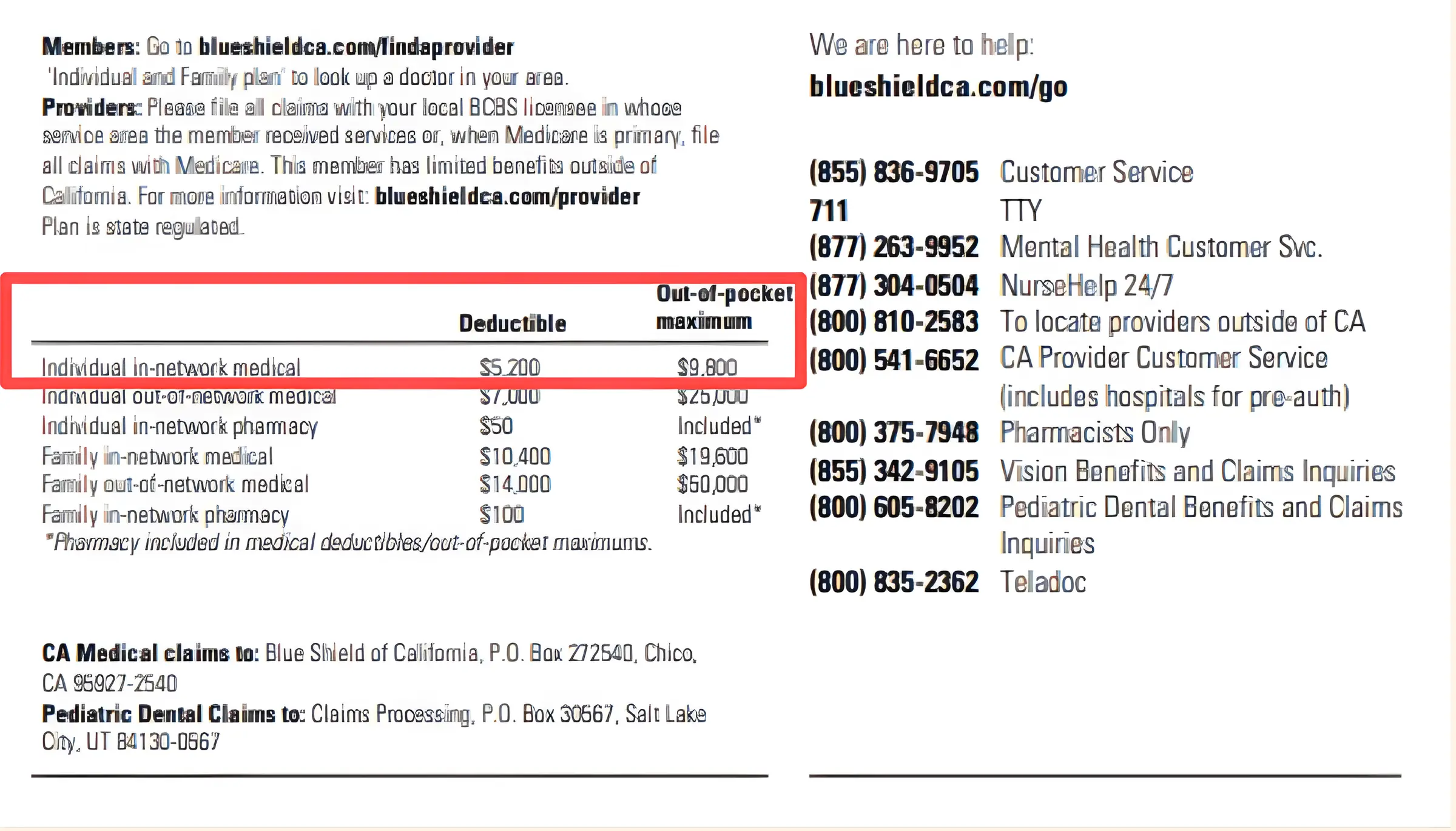
加州一份医疗保险计划卡背面:个人网内医疗免赔额 $5,200、每年自付上限 $9,800(红框),网外 $7,000 / $25,000,家庭网内 $10,400 / $19,600,网外 $14,000 / $50,000 / Back of a California health plan card: individual in-network deductible $5,200 and out-of-pocket maximum $9,800 (boxed in red); out of network $7,000 / $25,000; family in-network $10,400 / $19,600, out of network $14,000 / $50,000

有医保,生一场病自己也可能要先掏将近 $1 万Even with insurance, one illness can cost close to $10,000 out of pocket

为什么应急基金这么重要?我们不讲道理,直接看一张真实的医疗保险卡背面。这是加州一份个人医疗保险计划, 卡背面印着每年的免赔额和自付上限。

Why does an emergency fund matter so much? Rather than argue it, let's look at the back of a real health insurance card. This is an individual health plan in California, and the back of the card lists the annual deductible and out-of-pocket maximum.

看红框这一行,个人、网内医疗:免赔额 $5,200,每年自付上限 $9,800。 意思是,一年之内看病的费用,前 $5,200 要自己付,保险公司才开始分担;分担以后自己还要付一部分, 最多一年自己付到 $9,800 为止。如果去的是网外医院,自付上限是 $25,000。 家庭计划的数字再翻一倍:网内 $19,600,网外 $50,000。

Look at the row boxed in red, individual in-network: a $5,200 deductible and a $9,800 out-of-pocket maximum. That means within a year, the first $5,200 of medical bills is yours before the insurer starts sharing; after that you still pay a share, up to $9,800 for the year. Out of network, the maximum is $25,000. The family plan roughly doubles those figures: $19,600 in network, $50,000 out of network.

很多客户以为「我有医保就没事了」。其实有医保,生一场病、住一次院,自己先掏将近 $1 万是很正常的。 如果这时候正好收入也中断了,压力就更大。这就是为什么我们说应急基金要准备 3 到 6 个月的固定开支。

Many clients think, "I have health insurance, so I'm fine." In fact, with insurance, one illness or one hospital stay can easily cost close to $10,000 out of pocket. If income stops at the same time, the pressure is worse. That's why we say an emergency fund should hold three to six months of fixed costs.

这笔钱放在哪?放活期存款,利息很低;放股票,急用的时候可能正好在跌。 保单的现金价值是一个选项:平时在保单里按指数策略计息,有 0% 保底;急用的时候用保单贷款拿出来,不查信用,到账快, 等情况好转再慢慢还回去。注意,这要建立在保单已经有足够现金价值的基础上,新保单前几年不适合这样用,后面会讲。

Where should that money sit? In a savings account it earns very little; in stocks it may be down just when it's needed. A policy's cash value is one option: day to day it earns index credits with a 0% floor; when it's needed, a policy loan brings it out with no credit check and a quick payout, and it can be repaid gradually once things settle. Note this assumes the policy already has enough cash value. A new policy isn't suited to this in its first years, as we'll cover later.

互动设计Interaction

请大家拿出自己的医保卡,看看背面的免赔额和自付上限是多少。很多人是第一次认真看这两个数字。

Ask everyone to take out their own health insurance card and find the deductible and out-of-pocket maximum on the back. For many it's the first time they've really looked at those two numbers.

为什么要保单贷款Why Use a Policy Loan

  • 免税Not taxed
  • 速度快 & 不查信用Fast, and no credit check
  • 还款灵活:随借随还 / 部分还 / 只付利息 / 甚至不还Flexible repayment: any time, in part, interest only, or not at all
  • 现金价值继续增长:保单的「存款」继续积累利息The cash value keeps growing: the policy's "savings" keep earning

为什么要用保单贷款,而不是别的方式拿钱?四个理由。

Why use a policy loan rather than some other way of raising money? Four reasons.

第一,免税。前面讲过,贷款是负债,不是收入,所以借出来的钱不用报税。 前提还是那两条:保单持续有效,而且不是 MEC。

One, it isn't taxed. As we covered, a loan is a debt, not income, so the money borrowed isn't reported as income. The same two conditions apply: the policy stays in force, and it isn't a MEC.

第二,速度快,而且不查信用。向银行借钱要填申请、查信用分数、看收入证明,等审批。 保单贷款的抵押品就是保单本身的现金价值,所以不需要查信用,在手机 APP 上几分钟就能申请, 后面我们会一步一步演示。

Two, it's fast and there's no credit check. Borrowing from a bank means an application, a credit check, proof of income, and waiting for approval. A policy loan is secured by the policy's own cash value, so no credit check is needed, and it can be requested in the mobile app in a few minutes. We'll walk through that step by step later.

第三,还款灵活。银行贷款有固定的还款计划,晚还一期就影响信用。保单贷款没有固定的还款时间表: 可以随借随还,可以只还一部分,可以只付利息,甚至可以不还,最后理赔时从身故赔偿里结清。 当然,「可以不还」不等于「不用管」,借多了会出问题,后面专门讲。

Three, repayment is flexible. A bank loan has a fixed schedule, and one late payment hits your credit. A policy loan has no fixed repayment schedule: repay any time, repay part of it, pay only the interest, or don't repay at all and have it settled from the death benefit at claim. Of course, "no need to repay" doesn't mean "no need to watch it." Borrowing too much causes trouble, which we'll cover separately.

第四,也是最重要的一条,标成了重点:现金价值继续增长。借钱的时候,保单里的「存款」并没有被拿走, 还在继续积累利息。这就是保单贷款和从银行账户里取钱最大的不同。 至于被抵押的那部分钱怎么计息,取决于你选的贷款方式,这就是下一页开始的重点内容。

Four, and the most important, highlighted: the cash value keeps growing. While you borrow, the policy's "savings" aren't taken out; they keep earning. That's the biggest difference from taking money out of a bank account. How the pledged portion is credited depends on which loan type you choose, and that's the core of what starts on the next slide.

合规提醒Compliance note

不要说「借钱不花钱」「借出来还能赚钱」。可以这样说:「借钱的时候,留在保单里的钱还可以继续计息; 贷款本身有利息,具体成本看贷款方式和当年的指数表现。」

Don't say "borrowing costs nothing" or "you make money while you borrow." Say instead: "While you borrow, the money left in the policy can keep earning credits; the loan itself carries interest, and the actual cost depends on the loan type and that year's index performance."

保单贷款四种方式Four Kinds of Policy Loan

  • 标准贷款 Standard LoanStandard Loan
  • 参与型贷款:借出的钱继续参与指数策略Participating loans: the borrowed amount stays in an index strategy
    • 固定利息 Participating Fixed LoanFixed rate: Participating Fixed Loan
    • 浮动利息 Participating Variable LoanVariable rate: Participating Variable Loan
    • 奖金型 Participating Declared LoanDeclared rate with bonus: Participating Declared Loan

国家人寿的 IUL 有四种贷款方式。先记住这个大结构:一种标准贷款,加三种参与型贷款。

National Life's IULs offer four loan types. Remember the overall shape first: one standard loan, plus three participating loans.

标准贷款,英文 Standard Loan。它的特点是:被抵押的那部分钱不再跟指数走,而是拿一个返还利息,和贷款利息互相抵消。 第 11 年起两边利差为 0,所以很多人叫它「无息贷款」;前 10 年差 0.5%。下一页细讲。

The standard loan. Its feature: the pledged portion stops following the index and instead earns a credited rate that offsets the loan interest. From year 11 the spread between the two is zero, which is why many people call it an "interest-free loan"; in the first ten years there's a 0.5% gap. The next slide goes into detail.

参与型贷款,英文 Participating Loan。「参与」两个字是关键:借出来的钱,在保单里仍然继续参与指数策略计息。 指数好的年份,计息可能高过贷款利息;指数不好的年份,就有净成本。参与型又按贷款利率怎么定,分成三种。

Participating loans. The word "participating" is the key: the borrowed amount keeps participating in an index strategy inside the policy. In good index years the credit may beat the loan interest; in bad years there's a net cost. Participating loans split into three by how the loan rate is set.

固定利息 Participating Fixed Loan:贷款利率固定不变。浮动利息 Participating Variable Loan:贷款利率随市场变化。 奖金型 Participating Declared Loan:贷款利率由国家人寿宣布,但借出的金额另外有利息奖金。

Participating Fixed Loan: the loan rate is fixed. Participating Variable Loan: the loan rate moves with the market. Participating Declared Loan: National Life declares the loan rate, and the borrowed amount earns an extra interest bonus.

接下来我们会用同一个例子把四种一种一种算一遍:现金价值 $30 万,借出 $20 万,剩下 $10 万;保额 $100 万。 大家记住这几个数,后面每一页都是它。

Next we'll work through all four on the same example: $300,000 of cash value, $200,000 borrowed, $100,000 remaining, and a $1 million death benefit. Keep those numbers in mind; every slide that follows uses them.

讲师提醒Presenter note

四种方式是国家人寿 IUL 的贷款设计,不同产品、不同版本能选的不完全一样(例如固定利息参与贷款在表格上标的是「如适用」)。 做方案时以该产品的合同和计划书系统为准。

These four are how National Life's IULs structure loans; which ones are available varies by product and version (the loan form, for example, marks the participating fixed loan "if available"). When designing a case, follow that product's contract and the illustration system.

标准贷款 Standard LoanThe Standard Loan

现金价值Cash value$30 万$300k
剩余Remaining$10 万$100k继续跟随标普 500 增长keeps tracking the S&P 500
贷款出来Borrowed$20 万$200k被抵押部分拿返还利息collateral earns the credited rate
保额Death benefit$100 万 → $80 万$1M → $800k
贷款利率Loan rate返还利息Credited利差Spread
第 1–10 年Years 1–105.5%5.0%0.5% 费用0.5% cost
第 11 年起Year 11 on5.5%5.5%互相抵消Offset
第 11 年起:无论贷款利率多少,年底都返还相同的利息增长From year 11: whatever the loan rate, the same interest is credited back at year end

利差为 0 不等于没有成本:贷款本息仍会减少身故赔偿和可用现金价值A zero spread isn't zero cost: the loan and its interest still reduce the death benefit and available cash value

第一种,标准贷款 Standard Loan。我们用刚才说好的例子:现金价值 $30 万,从里面贷款出来 $20 万,剩下 $10 万。

The first type, the standard loan. Use the example we agreed on: $300,000 of cash value, $200,000 borrowed against it, $100,000 remaining.

先看左边。剩下没被抵押的 $10 万,照常放在指数策略里,继续跟随标普 500 增长,和没借钱的时候一样。 被抵押的那 $20 万,在标准贷款下不再跟指数走,而是转到一个贷款抵押账户,拿保险公司给的「返还利息」。 左下角是保额:借了 $20 万,身故赔偿就从 $100 万暂时变成 $80 万。

Start on the left. The $100,000 that isn't pledged stays in the index strategy and keeps tracking the S&P 500, just as if nothing were borrowed. Under a standard loan, the $200,000 that is pledged stops following the index; it moves to a loan collateral account and earns a credited rate from the insurer. Bottom left is the death benefit: with $200,000 borrowed, it drops for now from $1 million to $800,000.

再看右边这张小表,标准贷款的关键在时间。保单第 1 到 10 年,贷款利率 5.5%,返还利息 5.0%, 两边抵消后剩 0.5% 的费用。放到 $20 万上,一年付利息约 $11,000,返还约 $10,000,净成本约 $1,000。

Now the small table on the right. With a standard loan, timing is everything. In policy years 1 to 10, the loan rate is 5.5% and the credited rate is 5.0%, leaving a 0.5% cost after they offset. On $200,000 that's about $11,000 of interest charged and about $10,000 credited back, a net cost of about $1,000 a year.

保单第 11 年起,无论贷款利率是多少,年底保险公司都返还相同的利息增长:收 5.5%,返 5.5%,两边互相抵消, 利差为 0。这就是为什么大家习惯叫它「无息贷款」。严格说,前 10 年是 0.5% 的低利差,第 11 年起利差才是 0。

From policy year 11, whatever the loan rate, the insurer credits back the same interest at year end: 5.5% charged, 5.5% credited, the two cancel and the spread is zero. That's why people call it an "interest-free loan." Strictly, the first ten years carry a low 0.5% spread, and the zero spread starts in year 11.

还有一个细节:贷款利率不是写死的。我们这里用 5.5% 是为了好算,后面对照表上会看到,标准贷款的利率是浮动的, 上限是基础利率加 3%。但不管利率怎么变,第 11 年起返还的利息都跟着一起变,所以利差始终是 0。

One more detail: the loan rate isn't fixed in stone. We use 5.5% here because it's easy to work with; on the comparison table later you'll see the standard loan rate floats, capped at the base rate plus 3%. But however the rate moves, from year 11 the credited rate moves with it, so the spread stays at zero.

最后请大家注意右下角这行小字:利差为 0,不等于完全没有成本。贷款余额还在,利息不另外付就会滚进余额里, 身故时从赔偿里扣,可用的现金价值也跟着少。而且被抵押的 $20 万错过了指数好的年份,只拿固定返还,这本身也是一种机会成本。

Finally, note the small print bottom right: a zero spread isn't zero cost. The loan balance is still there; interest not paid separately is added to it, comes out of the death benefit at claim, and the available cash value shrinks with it. And the pledged $200,000 misses the good index years, earning only the fixed credit, which is an opportunity cost of its own.

合规提醒Compliance note

不要说「第 11 年起借钱完全免费」「零成本贷款」。可以这样说:「第 11 年起贷款利差为 0, 但贷款本息仍会减少身故赔偿和可用现金价值。」5.5%、5.0% 是演示数字,实际利率以合同和保险公司当期公布为准。

Don't say "from year 11 borrowing is free" or "a zero-cost loan." Say instead: "From year 11 the loan spread is zero, but the loan and its interest still reduce the death benefit and the available cash value." The 5.5% and 5.0% are illustrative; actual rates follow the contract and the carrier's current declared rates.

参与贷款 Participating LoanThe Participating Loan

现金价值Cash value$30 万$300k
剩余Remaining$10 万$100k继续跟随标普 500 增长keeps tracking the S&P 500
贷款出来Borrowed$20 万$200k利息增长跟随标普 500credited with the S&P 500
保额Death benefit$100 万 → $80 万$1M → $800k
贷款利率 5.5%Loan rate 5.5%
指数 +11% → 获利 5.5%Index +11% → gain 5.5%
指数 0% → 费用 5.5%Index 0% → cost 5.5%
  • 固定利息:贷款利率固定在 5%Fixed: the loan rate is fixed at 5%
  • 浮动利息:跟随市场贷款利率变化Variable: follows market lending rates
  • 奖金型:贷款利率国家人寿定,另给利息奖金Declared: National Life sets the rate and adds an interest bonus

第二大类,参与贷款 Participating Loan。还是同一个例子:现金价值 $30 万,贷款出来 $20 万,剩余 $10 万,保额 $100 万变成 $80 万。

The second family, the participating loan. Same example: $300,000 of cash value, $200,000 borrowed, $100,000 remaining, and the death benefit going from $1 million to $800,000.

和标准贷款的区别只有一个地方,但这个地方决定了一切:被抵押的那 $20 万,不转去拿固定返还, 而是留在指数策略里,利息增长继续跟随标普 500。这就是「参与」两个字的意思:借出去的钱,还在参与指数计息。

There's only one difference from the standard loan, but it decides everything: the pledged $200,000 doesn't move over to earn a fixed credit. It stays in the index strategy, and its interest keeps tracking the S&P 500. That's what "participating" means: the borrowed money is still participating in index credits.

那成本怎么算?看右边,贷款利率假设 5.5%。指数好的年份,比如记入封顶的 11%,11% 减掉 5.5% 的利息,获利 5.5%; 放到 $20 万上,大约多 $11,000。指数不好的年份,记入 0%:0% 保底保护的是现金价值不跟着指数亏, 但 5.5% 的贷款利息照样要算,这一年就是 5.5% 的费用,大约 $11,000 的净成本。

So what does it cost? Look on the right, with a loan rate of 5.5%. In a good index year, say the 11% cap is credited, 11% minus 5.5% interest is a 5.5% gain, about $11,000 on $200,000. In a bad year the credit is 0%. The 0% floor stops the cash value from falling with the index, but the 5.5% loan interest still runs, so that year costs 5.5%, a net cost of about $11,000.

所以参与贷款是一把双刃剑:好年份,借钱的同时账户还在长;坏年份,有实实在在的净成本。 长期下来是赚是亏,取决于指数平均记入的利率能不能跑赢贷款利率。

So a participating loan cuts both ways: in good years the account keeps growing while you borrow; in bad years there's a real net cost. Whether it comes out ahead over time depends on whether the average credited rate beats the loan rate.

右下角是参与贷款的三种细分,区别全在贷款利率怎么定。固定利息:贷款利率固定在 5%,不随市场变。 浮动利息:贷款利率跟着市场利率走,可高可低。奖金型:贷款利率由国家人寿自己宣布,但借出去的金额另外给一点利息奖金。 接下来几页一种一种看。

Bottom right are the three variants of the participating loan, and they differ only in how the loan rate is set. Fixed: the rate is fixed at 5% and doesn't move with the market. Variable: the rate follows market rates, up or down. Declared: National Life declares the rate itself but adds a small interest bonus on the amount borrowed. We'll take them one at a time over the next few slides.

合规提醒Compliance note

不要说「借钱还能赚钱」「稳赚利差」。可以这样说:「指数好的年份,计息可能高过贷款利息; 指数不好的年份,这笔贷款有净成本。」11%、0%、5.5% 都是演示数字,实际封顶和利率以当期产品为准。

Don't say "you make money while you borrow" or "a guaranteed spread." Say instead: "In good index years the credit may beat the loan interest; in bad years the loan has a net cost." The 11%, 0% and 5.5% are illustrative; actual caps and rates follow the current product.

互动设计Interaction

问大家:如果连续三年指数都是 0%,利息又没有另外付,这 $20 万的贷款三年后滚到多少? (按 5.5% 复利约 $234,848,多出约 $34,848。)让大家自己说出「要每年检视」。

Ask: if the index credits 0% three years running and the interest isn't paid, what does the $200,000 loan grow to? (At 5.5% compounded, about $234,848, roughly $34,848 more.) Let them arrive at "review it every year" themselves.

固定利息 参与贷款Participating Fixed Loan

现金价值Cash value$30 万$300k
剩余Remaining$10 万$100k继续跟随标普 500 增长keeps tracking the S&P 500
贷款出来Borrowed$20 万$200k进指数贷款账户,封顶 9.5%indexed loan account, 9.5% cap
贷款利率 5% 固定不变Loan rate fixed at 5%
指数 +9.5% → 获利 4.5%Index +9.5% → gain 4.5%
指数 0% → 费用 5%Index 0% → cost 5%

参与贷款的第一种:固定利息参与贷款,Participating Fixed Loan。名字已经说明了特点:贷款利率固定在 5%,不随市场变动。

The first participating variant: the participating fixed loan. The name says it: the loan rate is fixed at 5% and doesn't move with the market.

但有一个代价要讲清楚。被抵押的 $20 万还是参与指数计息,但它不是留在原来的指数账户,而是转到一个单独的 「指数贷款账户」。这个账户同样跟着标普 500,但封顶比原来低:原来的账户封顶 11%,这里只有 9.5%。

But there's a trade-off to spell out. The pledged $200,000 still earns index credits, but it doesn't stay in the original index account; it moves to a separate indexed loan account. That account also tracks the S&P 500, but with a lower cap: 9.5% here, against 11% in the original account.

所以算账是这样的:指数好的年份,最多记入 9.5%,减掉 5% 的利息,获利 4.5%,$20 万上大约 $9,000。 指数不好的年份记 0%,费用是 5%,大约 $10,000。

So the maths runs like this: in a good year, at most 9.5% is credited; minus 5% interest, that's a 4.5% gain, about $9,000 on $200,000. In a bad year the credit is 0% and the cost is 5%, about $10,000.

和上一页 5.5% 的例子比:好年份的上限低了,从 5.5% 降到 4.5%;坏年份的成本也低了,从 5.5% 降到 5%。 更重要的是确定性:不管以后市场利率涨到多少,这笔贷款的利率都是 5%。 你可以把它理解成「用一点上行空间,换一个锁定的利率」。

Compared with the 5.5% example on the last slide: the best-year gain is lower, 4.5% instead of 5.5%, and the bad-year cost is lower too, 5% instead of 5.5%. More importantly, it's certain: however high market rates go later, this loan stays at 5%. Think of it as giving up a little upside in exchange for a locked rate.

什么时候这个锁定特别有价值?当市场利率高、而且可能继续往上走的时候。后面「如何选择」那一页会讲到: 当前贷款利率高于 5%,就优先考虑固定利息。

When is that lock especially valuable? When market rates are high and may keep rising. The "how to choose" slide later puts it this way: when current loan rates are above 5%, look at the fixed option first.

讲师提醒Presenter note

9.5% 是这个指数贷款账户当时的封顶,会随产品调整;固定利息参与贷款在部分产品上标注「如适用」,做方案前先确认能不能选。

The 9.5% is that indexed loan account's cap at the time and is revised with the product; on some products the participating fixed loan is marked "if available," so confirm it can be chosen before designing a case.

浮动利息 参与贷款Participating Variable Loan

  • 贷款利率随穆迪(Moody's)公司债券指数变化,上限为基础策略利率 + 3%(目前上限 6.5%)The rate tracks Moody's corporate bond index, capped at the base strategy rate + 3% (currently 6.5%)
  • 目前是 5.6%,疫情期间最低时为 2.3%Currently 5.6%; at its pandemic low it was 2.3%

现金价值 $30 万 · 贷款出来 $20 万 · 剩余 $10 万;借出的钱留在原始指数账户(封顶 11%)$300k cash value · $200k borrowed · $100k remaining; the borrowed amount stays in the base index account (11% cap)

贷款利率Loan rate指数 +11%Index +11%指数 0%Index 0%
5.6%目前5.6%now获利 5.4%Gain 5.4%费用 5.6%Cost 5.6%
2.3%疫情期间2.3%pandemic low获利 8.7%Gain 8.7%费用 2.3%Cost 2.3%

第二种,浮动利息参与贷款,Participating Variable Loan。它和固定利息正好相反:贷款利率随市场变动。

The second variant, the participating variable loan. It's the opposite of the fixed one: the loan rate moves with the market.

它跟的是穆迪公司债券指数,Moody's corporate bond index。市场利率高,贷款利率就高;市场利率低,贷款利率就低。 但有一个上限:基础策略利率加 3%。现在基础策略利率是 3.5%,所以上限是 6.5%。基础策略利率如果调整,上限也跟着变。

It follows Moody's corporate bond index. When market rates are high, the loan rate is high; when they're low, it's low. But there's a ceiling: the base strategy rate plus 3%. The base strategy rate is 3.5% now, so the ceiling is 6.5%. If the base strategy rate is revised, the ceiling moves with it.

还有一个好处:被抵押的 $20 万留在原来的指数账户里,封顶还是 11%,不像固定利息那样降到 9.5%。

There's another plus: the pledged $200,000 stays in the original index account with its 11% cap, rather than dropping to 9.5% as it does under the fixed loan.

看下面这张表,两个利率,两种结果。按目前 5.6% 的利率:指数记入 11% 的年份,获利 5.4%;记入 0% 的年份,费用 5.6%。 再看疫情期间,市场利率很低,这个贷款利率最低到过 2.3%:同样记入 11% 的年份,获利 8.7%,$20 万上大约 $17,400; 记入 0% 的年份,费用也只有 2.3%。

Look at the table below: two rates, two outcomes. At today's 5.6%: an 11% index year gains 5.4%, a 0% year costs 5.6%. Now the pandemic, when market rates were very low and this loan rate fell as far as 2.3%: the same 11% year gains 8.7%, about $17,400 on $200,000, and a 0% year costs only 2.3%.

所以浮动利息是四种里波动最大的一种。利率低的时候,它是最划算的;利率高的时候,它的成本会贴着上限走。 选它,等于你同时承担两种波动:指数的波动,和利率的波动。

So the variable loan has the widest swing of the four. When rates are low it's the best value; when rates are high its cost runs up against the ceiling. Choosing it means carrying two kinds of movement at once: the index, and the interest rate.

另外提一句,纸质贷款申请表上如果没有勾选贷款方式,默认就是这一种,浮动利息参与贷款。后面讲填表时会再提醒。

One more point: if no loan type is ticked on the paper loan request form, this is the default, the participating variable loan. We'll flag it again when we cover the form.

讲师提醒Presenter note

5.6% 和 2.3% 是两个时间点的真实利率,用来说明波动范围,不是预测。不要说「利率会回到 2.3%」。 当期利率在保险公司网站或 APP 上可以查到,讲之前更新一下。

The 5.6% and 2.3% are actual rates at two points in time, shown to illustrate the range, not as a forecast. Don't say "rates will go back to 2.3%." The current rate is on the carrier's website or app; update it before you present.

奖金型 参与贷款Participating Declared Loan

  • 贷款利率由国家人寿决定,上限 8%,目前 6.25%National Life declares the rate: capped at 8%, currently 6.25%
  • 借出的金额另得利息奖金:保单第 2–9 年 0.6%,第 10 年起 0.85%The borrowed amount earns a bonus: 0.6% in policy years 2–9, 0.85% from year 10
  • 借出的钱:留在原始指数账户(封顶 11%)The borrowed amount stays in the base index account (11% cap)
打开 Enhancer 利息增加条款时,这种贷款方式不可用Not available when the Enhancer interest bonus rider is on
贷款利率 6.25% − 奖金 0.6–0.85%Loan rate 6.25% − bonus 0.6–0.85%
指数 +11% → 获利 5.35%–5.6%Index +11% → gain 5.35%–5.6%
指数 0% → 费用 5.65%–5.4%Index 0% → cost 5.65%–5.4%
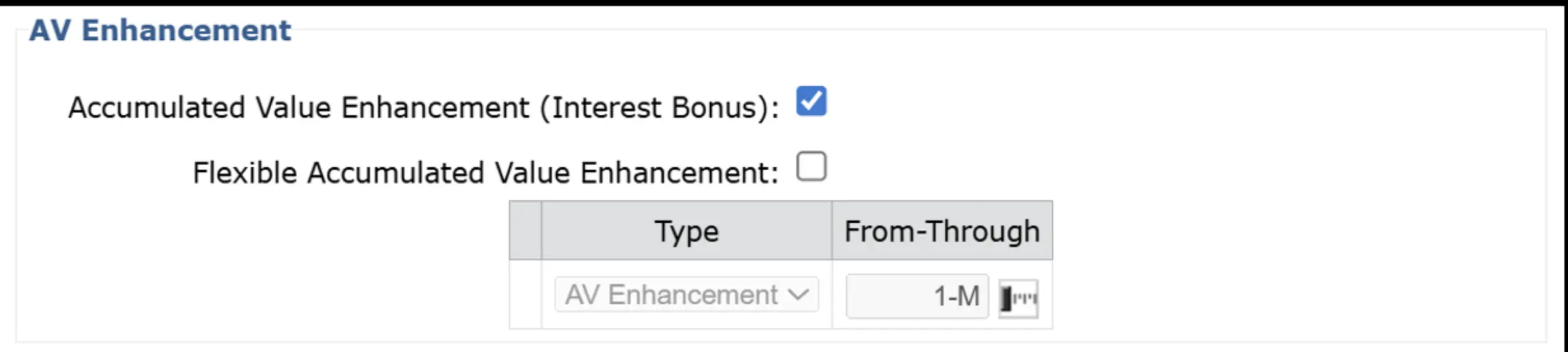
计划书系统 AV Enhancement 设置截图:Accumulated Value Enhancement (Interest Bonus) 已勾选,Flexible Accumulated Value Enhancement 未勾选 / Illustration system AV Enhancement settings: Accumulated Value Enhancement (Interest Bonus) ticked, Flexible Accumulated Value Enhancement unticked

第三种,奖金型参与贷款,Participating Declared Loan。Declared 是「宣布」的意思:贷款利率由国家人寿自己宣布。

The third variant, the participating declared loan. "Declared" means National Life announces the loan rate itself.

看左边三条。第一,贷款利率由国家人寿决定,上限 8%,目前是 6.25%。 第二,这种贷款的特别之处:借出去的金额,可以额外拿到一笔利息奖金。保单第 2 到 9 年是 0.6%,第 10 年及以后是 0.85%。 第三,被抵押的钱和浮动利息一样,留在原始指数账户,封顶 11%。

Look at the three points on the left. One, National Life sets the loan rate, capped at 8%, currently 6.25%. Two, what makes this loan different: the amount borrowed earns an extra interest bonus, 0.6% in policy years 2 to 9 and 0.85% from year 10 on. Three, as with the variable loan, the pledged money stays in the base index account with its 11% cap.

再看右边怎么算。指数记入 11% 的年份:11% 减 6.25%,再加上奖金。奖金 0.6% 时获利 5.35%,奖金 0.85% 时获利 5.6%。 指数记入 0% 的年份:0% 减 6.25%,加上奖金,费用是 5.65%,第 10 年起是 5.4%。 也就是说,奖金把贷款的实际成本拉低了 0.6 到 0.85 个百分点。

Now the maths on the right. In an 11% index year: 11% minus 6.25%, plus the bonus. With a 0.6% bonus the gain is 5.35%; with 0.85% it's 5.6%. In a 0% year: 0% minus 6.25%, plus the bonus, a cost of 5.65%, or 5.4% from year 10. In other words, the bonus pulls the effective cost of the loan down by 0.6 to 0.85 of a point.

左下角这一条非常重要,做方案的时候一定要注意:如果保单打开了 Enhancer 利息增加条款,奖金型贷款就不能选。 Enhancer 是让保单在指数计息上多拿一点利息奖金的设计,它和奖金型贷款不能同时用。 所以如果客户的方案里开了 Enhancer,这一档直接排除,只在另外三种里选。

The point bottom left matters a lot when designing a case: if the policy has the Enhancer interest bonus rider switched on, the declared loan can't be chosen. The Enhancer adds an interest bonus to the index credits, and it can't be combined with the declared loan. So if the client's design includes the Enhancer, rule this option out and choose among the other three.

奖金型的利率由公司宣布,所以它介于固定和浮动之间:不像固定利息那样写死,也不像浮动利息那样每天跟着市场跳。 它的上限 8% 比浮动利息的 6.5% 高,这一点也要让客户知道。

Because the rate is declared by the company, the declared loan sits between fixed and variable: not locked like the fixed loan, not jumping with the market like the variable one. Its 8% ceiling is higher than the variable loan's 6.5%, and clients should know that too.

讲师提醒Presenter note

6.25%、0.6%、0.85%、上限 8% 都是做培训时的数值,会改版。是否开了 Enhancer,看计划书系统里的勾选项 (Accumulated Value Enhancement);不确定就打给国家人寿的经纪人服务确认。

The 6.25%, 0.6%, 0.85% and 8% ceiling are the figures at the time of this training and get revised. Whether the Enhancer is on shows as a checkbox in the illustration system (Accumulated Value Enhancement); if unsure, call National Life's agent services to confirm.

贷款方式表格对比The Loan Types Side by Side

贷款类型Loan type 贷款利息上限Rate ceiling 抵押金额增长账户Where the collateral earns 目前贷款利率
(可能变化)
Current rate
(may change)
奖金Bonus
标准StandardStandard浮动利率上限:基础利息 + 3%Floatingceiling: base rate + 3%贷款抵押账户年底按贷款利息返还Loan collateral accountcredited back at year end5.60%无None
参与型浮动VariableParticipating variable浮动利率上限:基础利息 + 3%Floatingceiling: base rate + 3%原始指数账户标普 500,封顶 11%Base index accountS&P 500, 11% cap5.60%无None
参与型固定FixedParticipating fixed固定 5%投保时锁定Fixed 5%locked at issue指数贷款账户标普 500,封顶 9.5%Indexed loan accountS&P 500, 9.5% cap5%无None
参与型奖金DeclaredParticipating declared国家人寿设定上限 8%Set by National Lifeceiling 8%原始指数账户标普 500,封顶 11%Base index accountS&P 500, 11% cap6.25%0.6%(第 2–9 年)0.85%(第 10 年起)0.6% (years 2–9)0.85% (year 10 on)

前面几页一种一种看完了,这一页把四种放进一张表,横着比五个维度。这张表建议大家截图存在手机里,客户问的时候拿出来就能讲。

We've been through them one by one; this slide puts all four in one table across five dimensions. Save a screenshot of this table on your phone, and you can pull it out whenever a client asks.

第一列,贷款利息上限。标准贷款和参与型浮动都是浮动利率,上限是基础利息加 3%。参与型固定是固定 5%,投保时就锁定。 参与型奖金由国家人寿设定,上限 8%。

Column one, the rate ceiling. The standard loan and the participating variable loan both float, capped at the base rate plus 3%. The participating fixed loan is fixed at 5%, locked in at issue. The participating declared loan is set by National Life, capped at 8%.

第二列,被抵押的钱放在哪个账户增长,这是四种最本质的区别。标准贷款放在贷款抵押账户,年底按贷款利息返还,不参与指数。 参与型浮动和奖金型留在原始指数账户,跟标普 500,封顶 11%。参与型固定放在单独的指数贷款账户,也跟标普 500,但封顶只有 9.5%。

Column two, where the pledged money earns. This is the most fundamental difference between the four. The standard loan puts it in a loan collateral account, credited back at year end in line with the loan rate, outside the index. The variable and declared loans keep it in the base index account, tracking the S&P 500 with an 11% cap. The fixed loan moves it to a separate indexed loan account, also tracking the S&P 500, but capped at only 9.5%.

第三列,目前的贷款利率,标了「可能变化」。标准和浮动都是 5.60%,固定 5%,奖金型 6.25%。 前面标准贷款那一页用 5.5% 是为了好算,这里是做培训时的实际利率。

Column three, today's rates, marked "may change." Standard and variable are both 5.60%, fixed is 5%, declared is 6.25%. The standard loan slide used 5.5% for easy arithmetic; these are the actual rates when this training was made.

第四列,奖金。只有奖金型有:第 2 到 9 年 0.6%,第 10 年起 0.85%。其他三种都没有。

Column four, the bonus. Only the declared loan has one: 0.6% in years 2 to 9, 0.85% from year 10. The other three have none.

读这张表的时候,提醒大家不要只看「目前利率」哪个最低。真正决定长期结果的,是第二列:被抵押的钱能不能跟着指数走、封顶多少, 以及以后利率往哪个方向变。下一页我们用一份真实的计划书,看看四种方式放到同一个客户身上,结果差多少。

When reading this table, remind people not to look only for the lowest current rate. What really drives the long-run result is column two, whether the pledged money follows the index and at what cap, together with where rates go from here. On the next slide we use a real illustration to see how far apart the four come out for the same client.

案例讲解A Worked Case

5 岁女孩 · 演示利率 6.5% · 保费每月 $249 × 15 年,累计 $44,820 · 60 岁开始领取Girl, age 5 · 6.5% illustrated rate · $249 a month × 15 years, $44,820 in total · income from 60

贷款方式Loan type 每年领取
60–89 岁
Each year
ages 60–89
累计领取
60–89 岁
Total drawn
ages 60–89
90 岁身故赔偿Death benefit at 90 终身总价值Lifetime total
标准(5.5%)Standard (5.5%)$35,598$1,067,940$691,196$1,759,136
参与固定(5%)Part. fixed (5%)$46,349$1,390,470$302,733$1,693,203
参与浮动(5.5%)Part. variable (5.5%)$47,157$1,414,710$314,912$1,729,622
参与奖金(6.25%)Part. declared (6.25%)$49,204$1,476,120$328,131$1,804,251

计划书演示值,不是收益承诺;终身总价值 = 累计领取 + 90 岁身故赔偿Illustrated values, not a promise of results; lifetime total = total drawn + death benefit at 90

讲完了原理,我们看一个真实计划书的案例,同一个客户,四种贷款方式,结果放在一起比。

With the mechanics covered, let's look at a case from a real illustration: one client, four loan types, the results side by side.

先看客户:一个 5 岁的女孩,计划书的演示利率是 6.5%。保费每个月 $249,交 15 年,累计总保费 $44,820。 从 60 岁开始,每年从保单里借一笔钱出来,作为退休收入,一直领到 89 岁,一共 30 年。

The client first: a five-year-old girl, with a 6.5% illustrated rate. The premium is $249 a month for 15 years, $44,820 in total. From age 60 she borrows an amount from the policy each year as retirement income, through age 89: thirty years in all.

看第一列,每年能领多少。标准贷款每年 $35,598,参与固定 $46,349,参与浮动 $47,157,参与奖金 $49,204。 参与型贷款每年能领的比标准贷款多出三成左右,奖金型最多,多了将近四成。原因就是前面讲的:参与型借出去的钱还在跟着指数计息, 演示利率 6.5% 高于贷款利率,这个利差每年都在帮账户长。

Column one, what she can draw each year. Standard: $35,598. Participating fixed: $46,349. Participating variable: $47,157. Participating declared: $49,204. The participating loans pay roughly 30% more a year than the standard loan, and the declared loan nearly 40% more. The reason is what we covered: under a participating loan the borrowed money keeps earning index credits, and with a 6.5% illustrated rate above the loan rate, that spread helps the account grow every year.

第二列,30 年累计领取,就是每年的数乘以 30。标准贷款约 $107 万,参与型约 $139 万到 $148 万。

Column two, the total drawn over 30 years: the annual figure times 30. About $1.07 million under the standard loan, and about $1.39 to $1.48 million under the participating loans.

第三列要特别注意,90 岁时的身故赔偿:标准贷款反而最高,$691,196,是参与型的两倍多。 为什么?因为标准贷款每年领得少,账户里留得多,最后留给家人的就多。这就是一个取舍:生前多领,还是身后多留。

Pay special attention to column three, the death benefit at 90. The standard loan is actually the highest, $691,196, more than double the participating loans. Why? Because it draws less each year, more stays in the account, and more is left for the family at the end. That's the trade-off: more while living, or more left behind.

最后一列,终身总价值,就是累计领取加上 90 岁的身故赔偿。四种其实很接近,都在 $170 万到 $180 万之间。 所以选哪种,不是谁「赚得多」,而是客户想把钱花在哪个阶段。

The last column, the lifetime total: total drawn plus the death benefit at 90. The four are actually close, all between $1.7 and $1.8 million. So the choice isn't about which one "earns more," but at which stage of life the client wants the money.

还要提醒一点:计划书假设贷款利率 30 年不变、指数每年都按 6.5% 记入。现实中指数有好有坏,利率也会变, 所以这些数字只能拿来比较四种方式的相对差别,不能当成会拿到的金额。

One more caution: the illustration assumes the loan rate stays the same for 30 years and the index credits 6.5% every year. In reality index years vary and rates change, so these figures are for comparing the four options against each other, not amounts she will receive.

合规提醒Compliance note

不要说「每月存 $249,以后能领一百多万」。可以这样说:「按计划书 6.5% 的演示利率,四种贷款方式的演示结果是这样; 实际结果取决于指数表现和贷款利率,不是保证。」

Don't say "save $249 a month and collect over a million later." Say instead: "At the illustration's 6.5% assumed rate, these are the illustrated results for the four loan types; actual results depend on index performance and loan rates and are not guaranteed."

讲师提醒Presenter note

原稿这一栏的标题写的是「金额(AV 增强 / AV Enhancement)」:这份计划书选的是 AV 增强,没有开 Enhancer。 AV 增强和 Enhancer 是二选一的,所以和上一页「开了 Enhancer 时奖金型不可用」不冲突,奖金型那一行可以照讲。

The original's column heading reads "amount (AV Enhancement)": this illustration uses the AV enhancement, not the Enhancer. The two are either-or, so there's no conflict with the previous slide ("the declared loan isn't available with the Enhancer"), and the declared-loan row can be presented as is.

如何选择贷款方式?How to Choose a Loan Type

短期需要钱,以后还回去Short-term need, repaid later

→ 标准贷款 Standard Loan→ Standard loan

需要终身收入,以后不还回去Lifetime income, never repaid

→ 参与贷款 Participating Loans→ Participating loans 根据目前贷款利率:By today's loan rate: 贷款利率 > 5% → 固定利息参与贷款Rate > 5% → participating fixed 贷款利率 < 5% → 浮动利息 / 奖金型参与贷款Rate < 5% → participating variable or declared

四种方式讲完,客户最后一定会问:「那我该选哪个?」这一页给大家一个简单的决策方法,先问一个问题:这笔钱以后还不还?

After the four types, clients always end up asking, "So which should I choose?" This slide gives a simple way to decide, starting with one question: will this money be paid back?

左边:短期需要钱,以后会还回去。比如应急、周转、孩子一次性的学费,借一两年就还。这种情况选标准贷款。 为什么?因为借的时间短,参与型那点指数上行空间,抵不上一两年里碰到坏年份的风险;标准贷款的成本是可以预期的,借完还上就结束了。

On the left: a short-term need that will be repaid, such as an emergency, working capital, or a one-off tuition bill, borrowed for a year or two. Choose the standard loan. Why? Over a short period, the index upside of a participating loan isn't worth the risk of hitting a bad year; the standard loan's cost is predictable, and once it's repaid it's over.

右边:需要终身收入,以后不打算还。最典型的就是退休收入,每年借一笔,一借就是二三十年。这种情况选参与贷款。 时间拉长了,指数有好有坏,平均下来计息有机会跑赢贷款利率;上一页的案例也看到了,参与型每年能领的明显更多。

On the right: lifetime income that won't be repaid, typically retirement income, borrowed every year for twenty or thirty years. Choose a participating loan. Over a long horizon, good and bad index years average out, and the credits have a chance to beat the loan rate; the case on the last slide showed participating loans drawing clearly more each year.

参与贷款里再选哪一种,看当时的贷款利率,以 5% 为分界。贷款利率高于 5%,选固定利息参与贷款,把利率锁在 5%, 以后利率再往上走也不怕。贷款利率低于 5%,选浮动利息或者奖金型,享受低利率,而且借出的钱留在封顶 11% 的原始账户。

Which participating loan depends on the loan rate at the time, with 5% as the dividing line. If the loan rate is above 5%, choose the participating fixed loan to lock in 5%, so later rate rises don't matter. If it's below 5%, choose the variable or declared loan to take advantage of the low rate, with the borrowed money staying in the base account with its 11% cap.

这里要和上一页的案例对照着讲:案例里固定利息每年领得比浮动和奖金型少,是因为计划书假设利率几十年不变, 而固定型的贷款账户封顶只有 9.5%。固定利息买的是「利率不会再往上走」的确定性,这一点计划书体现不出来。 另外,选好的贷款方式之后能不能换、怎么换,以合同为准。

Explain this alongside the case on the last slide: there the fixed loan drew less than the variable and declared loans because the illustration assumes rates never change for decades, and the fixed loan's account is capped at 9.5%. What the fixed loan buys is certainty that the rate can't climb further, and an illustration can't show that. Whether and how the chosen loan type can be switched later follows the contract.

互动设计Interaction

出两个情景让大家抢答:「客户 45 岁,要借 $5 万给孩子付学费,两年内还」;「客户 65 岁,每年借 $4 万当生活费,目前贷款利率 5.6%」。 (第一个标准贷款;第二个参与贷款,利率高于 5%,看固定利息。)

Give two scenarios for a quick-fire round: "Client, 45, borrows $50,000 for tuition, repaid within two years"; "Client, 65, borrows $40,000 a year to live on, current loan rate 5.6%." (The first is the standard loan; the second is a participating loan, and with the rate above 5%, look at the fixed option.)

用完要不要还?Does It Have to Be Repaid?

  • 不一定要还。保单贷款跟银行不一样,没有硬性要求必须还Not necessarily. Unlike a bank loan, there's no hard requirement to repay
    • 选择不还,存的钱还是会继续计息,最后保险公司在理赔时自动结清If it isn't repaid, the savings keep earning, and the insurer settles the loan automatically at claim

客户借了钱,下一个问题一定是:「用完要不要还?」答案是:不一定要还。

Once a client borrows, the next question is always: "Do I have to pay it back?" The answer: not necessarily.

保单贷款跟银行贷款不一样。银行贷款有还款计划,每个月要还本付息,晚一期就影响信用。 保单贷款没有硬性的还款要求,没有月供,也不会因为没还而影响信用分数。

A policy loan isn't like a bank loan. A bank loan has a schedule with monthly principal and interest, and one late payment hits your credit. A policy loan has no hard repayment requirement, no monthly payment, and not repaying it doesn't touch your credit score.

如果选择不还,会怎样?留在保单里的钱还是继续计息。贷款的利息如果没有另外付,会加到贷款余额里。 最后被保险人身故理赔的时候,保险公司会自动从身故赔偿里把贷款本息扣掉、结清,剩下的再给受益人。 这就是为什么退休收入用参与贷款、一借二三十年、一直不还,是一个常见的做法。

What if it's never repaid? The money left in the policy keeps earning. Loan interest that isn't paid separately is added to the loan balance. When the insured dies, the insurer automatically deducts the loan and its interest from the death benefit, settles it, and pays the rest to the beneficiaries. That's why using participating loans for retirement income, borrowing for twenty or thirty years and never repaying, is a common approach.

但「不一定要还」有一个前提:保单要一直撑得住。如果贷款余额加上利息越滚越大,大到超过现金价值能承受的程度, 保单就有失效的风险。保单一旦失效,问题就不只是没有保障了,还会有税的问题。这就是下一页要讲的:如果拿钱拿多了。

But "no need to repay" has a condition: the policy has to keep holding up. If the loan balance plus interest keeps growing until it's more than the cash value can carry, the policy is at risk of lapsing. And if it lapses, the problem isn't only lost coverage; there's tax as well. That's the next slide: what happens if you take too much.

合规提醒Compliance note

不要只说「借了不用还」。完整的说法是:「保单贷款没有固定还款计划,不还的话理赔时从身故赔偿中扣除; 但贷款过高可能导致保单失效,需要定期检视。」

Don't stop at "you never have to pay it back." The full statement is: "A policy loan has no fixed repayment schedule; if it isn't repaid, it's deducted from the death benefit at claim. But a loan that grows too large can lapse the policy, so it needs regular review."

如果拿钱拿多了If Too Much Is Taken

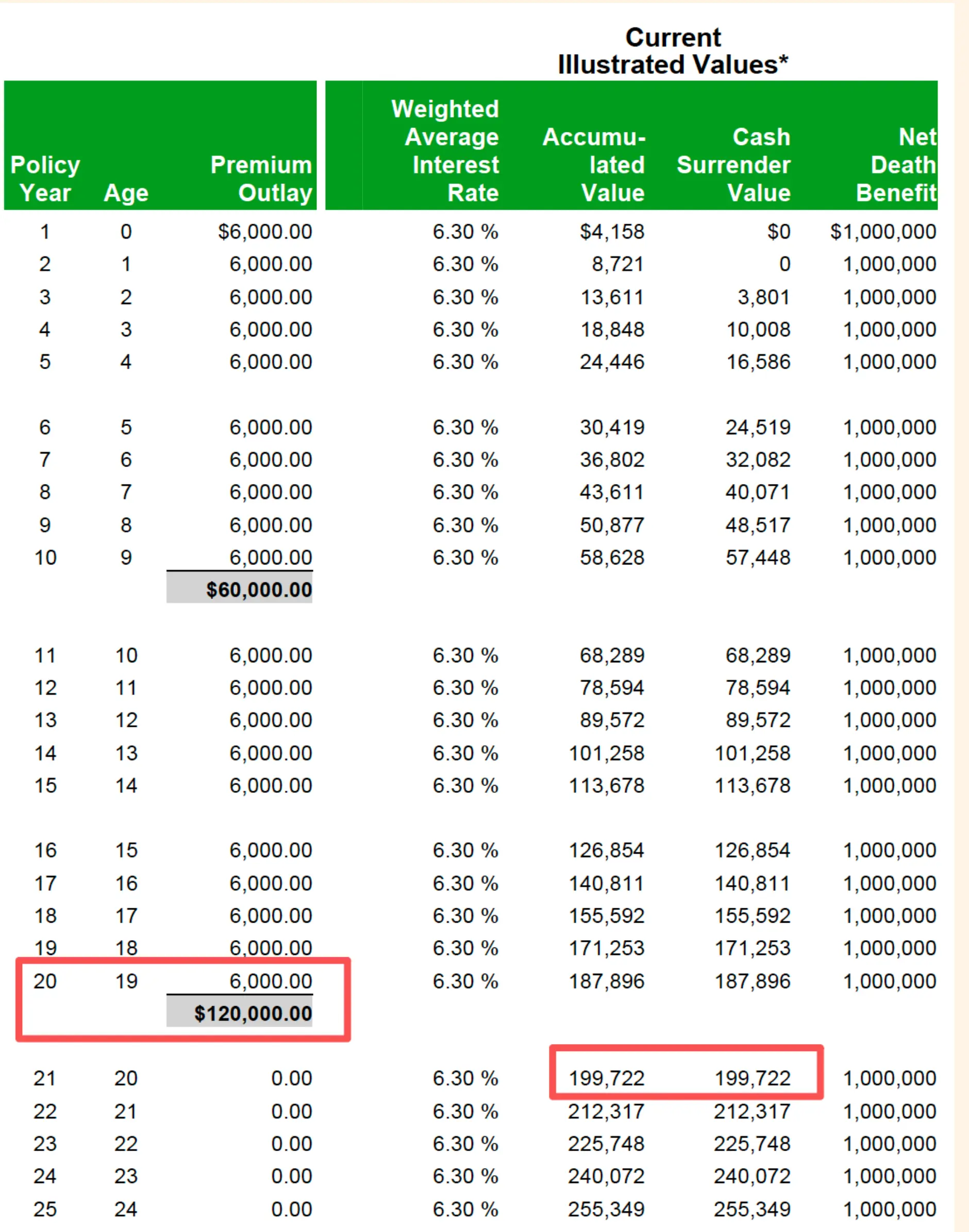
计划书节选:0 岁起每年保费 $6,000 交 20 年,第 20 年累计 $120,000(红框);演示利率 6.30%,第 21 年现金价值与退保价值 $199,722(红框),身故赔偿 $1,000,000 / Illustration excerpt: $6,000 a year from age 0 for 20 years, $120,000 in total by year 20 (boxed); at a 6.30% illustrated rate, the year-21 accumulated and surrender values are $199,722 (boxed), death benefit $1,000,000
  • ⚠️ 重大税务问题⚠️ A serious tax problem
    • 按照计划取钱Draw according to the plan
    • 找经纪人做保单年检Have your agent review the policy every year

一份计划书节选,演示利率 6.30%,非保证Excerpt from an illustration at a 6.30% assumed rate, not guaranteed

这一页讲保单贷款最大的风险:拿钱拿多了。我们先用一份计划书的节选,把「成本」和「增值」分清楚。

This slide covers the biggest risk with policy loans: taking too much. First, using an excerpt from an illustration, let's separate "cost" from "gain."

这是一个从 0 岁开始的保单,每年交 $6,000,交 20 年,到第 20 年累计交了 $120,000,这是客户的成本,也就是本金。 按 6.30% 的演示利率,第 21 年现金价值是 $199,722。也就是说,这时候保单里大约有 $8 万是增值的部分。

This policy starts at age 0 with $6,000 a year for 20 years; by year 20, $120,000 has gone in. That's the client's cost, the principal. At a 6.30% illustrated rate, the cash value in year 21 is $199,722. So at that point about $80,000 in the policy is gain.

为什么要分清楚?因为税只跟增值部分有关。保单有效的时候,贷款不算收入,所以不交税。 但如果借得太多,贷款本息超过了现金价值,保单失效了,这时候所有超过成本的贷款,都会被当成收入来补税。 客户钱早就花掉了,手上却收到一张税单,这就是我们说的「重大税务问题」。

Why separate them? Because tax only concerns the gain. While the policy is in force, a loan isn't income, so it isn't taxed. But if too much is borrowed and the loan plus interest outgrows the cash value, the policy lapses, and every dollar of loan above the cost is then treated as income and taxed. The client spent the money long ago and now receives a tax bill. That's what we mean by a serious tax problem.

怎么避免?右边两条。第一,按照计划取钱。计划书里每年能领多少,是算过能撑住的;客户自己临时多借,就可能打破这个平衡。 第二,找经纪人做保单年检。每年看一次贷款余额、贷款利率、当年计息和现金价值,指数连续几年不好的时候,要及时调整领取的金额。

How do you avoid it? The two points on the right. One, draw according to the plan. The annual amount in the illustration was calculated to be sustainable; a client borrowing extra on their own can break that balance. Two, have your agent review the policy every year: the loan balance, the loan rate, that year's credit and the cash value. After several weak index years, the amount drawn needs to be adjusted in time.

这也是我们作为经纪人的责任:保单卖出去不是结束,客户开始用钱以后,每年的检视更重要。 下一页讲一个专门为这种情况设计的保护条款。

This is our responsibility as agents too: selling the policy isn't the end. Once the client starts drawing, the annual review matters even more. The next slide covers a rider designed for exactly this situation.

讲师提醒Presenter note

「超过成本的部分要补税」是一般原则,具体怎么算、要不要报税,请客户咨询税务专业人士,我们不做税务建议。 6.30% 是这份计划书的演示利率,不是预期回报。

"Loans above cost become taxable" is the general principle; for the specific calculation and filing, clients should consult a tax professional, and we don't give tax advice. The 6.30% is this illustration's assumed rate, not an expected return.

过度贷款保护条款The Overloan Protection Rider

防止「贷款过大导致保单失效」的保护条款 · Overloan Protection RiderProtection against a loan so large it lapses the policy

没有这个条款会怎样?Without the rider?

  • 贷款太大 → 保单进入宽限期(Grace Period)Loan too large → the policy enters a grace period
  • 需要补钱(还贷 / 补保费),否则保单失效Money must go in (repay or add premium), or the policy lapses
  • 保单失效可能带来税务事故A lapse can trigger a tax event
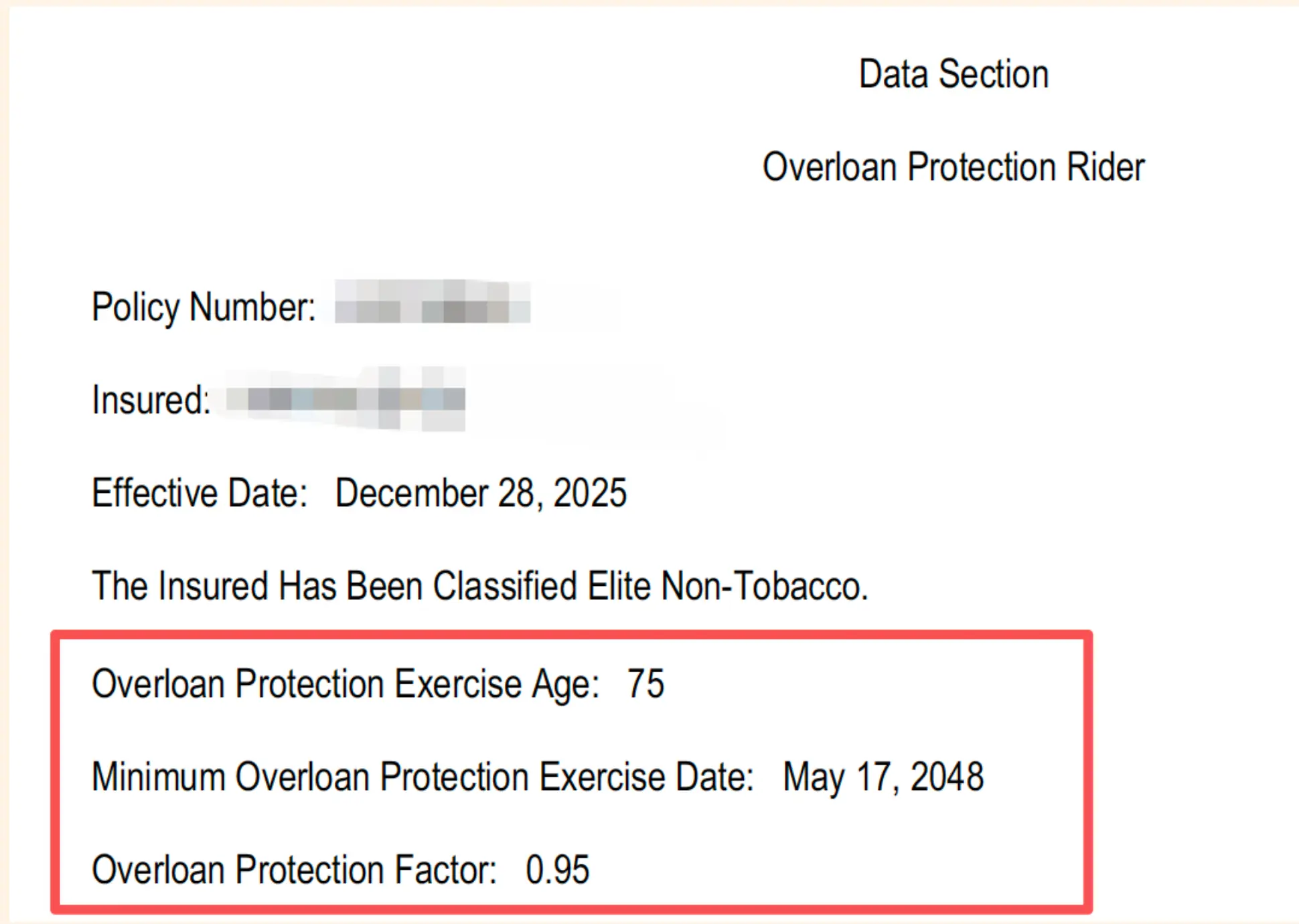
保单数据页 Overloan Protection Rider 一段:保单号和被保险人已打码;红框内 Overloan Protection Exercise Age 75、Minimum Overloan Protection Exercise Date May 17, 2048、Overloan Protection Factor 0.95 / Data page section for the overloan protection rider, policy number and insured blurred; boxed: exercise age 75, minimum exercise date May 17, 2048, overloan protection factor 0.95

什么时候可以启动?(必须同时满足)When can it be exercised? (all required)

  1. 被保险人年龄 ≥ 75 岁The insured is 75 or older
  2. 保单日期 ≥ 数据页写的 Minimum Exercise Date,且保单仍有效The policy has reached the minimum exercise date on the data page and is still in force
  3. 未偿还贷款 > 保单保额The outstanding loan exceeds the face amount
  4. 杠杆比率超过门槛:Debt ÷(Accumulated Value − Surrender Charge)> Overloan Protection FactorLeverage passes the threshold: debt ÷ (accumulated value − surrender charge) > the overloan protection factor

上一页讲了拿多了的风险,这一页讲国家人寿为这个风险设计的保护条款:过度贷款保护条款,Overloan Protection Rider。 它的作用就写在标题下面:防止「贷款过大导致保单失效」。

The last slide covered the risk of taking too much. This one covers the rider National Life designed for that risk: the overloan protection rider. Its purpose is right under the title: to stop a loan from growing so large that it lapses the policy.

先看左上,没有这个条款会怎样。贷款太大,保单就进入宽限期 Grace Period。宽限期里需要补钱,要么还贷款,要么补保费; 如果不补,保单失效。保单失效,就可能带来上一页讲的税务事故。

Top left: what happens without it. When the loan grows too large, the policy enters a grace period. During the grace period money has to go in, either loan repayment or premium; if it doesn't, the policy lapses. And a lapse can bring the tax event we covered on the last slide.

再看右边,什么时候可以启动这个条款。四个条件,必须同时满足。第一,被保险人年龄满 75 岁。 第二,保单日期已经到了数据页上写的最早行使日期,Minimum Exercise Date,而且保单还有效。 第三,未偿还的贷款已经超过保单保额。第四,杠杆比率超过门槛:贷款余额,除以现金价值减去退保费用,要大于数据页上的 Overloan Protection Factor。

Now the right: when the rider can be exercised. Four conditions, all required. One, the insured is at least 75. Two, the policy has reached the minimum exercise date on the data page and is still in force. Three, the outstanding loan exceeds the face amount. Four, leverage passes the threshold: the loan balance divided by the accumulated value minus the surrender charge must exceed the overloan protection factor on the data page.

左下角是保单数据页上这个条款的样子。每张保单都会写清楚三个数:可以行使的年龄 75 岁;最早可以行使的日期,每张保单不一样; 还有 Overloan Protection Factor,这一张是 0.95。0.95 的意思是:贷款已经占到可用现金价值的 95% 以上,才达到第四个条件。

Bottom left is how the rider appears on a policy's data page. Every policy states three figures: the exercise age, 75; the earliest exercise date, which differs by policy; and the overloan protection factor, 0.95 on this one. A factor of 0.95 means the loan has to reach more than 95% of the available cash value before the fourth condition is met.

所以这个条款不是随时能用的,它是在保单真的快被贷款压垮、而且客户年纪已经比较大的时候,最后的一道安全网。 行使以后保单会发生什么变化,下一页讲。

So the rider can't be used at any time. It's a last safety net for when the loan is genuinely about to sink the policy and the client is already older. What happens to the policy once it's exercised is on the next slide.

互动设计Interaction

请大家打开自己手上任意一份国家人寿保单的数据页,找到 Overloan Protection Rider 这一段,读出这三个数。

Ask everyone to open the data page of any National Life policy they have, find the Overloan Protection Rider section, and read out the three figures.

一旦行使:不可撤销Once Exercised: Irrevocable

保单将被「改造」为更封闭、更保守的结构The policy is rebuilt into a more closed, more conservative structure

  1. 指数策略被锁定:全部现金价值转入 Basic Strategy 3.5%,之后不能再转回任何指数 / 计息策略Index strategies locked: all value moves to the 3.5% Basic Strategy and can never move back
  2. 贷款被锁定(去杠杆):所有参与型贷款重写为标准贷款,禁止新增任何保单贷款Loans locked (deleveraged): participating loans are rewritten as standard loans; no new loans
  3. 现金流与操作被锁定:不能再追加保费、不能再提款;月扣费停止,其他付费条款终止;DB Option B 自动切换为 Option A,以后不能再改Cash flow locked: no more premium or withdrawals; monthly deductions stop and other paid riders end; Option B switches to Option A for good
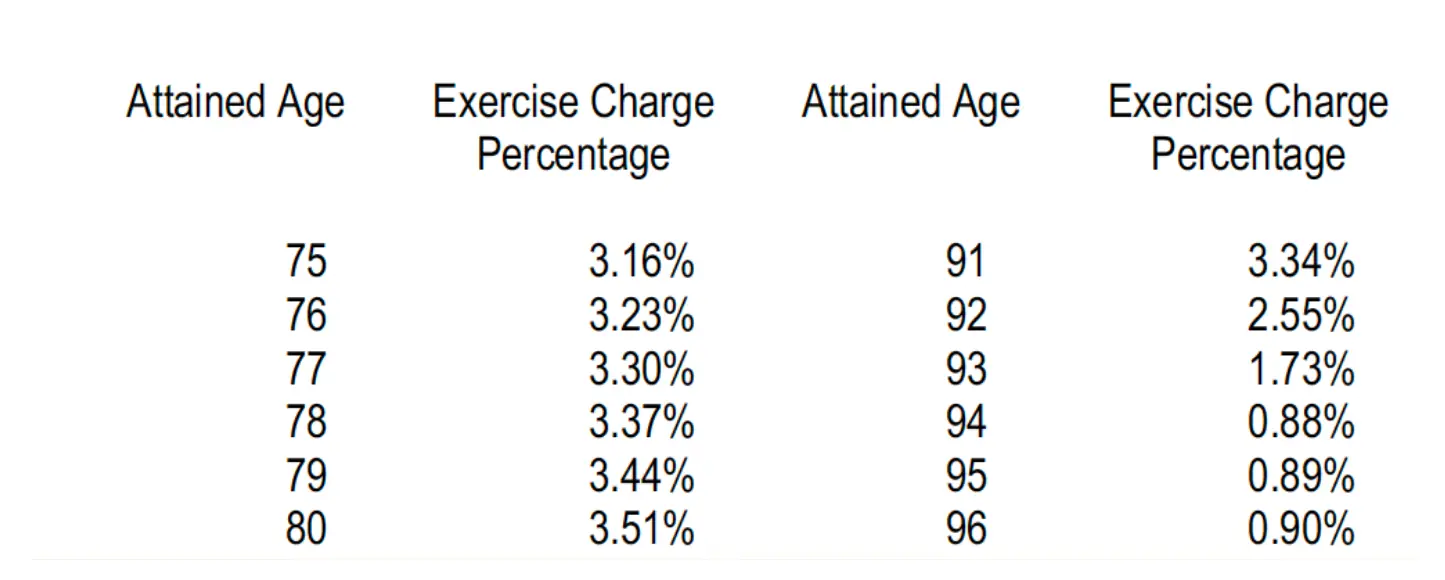
  4. 费用:只在行使时收一次 Exercise Charge = 数据页对应年龄的费率 × 现金价值,从 Basic Strategy 扣除Charge: a one-time exercise charge = the age rate on the data page × accumulated value, taken from the Basic Strategy
一张保单数据页的行使费率表节选(Percent of Accumulated Value Exercise Charge):75 岁 3.16% 到 80 岁 3.51%;91 岁 3.34%、92 岁 2.55%、93 岁 1.73%、94 岁 0.88%、95 岁 0.89%、96 岁 0.90% / Excerpt of one policy's exercise charge table: 3.16% at 75 rising to 3.51% at 80; 3.34% at 91, 2.55% at 92, 1.73% at 93, 0.88% at 94, 0.89% at 95, 0.90% at 96
行使费率表(一张保单数据页的节选)Exercise charge table (excerpt from one policy's data page)

过度贷款保护条款一旦行使,就不可撤销。保单会被「改造」成一个更封闭、更保守的结构。具体有四方面的变化。

Once the overloan protection rider is exercised, it can't be undone. The policy is rebuilt into a more closed, more conservative structure. The changes come in four parts.

第一,指数策略被锁定。所有现金价值都转到 Basic Strategy,也就是 3.5% 的基础计息策略,之后再也不能转回任何指数策略或其他计息策略。 保单从此不再参与指数的上涨。

One, the index strategies are locked. All the cash value moves into the Basic Strategy, the 3.5% base crediting strategy, and can never move back to an index or any other crediting strategy. From then on the policy no longer shares in index gains.

第二,贷款被锁定,也就是去杠杆。所有参与型贷款都重写成标准贷款,而且禁止再新增任何保单贷款。 换句话说,从这一天起,客户不能再从保单里借钱了。

Two, the loans are locked, in other words deleveraged. Every participating loan is rewritten as a standard loan, and no new policy loans are allowed. From that day on, the client can't borrow from the policy again.

第三,现金流和保单操作被锁定。不能再追加保费,不能再提款;每个月的扣费停止,其他要付费的附加条款终止。 如果原来的身故赔偿选的是 Option B,会自动切换成 Option A,以后也不能再改。

Three, cash flow and policy changes are locked. No more premium can be added and no withdrawals taken; the monthly deductions stop, and any other paid riders terminate. If the death benefit was on Option B, it switches automatically to Option A and can't be changed again.

第四,费用。这个条款平时不收钱,只有在行使的时候收一次,叫 Exercise Charge:数据页上对应年龄的费率,乘以当时的现金价值, 从 Basic Strategy 里扣。右边是一张保单数据页的节选:75 岁 3.16%,80 岁 3.51%,到 90 岁以后费率逐步降下来,95 岁 0.89%。 举个例子,80 岁行使,现金价值 $50 万,一次性收 3.51%,大约 $17,550。

Four, the charge. The rider costs nothing until it's exercised; then a one-time exercise charge applies: the rate for that age on the data page, times the accumulated value at the time, taken from the Basic Strategy. On the right is an excerpt from one policy's data page: 3.16% at 75, 3.51% at 80, falling after 90 to 0.89% at 95. For example, exercised at 80 with $500,000 of accumulated value, the one-time charge at 3.51% is about $17,550.

所以要这样理解这个条款:它是一张安全网,不是一个工具。它救的是保单不失效、客户不收到税单; 代价是保单从此失去所有弹性。我们做方案、做年检的目标,永远是不要走到这一步。

So understand the rider this way: it's a safety net, not a tool. It saves the policy from lapsing and the client from a tax bill; the price is that the policy loses all its flexibility for good. Our goal in designing and reviewing a case is always never to get here.

讲师提醒Presenter note

费率表每张保单不同,以客户自己的数据页为准;3.5% 的 Basic Strategy 利率也会调整。不要说「有了这个条款就可以放心借」。

The charge table differs by policy; use the client's own data page. The 3.5% Basic Strategy rate is also subject to change. Don't say "with this rider you can borrow without worry."

钱什么时候能用?When Can the Money Be Used?

可以用,注意几点It can, with a few cautions

  • 存得少的话,前 5 年最好别用:头几年现金值累积得慢,这时取钱会影响保单稳定On a modest policy, leave it alone for five years: cash value builds slowly at first, and taking from it destabilizes the policy
  • 5 年以后,现金值逐渐起来,可以考虑小额使用After five years, as cash value builds, small amounts can be considered
  • 10 年以后,现金值长起来,取用才更灵活、更安全After ten years, with the cash value grown, access is more flexible and safer

就像树苗Like a sapling

  • 前 3–5 年:树苗阶段,果子还没长好,最好不要摘Years 3–5: a sapling, the fruit isn't ready, best not to pick
  • 5 年后:树开始结小果,可以少摘一些After five years: small fruit appears, pick a little
  • 10 年以后:枝繁叶茂,果子多了,可以随时摘,不影响树继续生长After ten years: full branches, plenty of fruit, pick any time without stopping the tree's growth

客户听完保单贷款这么灵活,常常会问:「那我买了以后,钱什么时候能用?」答案是:可以用,但要注意时间。

Having heard how flexible policy loans are, clients often ask: "Once I buy it, when can I use the money?" The answer: you can, but timing matters.

看左边三条。存得少的话,前 5 年最好别用。保单头几年要扣保险成本和各种费用,还有退保费用,现金值累积得慢; 这时候把钱借出来,留在保单里的钱太少,保单的稳定性就会受影响。5 年以后,现金值逐渐起来了,可以考虑小额使用。 10 年以后,现金值长起来了,这时候取用才更灵活、也更安全。还记得标准贷款吗?第 11 年起利差为 0,也是这个道理。

Look at the three points on the left. On a modestly funded policy, leave it alone for the first five years. In the early years the policy pays insurance costs and charges, and there are surrender charges, so cash value builds slowly; borrow now, and too little stays in the policy for it to stay stable. After five years, as cash value builds, small amounts can be considered. After ten years, once the cash value has grown, access is both more flexible and safer. Remember the standard loan? Its zero spread from year 11 follows the same logic.

右边是跟客户讲的比方:就像种一棵果树。前 3 到 5 年是树苗阶段,果子还没长好,最好不要摘,摘了树也长不好。 5 年以后,树开始结小果,可以少摘一些。10 年以后,枝繁叶茂,果子多了,可以随时摘,而且不影响树继续生长。

On the right is the comparison to use with clients: it's like planting a fruit tree. Years three to five are the sapling stage; the fruit isn't ready, so best not to pick, or the tree suffers. After five years it starts to bear small fruit, and you can pick a little. After ten years the branches are full and there's plenty of fruit; you can pick any time without stopping the tree from growing.

这里的「存得少」是关键词。如果客户一开始存得多,比如按最高保费存满,现金值起来得快,用钱的时间可以早一些; 具体什么时候能借、能借多少,要看那份计划书的现金价值,不要一概而论。

"Modestly funded" is the key phrase. If a client funds heavily from the start, say up to the maximum premium, cash value builds faster and the money can be used sooner. When and how much can be borrowed depends on the cash values in that client's illustration; don't generalize.

互动设计Interaction

翻回第 18 页那份计划书:第 1 年现金价值 $4,158,退保价值是 $0;第 10 年退保价值 $57,448。 问大家:「如果第 1 年就想借 $5,000,能借吗?」让大家自己体会树苗阶段的意思。

Go back to the illustration on slide 18: in year 1 the accumulated value is $4,158 and the surrender value is $0; by year 10 the surrender value is $57,448. Ask: "If the client wanted to borrow $5,000 in year 1, could they?" Let them feel what the sapling stage means.

终身收入条款 LIBRThe Lifetime Income Benefit Rider (LIBR)

启动条件:60 岁 · 保单生效 10 年以上 · 保单贷款全部还清 · 身故赔偿比率要求满足To start: age 60 · in force 10+ years · all loans repaid · death benefit ratio test met

IUL 贷款收入IUL loan incomeLIBR 终身收入条款LIBR
结构StructureStructure四种贷款方式都可以用Any of the four loan types仅限标准贷款Standard loan only
领取金额DistributionAmount更高、更灵活Higher, more flexible更低Lower
控制权ControlControl客户自行管理Client-managed公司主导控制Company-managed
设计目的Design intentDesign intent以现金流为核心Built around cash flow以保单「活下去」为核心(不失效)Built around keeping the policy alive (no lapse)
市场影响Market impactMarket impact有(会受市场表现影响)Yes, follows market performance一旦启动,市场表现不再重要Once started, markets no longer matter

前面讲的都是用贷款来领退休收入。国家人寿还有另一条路:终身收入条款,Lifetime Income Benefit Rider,简称 LIBR。 这一页把两条路并排比较。

Everything so far uses loans for retirement income. National Life offers another route: the Lifetime Income Benefit Rider, LIBR for short. This slide compares the two side by side.

先看最上面的启动条件,四条要同时满足:年龄 60 岁以上;保单生效 10 年以上;保单贷款全部还清;身故赔偿比率达到要求。 注意第三条,如果客户之前借过钱还没还,要先还清才能启动 LIBR。

First the conditions at the top, all four required: age 60 or older; the policy in force at least ten years; all policy loans repaid; and the death benefit ratio requirement met. Note the third: if the client has an outstanding loan, it has to be repaid before LIBR can start.

再看表格,五个维度。结构:IUL 贷款收入四种贷款方式都可以用;LIBR 启动以后只能用标准贷款。 领取金额:贷款收入更高、更灵活,每年领多少自己定;LIBR 领得更低。 控制权:贷款收入由客户自己管理;LIBR 由公司主导控制。

Now the table, five dimensions. Structure: loan income can use any of the four loan types; once LIBR starts, only the standard loan. Amount: loan income is higher and more flexible, and the client decides each year; LIBR pays less. Control: with loan income the client manages it; with LIBR the company does.

设计目的:贷款收入以现金流为核心,目标是多领;LIBR 以保单「活下去」为核心,目标是保单不失效、收入不断。 市场影响:贷款收入会受指数表现影响,指数连续不好就要调整领取额;LIBR 一旦启动,市场表现就不再重要,按约定的金额一直领下去。

Design intent: loan income is built around cash flow, aiming to draw more; LIBR is built around keeping the policy alive, so it doesn't lapse and the income doesn't stop. Market impact: loan income follows index performance, and several weak years mean adjusting the amount drawn; once LIBR starts, markets no longer matter and the agreed amount keeps coming.

所以一句话:贷款给的是灵活,LIBR 给的是确定。客户如果最怕的是「活得太久、钱领光了」,LIBR 值得讨论; 如果更在意每年多领一点、自己掌控,就用贷款。要记住,之前借过钱的,得先把贷款还清,才能启动 LIBR。

In one line: loans give flexibility, LIBR gives certainty. If the client's biggest fear is living too long and running out, LIBR is worth discussing; if they care more about drawing more each year and staying in control, use loans. And remember: anyone who has borrowed must repay the loans in full before LIBR can start.

讲师提醒Presenter note

LIBR 每年能领多少,是按启动时保单的身故赔偿比率算出来的,不是一个固定比例,每份计划书都不一样。不要拿某一个案例的给付率当通用数字报。

What LIBR pays each year is calculated from the policy's death benefit ratio at the start; it isn't a fixed percentage and differs for every illustration. Don't quote one case's payout rate as a general figure.

手机 APP 取贷款(一)Requesting a Loan in the App (1)

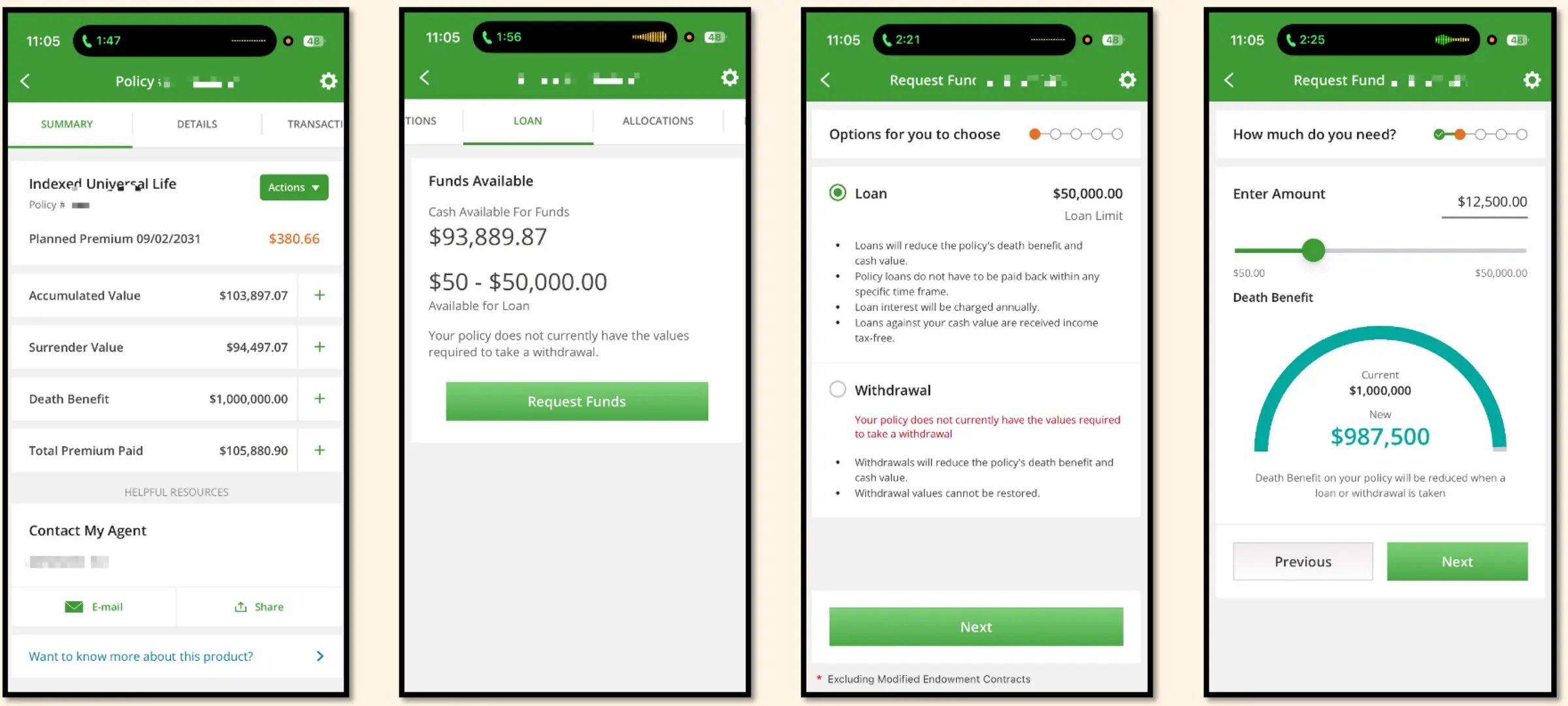
国家人寿 APP 取贷款前四步截图:保单首页(现金价值 $103,897.07、退保价值 $94,497.07、身故赔偿 $1,000,000)→ Loan 页(可用资金 $93,889.87,可贷 $50–$50,000)→ 选 Loan 还是 Withdrawal → 输入金额 $12,500,身故赔偿变为 $987,500 / First four steps in the National Life app: policy summary (accumulated value $103,897.07, surrender value $94,497.07, death benefit $1,000,000) → Loan tab (cash available $93,889.87, $50–$50,000 available) → choose loan or withdrawal → enter $12,500, death benefit becomes $987,500

讲完原理,来看实际怎么操作。最方便的方式是国家人寿的手机 APP,客户自己几分钟就能申请。我们按截图的顺序,一步一步走。

With the mechanics covered, let's see how it's actually done. The easiest route is National Life's mobile app; clients can apply themselves in a few minutes. We'll follow the screenshots step by step.

第一步,登录后进入保单首页 Summary。这里能看到这张保单的几个关键数字:现金价值 $103,897,退保价值 $94,497, 身故赔偿 $100 万。右上角有一个 Actions 按钮,点进去。

Step one: after logging in, open the policy summary. It shows this policy's key figures: an accumulated value of $103,897, a surrender value of $94,497, and a $1 million death benefit. Tap the Actions button at the top right.

第二步,进入 Loan 页面。这里显示可用资金 $93,889.87,以及这次在 APP 上可以借的范围:$50 到 $50,000。 注意可借的上限比可用资金低,以页面显示为准。点 Request Funds。

Step two: the Loan tab. It shows $93,889.87 of cash available, and the range that can be borrowed in the app this time: $50 to $50,000. Note the limit is lower than the cash available; go by what the screen shows. Tap Request Funds.

第三步,选择要 Loan 贷款还是 Withdrawal 提款。这张保单当时不能提款,所以只能选贷款。 页面上列了几条说明,正好是我们今天讲的内容:贷款会减少身故赔偿和现金价值;没有固定的还款期限;利息每年计算; 贷款不计入应税收入,但旁边有个星号,MEC 保单除外。

Step three: choose Loan or Withdrawal. This policy couldn't take a withdrawal at the time, so only a loan was possible. The screen lists a few notes that match what we've covered today: loans reduce the death benefit and cash value; there's no fixed repayment period; interest is charged annually; and loans are received tax-free, with an asterisk excluding modified endowment contracts.

第四步,输入金额。这个例子借 $12,500。下面的仪表盘直接显示身故赔偿的变化:从 $100 万变成 $987,500, 正好少了借的这 $12,500。客户在这一步就能清楚看到借钱对保障的影响。

Step four: enter the amount. This example borrows $12,500. The dial below shows the death benefit change right away: from $1 million to $987,500, exactly the $12,500 borrowed. The client sees the effect on coverage at this very step.

讲师提醒Presenter note

APP 界面会改版,可借范围按保单和当时的规定显示;以客户手机上实际看到的为准。不要替客户登录他的账户操作。

The app gets redesigned, and the borrowing range shown depends on the policy and the rules at the time; go by what the client actually sees. Don't log in to a client's account and do it for them.

手机 APP 取贷款(二)Requesting a Loan in the App (2)

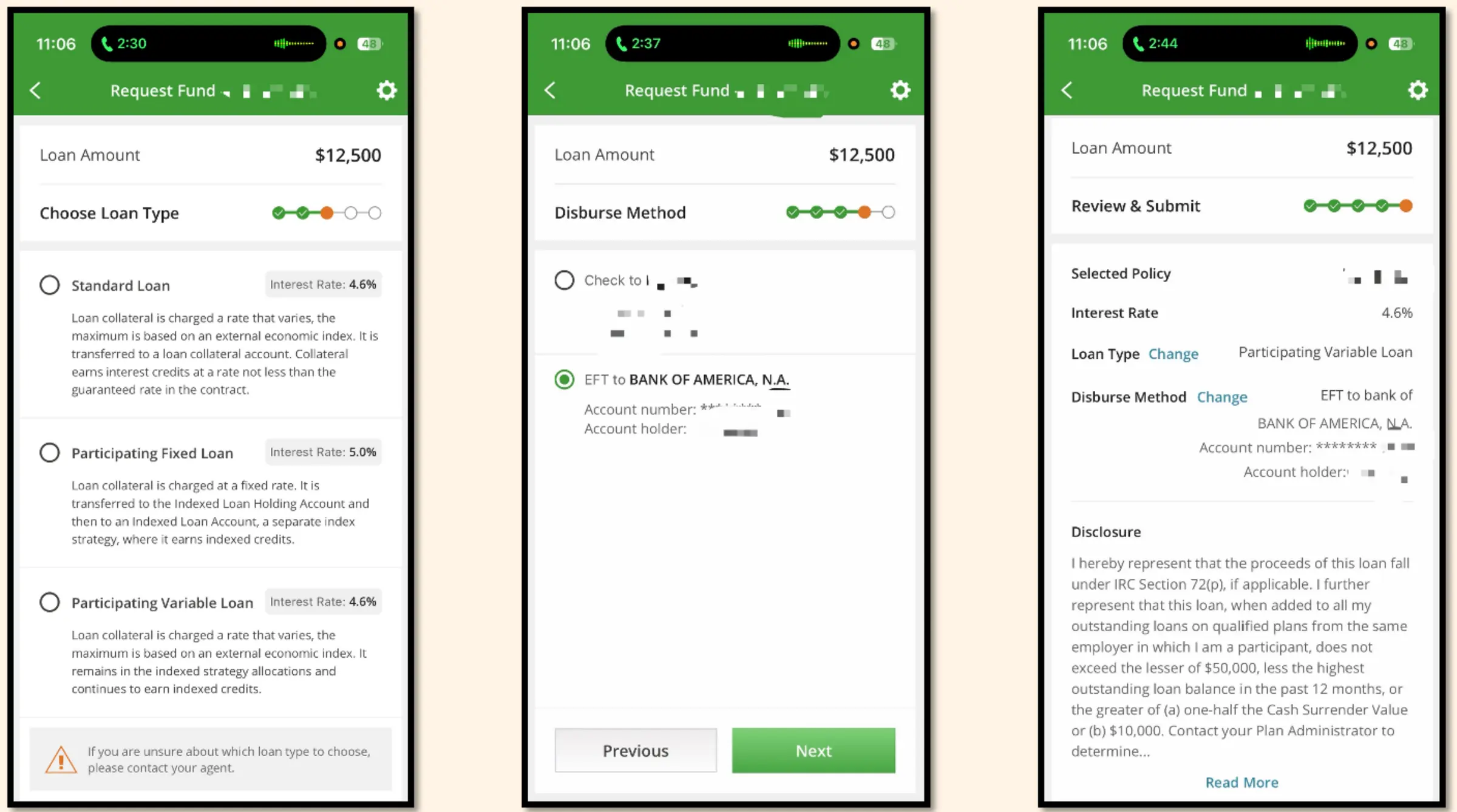
国家人寿 APP 取贷款后三步截图:选择贷款方式(Standard Loan 4.6%、Participating Fixed Loan 5.0%、Participating Variable Loan 4.6%)→ 收款方式(支票或 EFT 转入银行账户)→ 确认提交(Participating Variable Loan,利率 4.6%,附 Disclosure)/ Last three steps in the National Life app: choose the loan type (standard 4.6%, participating fixed 5.0%, participating variable 4.6%) → disbursement (check or EFT to a bank account) → review and submit (participating variable loan at 4.6%, with the disclosure)

接着上一页,第五步:选择贷款方式,Choose Loan Type。这一步就是今天讲的内容派上用场的地方。 截图里这张保单可以选三种:标准贷款,当时利率 4.6%;参与固定贷款,5.0%;参与浮动贷款,4.6%。 每一种下面都有一小段英文说明,比如标准贷款写的是:抵押的部分转到贷款抵押账户,按不低于合同保证的利率计息。

Continuing from the last slide, step five: choose the loan type. This is where today's content comes in. The policy in the screenshot offers three: the standard loan at 4.6% at the time, the participating fixed loan at 5.0%, and the participating variable loan at 4.6%. Each has a short description; the standard loan's, for example, says the collateral moves to a loan collateral account and earns interest at no less than the rate guaranteed in the contract.

注意两点。第一,截图当时的利率是 4.6%,和前面对照表上的 5.6% 不一样,因为利率一直在变,这也说明为什么讲之前要更新数字。 第二,这张保单的 APP 上没有出现奖金型,可选哪几种以保单和 APP 实际显示为准。 页面最下面还有一句提示:如果不确定选哪种贷款,请联系你的经纪人。这就是客户会打电话给我们的时候。

Note two things. One, the rate in the screenshot was 4.6%, unlike the 5.6% on the comparison table, because rates keep moving, which is also why figures need updating before you present. Two, the declared loan doesn't appear in this policy's app; which types are offered depends on the policy and what the app shows. At the bottom there's a line: if you're unsure which loan type to choose, contact your agent. That's when clients will call us.

第六步,选择收款方式,Disburse Method。两种:支票寄到保单登记的地址,或者 EFT 电子转账,直接转进客户绑定的银行账户。 EFT 通常更快。

Step six: the disburse method. Two options: a check mailed to the address on the policy, or EFT, an electronic transfer straight into the client's linked bank account. EFT is usually faster.

第七步,确认并提交,Review & Submit。页面会把这次的贷款金额、利率、贷款方式、收款账户全部列出来,可以点 Change 修改。 下面是一段 Disclosure 声明,提交前请客户读一遍。确认无误后提交,就完成了。

Step seven: review and submit. The screen lists the loan amount, rate, loan type and receiving account, each with a Change link. Below is a disclosure; have the client read it before submitting. Once everything is right, submit, and it's done.

互动设计Interaction

请大家用自己的保单(如果有)在 APP 上走到第五步看看,不要提交。看完说一说:你的保单能选哪几种贷款,当前利率是多少?

Ask those with their own policy to go through to step five in the app, without submitting, and report: which loan types can your policy choose, and what are today's rates?

填表 取贷款Requesting a Loan on Paper

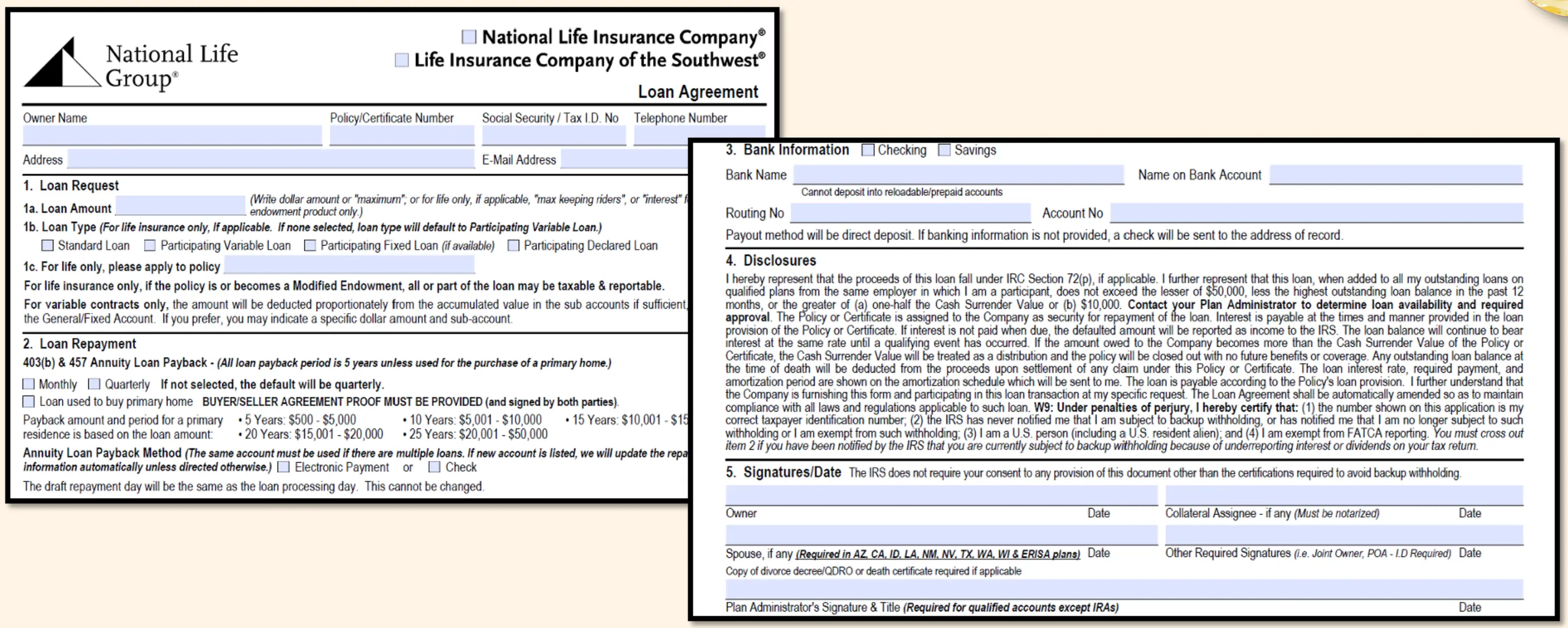
国家人寿 Loan Agreement 贷款申请表:保单持有人信息、1. Loan Request(金额、贷款方式,不勾默认 Participating Variable Loan)、2. Loan Repayment、3. Bank Information、4. Disclosures、5. Signatures / National Life Loan Agreement form: owner details, 1. loan request (amount and loan type, defaulting to the participating variable loan), 2. loan repayment, 3. bank information, 4. disclosures, 5. signatures

贷款方式要勾;不勾默认为参与浮动贷款Tick a loan type; otherwise it defaults to the participating variable loan

除了 APP,也可以填表申请。客户不习惯用手机,或者 APP 上办不了的,就用这张国家人寿的 Loan Agreement 贷款申请表。

Besides the app, a loan can be requested on paper, for example when the client isn't comfortable with a phone or the request can't be completed in the app. That's National Life's Loan Agreement form.

表格按顺序有五个部分。第一,最上面是保单持有人的信息:姓名、保单号、社安号或税号、电话、地址、邮箱。

The form has five parts in order. First, at the top, the owner's details: name, policy number, Social Security or tax ID number, phone, address and email.

第二,Loan Request 贷款申请。1a 写金额,可以写具体数字,也可以写 maximum,也就是能借的最高金额。 1b 勾选贷款方式:标准贷款、参与浮动、参与固定(如适用)、参与奖金型。这里要特别提醒:如果什么都不勾,默认就是参与浮动贷款。 所以帮客户填表时,一定要按前面讲的选择方法,主动勾好。

Second, the loan request. Line 1a is the amount, either a figure or "maximum," the most that can be borrowed. Line 1b is the loan type: standard, participating variable, participating fixed (if available), or participating declared. A key reminder: if nothing is ticked, it defaults to the participating variable loan. So when helping a client fill it in, tick the type deliberately, using the method we covered.

第三,收款的银行信息:账户名、路由号、账号。如果不填银行信息,公司会把支票寄到保单登记的地址。 表上还有一段 Loan Repayment 是给 403(b)、457 年金贷款用的,寿险保单不用填。

Third, the bank details for payment: account name, routing number and account number. If they're left blank, the company mails a check to the address on record. There's also a loan repayment section for 403(b) and 457 annuity loans; life policies don't need it.

第四,Disclosures 声明,包括贷款的条款,比如利息怎么计、贷款超过退保价值会怎样,以及 W-9 的税务身份声明。 第五,签名:保单持有人签;如果保单有抵押受让人 Collateral Assignee,要签名并公证;共同持有人或者授权人也要签。

Fourth, the disclosures, covering the loan terms, such as how interest is charged and what happens if the loan exceeds the surrender value, plus the W-9 tax certification. Fifth, signatures: the owner signs; if the policy has a collateral assignee, they sign and it must be notarized; joint owners or an attorney-in-fact also sign.

讲师提醒Presenter note

表格版本会更新,每次都从国家人寿官网或经纪人后台下载最新版。表上有社安号和银行账号,填好的表格不要用微信传,按公司规定的安全方式提交。

The form is updated from time to time; download the latest version from National Life's site or the agent portal every time. It carries Social Security and bank account numbers, so don't send a completed form over WeChat; submit it through the secure channels the company specifies.

对照:终身寿的保单贷款For Contrast: Whole Life Policy Loans

  • 没有标准贷款No standard loan
  • 没有参与贷款:借出的部分通常不再参与增长No participating loan: the borrowed part usually stops sharing in growth
  • 固定利率的非参与贷款:利息每年要付,不付就滚进贷款余额A fixed-rate, non-participating loan: interest is due every year, and unpaid interest is added to the loan
现金价值Cash value$30 万$300k
剩余Remaining$10 万$100k约 3–4%about 3–4%
贷款出来Borrowed$20 万$200k5% 固定,费用 5%5% fixed, cost 5%

原稿举的一家大型终身寿公司为例;各家规则不同,以对方合同为准Based on the original's example of one large whole life carrier; rules differ by company, so check that contract

最后一页,做个对照。很多客户手上已经有别家的终身寿保单,或者正在比较。终身寿也能贷款,但和我们今天讲的 IUL 贷款差别很大。

The last slide is a comparison. Many clients already hold a whole life policy elsewhere, or are comparing. Whole life can be borrowed against too, but it's very different from the IUL loans we've covered today.

看左边三条。第一,没有标准贷款,也就是没有我们第 11 年起利差为 0 的那一档。 第二,没有参与贷款:借出去的那部分钱,通常不再参与分红或增长。 第三,通常是固定利率的非参与贷款,原稿举的例子是 5% 固定利率。利息每年要付,不付就会滚进贷款余额里,越滚越大。

Look at the three points on the left. One, there's no standard loan, so nothing like our zero spread from year 11. Two, there's no participating loan: the borrowed part usually stops sharing in dividends or growth. Three, it's usually a fixed-rate, non-participating loan; the original's example is 5% fixed. Interest is due every year, and if it isn't paid it's added to the loan balance and keeps growing.

右边用同一个例子算:现金价值 $30 万,贷款出来 $20 万,剩余 $10 万。剩下的 $10 万按保单自己的增长走,大约 3 到 4%; 贷款出来的 $20 万按 5% 固定利率计息,又不参与增长,所以每年就是 5% 的费用,大约 $10,000。 和 IUL 参与型贷款比,它没有「指数好的年份把利息赚回来」的机会;和标准贷款比,它也没有返还利息来抵消。

The right side runs the same example: $300,000 of cash value, $200,000 borrowed, $100,000 remaining. The remaining $100,000 grows at the policy's own rate, roughly 3 to 4%; the borrowed $200,000 is charged 5% fixed and doesn't share in growth, so it costs 5% a year, about $10,000. Unlike an IUL participating loan, there's no chance of a good index year earning the interest back; unlike the standard loan, there's no credited rate to offset it.

讲这一页的目的不是说终身寿不好。终身寿的现金价值有保证,这是它的优点;我们只是把贷款这一个功能的差别讲清楚, 让客户在用钱这件事上,知道两种保单各自是怎么运作的。

The point of this slide isn't that whole life is bad. Whole life cash values are guaranteed, which is its strength. We're only making the difference in this one feature, loans, clear, so that when it comes to using the money, clients know how each kind of policy works.

讲师提醒Presenter note

各家终身寿的贷款规则不一样:利率有固定也有浮动,借出部分的分红怎么算(直接认定 / 非直接认定)也各不相同。 讲的时候说「很多传统终身寿」,具体到某一张保单,请客户拿出合同或打给那家公司确认。不要评价对方公司或代理人。

Whole life loan rules vary by carrier: rates may be fixed or variable, and how dividends treat the borrowed portion (direct or non-direct recognition) differs too. Say "many traditional whole life policies," and for any specific policy, have the client check the contract or call that company. Don't pass judgment on the other company or its agent.

先说数字First, about the numbers

下面的贷款利率、封顶、奖金比例都是成稿时的数值。这些数字会变:浮动利率每年都在动,封顶和奖金也会改版。 报给客户之前查当期产品说明书。

The loan rates, caps, and bonus percentages below were current when this page was written. They move: the variable rate changes annually, and caps and bonuses get revised. Check the current product guide before quoting.

1. 取钱和借钱,差在哪1. Withdrawing versus borrowing

取钱 Withdrawal

Withdrawal

像把钱包里的钱直接拿出来,里面就真的少了, 而且超过成本基数的部分要交税。

Like taking cash out of your wallet: it's actually gone, and anything above basis is taxable.

换成股票的说法:把股票卖了,钱拿出来用,卖出这一下就有税。

In equity terms: you sold the shares. The sale itself is the taxable event.

借钱 Loan

Loan

像把钱包当抵押,保险公司先借你一笔, 钱包里的钱还在继续帮你生利息。

Like pledging the wallet: the carrier advances you money and what's inside keeps earning.

换成股票的说法:有钱人抵押股票借钱出来用,没有税,股票继续涨还继续赚。

In equity terms: borrowing against the shares. No tax event, and the shares keep appreciating.

贷款是负债,不是收入,所以不征税。这是整件事的根。 但也因此有两个后果要记住:后续补回去的钱视为新保费, 成本和条款可能重算;身故赔偿会暂时减少(减少额 = 贷款本金 + 利息),还清后恢复。

A loan is a liability, not income, so it isn't taxed. That's the root of it. Two consequences follow: money paid back in counts as new premium, so charges and rider terms may be recalculated; and the death benefit is reduced while the loan is out (by principal plus interest), restored when it's repaid.

2. 什么是保单贷款2. What a policy loan is

用已经存进去的钱(现金价值)做抵押,向保险公司"借自己的钱"。 两个客户听得懂的类比:

Pledging the cash value you've already built to borrow your own money from the carrier. Two analogies clients get immediately:

拿来做什么What people use it for

应急基金(3–6 个月固定开支)、公司周转基金(3 个月运营成本)、教育基金、 买房基金、退休金、信托的流动性基金。

An emergency fund (three to six months of fixed costs), working capital for a business (three months of operating cost), education, a home down payment, retirement income, and liquidity for a trust.

应急基金为什么实际:加州一份个人医疗保险计划,网内医疗免赔额 $5,200、每年自付上限 $9,800 (网外 $25,000;家庭网内 $19,600)。有医保,生一场病自己也可能先掏将近 $1 万。

Why the emergency fund is practical: one California individual health plan has a $5,200 in-network deductible and a $9,800 annual out-of-pocket maximum ($25,000 out of network; $19,600 for a family in network). Even insured, one illness can cost close to $10,000 out of pocket.

为什么用它Why it gets used

3. 四种贷款方式3. Four kinds of loan

先把共同的画面建立起来:现金价值 $30 万,借出 $20 万,剩 $10 万 (这 $10 万继续跟着标普 500 增长),保额从 $100 万暂时降到 $80 万。 四种方式的区别,全在被抵押的那 $20 万怎么计息。

Set the picture first: $300k of cash value, $200k borrowed, $100k remaining (and that $100k keeps tracking the S&P 500), with the death benefit temporarily down from $1M to $800k. All four differ in how the $200k pledged as collateral is credited and charged.

① 标准贷款 Standard Loan① Standard loan

被抵押的部分转到贷款抵押账户,不再跟指数走;贷款收利息,同时保险公司返还利息,两边抵消。 贷款利率是浮动的,上限为基础利息 + 3%。

The pledged amount moves to a loan collateral account and stops following the index; the loan is charged interest and the carrier credits interest back, so the two offset. The loan rate floats, capped at the base rate plus 3%.

利差为 0 不等于没有成本:贷款本息仍会减少身故赔偿和可用现金价值,被抵押的部分也错过了指数好的年份。

A zero spread isn't zero cost: the loan and its interest still reduce the death benefit and the available cash value, and the pledged amount misses the good index years.

② 固定利息参与贷款 Participating Fixed Loan② Participating fixed loan

借出来的钱继续参与指数策略,但进的是 Indexed Loan Holding Account,封顶比原账户低。

The borrowed money stays in an index strategy, but inside an indexed loan holding account with a lower cap than the base account.

贷款利率固定 5%,该账户封顶 9.5% (原始指数账户是 11%)。指数走 +9.5% 时净赚 4.5%;指数 0% 时净亏 5%。

The rate is fixed at 5% and that account caps at 9.5% (the base index account caps at 11%). At +9.5% the net is +4.5%; at 0% the net is −5%.

③ 浮动利息参与贷款 Participating Variable Loan③ Participating variable loan

借出来的钱留在原始指数账户(封顶 11%),但贷款利率浮动: 随穆迪公司债券指数变化,上限为基础策略利率 + 3%(成稿时上限是 6.5%)。

The money stays in the base index account (11% cap) but the loan rate floats, tracking the Moody's corporate bond index, capped at the base strategy rate plus 3% (a 6.5% ceiling at the time of writing).

看两个极端就知道波动有多大:利率 5.6% 时,指数 +11% 净赚 5.4%; 疫情期间利率低到 2.3%,同样 +11% 就净赚 8.7%。 这是四种里波动最大的一种,赚的时候最多,利率冲高时也最难受。

Two ends show the swing: at 5.6%, an +11% index year nets 5.4%; during the pandemic the rate fell to 2.3%, and the same +11% year nets 8.7%. It has the widest spread of the four: the best upside, and the most painful when rates spike.

④ 奖金型参与贷款 Participating Declared Loan④ Participating declared loan

贷款利率由国家人寿自行设定(上限 8%,成稿时是 6.25%), 但借出的金额可以拿到额外利息奖金: FlexLife 保单第 2–9 年 0.6%、第 10 年及以后 0.85%;SummitLife 一律 0.85%。 算下来净成本约 5.4%–5.65%。

The carrier declares the rate (capped at 8%; 6.25% at the time of writing), and the borrowed amount earns an interest bonus: on FlexLife 0.6% in years 2–9 and 0.85% from year 10, on SummitLife 0.85% throughout. Net cost works out around 5.4%–5.65%.

打开 Enhancer 增加利息条款时,这种贷款方式不可用。 做方案时如果客户开了 Enhancer,这一档直接排除。

Not available when the Enhancer rider is switched on. If the case has an Enhancer, rule this one out at design time.

四种对照The four side by side

方式Type 贷款利息上限Rate ceiling 被抵押的钱在哪增长Where the collateral earns 目前利率(可能变化)Current rate (may change) 奖金Bonus
标准Standard 浮动,上限 = 基础利息 + 3%Floating, capped at base rate + 3% 贷款抵押账户,年底按贷款利息返还(前 10 年少返 0.5%),不参与指数Loan collateral account, credited back at year end (0.5% short in years 1–10); not indexed 5.60% 无None
参与浮动Participating variable 浮动,上限 = 基础利息 + 3%Floating, capped at base rate + 3% 原始指数账户(标普 500,封顶 11%)Base index account (S&P 500, 11% cap) 5.60% 无None
参与固定Participating fixed 固定 5%,投保时锁定Fixed 5%, locked at issue 指数贷款账户(标普 500,封顶 9.5%)Indexed loan account (S&P 500, 9.5% cap) 5% 无None
参与奖金型Participating declared 国家人寿设定,上限 8%Carrier-declared, capped at 8% 原始指数账户(标普 500,封顶 11%)Base index account (S&P 500, 11% cap) 6.25% FlexLife 0.6%(第 2–9 年)/ 0.85%(第 10 年起);SummitLife 0.85%FlexLife 0.6% (Y2–9) / 0.85% (Y10+); SummitLife 0.85%

一个计划书案例A case from an illustration

5 岁女孩,演示利率 6.5%,保费每月 $249 × 15 年,累计 $44,820;60 岁起每年用贷款领取退休收入,领到 89 岁。

A five-year-old girl, 6.5% illustrated rate, $249 a month for 15 years ($44,820 in total); from 60 she borrows a retirement income every year through 89.

贷款方式Loan type 每年领取Each year 60–89 岁累计Total, 60–89 90 岁身故赔偿Death benefit at 90 终身总价值Lifetime total
标准(5.5%)Standard (5.5%)$35,598$1,067,940$691,196$1,759,136
参与固定(5%)Participating fixed (5%)$46,349$1,390,470$302,733$1,693,203
参与浮动(5.5%)Participating variable (5.5%)$47,157$1,414,710$314,912$1,729,622
参与奖金型(6.25%)Participating declared (6.25%)$49,204$1,476,120$328,131$1,804,251

参与型每年多领三到四成,但 90 岁时留下的身故赔偿只有标准贷款的一半不到;四种的终身总价值都在 $170–180 万之间。 选哪种,是在「生前多领」和「身后多留」之间取舍。这些是计划书演示值,假设利率 30 年不变、指数每年记 6.5%,不是收益承诺。

The participating loans draw 30–40% more a year, but leave less than half the standard loan's death benefit at 90; all four lifetime totals land between $1.7M and $1.8M. The choice is between more while living and more left behind. These are illustrated values that assume unchanged loan rates for 30 years and a 6.5% credit every year. They are not a promise of results.

4. 怎么选4. How to choose

短期用钱,以后要还回去

Short-term, and you'll pay it back

→ 标准贷款。利息互相抵消,不承担指数波动,借完还上就结束了。

→ Standard loan. The interest washes out, no index exposure, and it's over when you repay.

要终身收入,以后不还

Lifetime income, never repaid

→ 参与型贷款。让借出来的钱继续赚,长期才跑得赢利息。 具体选哪一档,看当期贷款利率:

→ A participating loan. The borrowed money has to keep earning to outrun the interest over a long horizon. Which one depends on the current rate:

  • 贷款利率 > 5% → 选固定利息参与贷款(锁在 5%)
  • Rate above 5% → participating fixed, locked at 5%
  • 贷款利率 < 5% → 选浮动利息或奖金型
  • Rate below 5% → variable or declared

要的是「保证」的终身收入

Income that's guaranteed

→ 不走贷款,走 LIBR 终身收入条款。见第 7 节。

→ Not a loan at all. Use the lifetime income benefit rider. Section 7.

上面案例里固定利息领得比浮动和奖金型少,是因为计划书假设利率几十年不变,而固定型的贷款账户封顶只有 9.5%。 固定利息买的是「利率不会再往上走」的确定性,计划书体现不出来。

In the case above the fixed loan drew less than the variable and declared loans because the illustration assumes rates never change and the fixed loan's account caps at 9.5%. What the fixed loan buys is certainty that the rate can't climb further, which an illustration can't show.

5. 用完要不要还?5. Does it have to be repaid?

不一定要还。保单贷款跟银行贷款不一样,没有硬性还款要求。 选择不还,留在保单里的钱还是继续利滚利,最后保险公司在理赔时自动从身故赔偿里结清。

No. Unlike a bank loan there is no repayment schedule. If it's never repaid, what's left inside keeps compounding and the carrier settles the balance out of the death benefit at claim.

什么时候可以开始用?When can it start?

用树苗打个比方,分三个阶段:

Think of a sapling, in three stages:

6. 拿多了会怎样:过度贷款保护条款6. Taking too much: the overloan protection rider

没有这个条款的后果Without the rider

贷款太大 → 保单进入宽限期 Grace Period → 必须补钱(还贷或补保费), 否则保单失效。而保单一旦失效,未偿还的贷款会被视为收入, 这是重大税务事故:客户拿到的是一张税单,而不是钱。

Too large a loan puts the policy into a grace period. Money has to go in (repayment or premium) or the policy lapses. And when it lapses the outstanding loan becomes taxable income. That is a serious tax event: the client receives a tax bill, not a check.

所以三条动作:按计划取钱、有问题找经纪人、每年做保单年检。

Hence three habits: take what the plan says, call your agent, and review the policy every year.

先分清成本和增值。一份从 0 岁开始、每年 $6,000、交 20 年的计划书:累计保费 $120,000 是成本; 按 6.30% 的演示利率,第 21 年现金价值 $199,722,其中约 $8 万是增值。保单有效时贷款不交税; 一旦失效,超过成本的贷款就要当作收入补税。

First separate cost from gain. In one illustration starting at age 0, $6,000 a year for 20 years: the $120,000 of premiums is the cost; at a 6.30% assumed rate, the year-21 cash value is $199,722, about $80,000 of it gain. While the policy is in force the loans aren't taxed; once it lapses, loans above cost become taxable income.

什么时候可以启动(四个条件必须同时满足)When it can be exercised (all four required)

  1. 被保险人年龄 ≥ 75 岁
  2. The insured is 75 or older
  3. 保单日期 ≥ 数据页写的 Minimum Exercise Date,且保单仍有效
  4. The policy has passed the minimum exercise date on the data page and is still in force
  5. 未偿还贷款 > 保单保额
  6. The outstanding loan exceeds the face amount
  7. 杠杆比率超过门槛:负债 ÷(现金价值 − 退保罚金)> Overloan Protection Factor
  8. Leverage is past the threshold: debt ÷ (accumulated value − surrender charge) > the overloan protection factor

保单数据页的 Overloan Protection Rider 一段会写明这几个数,例如:Exercise Age 75、 Minimum Exercise Date(每张保单不同)、Overloan Protection Factor 0.95。

The overloan protection section of the policy data page states these figures, for example: exercise age 75, a minimum exercise date (different for every policy), and an overloan protection factor of 0.95.

一旦行使,保单会被"改造"Once exercised, the policy is rebuilt

不可撤销。保单被换成一个更封闭、更保守的结构:

Irrevocable. The contract is converted into something closed and conservative:

被锁住的东西What gets locked变成什么Into what
指数策略Index strategy全部现金价值转入 Basic Strategy 3.5%,之后不能再转回任何指数或计息策略All value moves to the 3.5% basic strategy and can never move back
贷款Loans所有参与型贷款重写为标准贷款,禁止新增任何保单贷款Participating loans are rewritten as standard loans and no new loans are allowed
现金流与操作Cash flow不能再追加保费、不能再提款;月扣费停止;其他付费条款终止。若当时是 Option B,自动切回 Option A 且以后不得更改No further premium, no withdrawals; monthly deductions stop and paid riders terminate. If it was on Option B it reverts to Option A permanently
费用Charge只有在行使时才收:一次性 Exercise Charge =(数据页对应年龄的费率 %)× 现金价值,从 Basic Strategy 扣除Only at exercise: a one-time charge of (the age-based rate on the data page) × accumulated value, taken from the basic strategy

行使费率按年龄查数据页,例如一张保单上 75 岁 3.16%、80 岁 3.51%、95 岁 0.89%。 80 岁行使、现金价值 $50 万,一次性收约 $17,550。

The exercise charge rate is looked up by age on the data page; one policy shows 3.16% at 75, 3.51% at 80 and 0.89% at 95. Exercised at 80 with $500,000 of value, the one-time charge is about $17,550.

所以它是安全网,不是工具。它救的是保单不失效、客户不吃税单; 代价是保单从此失去全部弹性。做方案时的目标永远是不要走到这一步。

It is a safety net, not a feature. It saves the policy from lapsing and the client from the tax bill; the price is that the contract loses all of its flexibility. The design goal is always to never need it.

7. 另一条路:LIBR 终身收入条款7. The other route: the lifetime income benefit rider

贷款给的是灵活的收入;LIBR 给的是保证的收入。 要"活多久领多久、不怕领光",走这一条。

Loans give flexible income; LIBR gives guaranteed income. If the requirement is "pays as long as I live, and can't run out," this is the route.

启动条件To switch it on

IUL 贷款收入IUL loan incomeLIBRLIBR
结构Structure四种贷款方式都可以用Any of the four loan types仅限标准贷款Standard loan only
领取金额Amount更高、更灵活Higher, more flexible更低Lower
控制权Control客户自行管理Client-managed公司主导控制Company-managed
设计目的Design intent以现金流为核心Built around cash flow以保单「活下去」为核心(不失效)Built around keeping the policy alive
市场影响Market impact会受市场表现影响Follows market performance一旦启动,市场表现不再重要Once started, markets no longer matter

给付比例不是一个固定数,是按保单当时的身故赔偿比率算出来的, 比率越高,给付率越高。有一个 0 岁男宝、$100 万保额、$500/月存 20 年、67 岁起领的算例, 推出约 7.05% 的给付率。这个数字完全取决于那份计划书的假设,不要拿去当通用数字报。

The payout factor isn't fixed. It's derived from the policy's death benefit ratio at the time, and a higher ratio gives a higher factor. One worked case (male age 0, $1M, $500 a month for twenty years, income from 67) comes to roughly a 7.05% factor. That number belongs to that illustration's assumptions. Don't quote it as a general figure.

8. 对照:终身寿(WL)的贷款8. For contrast: whole life loans

客户如果手上有别家的终身寿保单,差别要讲清楚:

If a client holds a whole life policy elsewhere, spell out the difference:

各家规则不同(利率固定或浮动、直接认定或非直接认定),具体以那张保单的合同为准,不评价对方公司或代理人。

Rules differ by carrier (fixed or variable rates, direct or non-direct recognition); go by that policy's contract, and don't pass judgment on the other company or its agent.

9. 怎么操作9. How it's actually done

两条路:保险公司的手机 APP 直接申请,或者填表提交。 实际界面以当期 APP 版本为准。

Two routes: through the carrier's mobile app, or by submitting the form. The app's current build is what you'll actually see.

手机 APPIn the app

  1. 保单首页 Summary → 点 Actions
  2. Policy summary → tap Actions
  3. Loan 页看可用资金和这次可借的范围(以页面显示为准)→ Request Funds
  4. The Loan tab shows the cash available and the range that can be borrowed (go by the screen) → Request Funds
  5. 选 Loan(贷款)还是 Withdrawal(提款)
  6. Choose Loan or Withdrawal
  7. 输入金额,页面会显示身故赔偿随之减少多少
  8. Enter the amount; the screen shows how much the death benefit drops
  9. 选择贷款方式(页面显示当期利率;不确定就联系经纪人)
  10. Choose the loan type (current rates are shown; if unsure, contact the agent)
  11. 选择收款方式:支票寄到登记地址,或 EFT 转入银行账户
  12. Choose the disbursement: a check to the address of record, or EFT to a bank account
  13. 核对金额、利率、贷款方式和账户,读完 Disclosure 后提交
  14. Check the amount, rate, loan type and account, read the disclosure, and submit

填表On paper

用国家人寿的 Loan Agreement:金额写数字或「maximum」;贷款方式要勾,不勾默认为参与浮动贷款; 不填银行信息就寄支票到登记地址;有抵押受让人的要签名并公证。表上有社安号和银行账号,按公司规定的安全方式提交,不要用微信传。

Use National Life's Loan Agreement: write a figure or "maximum" for the amount; tick a loan type, or it defaults to the participating variable loan; leave the bank details blank and a check goes to the address of record; a collateral assignee must sign and be notarized. The form carries Social Security and bank numbers, so submit it through the company's secure channels, never over WeChat.

10. 一页总结10. One-page summary

  1. 借不是取。贷款是负债不是收入,所以不征税;留下的钱继续生息。
  2. Borrowing isn't withdrawing. A loan is a liability, not income, so it isn't taxed, and what stays behind keeps earning.
  3. 四种方式的差别,全在借出来那笔钱怎么计息。
  4. The four types differ only in how the borrowed money is credited and charged.
  5. 短期要还 → 标准贷款;长期不还 → 参与型,按当期利率在 5% 上下选档。
  6. Short-term and repaid → standard. Long-term and never repaid → participating, choosing by whether the current rate is above or below 5%.
  7. 开了 Enhancer 就不能用奖金型。
  8. With an Enhancer on, the declared loan is unavailable.
  9. 不还也可以,理赔时自动结清。但拿多了会让保单失效,失效就要吃税单。
  10. It never has to be repaid; it settles at claim. But over-borrowing lapses the policy, and a lapse is a tax bill.
  11. Overloan 是安全网不是工具:救得了保单,但保单从此失去全部弹性。
  12. Overloan protection is a net, not a feature: it saves the policy and costs it all its flexibility.
  13. 要保证的终身收入,走 LIBR,不走贷款。
  14. For guaranteed lifetime income, use LIBR rather than loans.
上一篇Previous 保单费用Policy Costs 相关Related IUL 如何运作How IUL Works

内部培训资料,仅供签约经纪人使用,不可转发给客户。 文中利率、封顶与奖金比例对应成稿时的数值,浮动利率与产品条款都会变动; 一律以承保公司当期资料和实际计划书为准,不构成任何收益承诺。

Internal training material for contracted agents; not for forwarding to clients. Rates, caps, and bonuses reflect the values current when this page was written; floating rates and contract terms both change. Always use the carrier's current material and the actual illustration. Nothing here is a promise of any result.