




Home/产品中心Products/终身寿 vs IULWhole Life vs IUL

团队建设 · 约 30 分钟Team Building · 30 min

终身寿 vs IUL

Whole Life vs Indexed Universal Life

这一篇不讲"我们更好",只把保证的代价、成本的透明度、生前福利的边界、 贷款能不能继续增长这四件事拆开,让你在客户面前能逐条指着讲。

This isn't an "ours is better" page. It pulls apart four things: what guarantees cost, how visible the charges are, where living benefits stop, and whether borrowed money keeps growing. That way you can point at each one in front of a client.

幻灯片 · 52 页 · 每页下方附详细讲解Slides · 52 pages · full presenter notes under each ↓ 跳到全文↓ Skip to the full article

终身寿险 vs
指数型万能寿险
Whole Life vs
Indexed Universal Life

Presented by Team Rise

各位伙伴好,我们是 Team Rise。今天这一组讲一个我们几乎天天会碰到的话题:终身寿险 Whole Life 和指数型万能寿险 IUL,到底差在哪里。

Hello everyone, we're Team Rise. Today's set covers a question we run into almost every day: what actually separates whole life from indexed universal life, or IUL.

为什么要专门讲?因为在市场上,我们经常和卖终身寿的同业出现在同一个客户面前。客户会听到两套说法: 一边说「只有终身寿才是真保险」,一边说「IUL 更灵活、资金效率更高」。客户自己分不清,最后往往是谁的气场强就听谁的。 我们今天要做的,是先把两边的条款和机制摆清楚,让我们自己心里有数。

Why give it a whole session? Because in the field we often end up in front of the same client as an agent selling whole life. The client hears two stories: one says "whole life is the only real insurance," the other says "an IUL is more flexible and makes the money work harder." Clients can't tell them apart, so they often go with whoever sounds more sure. Our job today is to lay out the terms and mechanics on both sides, so we're clear on them first.

今天一共分五个部分。第一部分讲代理人:为什么卖 Whole Life 的代理人普遍那么自信,这份自信从哪里来。 第二部分讲公司总资产:公司大,是不是就代表对客户更好。第三部分讲福利:终身寿的附加条款到底保什么。 第四部分讲保证:那些「保证」背后要付出什么代价。第五部分讲现金价值:钱放进去以后,能不能用、怎么用。

There are five parts. Part one is about the agents: why people who sell whole life tend to be so confident, and where that confidence comes from. Part two is about total assets: does a bigger company mean a better deal for the client? Part three is about benefits: what whole life riders actually cover. Part four is about guarantees: what those guarantees cost. Part five is about cash value: once the money is in, can you use it, and how.

中间还会插一段「买定期、投资差额」,也就是 BTID,因为它是客户最常拿来和这两种产品比较的第三种做法。 最后有一张总对照表,把两种产品在各个维度上并排放在一起。

Along the way there's a section on "buy term and invest the difference," or BTID, because it's the third option clients most often weigh against these two. We finish with one comparison table that puts both products side by side on every dimension.

先定个调:今天不是要证明谁错。终身寿有适合它的客户,IUL 也有适合它的客户。 我们要做的,是把条款和机制讲清楚,再按客户的需要去匹配。讲到别家公司和同业时,我们只讲制度和事实,不评价人。

Let's set the tone now: we're not here to prove anyone wrong. Whole life suits some clients, and an IUL suits others. What we do is explain the terms and mechanics clearly, then match the product to what the client needs. When other companies and other agents come up, we talk about systems and facts, never about people.

互动设计Interaction

开场请大家在聊天框里打一个词:你见过的终身寿代理人,给你的第一印象是什么?「专业」「自信」「强势」都可以。 把大家的回答记下来,第一部分讲完再回来看,这些印象是怎么来的。

Open by asking everyone to type one word in the chat: what was your first impression of a whole life agent you've met? "Professional," "confident," "pushy," anything goes. Note the answers, and come back to them at the end of part one to see where those impressions come from.

第一部分:为什么 Whole Life
代理人个个自信爆棚?
Part I: Why Are Whole Life Agents
So Sure of Themselves?

这一部分讲五件事Five things in this part

  • 一则招募启事A recruiting post
  • 入职流程The onboarding process
  • Project 200Project 200
  • FINRA 牌照FINRA licensing
  • 自信背后的五个原因Five reasons behind the confidence

进入第一部分。标题起得很直白:为什么 Whole Life 代理人个个自信爆棚,甚至有点傲气?

On to part one. The title is deliberately blunt: why are whole life agents so sure of themselves, sometimes to the point of arrogance?

这不是抬杠。如果你在市场上接触过 Northwestern Mutual、New York Life、MassMutual 这些大公司的代理人, 你多半感受过那种气场:他们相信只有终身寿险才是「真保险」,IUL、定期都算次一等。 这份自信是天生的吗?不是。它是一整套招募体系、牌照体系和公司文化,一步步塑造出来的。

This isn't picking a fight. If you've dealt with agents from the big companies, Northwestern Mutual, New York Life, MassMutual, you've probably felt it: they believe whole life is the only "real" insurance, and that IUL and term are second-rate. Were they born that confident? No. A whole system of recruiting, licensing and company culture built it, step by step.

这一部分我们按顺序看五件事。先看一则招募启事,看大公司用什么来吸引新人;再看 Northwestern Mutual 的入职流程; 然后讲 Project 200 是什么;接着讲 FINRA 和几张证券牌照,以及「金融顾问」这个头衔是怎么来的; 最后把他们自信的来源归纳成五条。

We'll take five things in order. First a recruiting post, to see what the big companies use to attract new people. Then Northwestern Mutual's onboarding process. Then what Project 200 is. Then FINRA, the main securities licenses, and where the "financial advisor" title comes from. Finally, we sum up the sources of that confidence in five points.

看完你会发现,这份自信一部分来自真实的专业训练,一部分来自精心设计的筛选和身份包装。 看懂了这套机制,我们和他们同台的时候就不会被气场压住,而是能就事论事,用条款和数字说话。

By the end you'll see that the confidence comes partly from real professional training and partly from carefully designed screening and positioning. Once you understand the system, you won't be thrown by the aura when you're up against them. You can stay on the facts and let the terms and the numbers do the talking.

提前说一句:这一部分不是让大家去笑话谁。人家的训练体系有很多值得我们学的地方,我们要的是理解,不是对立。

One thing up front: this part is not about mocking anyone. Their training system has a lot we can learn from. What we're after is understanding, not hostility.

一则招募启事A Recruiting Post

纽约人寿(New York Life)的团队招募(按原帖文字整理)A New York Life team recruiting post (summarised from the original)

我们是谁Who are we?

  • 世界财富 500 强第 73 位No. 73 on the Fortune 500
  • 全美最大的互惠人寿公司The largest mutual life insurer in the US
  • 以上为发布方自称Both as the poster describes itself

为什么选我们Why choose us?

  • 工作时间灵活Flexible hours
  • 学到美国金融市场的很多知识Learn a lot about US financial markets
  • 付出与回报成正比Rewards in proportion to effort
  • 免费学习机会,包括考 SIE、Series 6、Series 63 等牌照Free training, including licenses such as the SIE, Series 6 and Series 63

要求Requirements

  • 基本的英文听说读写Basic spoken and written English
  • 金融、数学、统计、数据分析等专业最佳,无硬性学历要求Finance, math, statistics or data analytics preferred; no hard degree requirement
  • 对工作热忱,自律,能自我管理Passion, self-discipline and self-management
  • 熟悉电脑和办公软件Comfortable with computers and office software
  • 需合法身份报税,暂不支持 OPTMust be able to file taxes legally; OPT not supported for now

先看一则真实的招募启事。这是纽约人寿一个团队发在网上的招人帖,我们把截图里的文字整理成了这张卡片。 放这一页想说的第一件事是:连纽约人寿这样的百年大公司,也一样要招人、要建团队。招募不是小公司才做的事,是这个行业的常态。 帖子分三块:我们是谁、为什么选我们、对你有什么要求。

Let's start with a real recruiting post. A New York Life team put it online, and we've turned the text of the screenshot into this card. The first point of this slide: even a century-old giant like New York Life recruits and builds teams. Recruiting isn't something only small firms do; it's how this industry works. The post has three parts: who we are, why choose us, and what we require.

「我们是谁」:发布方自称世界财富 500 强第 73 位、全美最大的互惠人寿公司。 这两条说的就是纽约人寿。大家注意一点:招募的第一句话,讲的是公司的排名和规模。 这一点到第二部分讲公司总资产时,我们还会再碰到。

"Who are we": the poster describes itself as No. 73 on the Fortune 500 and the largest mutual life insurer in the US. Those two lines describe New York Life. Notice one thing: the first line of the pitch is about the company's rank and size. We'll meet that idea again in part two, on total assets.

「为什么选我们」:工作时间灵活;能学到美国金融市场的很多知识;付出与回报成正比; 公司提供很多免费学习的机会,包括考 SIE、Series 6、Series 63 这些金融牌照。 大家看,这里卖的不是「来卖保险」,而是学习机会、考证和灵活。对刚毕业的留学生、想转行的人,这几条很有吸引力。 「付出与回报成正比」是招募帖自己的说法,佣金制的工作大体如此,但它不是收入承诺,我们自己招人时也不要这样许诺。

"Why choose us": flexible hours; a chance to learn a lot about US financial markets; rewards in proportion to effort; and plenty of free training, including financial licenses such as the SIE, Series 6 and Series 63. Notice what's being sold here. It isn't "come sell insurance." It's learning, licenses and flexibility, which appeal strongly to recent international graduates and career changers. "Rewards in proportion to effort" is the post's own claim. Commission work broadly runs that way, but it isn't an income promise, and we shouldn't make that promise when we recruit either.

「要求」有五条:基本的英文听说读写;金融、数学、统计、数据分析这类专业最好,但没有硬性学历要求; 对工作有热情、自律、能自我管理;会用电脑和办公软件。最后一条很关键:需要合法身份报税,暂时不支持 OPT。 也就是说,F-1 学生毕业后靠 OPT 工作的这一类人,这个岗位暂时进不来。

"Requirements" lists five things: basic spoken and written English; a background in finance, math, statistics or data analytics preferred, with no hard degree requirement; passion, self-discipline and the ability to manage yourself; and comfort with computers and office software. The last one matters: you must be able to file taxes legally, and OPT isn't supported for now. In other words, F-1 graduates working on OPT can't get in for the time being.

把这几条放在一起看:门槛不算高,但每一条都在筛人。英文是为了面对主流客户、考英文的牌照; 专业背景给「金融顾问」的形象打底;自律,是因为时间灵活就意味着没人盯着你,全靠自己推进; 合法报税身份,是签约和领佣金的前提。

Put them together and the bar isn't high, but every line filters people. English is for mainstream clients and English-language licensing exams. The academic background supports the "financial advisor" image. Self-discipline matters because flexible hours mean nobody is watching you, so everything depends on you. And legal tax status is the precondition for signing a contract and being paid commission.

吸引人的卖点,加上一道道筛选,这就是大公司招人的基本思路。下一页看具体的入职流程, 就能更清楚地看到这种筛选是怎么一步步做的。

Attractive selling points plus layer after layer of screening: that's the basic logic of how the big companies recruit. The next slide walks through an actual onboarding process, where you can see the screening play out step by step.

讲师提醒Presenter note

这一页的重点是「纽约人寿也在招募」,不要把它和下一页的 Northwestern Mutual 混在一起讲。 拿别家的招聘帖做材料,是为了理解行业,不是为了取笑;不要在客户面前拿出来讲。

The point of this slide is "New York Life recruits too"; don't blend it with Northwestern Mutual on the next slide. We use another firm's recruiting post to understand the industry, not to make fun of it, so don't bring it up in front of clients.

Northwestern Mutual 入职流程Northwestern Mutual: How to Get In

01

在线申请Online application

02

Zoom
视频面试
Zoom interview

03

面对面
面试
Face-to-face interview

04

推荐人 &
考牌要求
Referral & licensing

05

完成
Project 200
Complete Project 200

三轮面试、推荐人、考牌,再加 Project 200:
既是筛选,也在塑造心态
Three interviews, a referral, licensing and Project 200:
screening, and shaping a mindset

再看大公司的入职流程。这里用 Northwestern Mutual 做例子,因为它在行业里很有代表性。

Now an onboarding process at a big company. We'll use Northwestern Mutual as the example, because it's highly representative of the industry.

进 NM 要走五步:第一步,在线申请;第二步,Zoom 视频面试;第三步,面对面面试; 第四步,推荐人加考牌要求;第五步,也是最关键的一步,完成 Project 200。

Getting into NM takes five steps. One, an online application. Two, a Zoom interview. Three, a face-to-face interview. Four, referral and licensing requirements. And five, the most important, completing Project 200.

大家注意这个流程的设计。一个卖保险的岗位,为什么要安排三轮面试,还要推荐人? 因为它在营造一种「稀缺感」和「精英感」:让你觉得能进来,是被层层挑选出来的。 这种仪式感会慢慢变成代理人的自我认同:「我是经过严格筛选才进来的,所以我比别人专业。」

Look at how the process is designed. Why would an insurance sales job need three rounds of interviews and a referral? Because it creates a sense of scarcity and of being elite: you feel you were hand-picked through round after round. That sense of ritual gradually becomes part of how agents see themselves: "I got in through a tough selection process, so I'm more professional than the rest."

第四步里的考牌,就是上一页那句「公司提供免费学习机会,考 SIE、Series 6、Series 63」落到实处。 牌照考下来,是实打实的专业门槛,这一点我们要尊重。后面两页会把这些牌照一张张拆开讲。

The licensing in step four is where the last slide's "free training, including the SIE, Series 6 and Series 63" becomes real. Passing those exams is a genuine professional bar, and we should respect that. Two slides from now we'll take those licenses apart one by one.

第五步 Project 200,下一页专门讲。先记住一点:这套流程的目的不只是招人,也在塑造一个人的心态。 后面你会发现,他们卖高保费产品时的那份笃定,和这套入门机制是一脉相承的。

Step five, Project 200, gets its own slide next. For now, remember this: the process isn't only about hiring. It also shapes how a person thinks. Later you'll see that the certainty they bring to selling high-premium products comes straight out of this entry process.

合规提醒Compliance note

这一页讲的是招聘流程,是制度层面的事实。不要在客户面前拿别家的招聘流程取笑, 也不要说「他们这样招人,所以他们的产品不好」:招聘方式和产品好坏是两回事。

This slide is about a hiring process, a fact about how a system works. Don't make fun of another company's hiring process in front of clients, and don't say "they hire like that, so their products are bad." How a company recruits and how good its products are are separate questions.

Project 200Project 200

入职前,列出 200 个你认识的人:这就是你的第一批「市场」Before you start, list 200 people you know: that's your first "market"

亲戚 / 家人Relatives / family
同学 / 校友Classmates / alumni
前同事Former colleagues
朋友 / 邻居Friends / neighbours
社群 / 教会Community / church
任何有联系方式的人Anyone with contact details

名单模板的栏位:First Name、Last Name(必填)、Gender、Approximate Age、Marital Status、Primary Phone Type、Home Phone / Mobile Phone(至少填一个)、Email、Employer、Job Title、Approximate IncomeTemplate columns: First Name, Last Name (required), Gender, Approximate Age, Marital Status, Primary Phone Type, Home Phone / Mobile Phone (at least one), Email, Employer, Job Title, Approximate Income

含义:你的「市场」其实是你的人脉。人脉用完,业绩往往就见顶,这也是新人淘汰率高的一个原因What it means: your "market" is your network. When it runs out, results often plateau, which is one reason so many new agents leave

Project 200,这是理解大公司模式的一把钥匙。

Project 200 is one of the keys to understanding the big-company model.

什么是 Project 200?就是在你正式上岗之前,公司要求你列出 200 个你认识的人:亲戚家人、同学校友、前同事、 朋友邻居、社群和教会里的人,任何你手机里有联系方式的人,全部列出来。这 200 个人,就是公司为你规划的「第一批市场」。

What is it? Before you start for real, the company asks you to list 200 people you know: relatives and family, classmates and alumni, former colleagues, friends and neighbours, people from your community or church, anyone whose contact details are in your phone. Those 200 people are the "first market" the company plans for you.

这份名单不是随手写在纸上的,而是一张表格模板。原稿里那张表的栏位是:名和姓,这两栏必填,而且不能用特殊字符; 然后是性别、大概年龄、婚姻状况、主要电话类型;家庭电话和手机至少要填一个;再往后是电子邮件、雇主、职位, 最后一栏是大概收入。大家体会一下:这已经不只是一份通讯录,而是一份可以按年龄、家庭、职业、收入去筛的潜在客户名单。

The list isn't jotted on paper; it's a spreadsheet template. The columns in the original are: first name and last name, both required and with no special characters; then gender, approximate age, marital status and primary phone type; at least one of home phone or mobile phone; then email, employer and job title; and finally approximate income. Think about what that means: it's no longer just a contact list. It's a prospect list you can sort by age, family, occupation and income.

听起来很有道理,对吧?先从熟人开始。但我们要看清它的本质:新人入行时最大的资产,往往不是专业, 而是信任你的那 200 个熟人。公司让你先把这批人转化成保单。等这 200 个人联系得差不多了, 如果你还没建立起持续开发新客户的能力,业绩就很容易断档。这也是大公司新人留存率低、头几年流失很多人的原因之一。

Sounds sensible, right? Start with people you know. But look at what's really going on. A new agent's biggest asset usually isn't expertise; it's the 200 people who trust them. The company has you turn that group into policies first. Once you've worked through the 200, if you haven't built the ability to keep finding new clients, your results can easily dry up. That's one reason new-agent retention at the big companies is low and so many leave in the first few years.

但反过来想:能在这种机制里留下来的人,确实有本事。这也是他们自信的来源之一: 「我把熟人市场做完了还留在这个行业,我当然行。」所以他们的自信,一半来自真本事,一半有幸存者偏差: 我们看到的都是留下来的人,没看到离开的那一批。看懂这一点,我们就不必盲目仰视。

Turn it around, though: the people who survive this system really are capable. That's one source of their confidence: "I worked through my whole warm market and I'm still in the business, so of course I'm good." Their confidence is half real skill and half survivorship bias. We only see the ones who stayed, not the ones who left. Once you see that, there's no need to look up to them blindly.

对我们自己也是提醒:从身边的人讲起,谁都会这样做,Team Rise 也一样。关键有两点:第一,给对方讲的是他真正需要的方案; 第二,在熟人之外,尽早学会开发新的客户来源。

It's a reminder for us too. Everyone starts with the people around them, Team Rise included. Two things matter: first, offer people what they actually need; second, learn early on to find clients beyond your warm market.

讲师提醒Presenter note

不要报具体的留存率或淘汰率数字;被问到时就说「行业里新人头几年流失多」,不报没有出处的比例。 也不要在客户面前拿 Project 200 开玩笑,很多客户本身就在某位代理人的名单上。 我们自己整理名单时,电话、收入这些都是个人信息,要妥善保管。

Don't quote a specific retention or turnover figure. If asked, say "the industry loses a lot of new agents in the first few years," and leave out any percentage without a source. Don't joke about Project 200 in front of clients either; plenty of clients are on some agent's list. And when we build our own lists, phone numbers and income are personal information, so keep them secure.

FINRA 牌照FINRA Licensing

FINRA = 美国金融业监管局,受 SEC 监督的自律机构,负责监管券商与注册代表FINRA = the Financial Industry Regulatory Authority, a self-regulatory body overseen by the SEC that regulates broker-dealers and registered representatives

1管理:证券从业资格考试(SIE / Series 系列)Administers: the securities qualification exams (SIE and the Series)
2监管:券商、注册代表的执业行为Oversees: how broker-dealers and registered reps conduct business
3意义:想卖证券类产品,必须先过 FINRA 的牌照Why it matters: to sell securities, you need FINRA licensing first

定期、Whole Life、IUL 是固定型寿险,归各州保险局管;变额寿险、变额年金同时属于证券,还要证券牌照Term, whole life and IUL are fixed life insurance, regulated by state insurance departments; variable life and variable annuities are also securities and need a securities license

要理解 Whole Life 代理人身上的「专业光环」,得先理解牌照体系。牌照体系里最核心的监管机构,就是 FINRA。

To understand the professional aura around whole life agents, you first need to understand licensing, and the central regulator in that system is FINRA.

FINRA 全称 Financial Industry Regulatory Authority,美国金融业监管局。它不是政府部门, 而是一个受美国证券交易委员会 SEC 监督的自律组织,专门监管券商和注册代表的执业行为。 简单说,凡是涉及证券类产品的销售,比如共同基金、变额年金、变额寿险、股票,都归它管。

FINRA stands for the Financial Industry Regulatory Authority. It isn't a government agency. It's a self-regulatory organization overseen by the Securities and Exchange Commission, the SEC, and it regulates how broker-dealers and registered representatives do business. Put simply, anything involving the sale of securities, such as mutual funds, variable annuities, variable life or stocks, falls under it.

它做的事,就是幻灯片上这三条。管理:证券从业资格考试,也就是 SIE 和 Series 系列; 监管:券商和注册代表平时怎么执业、有没有违规;意义:想卖证券类产品,必须先通过这些考试,并在一家券商名下注册。

What it does is the three points on the slide. It administers the securities qualification exams, the SIE and the Series. It oversees how broker-dealers and registered reps conduct business and whether they break the rules. And the upshot: to sell securities, you must pass those exams and be registered through a broker-dealer.

这跟保险代理人有什么关系?因为大公司不只让代理人卖保险,还鼓励他们去考证券牌照。 考下来,能卖的产品类型就多了,同时也能给自己贴上「金融顾问」的标签,而不只是「保险销售」。 考过 SIE、Series 6 或 Series 7 并完成注册以后,很多人就在名片上写 Financial Advisor。

Why does this matter for insurance agents? Because the big companies don't just have agents sell insurance; they encourage them to get securities licenses too. With those, agents can sell more kinds of products, and they can present themselves as "financial advisors" rather than "insurance salespeople." Once they've passed the SIE and Series 6 or Series 7 and are registered, many put "Financial Advisor" on their business cards.

顺带讲清楚一个容易混的点:固定型的人寿保险,比如 Whole Life、IUL、定期,属于保险产品,归各州保险局监管, 考州保险牌照就能卖;但变额型产品,比如变额寿险 VUL、变额年金,现金价值直接投在证券市场里,同时也属于证券, 必须有 FINRA 的牌照才能卖。这就是为什么我们卖 IUL 不需要证券牌照,而卖 VUL 需要。

While we're here, let's clear up a common mix-up. Fixed life insurance, such as whole life, IUL and term, is an insurance product. It's regulated by each state's insurance department, and a state insurance license is enough to sell it. Variable products, such as variable universal life (VUL) and variable annuities, invest the cash value directly in the securities markets, so they're securities as well, and you need FINRA licensing to sell them. That's why we don't need a securities license to sell an IUL, while selling a VUL does.

IUL 的现金价值是按指数表现记息,钱并没有直接投进股市,所以它是固定型保险,不是证券。 客户问「你没有证券牌照,怎么能讲 IUL」,就用这一句回答。记住这个逻辑:FINRA 牌照,是卖证券类产品的资格, 也是一个职业身份的标签。下一页我们把具体的几张牌照拆开看。

An IUL credits interest based on an index; the money isn't invested directly in the stock market. That makes it fixed insurance, not a security. If a client asks, "You don't have a securities license, so how can you talk about an IUL?", that's your answer. Keep the logic in mind: a FINRA license is the qualification to sell securities, and it's also a professional identity badge. Next, we take the individual licenses apart.

合规提醒Compliance note

没有证券牌照,就不要推荐或比较具体的基金、股票,也不要给投资建议。讲 IUL 时说「按指数表现记息」, 不要说「投资股市」或者把保单说成「股票」。

Without a securities license, don't recommend or compare specific funds or stocks, and don't give investment advice. When you describe an IUL, say "it credits interest based on an index," not "it invests in the stock market," and never call a policy a "stock."

证券牌照一览The Securities Licenses at a Glance

牌照License是什么What it is能做什么What it allows
Series 6允许销售有限类别的证券产品Sells a limited range of securities共同基金、变额年金、变额寿险(VUL)等Mutual funds, variable annuities, variable life (VUL) and similar
Series 7允许销售范围更广的证券产品Sells a much wider range of securities股票、债券、期权、共同基金、ETF、变额年金、变额寿险,以及其他证券产品Stocks, bonds, options, mutual funds, ETFs, variable annuities, variable life and other securities
Series 63满足州层面对证券销售人员的法律合规要求Meets state-law requirements for securities salespeople通常搭配 Series 6 或 Series 7,注册为州层面的 securities agentUsually paired with Series 6 or 7 to register as a state securities agent
Series 65注册为投资顾问代表(IAR),提供投资建议与收费型顾问服务Registers you as an investment adviser representative (IAR) for advice and fee-based servicesRIA / IAR、投资组合建议、资产管理、收取 advisory fee 的顾问业务RIA / IAR work: portfolio advice, asset management, advisory-fee business
Series 66相当于把 Series 63 和 Series 65 合并Combines Series 63 and Series 65通常与 Series 7 配套,同时满足证券代理人和投资顾问代表的州法要求Usually paired with Series 7 to meet state rules for both securities agents and IARs

先考 SIE 入门;Series 6 / 7 要由券商担保报名。Series 63 / 65 / 66 是 NASAA 的州法考试,由 FINRA 代办考试The SIE comes first; Series 6 and 7 need a sponsoring broker-dealer. Series 63, 65 and 66 are NASAA state-law exams that FINRA delivers

上一页说 FINRA 管证券从业考试,这一页把最常见的五张牌照拆开来看。先讲一个前提:现在考证券牌照,一般先考 SIE, 全称 Securities Industry Essentials,证券业基础知识。SIE 本身不能让你卖任何东西,它只是入门; 要真正执业,还要再考一张代表类的牌照,比如 Series 6 或 Series 7,而且要由一家券商担保报名、在它名下注册。

The last slide said FINRA runs the securities exams. This one takes apart the five most common licenses. One starting point first: today you usually begin with the SIE, the Securities Industry Essentials exam. The SIE on its own doesn't let you sell anything; it's the entry ticket. To actually practise you need a representative-level license on top, such as Series 6 or Series 7, and a broker-dealer has to sponsor you for it and register you.

第一行,Series 6。它允许销售有限类别的证券产品,主要是共同基金、变额年金、变额寿险 VUL 这一类「打包型」的产品, 不能卖个股和债券。保险公司体系里的代理人考这一张的很常见,因为它正好覆盖了保险公司自己的变额产品。

Row one, Series 6. It covers a limited range of securities, mainly "packaged" products such as mutual funds, variable annuities and variable life (VUL). It doesn't cover individual stocks or bonds. It's a common choice for agents in insurance-company systems, because it covers exactly the variable products those companies sell.

第二行,Series 7,范围宽得多:股票、债券、期权、共同基金、ETF、变额年金、变额寿险,以及其他证券产品, 基本都能卖,所以业内常叫它「全牌照」。它的题量和考试时间也比 Series 6 多得多。

Row two, Series 7, is far broader: stocks, bonds, options, mutual funds, ETFs, variable annuities, variable life and other securities. It covers almost everything, which is why the industry calls it the "full license." The exam is also much longer than the Series 6, with many more questions.

第三行,Series 63。前两张是全国统一的代表资格,而各州对证券销售人员还有自己的法律要求,Series 63 就是这门州法考试。 它通常和 Series 6 或 Series 7 搭配,考过以后才能在州里注册为 securities agent,也就是证券代理人。

Row three, Series 63. The first two are national representative qualifications, but each state also has its own laws for securities salespeople, and the Series 63 is that state-law exam. It's usually paired with Series 6 or Series 7; once you pass it, you can register in a state as a securities agent.

第四行,Series 65,走的是另一条线:投资顾问。考过它,可以注册为投资顾问代表,IAR,在 RIA, 也就是注册投资顾问机构名下,提供投资组合建议、做资产管理,按约定收取 advisory fee 顾问费。 前几张牌照是「卖产品」的资格,这一张是「收费给建议」的资格。

Row four, Series 65, is a different track: investment advice. Passing it lets you register as an investment adviser representative, an IAR, under an RIA, a registered investment adviser firm, giving portfolio advice and managing assets for an agreed advisory fee. The earlier licenses qualify you to sell products; this one qualifies you to charge for advice.

第五行,Series 66,相当于把 Series 63 和 Series 65 合在一起考。它要和 Series 7 配套, 一次满足证券代理人和投资顾问代表两边的州法要求。

Row five, Series 66, is effectively the Series 63 and Series 65 rolled into one exam. It goes with the Series 7, and together they meet state requirements for both a securities agent and an investment adviser representative.

常见的搭配就两类:Series 6 加 63,能卖基金和变额产品;Series 7 加 66,或者 Series 7 加 63 再加 65, 既能卖证券,也能收费做顾问。下一页就把这两类搭配,对应成两条「金融顾问」的路径。

The common combinations fall into two groups. Series 6 plus 63 lets you sell funds and variable products. Series 7 plus 66, or Series 7 plus 63 and 65, lets you sell securities and also charge for advice. The next slide maps those two groups onto two "financial advisor" paths.

讲师提醒Presenter note

严格说,Series 63、65、66 是 NASAA(北美证券管理者协会)的考试,由 FINRA 代为安排; 各州的注册要求也不完全一样。这一页讲的是大致分工,伙伴真要考牌,以 FINRA 和所在州的最新规定为准。

Strictly speaking, Series 63, 65 and 66 are NASAA (North American Securities Administrators Association) exams that FINRA delivers, and state registration rules vary. This slide gives the broad division of labour; anyone actually sitting the exams should follow the current FINRA and state rules.

如何成为「金融顾问」Becoming a "Financial Advisor": Two License Paths

路径 A · 保险型金融顾问Path A · Insurance-side advisor

SIE + 人寿健康意外险牌照
+ Series 6 + Series 63
SIE + life, health & accident license
+ Series 6 + Series 63

可销售:共同基金、变额年金、变额寿险 VULCan sell: mutual funds, variable annuities, variable life (VUL)

路径 B · 全能型金融顾问Path B · Full-service advisor

SIE + Series 7 + Series 66

可销售:股票、债券、ETF、共同基金,并可提供投资顾问服务Can sell: stocks, bonds, ETFs and mutual funds, and give investment advice

卖变额年金、变额寿险,证券牌照之外还要州保险牌照;只有证券牌照,不能卖保险Selling variable annuities or variable life takes a state insurance license on top of the securities licenses; securities licenses alone don't let you sell insurance

这一页把「金融顾问」这个头衔背后的牌照组合讲清楚。业内常见的是两条路径。

This slide spells out the license combinations behind the "financial advisor" title. There are two common paths in the industry.

路径 A,保险型金融顾问:SIE,加上人寿、健康、意外险的州保险牌照,再加 Series 6 和 Series 63。 这套组合能卖共同基金、变额年金、变额寿险,当然也能卖普通的保险产品。注意 Series 6 是「打包型证券」的牌照, 只能卖基金这一类,不能卖个股;Series 63 是州一级的证券代理人资格。这条路和保险公司的产品线最贴合。

Path A, the insurance-side advisor: the SIE, plus a state life, health and accident insurance license, plus Series 6 and Series 63. That combination sells mutual funds, variable annuities and variable life, and of course ordinary insurance products too. Remember that Series 6 is a "packaged securities" license: funds and the like, but no individual stocks. Series 63 is the state-level securities agent qualification. This path fits an insurance company's product line most closely.

路径 B,全能型金融顾问:SIE 加 Series 7 加 Series 66。Series 7 是「全牌照」,股票、债券、ETF、共同基金, 几乎所有证券都能卖;Series 66 让你既能做证券代理人,又能注册为投资顾问代表,提供收费的投资建议。 这条路要考的内容更多。注意它本身不含保险牌照,要卖保险、卖变额年金和变额寿险,还得另外考州保险牌照。

Path B, the full-service advisor: SIE plus Series 7 plus Series 66. Series 7 is the "full license": stocks, bonds, ETFs, mutual funds, almost every security. Series 66 lets you act as a securities agent and also register as an investment adviser representative who charges for investment advice. There's more to study on this path. Note that it includes no insurance license; to sell insurance, variable annuities or variable life, you'd still need a state insurance license.

为什么花时间讲这个?因为很多 Whole Life 代理人就是靠这些牌照,把自己定位成「财富策略师」「理财顾问」, 而不只是保险销售。牌照本身是真功夫,值得尊重。

Why spend time on this? Because many whole life agents use these licenses to position themselves as "wealth strategists" or "financial advisors" rather than just insurance salespeople. The licenses represent real work, and they deserve respect.

但大家心里要清楚:有 Series 7,不代表他给客户的 Whole Life 方案就一定最合适。 头衔证明的是考过了哪些考试、能卖哪些产品,不保证某一个产品适合某一个客户。

But be clear about this: holding a Series 7 doesn't mean the whole life plan someone offers a client is the best fit. A title proves which exams a person passed and which products they may sell. It doesn't guarantee that a given product suits a given client.

我们 Team Rise 是独立代理人,能对接多家保险公司、多种产品,可以按客户的情况去比较、去选。 这是我们的工作方式,不是说我们比谁高一等。客户需要基金、股票这类证券服务时,交给有相应牌照的专业人士去做。

At Team Rise we're independent agents. We work with several carriers and many products, so we can compare and choose based on the client's situation. That's how we work; it doesn't make us better than anyone. When a client needs securities services such as funds or stocks, hand that to a professional who holds the right licenses.

合规提醒Compliance note

只卖保险、没有证券牌照的伙伴,名片和社交媒体上不要自称「理财顾问」「投资顾问」或 Financial Advisor, 这在合规手册里是明确不能做的。

If you only hold insurance licenses, don't call yourself a "financial advisor," "investment advisor" or similar on business cards or social media. The compliance handbook explicitly rules this out.

为什么他们的 ego 这么大?Why the Big Egos? Five Reasons

1高保费产品:Whole Life 单均保费高,佣金可观High-premium products: whole life cases are large, and so are the commissions
2「唯一真保险」:把终身寿险讲成唯一正统的保险"The only real insurance": whole life presented as the one legitimate kind
3财富顾问身份:考取 SIE、Series 6 / 7、63 / 65 / 66,以顾问身份展业An advisor identity: the SIE and Series 6 / 7, 63 / 65 / 66 back an advisor title
4公司品牌声誉:百年大公司的光环Company brand: the halo of a century-old firm
5强者生存:淘汰率高,留下来的都经过了考验Survival of the fittest: high turnover, so those who stay have been tested

好,把第一部分收个尾。为什么 Whole Life 代理人的 ego 这么大?归纳起来是五条原因。

Let's wrap up part one. Why do whole life agents have such big egos? It comes down to five reasons.

第一,高保费产品。Whole Life 单均保费高,对应的佣金也可观,收入有底气,说话自然有底气。 第二,「唯一真保险」的说法。他们在培训里反复听到:终身寿险才是唯一正统的保险,定期、IUL 都不算。这个信念很牢。

One, high-premium products. Whole life cases carry large premiums and correspondingly sizeable commissions, and confidence in your income shows in how you talk. Two, the "only real insurance" story. In training they hear again and again that whole life is the only legitimate insurance and that term and IUL don't count. That belief runs deep.

第三,财富顾问的身份。靠我们刚讲的 SIE、Series 6 / 7、63 / 65 / 66 这些牌照,从保险销售变成「理财顾问」「投资顾问」。 第四,公司品牌。背后是百年老牌公司,New York Life、Northwestern Mutual 这些名字本身就是信用背书。 第五,强者生存。前面讲的 Project 200 加上高淘汰率,留下来的人确实经过了考验,很能做。

Three, the advisor identity. With the licenses we just covered, the SIE, Series 6 or 7, and 63, 65 or 66, they move from insurance salesperson to "financial advisor" or "investment advisor." Four, the company brand. They stand behind firms more than a century old; names like New York Life and Northwestern Mutual are a credibility stamp in themselves. Five, survival of the fittest. Project 200 and high turnover mean the people who remain have been tested and are genuinely good at the work.

讲这五条,不是要贬低他们。恰恰相反,前四条里有真东西,第五条也是事实。 我们的目的是让大家知道:他们的自信是有来源的,而每一条来源,我们都能拆开来看、都能回应。

The point of these five isn't to run them down. Quite the opposite: the first four contain real substance, and the fifth is a fact. What we want you to take away is that their confidence has sources, and every one of those sources can be examined and answered.

怎么回应?佣金高,不等于对客户最优;「唯一真保险」是一种营销说法,不是条款上的结论,IUL 同样是永久型寿险; 牌照证明的是资格,不是产品适配;能留下来,说明他会做,不说明他的方案适合每一个客户。

How do you answer them? High commissions don't make a product best for the client. "The only real insurance" is a marketing line, not something the contract terms establish; an IUL is permanent life insurance too. A license proves qualification, not product fit. And surviving in the business shows someone is good at it, not that their plan suits every client.

还剩第四条:品牌大、公司大,是不是就等于产品好?这正是第二部分要讲的:公司规模和总资产。

That leaves reason four: does a big brand and a big company mean a better product? That's exactly what part two covers: company size and total assets.

互动设计Interaction

请大家回看开场时打的那个印象词,对一对:你见过的那位代理人,他的自信主要来自这五条里的哪一条? 再想一想,如果客户把那一条原话转述给你,你会怎么回应。请两三位伙伴说说。

Ask everyone to look back at the word they typed at the start. Which of these five reasons mostly explains the confidence of the agent they had in mind? Then: if a client repeated that line to you word for word, how would you respond? Invite two or three people to share.

讲师提醒Presenter note

「ego」这个说法只在内训里用。面对客户,不评价别家代理人的为人,只讲产品、条款和客户自己的需要。

"Ego" is a word for internal training only. With clients, never comment on another agent's character; talk about products, terms and the client's own needs.

第二部分 · 总资产
谁家公司更大?
Part II · Total Assets
Whose Company Is Bigger?

截至 2023 年 12 月 31 日As of December 31, 2023

  • 终身寿公司为什么更大Why whole life carriers are bigger
  • 高保费有多高How high the premiums are
  • 行业销售怎么变How industry sales have shifted
  • 大,就更好吗Is bigger better?
  • 2022–2024 年的市场份额Market share, 2022–2024

好,进入第二部分:总资产。

Now into part two: total assets.

各位伙伴在市场上一定会碰到这种说法:「你看我们公司多大,资产多少,成立了多少年。」 卖终身寿的同业最常拿出来讲的就是这一点,客户听了也很容易被说服。 这一部分我们正面回应三个问题:终身寿公司是不是真的更大?如果是,为什么更大? 还有最关键的一个:更大的保险公司,是不是就一定对客户更好?

You will run into this in the market: "Look how big our company is, how much it holds, how long it's been around." It's the point agents who sell whole life raise most often, and clients find it persuasive. This part answers three questions head-on. Are whole life carriers really bigger? If so, why? And the one that matters most: does a bigger insurer automatically mean a better deal for the client?

顺序是这样的:先讲终身寿公司为什么更大,一共四个原因;再拿同一位客户、同样 $100 万保额的三个报价, 看高保费到底有多高;接着用两张行业图,看过去四十多年寿险的销售是怎么变的; 然后问一句「大就更好吗」,用寿险产品的演进和 Nokia 的故事来回答;最后看 LIMRA 2022 到 2024 年的市场份额。

Here's the order. First, the four reasons whole life carriers are bigger. Then three quotes for the same client and the same $1 million of cover, to see how high the premiums really are. Next, two industry charts showing how life insurance sales have shifted over four decades. Then we ask "is bigger better?" and answer it with how the products evolved and the story of Nokia. Last, LIMRA's market share figures for 2022 through 2024.

副题上的日期是这一部分讲公司资产规模时用的时间点:截至 2023 年 12 月 31 日。 资产规模每年都在变,我们自己引用时也要带上日期,不要把某一年的数字说成永远的排名。

The date in the subtitle is the reference point for company size in this part: as of December 31, 2023. Asset figures change every year, so when we quote them we give the date too, and never present one year's number as a permanent ranking.

讲完这一部分,下次客户说「那家公司大」,你就有一套有数据支撑、也讲公道话的回应, 不用回避,也不用去说别家公司不好。

By the end of this part, the next time a client says "but that company is bigger," you'll have an answer that's backed by data and fair to everyone. No need to dodge the point, and no need to run anyone else down.

互动设计Interaction

开场问一句:「有没有客户跟你说过『我只买大公司的』?你当时怎么回答?」请一两位伙伴说说, 讲完这一部分再回来对照。

Open with: "Has a client ever told you 'I only buy from big companies'? How did you answer?" Take one or two answers, and come back to them at the end of this part.

为什么 Whole Life 公司更大?Why Are Whole Life Companies Bigger?

1高保费 → 高现金沉淀
客户每年缴的钱远高于纯保障成本,差额沉淀在公司账上
High premium, high retained cash
Clients pay far more each year than the pure cost of cover; the difference stays on the books
2长期持有
终身保单一拿几十年,资金长期留存、不断累积
Long holding periods
A whole life policy is held for decades, so the money stays and keeps building
3历史悠久
很多公司经营上百年,长期累积出庞大的资产规模
Long history
Many have operated for a century or more, and the assets have built up over that time
4一般账户投资
公司把保费投入债券等一般账户,资产持续增值
General account investing
Premiums go into bonds and other general account assets, which keep growing

为什么终身寿公司的资产规模,普遍比主做 IUL、定期的公司大?一共四个原因。 大家注意听,这四个原因恰好也说明了高保费是怎么回事。

Why are whole life carriers generally larger by assets than companies that mainly sell IUL and term? There are four reasons, and listen closely, because together they also explain what a high premium really is.

第一,高保费带来高现金沉淀。客户每年缴的保费,远远高于这个年龄段纯保障所需要的成本, 多出来的那一大块差额,就沉淀在公司的账上。

One: high premiums mean a lot of retained cash. The premium the client pays each year is far above what pure protection costs at that age, and the large difference sits on the company's balance sheet.

第二,长期持有。终身寿险的设计就是让客户拿一辈子,几十年的资金长期留在公司,不断累积。 第三,历史悠久。很多终身寿公司经营了上百年,这么长的时间加上资金的长期累积,资产规模自然很大。

Two: long holding periods. Whole life is designed to be kept for life, so decades of money stay with the company and keep building. Three: long history. Many whole life carriers have been in business for over a hundred years, and that much time, with money accumulating all along, naturally produces very large balance sheets.

第四,一般账户投资。公司把收到的保费投进债券这类一般账户资产里,资产持续增值。 终身寿合同里的保证现金价值,背后靠的就是这个一般账户。

Four: general account investing. The company puts premiums into general account assets such as bonds, and those assets keep growing. The guaranteed cash values in a whole life contract are backed by that general account.

现在请大家把逻辑反过来想一遍:公司为什么这么有钱?很大一部分,是因为客户交了远超保障成本的保费, 提前几十年把钱放在了公司那里。所以公司资产大,说明它管着很多钱, 不等于每一位客户拿到的资金效率就高。这个反过来的角度,今天会反复提到。

Now turn the logic around. Why are these companies so well funded? In large part because clients paid premiums well above the cost of cover and handed the money over decades in advance. So a large balance sheet tells you the company manages a lot of money. It doesn't tell you that each client is getting an efficient use of theirs. We'll come back to this reversed view several times today.

也要讲公道话:资产大、经营久,代表偿付能力和稳健,这是真实的优点,我们不否认。 只是「大」和「对这位客户最划算」是两个问题。下一页用一个具体的报价,把高保费的差距量化给大家看。

And to be fair: size and a long track record do signal solvency and stability. That's a real strength and we don't deny it. It's just that "big" and "best value for this client" are two separate questions. The next slide puts a number on the premium gap with a real quote.

合规提醒Compliance note

讲的是保险产品的机制,不是哪家公司的人品。不要说「大公司拿客户的钱养自己」「终身寿是坑」这类话; 客户手上已经有终身寿保单的,也不要劝他退保,先一起看清楚保单在做什么。

We're explaining how the product works, not judging any company. Don't say things like "big carriers live off their clients' money" or "whole life is a trap." If a client already owns whole life, don't push them to surrender it; first look together at what the policy is doing.

高保费有多高?How High Are the Premiums?

案例:男性,40 岁,$1M 保额,标准不吸烟体(SNT)Case: male, age 40, $1M face, standard non-tobacco (SNT)

产品Product 年缴 × 年限Annual × years 总保费Total premium
New York Life$28,230 × 20$564,600
NLG Total Secure$19,522 × 20$390,440
NLG Living Life Defender$10,800 × 20$216,000

同样 $1M 保障,最贵与最便宜相差 $348,600,价格相差超过 2.6 倍Same $1M of cover: the highest and lowest differ by $348,600, a price gap of more than 2.6×

成稿时的报价,演示值;三个产品结构不同,保费随年龄、体况和产品改版变动Quotes as of writing, illustrative; the three products are built differently, and premiums move with age, class and revisions

这一页很关键,请大家盯着这三个数字看。

This slide matters. Keep your eyes on these three numbers.

同一个人:40 岁男性,标准不吸烟体,英文缩写 SNT,要 $100 万的保额。 在不同公司、不同产品上,价格能差到什么程度?

One person: a 40-year-old man, standard non-tobacco, SNT for short, who wants $1 million of cover. Across different companies and products, how far apart can the price be?

New York Life,典型的大牌终身寿:每年 $28,230,缴 20 年,总共 $564,600。 国家人寿的 Total Secure:每年 $19,522,20 年总共 $390,440。 国家人寿的 Living Life Defender:每年 $10,800,20 年总共 $216,000。

New York Life, a classic big-name whole life: $28,230 a year for 20 years, $564,600 in total. National Life's Total Secure: $19,522 a year, $390,440 over 20 years. National Life's Living Life Defender: $10,800 a year, $216,000 over 20 years.

同样是 $100 万的身故保障,最贵的方案要交 56 万多,最便宜的 21 万多,相差 $348,600, 价格相差超过 2.6 倍。

The same $1 million death benefit: the most expensive option costs over $560,000, the cheapest just over $210,000. That's a difference of $348,600, a price gap of more than 2.6 times.

这里要提醒大家两点。第一,这三个产品不完全是同一类。New York Life 这张是带强现金价值的终身寿, Living Life Defender 是一张 IUL,这份报价按偏保障的方式设计。 所以贵的那张里,有一部分是在帮客户「强制储蓄」,不能简单说它就是贵在没用的地方。

Two points to stress. First, these three aren't the same kind of product. The New York Life policy is whole life with strong cash value; Living Life Defender is an IUL, quoted here with a protection-focused design. So part of what the expensive one costs is "forced saving" on the client's behalf. You can't simply say the extra money buys nothing.

第二,也正因为这样,关键问题不是「哪个便宜」,而是「客户为多交的那 35 万,到底买到了什么? 那笔钱如果放在 IUL 的现金价值里,或者客户自己安排,效率会不会更高?」这正是这一整套要回答的核心问题。 高保费里有相当一部分,是客户拿资金的灵活度换来的保证。

Second, and precisely because of that, the real question isn't "which is cheaper" but "what does the client get for the extra $350,000? Would that money work harder inside an IUL's cash value, or arranged by the client themselves?" That's the core question this whole deck sets out to answer. A good part of a high premium is a guarantee the client pays for with the flexibility of their money.

讲师提醒Presenter note

这三个数字是成稿时的报价,保费会随年龄、健康等级、产品改版变动。 要在客户面前用,现场调当期计划书,按客户自己的年龄和体况跑;不要把这一页截图发给客户,也不要拿它评价别家公司。

These three figures were the quotes when the deck was written, and premiums change with age, health class and product revisions. To use this with a client, pull current illustrations on the spot for their own age and class. Don't screenshot this slide to clients, and don't use it to pass judgement on another carrier.

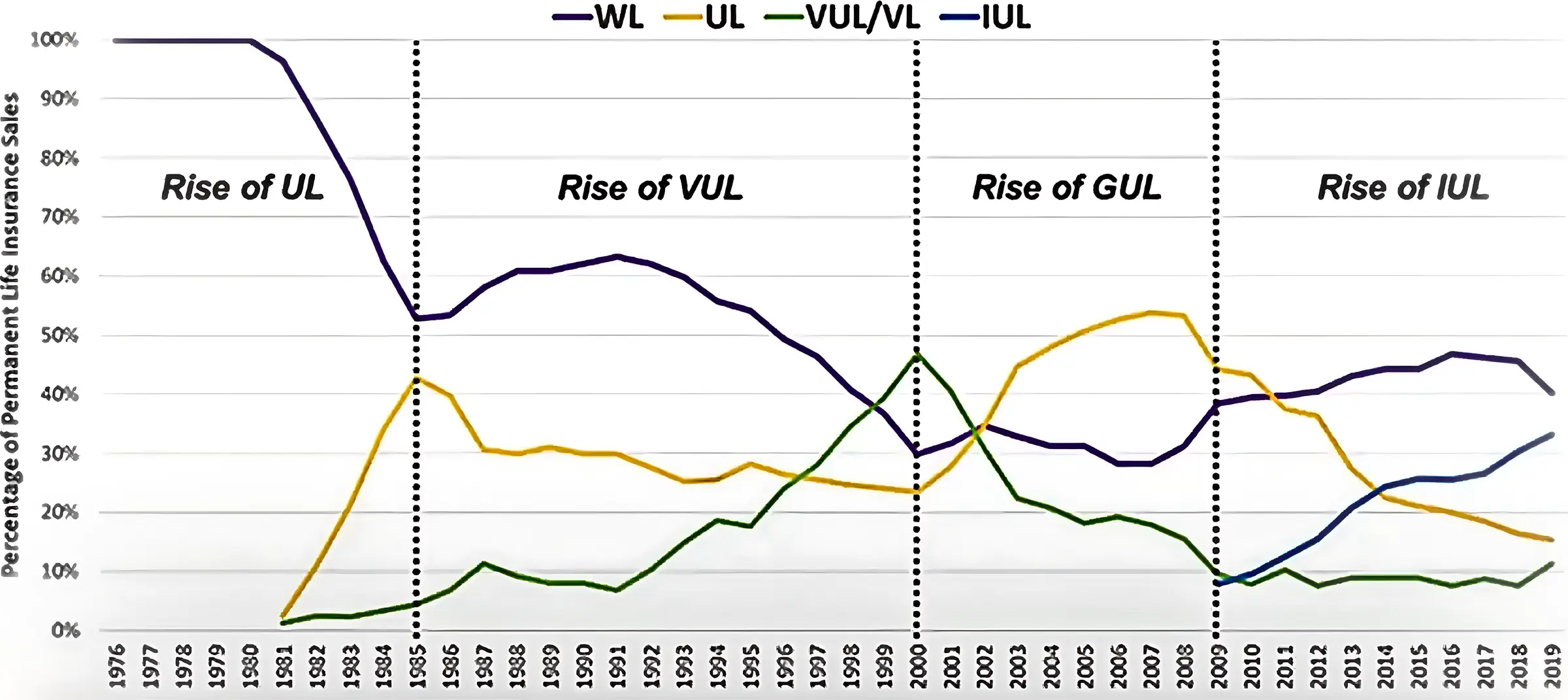
永久型寿险销售占比 1976–2019Share of Permanent Life Sales, 1976–2019

美国永久型寿险销售中各类产品的占比,1976–2019:终身寿险从 100% 降到 1985 年约 53%、2000 年约 30%,2019 年约 40%;万能寿险 1985 年约 42%、2007 年约 54%,2019 年约 15%;变额万能 2000 年约 47%;指数型万能 2009 年约 8%、2019 年约 33%。四段标注:Rise of UL、Rise of VUL、Rise of GUL、Rise of IUL / Share of US permanent life sales by product, 1976–2019: whole life from 100% to about 53% in 1985, 30% in 2000 and 40% in 2019; UL about 42% in 1985, 54% in 2007, 15% in 2019; VUL/VL about 47% in 2000; IUL about 8% in 2009 and 33% in 2019. Four eras labelled Rise of UL, VUL, GUL and IUL
美国永久型寿险销售中各类产品占比 · 原图未标数据出处Share of US permanent life sales by product · the original chart gives no source

四个阶段:万能、变额万能、保证型万能、指数型万能先后兴起;终身寿从 100% 降到四成上下Four eras: UL, VUL, GUL and IUL each had their rise, while whole life fell from 100% to around 40%

讲完公司为什么大,我们看市场本身是怎么选的。这张图的纵轴,是美国永久型寿险销售里各类产品各占多少; 横轴从 1976 年到 2019 年。图上四条线:深紫色是终身寿 WL,黄色是万能寿险 UL,绿色是变额万能 VUL / VL, 蓝色是指数型万能 IUL。三条竖的虚线,把四十多年切成了四个阶段。

We've seen why the companies are big; now let's see how the market itself has chosen. The vertical axis is each product's share of US permanent life sales, and the horizontal runs from 1976 to 2019. Four lines: dark purple is whole life, yellow is universal life, green is variable UL and variable life, blue is indexed UL. Three dotted verticals divide four decades into four eras.

第一段,Rise of UL,万能寿险兴起。1980 年以前,永久型寿险几乎百分之百是终身寿。 万能寿险 1979 年出来,正赶上八十年代初的高利率,几年时间就涨到四成多; 到 1985 年,终身寿的占比已经掉到一半出头。

Era one, the rise of UL. Before 1980, permanent life was essentially 100% whole life. Universal life arrived in 1979, just as interest rates peaked in the early eighties, and within a few years it was past 40%. By 1985 whole life's share had dropped to just over half.

第二段,Rise of VUL,变额万能兴起。1985 到 2000 年,九十年代股市走牛,绿线一路往上, 2000 年前后接近一半;同一时间终身寿降到三成左右,是整张图的最低点。

Era two, the rise of VUL. From 1985 to 2000, with the bull market of the nineties, the green line climbed to nearly half of sales around 2000. At the same point whole life fell to about 30%, its lowest on the chart.

第三段,Rise of GUL,保证型万能兴起。2000 年以后股市回落,变额万能跟着下滑, 带长期保证的万能寿险接棒,黄线在 2007 年前后涨到五成多。 第四段,Rise of IUL,指数型万能兴起。2009 年起,蓝线从不到一成涨到 2019 年的三成多, 万能寿险降到一成半左右,终身寿稳在四成上下。

Era three, the rise of GUL. After 2000 markets fell back, VUL slid with them, and universal life with long-term guarantees took over, carrying the yellow line past 50% around 2007. Era four, the rise of IUL. From 2009 the blue line rose from under a tenth to over a third by 2019, UL dropped to about 15%, and whole life held at around 40%.

所以看全图:终身寿从 1976 年的 100%,降到近十年的四成上下,中间每一个阶段都有一种新设计起来。 这不是说终身寿不好,它到今天仍是很大的一类;而是说客户的选择一直在变,每一次都跟着当时的利率和股市走。 IUL 这十年的上涨,靠的是「涨的时候能参与、跌的时候有下限」这个组合。

So across the whole chart, whole life went from 100% in 1976 to around 40% in the last decade, and in every era a new design came up. That doesn't make whole life bad; it is still a very large category today. It means client choices keep shifting, each time following the interest rates and markets of the day. IUL's rise over the past decade rests on one combination: taking part when markets rise, with a floor when they fall.

讲师提醒Presenter note

百分比是从曲线上目测的,讲「大约」「接近一半」就好。原图没有标数据出处, 被问到时如实说「这是行业里流传的一张图,原图没标来源」,不要替它补一个出处。 IUL 的下限和参与率都有条件,讲机制时把条件一起讲。

The percentages are read off the curves by eye, so say "about" and "nearly half." The original chart has no source. If asked, say plainly that it's an industry chart that circulates without one, and don't supply a source for it. IUL's floor and participation both come with conditions; state them whenever you describe the mechanism.

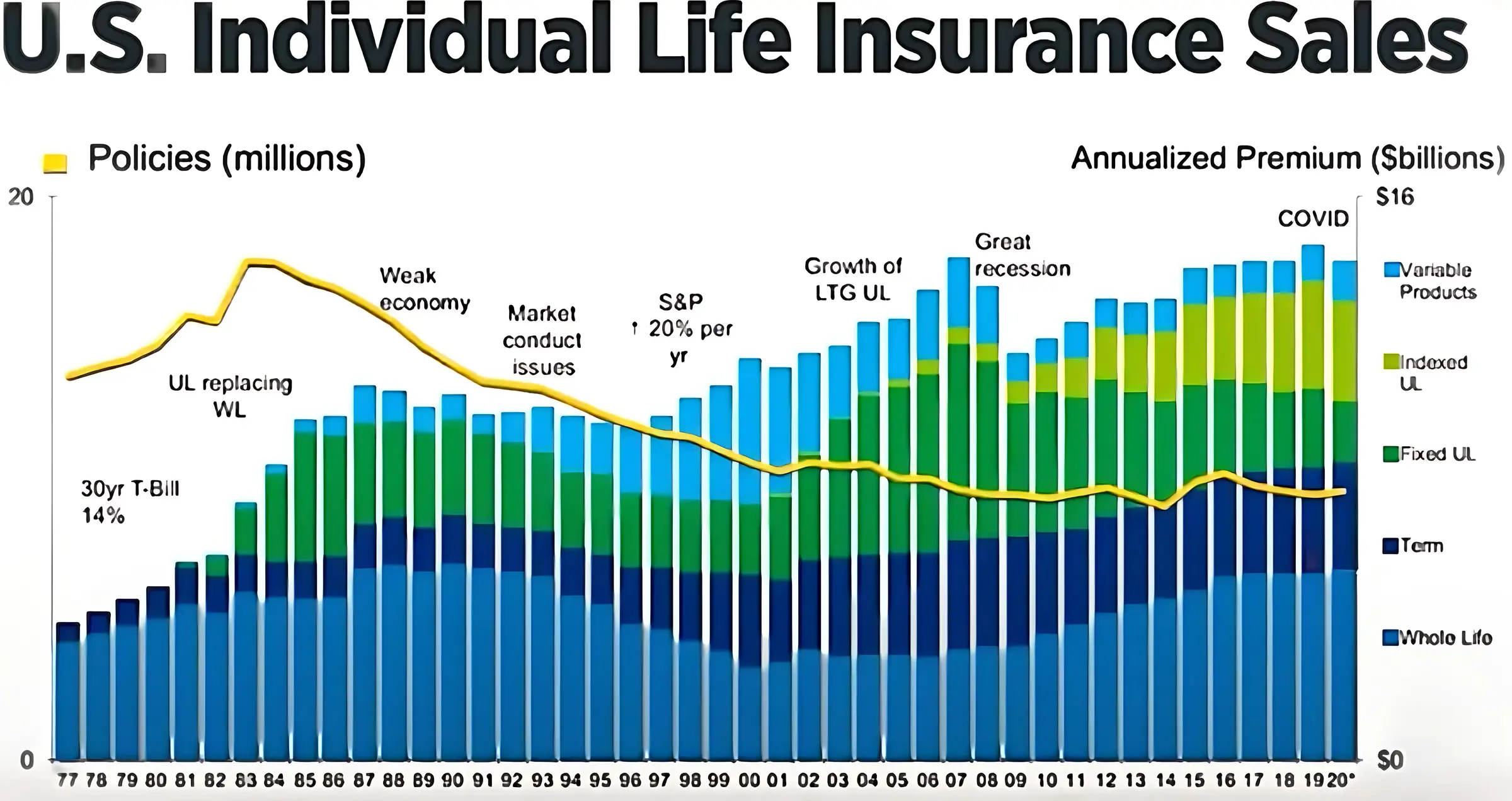
美国个人寿险销售 1977–2020U.S. Individual Life Insurance Sales, 1977–2020

U.S. Individual Life Insurance Sales,1977–2020:堆叠柱为按产品分的年化保费(终身寿险、定期、固定万能、指数型万能、投资型产品,右轴 $0–16 十亿),黄线为保单件数(左轴 0–20 百万);标注 30 年期国债 14%、UL replacing WL、Weak economy、Market conduct issues、S&P 每年涨 20%、Growth of LTG UL、Great recession、COVID / US individual life sales 1977–2020: stacked bars of annualised premium by product (whole life, term, fixed UL, indexed UL, variable; right axis $0–16bn) and a yellow line for policy count (left axis 0–20 million), annotated 30-year T-bill 14%, UL replacing WL, weak economy, market conduct issues, S&P up 20% a year, growth of LTG UL, great recession, COVID
柱:年化保费(十亿美元)· 线:保单件数(百万)· 2020 为估计 · 原图未标出处Bars: annualised premium ($bn) · line: policies (millions) · 2020 estimated · no source on the original

终身寿的保费仍是最大的一块;指数型万能 2009 年以后越来越厚Whole life is still the biggest block of premium; indexed UL has grown thicker since 2009

上一张只看永久型寿险里谁占多少,这一张把定期也放进来,看美国个人寿险每年总共卖了多少。

The last chart only split up permanent sales. This one adds term and shows everything US individual life sells in a year.

先认图。柱子是年化保费,看右边的刻度,单位十亿美元,按产品一层一层叠起来:最下面一层是终身寿, 往上依次是定期、固定万能、指数型万能,最上面是变额类产品。那条黄线是保单件数,看左边的刻度,单位百万张。

First, how to read it. The bars are annualised premium on the right-hand scale, in billions of dollars, stacked by product: whole life at the bottom, then term, fixed UL, indexed UL, and variable products on top. The yellow line is the number of policies on the left-hand scale, in millions.

图上的文字标注,跟上一页的四个阶段对得上。八十年代初,30 年期国债利率高到 14%,万能寿险开始取代终身寿; 九十年代后期标普每年涨两成上下,变额类那一截明显变厚;2000 年代,带长期保证的万能寿险增长; 2008 年金融危机,保费一下掉下来;2009 年以后,指数型万能那一截从很薄长到很厚。

The annotations match the four eras on the last slide. In the early eighties the 30-year Treasury yield hit 14% and universal life began replacing whole life. In the late nineties the S&P gained around 20% a year and the variable band visibly thickened. The 2000s saw growth in UL with long-term guarantees. The 2008 crisis knocked premium down. And after 2009 the indexed UL band grew from a sliver into a thick layer.

两件事要看清楚。第一,最下面终身寿那一层一直都在,到 2020 年仍是最大的一块,大约占三分之一。 终身寿的保费规模很大,这和第 11 页讲的「公司为什么更大」是一回事。 第二,指数型万能那一截 2009 年以后越来越厚,在总保费里的占比一直在长。

Two things to notice. First, the whole life layer at the bottom never goes away; in 2020 it's still the biggest block, roughly a third. Whole life brings in a lot of premium, which is the same point we made about why those companies are big. Second, the indexed UL layer has grown thicker since 2009, and its share of total premium keeps rising.

再看黄线。保单件数在 1983、84 年前后见顶,大约 1,700 多万张,之后一路往下,近几年只有 1,000 万张上下; 而保费总额反而涨到每年接近 150 亿美元。也就是说,买寿险的人变少了,每个人买得更多。 很多家庭其实没有被保障到,这也是我们的工作空间。

Now the yellow line. Policy count peaked around 1983–84 at a little over 17 million and fell steadily to about 10 million in recent years, while total premium rose to nearly $15 billion a year. Fewer people are buying life insurance, and each buyer buys more. Many families simply aren't covered, and that's where our work is.

讲师提醒Presenter note

数字是按刻度目测的,讲「大约」。2020 年那根柱子带星号,是估计值。 原图没标出处,不要说成「LIMRA 数据」;要引用正式数字,用后面第 18 页那张带出处的表。

Figures are read off the scale by eye, so say "about." The 2020 bar carries an asterisk: it's an estimate. The original gives no source, so don't call it LIMRA data. For citable figures, use the sourced table on slide 18.

更大的保险公司,
真的就更好吗?
Is a Larger Insurer
Really Better?

规模代表一定的稳健,但「大」不等于「对你最有利」Size signals some stability, but "big" isn't the same as "best for you"

讲完高保费和行业的变化,我们抛出这一部分最核心的问题:更大的保险公司,真的就更好吗?

With high premiums and the industry's shifts behind us, here's the central question of this part: is a larger insurer really better?

很多客户、很多同业都有一个本能的假设:公司越大越安全,越大越靠谱,越大越值得托付一辈子。 这个假设对不对?规模确实代表一定的稳健和偿付能力,这一点我们不否认。

Many clients, and many agents, carry an instinctive assumption: the bigger the company, the safer, the more reliable, the more worthy of a lifelong commitment. Is that right? Size does signal a degree of stability and solvency, and we don't deny it.

但「大」不等于「对你最有利」,也不等于「永远不会变」。公司大,说的是它整体管着多少钱; 对你好不好,要看你买的这张保单:保费多少、保障多少、钱能不能灵活用、几十年后还合不合适。

But "big" doesn't mean "best for you," and it doesn't mean "never changes." Size describes how much money a company manages overall. Whether it's good for you depends on the policy you buy: what it costs, what it covers, how flexibly you can use the money, and whether it still fits decades from now.

接下来两页把这个道理讲透:先看寿险产品本身是怎么一代一代演进的, 再请出一个所有人都认识的名字:Nokia。一家曾经大到人人都觉得不可能倒的公司,它的故事会告诉我们,「大」这件事有多容易变。

The next two slides make the case. First, how life insurance products have evolved generation by generation. Then a name everyone knows: Nokia. A company once so big that nobody imagined it could fall, and its story shows how quickly "big" can change.

大家先把这个问题放在心里:选一张要拿几十年的保单,只看这家公司现在大不大,够不够?

Hold this question in your mind: when you choose a policy you'll keep for decades, is it enough to look at how big the company is today?

节奏提示Pacing

这一页字很少,念完问题停几秒,不要急着给答案,让大家自己先想一想,再翻下一页。

There's very little on this slide. Read the question, pause for a few seconds, and don't rush to the answer. Let people think it through before you move on.

寿险产品是怎么演进的How Life Insurance Products Evolved

1583定期寿险 Term LifeTerm Life 1762终身寿险 Whole LifeWhole Life 1979万能寿险 Universal LifeUniversal Life 1985变额万能 Variable ULVariable Universal Life 1997指数型万能 Indexed ULIndexed Universal Life

就像身边的东西Like everyday things

大哥大 → 智能手机Brick phone → smartphone
编织袋 → 名牌手袋Woven sack → designer handbag
自行车 → 电动车Bicycle → electric car

「老牌」不等于「最新的设计」"Established" isn't the same as "the latest design"

回答「大就更好吗」之前,先看产品本身。左边这条时间线,是寿险五代产品出现的年份。

Before answering "is bigger better," look at the products themselves. The timeline on the left shows when each of the five generations of life insurance appeared.

第一代是定期寿险,1583 年的伦敦就已经有一年期的寿险保单。第二代是终身寿险, 1762 年伦敦成立的 Equitable 开始卖平准保费的终身寿险。也就是说,终身寿这个设计已经有两百六十多年了。

Generation one is term life: London already had one-year life policies in 1583. Generation two is whole life: the Equitable, founded in London in 1762, began selling level-premium whole life. In other words, the whole life design is more than 260 years old.

后面三代都很年轻:1979 年万能寿险,1985 年变额万能,1997 年指数型万能。 这三代都属于「万能」家族,保费可以多交少交,保额可以调整;区别在于账户里的钱怎么记利息。 IUL 是这一串里最新的一代,到今天不到三十年。

The last three are young: universal life in 1979, variable UL in 1985, indexed UL in 1997. All three belong to the "universal" family: premiums can go up or down and the face amount can be adjusted. What differs is how the account is credited. IUL is the newest of the line, not yet thirty years old.

右边是三个类比。手机从大哥大到今天的智能手机;包从装东西的编织袋到名牌手袋; 出行从自行车到电动车。每一样都还是手机、还是包、还是车,但设计一代比一代更贴合今天的需要。 寿险也一样,每一代都在补上一代的短处,同时也带来自己的新问题。

On the right are three analogies. Phones went from the brick phone to today's smartphone; bags from a woven sack to a designer handbag; getting around from a bicycle to an electric car. Each is still a phone, a bag, a way to travel, but every generation fits today's needs a little better. Life insurance is the same: each generation fixes a weakness of the one before, and brings new issues of its own.

这一页要传达的意思是:「老牌」不等于「最新的设计」。一家公司历史悠久,说明它经营得久, 不说明它卖的那一类产品就是最新、最适合客户的设计。

The point of this slide: "established" isn't the same as "the latest design." A long history tells you a company has lasted. It doesn't tell you that the type of product it sells is the newest or the best fit for the client.

同时也要讲公道话:新一代不等于人人都该换。今天还有人骑自行车,因为对他最合适; 定期寿险到今天仍是很多年轻家庭的正确选择。很多老牌公司也卖万能和 IUL,我们比的是产品设计,不是公司的年头。

And to be fair: newer doesn't mean everyone should switch. People still ride bicycles because it suits them, and term life is still the right choice for many young families. Plenty of established carriers sell UL and IUL as well. What we're comparing is product design, not how old a company is.

讲师提醒Presenter note

年份照屏幕上讲:定期寿险 1583、终身寿险 1762。被问到出处,就说「伦敦 1583 年已有一年期保单,Equitable 1762 年成立」。 更完整的讲法见《寿险的演进》那一组幻灯片。

Quote the years as shown: term 1583, whole life 1762. If asked for a source: "London had one-year policies by 1583; the Equitable was founded in 1762." The full version is in the How Life Insurance Evolved slides.

Nokia:大,不等于永远大Nokia: Bigger Isn't Forever

2000约 $2,500 亿≈ $250B巅峰市值Peak market value
2007约 $1,500 亿≈ $150BiPhone 问世那年The year the iPhone launched
2025约 $267 亿≈ $26.7B如今Today

25 年里市值蒸发约 90%:当年没人相信 Nokia 会跌下神坛About 90% of its value gone in 25 years, and nobody believed it at the time

市值为约数(美元)Market values are approximate (US$)

Nokia 的数字,大家看了都会吃一惊。

Nokia's numbers surprise everyone.

2000 年,Nokia 的巅峰市值大约 $2,500 亿美元,是全球手机的代名词,几乎人手一台。 2007 年,也就是 iPhone 问世那一年,它还有大约 $1,500 亿。到 2025 年,市值只剩大约 $267 亿。 25 年里,市值蒸发了大约 90%。

In 2000, Nokia peaked at a market value of about $250 billion. It was the name for mobile phones worldwide; almost everyone had one. In 2007, the year the iPhone launched, it was still worth about $150 billion. By 2025 it was down to about $26.7 billion. Roughly 90% of its value gone in 25 years.

请大家把自己放回 2000 年那个时间点。如果当时有人跟你说「Nokia 会衰落到只剩零头」,你会觉得他在开玩笑: 它太大了,大到不可能倒。可后来的事就是这样发生的。上一页那台大哥大到智能手机的变化,Nokia 正好站在中间。

Put yourself back in 2000. If someone had told you "Nokia will shrink to a fraction of this," you'd have thought they were joking: it was too big to fall. Yet that's what happened. The shift from brick phone to smartphone on the last slide is exactly where Nokia stood.

但要讲公道话:我们讲 Nokia,不是说保险公司会像它一样崩盘。保险业受严格监管,有法定准备金、再保险和州担保基金等多重机制, 破产概率比科技公司低得多,这一点要对客户讲清楚。

But in fairness: we tell the Nokia story not to suggest insurers will collapse the same way. Insurance is strictly regulated, with statutory reserves, reinsurance and state guaranty funds among several layers of protection, and the odds of an insurer failing are far lower than for a tech company. Make that clear to clients.

我们要传达的是一种思维方式:「现在很大」和「永远对你最好」是两回事。客户买一张终身保单,是几十年的承诺, 这期间行业格局、利率环境、公司经营都会变。所以选择的依据应该是产品本身的机制、灵活性和对客户的资金效率, 而不是只被「公司大、历史久」的光环锁定。

The point is a way of thinking: "very big now" and "always best for you" are two different things. A permanent policy is a commitment of several decades, and over that time the industry, interest rates and the company itself will all change. So the choice should rest on how the product works, how flexible it is and how efficiently it uses the client's money, not on the glow of "big company, long history" alone.

下一页我们回到保险业的现实,看 LIMRA 2022 到 2024 年三年的数字。

Next, back to the insurance industry itself, with LIMRA's figures for 2022 through 2024.

合规提醒Compliance note

不要说「某某保险公司就是下一个 Nokia」,也不要暗示哪家公司会倒闭。Nokia 只是一个类比,讲的是「大不等于永远」, 不是对任何保险公司的财务判断。

Never say "such-and-such insurer is the next Nokia," and don't hint that any company will fail. Nokia is an analogy for "big isn't forever," not a financial judgement on any insurer.

美国零售寿险:2022–2024 年各产品U.S. Retail Life Sales by Product, 2022–2024

产品Product 全年年化保费增长Annualized premium, year 全年件数增长Policy count, year 按保费市场份额Market share by premium
202220232024202220232024202220232024
指数型万能 IULIndexed UL+13%−4%+4%+11%+19%+10%25%24%24%
终身寿 WLWhole life−5%+1%−4%−13%+2%−2%38%39%36%
定期 TermTerm−5%+5%+1%−9%+3%+1%19%19%19%
变额万能 VULVariable UL+8%+8%+15%−6%−1%+6%11%12%14%
固定万能 FULFixed UL−17%−3%+7%−29%−6%−12%7%6%7%
合计Total0%+1%+3%−10%+4%0%100%100%100%

IUL 件数三年都在涨,份额稳在四分之一左右;终身寿份额仍最大,保费和件数有起有落IUL policy counts rose all three years and its share held near a quarter; whole life still has the largest share, with premium and counts up and down

全年数字,与上一年相比;2022 年份额为行业估计。来源:LIMRA《U.S. Retail Life Insurance Sales》2022、2023、2024 年第四季度报告Full-year change vs the prior year; 2022 shares are industry estimates. Source: LIMRA, U.S. Retail Life Insurance Sales, Q4 2022, 2023 and 2024 reports

这一页是有正式出处的数字:LIMRA,美国寿险行业的研究机构,每个季度发布零售寿险的销售报告。 我们把 2022、2023、2024 三年第四季度报告里的「全年」那几行抽出来,合成一张表。

These figures have a proper source: LIMRA, the US life insurance industry's research body, which publishes a retail life sales report every quarter. We've taken the full-year rows from the fourth-quarter reports for 2022, 2023 and 2024 and put them in one table.

先认表。每一行是一类产品,三组列:第一组是全年年化保费比上一年增长多少,第二组是全年保单件数比上一年增长多少, 第三组是按保费算的市场份额,每一年五类加起来都是 100%。2022 年的份额,报告里写的是行业估计。

How to read it: each row is a product, with three groups of columns. The first is the full-year change in annualized premium, the second the full-year change in policy count, and the third market share by premium, which adds up to 100% across the five products each year. The 2022 shares are labelled industry estimates in the report.

先看第一行,指数型万能 IUL。件数三年都在涨:+11%、+19%、+10%。保费有起伏,2022 年 +13%,2023 年 −4%,2024 年 +4%; 2023 年件数涨了 19%、保费反而降了 4%,说明那一年平均每张保单的保费变小了。份额三年是 25%、24%、24%,稳在四分之一左右。

Start with the first row, indexed UL. Policy counts rose all three years: +11%, +19%, +10%. Premium moved around: +13% in 2022, −4% in 2023, +4% in 2024. In 2023 counts rose 19% while premium fell 4%, which means the average premium per policy got smaller that year. Its share was 25%, 24% and 24%: steady at about a quarter.

再看终身寿 WL。份额仍是五类里最大的:38%、39%、36%。但保费和件数有起有落:保费 −5%、+1%、−4%, 件数 −13%、+2%、−2%。终身寿体量大,这跟前面讲的高保费是一致的;只是这三年它没有在长。

Now whole life. Its share is still the largest of the five: 38%, 39%, 36%. But premium and counts went up and down: premium −5%, +1%, −4%; counts −13%, +2%, −2%. Whole life's size fits what we said about high premiums; it just hasn't been growing over these three years.

其他三类也照实讲:定期的份额三年都是 19%;变额万能的保费三年都在涨,2024 年 +15%,是那一年保费涨得最快的, 份额从 11% 升到 14%;固定万能的件数三年都在降。最后一行是合计,三年的总保费分别是 0%、+1%、+3%。

Read the other three honestly too. Term held a 19% share all three years. Variable UL premium grew every year, by 15% in 2024, the fastest that year, and its share rose from 11% to 14%. Fixed UL policy counts fell all three years. The bottom row is the total: overall premium changed 0%, +1% and +3%.

所以这张表说的是:终身寿按保费仍是最大的一类,但 IUL 的件数年年在涨,已经稳稳占住四分之一。 份额是按产品分的,那每一类产品是哪些公司在领跑?下一页讲结论。

So the table says: whole life is still the largest category by premium, but IUL's policy count rises every year and it holds a solid quarter of the market. These shares are by product. So who leads in each product? That's the next slide.

讲师提醒Presenter note

表里只放了「全年」的数字;原报告每类产品还有「第四季度」一行,数字不一样,引用时不要混用。 百分比是和上一年比的增长率,不是金额;被问到具体金额,请对方看 LIMRA 原报告。

The table shows full-year figures only. Each product in the original reports also has a fourth-quarter row with different numbers, so don't mix the two when you quote them. The percentages are growth rates against the prior year, not dollar amounts; if asked for amounts, refer people to the LIMRA reports.

2024 年市场份额(按保费)说明了什么What 2024 Market Share by Premium Tells Us

截至 2024 年 12 月 31 日As of December 31, 2024

1市场是分散的:没有任何一家公司垄断,不同产品类别里,领跑者各不相同The market is fragmented: no one company dominates, and each product category has different leaders
2Whole Life 巨头在「终身寿险」这一类里份额领先,那是他们的主场;在 IUL、指数年金上,领跑的往往是另一批专精公司(如 NLG、AIG)Whole life giants lead in whole life, their home ground; in IUL and indexed annuities the leaders are often a different set of specialists (such as NLG and AIG)
3客户该问的不是「谁家最大」,而是「在我需要的这类产品上,谁做得最好」The client's question isn't "who's biggest" but "who does best at the kind of product I need"

这一页是截至 2024 年底、按保费算的市场份额,我们把它归纳成三点结论。

This slide covers market share by premium as of the end of 2024, boiled down to three takeaways.

第一,市场是分散的。没有任何一家公司一统天下,份额分在很多家手里。 所以「我们公司最大」这句话,往往只是在某一个细分类别里最大,而不是整个市场最大。

One: the market is fragmented. No single company has it all; share is spread across many carriers. So "our company is the biggest" usually means biggest in one segment, not across the whole market.

第二,分类别看,领跑者完全不同。Whole Life 那几家巨头,确实在终身寿这一类里份额领先,那是他们的主场,无可厚非。 但在 IUL、指数型年金这些指数类产品上,跑在前面的往往是另一批专精公司,比如 NLG、AIG。术业有专攻。

Two: look category by category and the leaders are completely different. The big whole life carriers really do lead in whole life; that's their home ground, and fair enough. But in indexed products such as IUL and indexed annuities, the front-runners are often a different set of specialists, such as NLG and AIG. Each has its own specialty.

第三,也是给客户的关键提问方式:客户真正该问的,不是「谁家公司最大」,而是「在我需要的这一类产品上,谁做得最好、谁最专业」。 打个比方:一个人感冒了,要找的是合适的医生,而不是去找全国最大那家医院的院长。 客户要的是某一类产品的最优解,而不是被一个笼统的「规模最大」标签牵着走。

Three, and this is the question to give the client: the real question isn't "which company is biggest" but "for the kind of product I need, who does it best, who knows it best?" Think of it this way: if you catch a cold, you want the right doctor, not the director of the country's largest hospital. The client wants the best answer for one type of product, not to be led by a vague "biggest" label.

第二部分到这里收尾:公司大是事实,资产规模和偿付能力是真实的优点;但大不等于对客户最好, 市场是分散的,要按客户的需要选产品。

That wraps up part two. Being big is a fact, and size and solvency are real strengths. But big doesn't mean best for the client; the market is fragmented, and the product should be chosen for the client's needs.

接下来第三部分,我们具体看 Whole Life 到底提供了哪些福利。每一项我们都会讲清楚它是怎么来的、客户要为它付出什么, 有些福利其实没有大家想象的那么特别。

In part three we look at exactly what benefits whole life provides. For each one we'll be clear about where it comes from and what the client gives up for it, and some of them turn out to be less special than people assume.

讲师提醒Presenter note

公司在各类产品上的排名每个季度都在变,讲的时候说「领跑的公司之一」「往往是」,不要说「第一名」。 被问到具体排名,请对方看 LIMRA 当期报告。也不要拿这一页贬低卖终身寿的公司,讲的是分工,不是好坏。

Company rankings by product change every quarter, so say "among the leaders" or "often," never "number one." If asked for exact rankings, point people to LIMRA's current report. And don't use this slide to run down whole life carriers; the point is specialisation, not better or worse.

第三部分:Whole Life 到底有哪些福利?Part III: What Benefits Does Whole Life Offer?

回到保单条款本身,一条一条看Back to the policy wording, one clause at a time

  • 伤残保费豁免 DWPDisability waiver of premium
  • DWP 的除外责任DWP exclusions
  • 末期疾病提前给付Terminal illness acceleration
  • 12 个月 vs 24 个月12 months vs 24 months
  • 生前福利对比:WL vs IULLiving benefits: WL vs IUL
  • 两份真实材料Two real-world examples
  • 福利 vs 总资产Benefits vs total assets

好,进入第三部分:Whole Life 到底有哪些福利?前面两部分我们聊了代理人和公司, 这一部分回到产品本身,看保单条款里的附加条款,也就是 rider,以及客户活着的时候能用上的保障。

Now Part III: what benefits does whole life actually offer? The first two parts were about agents and companies. This part goes back to the product itself: the riders in the policy, and the cover a client can use while still alive.

路线是这样的。先讲两个最常被拿来当卖点的条款:第一个是伤残保费豁免,英文 Disability Waiver of Premium, 简称 DWP,连同它的除外责任;第二个是末期疾病提前给付,连同 12 个月和 24 个月两种定义的差别。 然后把 Whole Life 和 IUL 的生前福利放在一起比。中间看两份真实材料:一份定期寿险的计划书,一段网上的分享。 最后把公司的总资产和给付放在一起看,做这一部分的收口。

Here's the route. First, the two riders most often used as selling points: the disability waiver of premium, DWP, together with its exclusions; then terminal illness acceleration, together with the difference between a 12-month and a 24-month definition. Next, whole life and IUL living benefits side by side. Along the way, two real-world examples: a term illustration and a post someone shared online. Finally, company assets and benefits paid, to close the section.

先把态度说清楚:讲这些不是要否定它们。伤残豁免和末期给付都有价值。 但条款的价值在细节里:要等多久、怎么定义、上限多少、哪些不保。 客户如果只听到一句「有伤残豁免、有提前给付」,很容易以为自己买到了全方位的保障,真到理赔的时候才发现处处有条件。

Let's be clear about the attitude first. We're not here to dismiss these riders. The disability waiver and terminal acceleration both have value. But the value sits in the details: how long you wait, how terms are defined, what the cap is, what's excluded. A client who only hears "there's a disability waiver and an accelerated benefit" can easily believe they're covered for everything, and find the conditions only at claim time.

作为专业的代理人,我们要比客户更懂这些条款,做到两件事:不夸大,也不漏讲。 讲别人的产品是这样,讲我们自己卖的产品也是这样。

As professionals we need to know these clauses better than the client does, and do two things: not overstate, and not leave things out. That applies to other carriers' products and equally to the ones we sell.

还有一句提醒:后面几页引用的是终身寿常见的条款写法。不同公司、不同产品、不同州的版本都可能不一样, 跟客户讲某一张具体保单时,以那张保单的合同为准。

One more reminder: the next few slides quote wording that's common in whole life policies. Versions differ by company, product and state, so when you discuss a specific policy with a client, that policy's contract is what counts.

互动设计Interaction

开场问一句:「客户拿来的终身寿保单,里面有哪些 rider,你们有没有翻到合同原文看过?」 请看过的伙伴打 1,再请一位说说当时看到了什么,讲完这一部分再回来对照。

Open with: "When a client shows you their whole life policy, have you ever turned to the actual rider wording in the contract?" Ask those who have to type 1, invite one to say what they found, and come back to it at the end of this section.

伤残保费豁免 Rider(DWP)Disability Waiver of Premium (DWP)

定义Definition

  • 被保人在 rider 生效期间完全伤残时,豁免全部保费If the insured becomes totally disabled while the rider is in force, all premiums are waived

理赔资格Eligibility

  • 全残须连续至少 6 个月才能申请Total disability must last at least 6 consecutive months before a claim
  • 理赔批准前,保费仍须照常缴纳Premiums stay due until the claim is approved

何时豁免保费When premiums are waived

  • 60 岁前致残:整个伤残期间均豁免Disabled before 60: waived for the whole disability
  • 持续至 65 岁:此后无需再缴Still disabled at 65: nothing further is due
  • 60 岁后致残:仅豁免 65 岁前到期的保费Disabled after 60: only premiums due before 65 are waived

「完全伤残」如何定义?What counts as "total disability"?

1前 2 年:无法从事本职工作的核心任务First 2 years: unable to do the core duties of your own occupation
22 年后:依其训练与经验,无法从事任何合理职业After 2 years: unable to do any reasonable occupation given your training and experience
3未成年人:因伤病无法上学Minors: unable to attend school due to injury or illness
4严重情形:双目失明,或双手 / 双足 / 一手一足丧失功能Severe cases: loss of sight in both eyes, or loss of use of both hands, both feet, or one hand and one foot

先讲伤残保费豁免,Disability Waiver of Premium,简称 DWP。这是终身寿常见的一个附加条款,也是个好东西: 人伤残了、没有收入了,保单不会因为交不起保费而失效。但条款要讲清楚。

First, the disability waiver of premium, DWP. It's a common whole life rider, and a good one: if the insured is disabled and loses their income, the policy doesn't lapse for want of premiums. But the wording needs explaining.

先看左边的定义:被保人在 rider 生效期间完全伤残,公司就豁免全部保费。也就是你不用再交钱,保单继续有效。 请大家记住一个字眼:它豁免的是「保费」,不是给你一笔钱。这一点后面讲那段网上分享的时候,我们还会回来。

The definition on the left: if the insured becomes totally disabled while the rider is in force, the company waives all premiums. You stop paying and the policy stays in force. Hold on to one word: what's waived is the premium. It doesn't pay you any money. We'll come back to that when we look at the online post later.

再看理赔资格,两条。第一,全残必须连续持续至少 6 个月,才能提出申请。 第二,这一点特别容易被忽略:在理赔批准之前,保费还得照常交。 也就是说,人伤残了,前半年甚至更久,保费一分不能少,等批下来再说。 批准以后,等待期里交的保费退不退,各家合同写法不同,要看原文。这段现金流的压力,销售时一定要跟客户讲明白。

Then eligibility, two points. One, total disability must last at least six consecutive months before you can claim. Two, and this one is easy to miss: until the claim is approved, premiums are still due as normal. So for the first six months after a disability, or longer, every premium still has to be paid. Whether premiums paid during that wait are refunded after approval depends on the contract wording. Make sure the client understands that cash-flow pressure.

然后是「何时豁免」的三条时间规则。60 岁之前致残的,整个伤残期间都豁免;伤残一直持续到 65 岁的,之后就不用再交了。 但如果是 60 岁之后才致残,只豁免 65 岁之前到期的那部分保费。举个例子:62 岁致残,豁免的只是 62 到 65 岁这三年, 65 岁以后保费要自己交。所以这个保障明显向「年轻时致残」倾斜。

Next, the three timing rules. Disabled before 60: premiums are waived for the whole disability, and if it lasts to 65, nothing further is ever due. Disabled after 60: only the premiums due before 65 are waived. For example, someone disabled at 62 has only the three years from 62 to 65 waived; from 65 on, they pay again. The cover is clearly weighted towards disability at a younger age.

右边是理赔的核心:「完全伤残」到底怎么定义。前两年的标准是无法从事本职工作的核心任务,相对宽松; 两年之后标准变严,变成依你的训练和经验,无法从事任何合理职业。注意,是任何合理职业,不只是你原来那一行。 未成年人的标准是因伤病无法上学。最严重的情形,比如双目失明,或者双手、双足、一手一足丧失功能,直接认定。

On the right is the heart of any claim: how "total disability" is defined. For the first two years it's being unable to do the core duties of your own occupation, which is relatively generous. After two years it tightens to being unable to do any reasonable occupation for which your training and experience fit you. Any reasonable occupation, not just your own line of work. For minors it's being unable to attend school. The most severe cases, such as loss of sight in both eyes, or loss of use of both hands, both feet, or one of each, qualify outright.

请大家记住「两年后标准收紧」这个设计。举个例子:一位牙医手受了伤,前两年不能看牙就算全残; 两年之后,如果按他的训练和经验还能去教书、做顾问,就可能不再算全残,豁免也可能停止。 这是保险公司控制理赔的常见设计,本身不奇怪。我们跟客户讲 DWP,既讲它的好,也把这个门槛讲清楚,这才是专业。 下一页讲它的除外责任。

Remember that the definition tightens after two years. Say a dentist injures a hand. For the first two years, being unable to practise dentistry counts as total disability. After that, if his training and experience would let him teach or consult, he may no longer count as totally disabled, and the waiver may stop. That's a common way carriers manage claims, and nothing unusual. When we explain DWP, we cover what's good about it and we spell out this threshold too. That's what professional means. Next: the exclusions.

讲师提醒Presenter note

页面上的 6 个月、60 岁、65 岁、2 年,是终身寿常见的条款写法,不代表每家公司、每个产品都一样。 跟客户讲某张具体保单时,翻到那张保单的 rider 原文念。

The six months, ages 60 and 65 and the two years shown here are common whole life wording, not the same for every company or product. When you discuss a specific policy, turn to that policy's rider text and read from it.

DWP 除外责任DWP Exclusions: Premiums Will Not Be Waived

以下原因造成的伤残,不予豁免保费:Disability caused by any of the following does not qualify for the waiver:

✕Rider 生效之前就已存在的伤残Disability that existed before the rider took effect
✕被保人 5 岁之前发生的伤残Disability that began before the insured's fifth birthday
✕自杀未遂、自残或精神失常导致的伤残Disability from attempted suicide, self-inflicted injury or insanity
✕战争、兵役或恐怖主义造成的伤残Disability caused by war, military service or terrorism

接着讲 DWP 的除外责任,也就是哪些原因造成的伤残,公司不给你豁免保费。一共四类。

Now the DWP exclusions: the causes of disability for which the company will not waive premiums. There are four.

第一,rider 生效之前就已经存在的伤残,也就是带着伤残去投保的那一部分,不保。 第二,被保人 5 岁之前发生的伤残,这一条主要针对给孩子买的保单。 第三,自杀未遂、自残,或者精神失常导致的伤残。 第四,战争、兵役或者恐怖主义造成的伤残。

One, a disability that already existed before the rider took effect, in other words one the insured brought into the policy, isn't covered. Two, a disability that began before the insured turned five, which mainly concerns policies bought for children. Three, disability from attempted suicide, self-inflicted injury or insanity. Four, disability caused by war, military service or terrorism.

这四条本身都是行业惯例,不奇怪。之所以专门用一页讲,是想强调一个原则:任何 rider 都有除外责任, 没有哪一种保障是无条件的。我们自己卖的 IUL 和生前福利也一样,生前福利那一套里有专门的承保排除和不赔清单。

All four are standard industry practice and nothing surprising. The reason for a whole slide is to make one principle stick: every rider has exclusions, and no cover is unconditional. The IUL and living benefits we sell are no different; the Living Benefits deck has its own pages on underwriting exclusions and what isn't covered.

如果销售时只讲「保什么」、不讲「不保什么」,客户买了之后会有不切实际的期待。 真到理赔被拒,客户会觉得被骗了,信任就没了,甚至投诉、退保。

If a sale covers only what's included and never what's excluded, the client walks away with unrealistic expectations. When a claim is then declined, they feel misled, the trust is gone, and it can end in a complaint or a surrender.

正确的做法是主动把除外责任讲清楚。短期看好像在泼冷水,长期看,这恰恰是建立信任的方式: 客户会觉得你诚实、专业,而不是只想成交。把丑话说在前面,是对客户负责,也是对自己执业的保护。 下一页换一个最常被误解的保障:末期疾病给付。

The right approach is to raise the exclusions yourself. It can feel like throwing cold water on the sale, but over time it's exactly how trust is built: the client sees you as honest and competent, not just chasing a close. Saying the hard part up front protects the client, and protects your own practice. Next, the benefit that's misunderstood more than any other: terminal illness acceleration.

互动设计Interaction

请一位伙伴扮演客户问:「我几年前腰受过伤,以后要是伤残了,能豁免保费吗?」让大家试着回答。 答案的方向:要看伤残是不是在 rider 生效前就已存在,以及核保时怎么写的,以合同和核保结果为准,不当场打包票。

Have someone play a client: "I hurt my back a few years ago. If I'm disabled later, will the premiums be waived?" Let the group answer. The direction: it depends on whether the disability existed before the rider took effect and how underwriting recorded it. The contract and the underwriting decision govern, so don't promise anything on the spot.

是重疾吗?不,是末期疾病Critical Illness? No, Terminal Illness

常见误解The common mistake ≠ 重大疾病 Critical Illness≠ Critical Illness 它保的是「末期疾病」,不是大病就赔It covers terminal illness, not every major illness
实际定义 Terminal IllnessThe actual definition: Terminal Illness 被诊断为末期疾病,Diagnosed with a terminal illness, with 预期寿命 ≤ 12 个月life expectancy ≤ 12 months
最高可提前给付额度Maximum accelerated amount 保额的 50%,且不超过 $250,00050% of the face amount, up to $250,000 注:这是「预支」自己的身故金,不是额外多给的钱Note: it's an advance on your own death benefit, not extra money

这一页要纠正一个非常普遍的误解,也是销售中最容易出问题的地方。 很多人,包括不少客户,会把终身寿里的「提前给付」当成重大疾病保障 Critical Illness,以为查出癌症、心脏病这种大病就能赔。 看左边:它不是重疾。它保的是末期疾病 Terminal Illness。

This slide corrects a very common misunderstanding, and one of the easiest places for a sale to go wrong. Many people, clients included, take the accelerated benefit in a whole life policy for critical illness cover and assume a cancer or heart attack diagnosis pays out. Look at the left: it isn't critical illness. It covers terminal illness.

看右边的实际定义:必须被诊断为末期疾病,而且预期寿命在 12 个月以内,才能触发。 这两者差别很大。重疾是确诊了符合定义的大病,就可以申请;末期是医生判断大概活不过一年。 一个是帮你撑过治疗期,一个是在生命最后阶段提前拿一部分钱安排后事,完全是两回事。

Now the actual definition on the right: it's triggered only by a terminal diagnosis with a life expectancy of 12 months or less. That's a world of difference. Critical illness pays when you're diagnosed with a covered condition; terminal illness pays when a doctor judges you're unlikely to live another year. One helps you get through treatment; the other releases some money in the last stage of life to put affairs in order. They're entirely different things.

再看下面的额度:最高能提前给付保额的 50%,而且不超过 $250,000。算两个例子: 保额 $100 万,50% 是 $50 万,但封顶 $25 万,所以最多拿 $25 万;保额 $30 万,50% 是 $15 万,最多就是 $15 万。

Then the amount at the bottom: at most 50% of the face amount, and no more than $250,000. Two examples. On a $1 million policy, 50% is $500,000, but the cap is $250,000, so that's the most you get. On a $300,000 policy, 50% is $150,000, and that's the limit.

最关键的是最底下那一句:这是「预支」你自己的身故金,不是公司额外多给的钱。 提前拿了 $25 万,将来受益人拿到的身故金至少相应减少 $25 万;有的条款还会扣利息或手续费,以合同为准。 它是把未来的钱挪到现在用,不是凭空多出来的福利。

The key line is the last one: it's an advance on your own death benefit, not extra money from the company. Take $250,000 early and the beneficiaries' death benefit falls by at least $250,000; some contracts also deduct interest or a fee, so check the wording. It moves future money into the present. It isn't a benefit that appears from nowhere.

为什么要讲这么细?如果客户以为自己买了重疾保障,等真的中风了、得了可以治疗的癌症去申请,才发现不符合, 那是最伤信任的客诉,也是合规风险。所以我们要用准确的说法:「这是末期疾病提前给付,不是重疾险。」 客户如果需要重疾保障,就要另外配置,或者选一个本身能附重疾加速给付的产品,后面对比页会讲。 下一页先把 12 个月和 24 个月两种定义的区别讲清楚。

Why go into this much detail? If a client thinks they bought critical illness cover and only finds out when they claim after a stroke or a treatable cancer, that's the complaint that does the most damage to trust, and it's a compliance risk. So use precise language: "This is a terminal illness accelerated benefit, not critical illness insurance." If the client needs critical illness cover, it has to be arranged separately, or through a product that can carry a critical illness acceleration rider, which the comparison slide covers. First, the next slide explains the 12-month versus 24-month definitions.

合规提醒Compliance note

讲我们自己的产品也要守同一条线:IUL 的生前福利同样是打折提前动用身故金,用了以后身故金相应减少。 不要说成「额外一笔钱」,也不要把它叫作「重疾险」。

Hold our own products to the same line. IUL living benefits are also a discounted advance on the death benefit, which falls once they're used. Don't call it "extra money," and don't call it critical illness insurance.

12 个月 vs 24 个月12-Month vs 24-Month Definition

12 个月定义12-Month Definition

癌症已广泛扩散、无法治愈,主要只能采取缓和医疗(palliative care)Cancer has spread widely and can't be cured; palliative care is the main option

→ 门槛更高、更接近临终→ A higher bar, closer to the end of life

24 个月定义24-Month Definition

癌症虽已晚期,但仍对治疗有反应Cancer is advanced but still responding to treatment

→ 门槛相对宽松、可及性更好→ A lower bar, easier access to the money

承接上一页,末期疾病提前给付里还有一个细节:「预期寿命」到底按 12 个月还是 24 个月来定义。 不同公司、不同产品,标准不一样。这个差别直接决定了客户能不能拿到钱、什么时候拿到。

Following on from the last slide, there's one more detail in terminal illness acceleration: is life expectancy defined as 12 months or 24? It varies by company and product, and the difference decides whether, and when, the client can get the money.

看左边,12 个月的定义:通常意味着癌症已经广泛扩散、无法治愈,主要只能采取缓和医疗,英文 palliative care, 也就是以减轻痛苦为主,已经到了临终关怀那个阶段。这个门槛非常高,几乎是到了生命的最后阶段才符合。

On the left, the 12-month definition. It usually means the cancer has spread widely and can't be cured, and the main option left is palliative care, treatment aimed at relieving suffering, the hospice stage. It's a very high bar, met only near the very end of life.

看右边,24 个月的定义:癌症虽然到了晚期,但仍然对治疗有反应。这个门槛相对宽松,客户能早一点触发给付, 钱到手的时候还用得上:治疗、请人照护、家里的安排。

On the right, the 24-month definition: the cancer is advanced but still responding to treatment. That's a lower bar, so the client can trigger the benefit earlier, while the money can still be put to use: treatment, paid care, arrangements for the family.

对客户来说这意味着什么?同样叫「末期疾病提前给付」,12 个月和 24 个月,体验差很多。 国家人寿的末期疾病条款用的是 24 个月,同业不少是 12 个月,细节见生前福利那一套。 帮客户比较产品时,不要默认各家一样,这种条款细节就是我们的专业价值所在。

What does that mean for the client? Two benefits both called "terminal illness acceleration" can work very differently at 12 months and at 24. National Life's terminal illness rider uses 24 months, while many carriers use 12; the details are in the Living Benefits deck. When comparing products for a client, don't assume they're all the same. Knowing this kind of detail is where our professional value lies.

这也再次说明这一部分的主线:不要只看笼统的卖点名称,要看条款的具体定义。 下一页把 Whole Life 和 IUL 的生前福利正面放在一起比,差距会更直观。

It brings us back to the thread of this section: don't stop at the name of a feature; read how the clause defines it. Next, whole life and IUL living benefits side by side, where the gap is easier to see.

讲师提醒Presenter note

预期寿命要由医生判断、出具证明,再由保险公司审核,不是客户或代理人说了算。 不要跟客户说「24 个月的更容易赔」,可以说「定义更宽,可以更早申请;符不符合,由医生证明和公司审核决定」。

Life expectancy is certified by a physician and then reviewed by the insurer; it's not up to the client or the agent. Don't tell a client "the 24-month version pays more easily." Say instead: "The definition is broader, so you can apply earlier. Whether you qualify is decided by the doctor's certification and the company's review."

生前福利对比:WL vs IULLiving Benefits: WL vs IUL

传统 Whole LifeTraditional Whole Life

通常仅内嵌:Usually built in, only:

  • 末期疾病 Terminal Illness
    (预期寿命 ≤ 12 个月)
    Terminal Illness
    (life expectancy ≤ 12 months)

重疾 / 慢性疾病通常需另购或不可得Critical and chronic illness: usually an extra purchase, or not available

现代 IUL(以 NLG 为代表)Modern IUL (NLG as the example)

通常可附带三类加速给付 ABR:Can usually carry three accelerated benefit riders (ABR):

  • ✓ 末期疾病 Terminal Illness✓ Terminal Illness
  • ✓ 慢性疾病 Chronic Illness✓ Chronic Illness
  • ✓ 重大疾病 Critical Illness✓ Critical Illness

人还活着,钱就能用上;NLG 附带 5 项生前福利Usable while you're alive; NLG carries five living benefits

注:rider 可得性与条款因产品、州而异,一切以保单合同为准Note: rider availability and terms vary by product and state; the policy contract governs

这一页把两类产品的生前福利正面放在一起比。

This slide puts the living benefits of the two product types side by side.

左边,传统 Whole Life。它通常内嵌的加速给付只有一种:末期疾病,也就是我们刚刚讲的,预期寿命 12 个月以内才能触发。 重疾和慢性疾病的保障,要么另外加买附加条款、另付费用,要么这张产品根本没有。 换句话说,对一张传统终身寿来说,客户活着的时候能从保障里拿到钱的情形,非常有限。

On the left, traditional whole life. The accelerated benefit usually built in is just one: terminal illness, triggered only, as we just saw, by a life expectancy of 12 months or less. Critical and chronic illness cover is either an extra rider at extra cost or not offered on that product at all. In other words, on a traditional whole life policy, the situations in which the client can draw on the cover while alive are quite limited.

右边,现代的 IUL,以 NLG 的产品线为代表。它通常可以附带三类加速给付条款,行话叫 ABR,Accelerated Benefit Riders。 第一类,末期疾病,和终身寿一样有。第二类,慢性疾病 Chronic Illness,比如吃饭、穿衣、洗澡这些日常生活活动没法自理。 第三类,重大疾病 Critical Illness,比如心脏病、中风、癌症这些重大健康事件。 人还活着、还在治疗、还需要钱的时候,保单可以把一部分身故金提前释放出来用。

On the right, a modern IUL, with NLG's product line as the example. It can usually carry three accelerated benefit riders, ABRs. One, terminal illness, which whole life has too. Two, chronic illness, such as being unable to manage daily activities like eating, dressing or bathing. Three, critical illness: major health events such as a heart attack, stroke or cancer. While the insured is alive, in treatment and needing money, the policy can release part of the death benefit early.

右下角那一句:NLG 附带 5 项生前福利。除了这三类,还有重大伤害和阿尔茨海默。 每一项怎么触发、怎么打折、合并封顶怎么算,细节见生前福利那一套,这里不展开。

The line at the bottom right: NLG carries five living benefits. On top of those three, there's critical injury and Alzheimer's disease. How each one is triggered, how the discount works and how the combined cap applies are all in the Living Benefits deck, so we won't go into them here.

上一页说,客户如果需要重疾保障要另外配置;IUL 的做法,是把这层保障直接放进寿险里。 但还是那句话:这是打折提前动用身故金,不是额外的钱,用了以后身故金相应减少。

Earlier we said a client who needs critical illness cover has to arrange it separately; the IUL approach builds that cover into the life policy itself. But the same rule holds: it's a discounted advance on the death benefit, not extra money, and the death benefit falls once it's used.

注意底部那一行小字,大家讲的时候也要带上:rider 的可得性和具体条款,因产品、因州而异,一切以保单合同为准。 我们讲优势,但不讲过头话。下面两页,看两份真实材料。

Note the small print at the bottom, and say it out loud when you present: rider availability and terms vary by product and state, and the policy contract governs. We talk about strengths, but we don't overstate them. The next two slides are two real-world examples.

合规提醒Compliance note

不要说「终身寿没有生前福利」「只有 IUL 活着能用」。有的终身寿也可以加买慢性疾病或长期护理条款,通常要另付费用。 可以说:「您这张保单附了哪些条款、怎么定义,我们一起翻合同看。」

Don't say "whole life has no living benefits" or "only an IUL pays while you're alive." Some whole life policies can add a chronic illness or long-term care rider, usually at extra cost. Say instead: "Let's open the contract together and see which riders your policy has and how they're defined."

一份定期的计划书A Term Policy Illustration

哪怕是一份每月 $25.96 的定期,也带生前福利Even a term policy at $25.96 a month comes with living benefits

身故金Death benefit$1,000,000
转换权Conversion10 年内可转永久寿险To permanent within 10 years
37 岁时的预估加速给付值Projected accelerated benefit values at age 37
末期疾病Terminal illness$854,907 一次性$854,907 lump sum
慢性疾病Chronic illness$4,902 每月$4,902 per month
重大疾病Critical illness最高 $783,760Up to $783,760
重大伤害Critical injury最高 $783,760Up to $783,760
阿尔茨海默Alzheimer's disease$531,768 一次性$531,768 lump sum

预估值,非保证:实际金额在理赔时按病情、年龄、剩余寿命计算,是打折提前给付Projected, not guaranteed: the actual amount is worked out at claim time from the condition, age and remaining life expectancy, as a discounted advance

定期寿险计划书摘要页 My Planned Life Insurance Offers:每月 $25.96(EFT 自动扣款);身故金 $1,000,000;10 年内可把定期转换成永久寿险;37 岁时的预估加速给付值:末期疾病 $854,907 一次性、慢性疾病每月 $4,902、重大疾病最高 $783,760、重大伤害最高 $783,760、阿尔茨海默 $531,768 / Term illustration summary, “My Planned Life Insurance Offers”: $25.96 monthly by EFT; $1,000,000 death benefit; convertible from term to permanent within 10 years; projected accelerated benefit values at age 37: terminal illness $854,907 lump sum, chronic illness $4,902 per month, critical illness up to $783,760, critical injury up to $783,760, Alzheimer’s disease $531,768

右边是一份计划书的摘要页,标题叫 My Planned Life Insurance Offers。先注意一件事: 这是一份定期寿险,不是终身寿,也不是 IUL。

On the right is the summary page of an illustration, titled "My Planned Life Insurance Offers." Notice one thing first: this is a term policy. It's not whole life, and it's not an IUL.

从上往下看。最上面:每月 $25.96,EFT,也就是银行账户自动扣款。 第一块,If I Die Tomorrow,如果明天身故,受益人拿到 $1,000,000。

Read it from the top. First, $25.96 a month by EFT, an automatic bank draft. Then the first block, "If I Die Tomorrow": the beneficiaries receive $1,000,000.

第二块,If My Needs Change:10 年内可以把定期转换成永久寿险。转换权的意义在于,将来身体变差了, 也还有机会把保障换成终身的;转换时的具体条件以合同为准。右边写的现金价值、贷款和取款,是转成永久寿险以后的事, 这份定期本身没有现金价值。

The second block, "If My Needs Change": the term can be converted to permanent insurance within 10 years. The value of a conversion right is that even if the insured's health gets worse, there's still a way to turn the cover into lifetime cover; the exact conversion terms are in the contract. The cash value, loans and withdrawals listed beside it apply after conversion to permanent insurance. The term policy itself has no cash value.

第三块,If I Become Ill,生病时可以动用一部分身故金。这是 37 岁时的预估加速给付值,我念一下: 末期疾病,$854,907,一次性;慢性疾病,每月 $4,902;重大疾病,最高 $783,760,一次性; 重大伤害,最高 $783,760,一次性;阿尔茨海默,$531,768,一次性。

The third block, "If I Become Ill": part of the death benefit can be accessed. These are the projected accelerated benefit values at age 37. Let me read them: terminal illness, $854,907 lump sum; chronic illness, $4,902 a month; critical illness, up to $783,760 lump sum; critical injury, up to $783,760 lump sum; Alzheimer's disease, $531,768 lump sum.

请大家注意「预估」这两个字。这些都是预估值,不是保证。实际理赔时,金额按当时的病情、年龄和剩余寿命来算, 是打折提前给付。你看末期疾病这一项是 $854,907,比 $100 万保额少的那一部分,就是提前拿钱的折扣; 理赔时年龄、病情不同,数字都会变。

Note the word "projected." These are estimates, not guarantees. At claim time the amount is calculated from the condition, age and remaining life expectancy, as a discounted advance. Terminal illness shows $854,907; the gap below the $1 million face amount is the discount for taking the money early. A different age or condition at claim time gives a different number.

这一页想说明的是:哪怕是一份每月 $25.96 的定期,也带生前福利。 一张保单生病时能不能拿到钱,跟每月交多少、是不是终身寿,没有必然关系,要看产品和条款。

The point of this slide: even a term policy at $25.96 a month comes with living benefits. Whether a policy pays when you're ill has no necessary link to the premium or to whether it's whole life. It comes down to the product and its riders.

合规提醒Compliance note

不要跟客户说「每月 $25 多,生病能拿 $85 万」。这是某一位被保人在某个年龄、某个体况下的预估值; 保费按年龄、体况、保额和产品而定,生前福利的金额理赔时才算出来,都不保证。

Don't tell a client "$25 a month gets you $850,000 if you're ill." These are projections for one insured at one age and rate class. Premiums depend on age, health, face amount and product, and the living benefit is only calculated at claim time. None of it is guaranteed.

网上的一段分享A Post Someone Shared Online

小红书帖子《national life group 保险靠谱吗?》评论区的截图(用户名、头像已模糊):一位网友说她妈妈有纽约人寿、State Farm、National Life 三份保险,乳腺癌手术加化疗放疗、一年多不能工作,只有 NLG 做了理赔、赔了 over 50%,另外两家没赔;有人追问纽约人寿的保单有没有加 wp rider、工作不了保费应该就不用交,她回答「有啊,但是当真正遇到这种情况下最需要的不是不交保费」 / Screenshot of a Xiaohongshu post asking whether National Life Group is reliable (usernames and avatars blurred): on the left a chat screenshot attached to the post; in the comments, a user says her mother had three policies, with New York Life, State Farm and National Life, and after breast cancer surgery, chemotherapy and radiation could not work for over a year; only NLG paid a claim, over 50%, and the other two did not. Asked whether the New York Life policy had a waiver of premium rider, she replies that it did, but when it really happens, not having to pay premiums isn’t what you need most

生病不能工作时,最需要的是现金,不只是不交保费When illness stops you working, you need cash, not just a premium waiver

这是小红书上的一段分享,用户名和头像已经模糊处理了。帖子标题是「national life group 保险靠谱吗?」, 发帖的人说家里人要买,担心被洗脑。截图是帖子下面的评论区。

This is a post from Xiaohongshu, with usernames and avatars blurred. The title asks, "Is National Life Group insurance reliable?" The poster says family members are about to buy and worries they're being talked into it. The screenshot shows the comments under the post.

评论里一位网友说:她妈妈有 3 份保险,纽约人寿、State Farm 和 National Life。后来得了乳腺癌,手术加化疗、放疗, 一年多不能工作。她说只有 NLG 做了理赔,另外两家没赔。有人问赔了百分之几,她说 NLG 是最后买的,交了不到一年,赔了 over 50%。

One commenter says her mother had three policies: New York Life, State Farm and National Life. Then came breast cancer, with surgery, chemotherapy and radiation, and more than a year unable to work. She says only NLG paid a claim and the other two didn't. Asked what percentage, she says the NLG policy was the last one bought, with less than a year of premiums paid, and it paid out over 50%.

下面有人追问:「纽约人寿的保单有加 wp rider 吗?工作不了,保费应该就不用交的。」wp 就是我们前面讲的保费豁免。 她回答:「有啊,但是当真正遇到这种情况下,最需要的不是不交保费。」

Someone then asks: "Did the New York Life policy have a WP rider? If she can't work, the premiums should be waived." WP is the premium waiver we covered earlier. Her reply: "It did. But when this actually happens, not having to pay premiums isn't what you need most."

先讲清楚:这是网友的分享,细节我们无法核实。三份保单各是什么产品、附了哪些条款、有没有提出申请、按什么定义审核, 我们都不知道。所以这一页不评价任何一家公司,只用它说明一个道理。

Let's be clear: this is a stranger's post, and we can't verify any of the details. We don't know what each of the three policies was, which riders they carried, whether claims were filed, or what definitions they were assessed against. So this slide passes no judgement on any company. We use it only to illustrate one point.

道理就是我们前面讲 DWP 时说的:豁免保费,不等于给钱。生病不能工作的时候,房贷、生活费、治疗费照样要付, 豁免保费只是让保单不失效,手里不会多一分钱。有没有生前福利、条款怎么定义,决定了生病那天手里有没有钱。

It's the point we made with DWP: waiving premiums is not the same as paying money. When illness stops you working, the mortgage, living costs and medical bills still have to be paid. A premium waiver keeps the policy in force, but it doesn't put a cent in your hand. Whether there are living benefits, and how the riders define them, decides whether there's money in hand on the day you fall ill.

跟客户讲这个道理,不需要这张图。直接问:「如果您明天确诊重病,一年不能工作,这张保单能给您什么? 是不用交保费,还是能拿到一笔钱?」然后一起翻合同看。

You don't need this screenshot to make the point with a client. Just ask: "If you were diagnosed with a serious illness tomorrow and couldn't work for a year, what would this policy give you? A break from premiums, or a sum of money?" Then go through the contract together.

合规提醒Compliance note

不要拿这张截图去说「别家不赔」「NLG 一定赔」,也不要把截图转发给客户或发到社交媒体。 每张保单赔不赔,要看各自的条款和病情。

Don't use this screenshot to say "other carriers don't pay" or "NLG always pays," and don't forward it to clients or post it on social media. Whether any policy pays depends on its own terms and the medical facts.

福利 vs 总资产Benefits vs Total Assets

  • 公司资产庞大,很大一部分来自高保费的长期沉淀Company assets are huge, built up largely from high premiums held over many years
  • 但回到客户手里的「福利」,往往附带 6 个月等待、严格全残定义、末期门槛、50% 上限等限制But the benefits that reach the client often come with a six-month wait, a strict disability definition, a terminal threshold and a 50% cap
  • 资产的庞大,与福利的「有条件」,形成鲜明对照Vast assets on one side, conditional benefits on the other

结论:公司的「大」,部分是客户资金效率的代价;福利好不好,要逐条看条款,而不是看公司账面有多少钱Conclusion: part of a company's size is paid for in its clients' capital efficiency. Judge the benefits clause by clause, not by the balance sheet

公司 CompanyCompany 总资产 AssetsAssets 给付 Benefits PaidBenefits Paid 给付占资产比 Benefits-to-Assets RatioBenefits-to-Assets Ratio
New York Life$4,089 亿$408.9 billion$147 亿$14.7 billion3.6%
Northwestern Mutual$3,588 亿$358.8 billion$128 亿$12.8 billion3.6%
National Life Group$473 亿$47.3 billion$27 亿$2.7 billion5.7%

截至 2023 年 12 月 31 日,取自各公司年报;给付不含分红,各公司口径略有不同As of 31 December 2023, from each company's annual figures; benefits paid exclude dividends, and bases differ slightly

这一页把第二部分讲的「资产」和第三部分讲的「福利」放在一起看,作为第三部分的收口。

This slide puts Part II's "assets" next to Part III's "benefits," and closes the section.

一边是公司账面上庞大的总资产,截至 2023 年底,表里 New York Life 约 $4,089 亿,Northwestern Mutual 约 $3,588 亿, National Life Group 约 $473 亿。另一边,是我们刚刚逐条看过的那些福利。

On one side, the companies' total assets at the end of 2023: in the table, about $408.9 billion for New York Life, $358.8 billion for Northwestern Mutual and $47.3 billion for National Life Group. On the other, the benefits we've just gone through one by one.

公司的资产是怎么来的?第二部分讲过,终身寿的保费定得高,多交的部分长期沉淀在公司账上。 那回到客户手里的福利呢?伤残豁免要等满 6 个月、先垫着交保费、两年后全残定义还收紧; 末期疾病给付要预期寿命 12 个月以内,最多 50% 还封顶 $25 万,而且是预支自己的身故金。 收保费的时候是确定的,给福利的时候是有条件、有上限、有门槛的。

Where do the assets come from? As Part II showed, whole life premiums are set high, and the extra sits on the company's books for decades. And the benefits that come back to the client? The disability waiver needs six months' wait, premiums paid in the meantime, and a definition that tightens after two years. Terminal illness acceleration needs a life expectancy of 12 months or less, pays at most 50% capped at $250,000, and is an advance on the client's own death benefit. Collecting premiums is certain; paying benefits comes with conditions, caps and thresholds.

再看表的后两列,给付 Benefits Paid 和给付占资产的比例。New York Life 给付 $147 亿,约占资产 3.6%; Northwestern Mutual 给付 $128 亿,也约占 3.6%;National Life Group 给付 $27 亿,约占 5.7%。 这里的给付都不含分红。这两列只说明一件事:规模和给付是两件事,公司账上的钱多,不等于客户拿到的多。

Now the last two columns, benefits paid and benefits as a share of assets. New York Life paid $14.7 billion, about 3.6% of assets; Northwestern Mutual paid $12.8 billion, also about 3.6%; National Life Group paid $2.7 billion, about 5.7%. None of these include dividends. These columns make one point only: size and benefits paid are two different things, and a bigger balance sheet doesn't mean more money reaching clients.

所以这一部分的结论是:福利到底好不好,不能看公司账上有多少钱,要一条一条看保单条款。 规模是公司的,条款才是客户的。

So the conclusion of this section: you can't judge benefits by how much money a company holds. You read the policy, clause by clause. The size belongs to the company; the contract terms are what belong to the client.

好,第三部分讲完。代理人、公司、福利,我们都聊过了。接下来第四部分,进入最硬核、也最能体现专业度的地方: 「保证」这两个字,保证的代价是什么,以及为什么 Whole Life 的保费定得那么高。

That's Part III. We've covered agents, companies and benefits. Part IV goes into the most technical ground, and the place where professionalism shows most: the word "guaranteed," what a guarantee costs, and why whole life premiums are set so high.

讲师提醒Presenter note

表里的数字已按各公司 2023 年的公开数据核对:New York Life 公布「分红 + 给付」共 $167 亿,其中分红 $20 亿; Northwestern Mutual 是法定报表里给付给保单持有人和受益人的 $128.18 亿(另有分红 $73.7 亿);National Life Group 是年报摘要的 2023 年给付。 国家人寿的业务里年金占比高,业务结构不同,比例自然不同。不要拿这个比例去说谁「对客户好」,只用它说明规模和给付是两件事。

The figures have been checked against each company's published 2023 numbers: New York Life reports $16.7 billion in "dividends and benefits," of which $2.0 billion was dividends; Northwestern Mutual's statutory statements show $12.818 billion in benefit payments to policyowners and beneficiaries (plus $7.37 billion in dividends); National Life Group's is the 2023 benefits paid from its year-end summary. Annuities are a large share of National Life's business, and different business mixes produce different ratios. Don't use the ratio to argue which company "treats clients better." Use it only to show that size and benefits paid are two separate things.

第四部分:『保证』的代价Part IV: The Price of Guarantees

为什么 Whole Life 的保费那么高?Why are whole life premiums so high?

  • 终身寿的三大保证,平准保费怎么运作Whole life's three guarantees, and how a level premium works
  • 保险成本:黑箱与透明,IUL 的成本为什么不一定变高Cost of insurance: hidden vs itemized, and why an IUL's need not keep rising
  • 增长引擎:S&P 500,和一百年的亏损统计The growth engine: the S&P 500 and a century of down years
  • IUL 会失效吗:保证栏、三道防线、保证的前提、宽限期Will an IUL lapse? The guaranteed column, three lines of defense, the conditions, the grace period

好,进入第四部分:『保证』的代价,也就是为什么 Whole Life 的保费定得那么高。

Now Part IV: the price of guarantees, or why whole life premiums are set so high.

跟终身寿的代理人同场,或者客户拿着一份终身寿方案来比较,我们最常听到的一句话是: 「终身寿是保证的,IUL 不保证,所以终身寿更安全。」这句话听起来很难反驳,而且它说的「保证」也确实是真的。

When you're up against a whole life agent, or a client brings a whole life proposal to compare, the line you'll hear most is: "Whole life is guaranteed, IUL isn't, so whole life is safer." It sounds hard to argue with, and the guarantees it refers to are real.

这一部分我们不去否认保证,而是把「保证」两个字拆开来看:保证不是凭空来的,它是有代价的, 那个代价就算在保费里。看懂了代价,客户才能自己判断,这份保证对他值不值得。

We're not going to deny the guarantees in this part. We're going to take the word apart: a guarantee doesn't come from nowhere, it has a price, and the price is built into the premium. Once the client sees the price, they can decide for themselves whether the guarantee is worth it to them.

路线是这样的:先看终身寿的三大保证,再拆平准保费的机制;然后看保险成本,终身寿为什么像一个黑箱, IUL 的保险成本为什么不一定越来越高;接着认识 IUL 的增长引擎 S&P 500,看它一百年来连续下跌的统计; 最后正面回答「IUL 会不会失效」:先读一份计划书的保证栏,再讲三道防线、保证的前提和宽限期。

Here's the route. First whole life's three guarantees, then the mechanics of a level premium. Then the cost of insurance: why whole life is something of a black box, and why an IUL's cost need not keep climbing. Next the IUL's growth engine, the S&P 500, and its record of consecutive down years over a century. Finally we answer head-on whether an IUL can lapse: we read the guaranteed column of an illustration, then cover the three lines of defense, the conditions behind every guarantee, and the grace period.

这一部分页数最多、信息量最大,中间有公式、有表格。请大家集中注意力,手边有纸笔的,可以把几个关键数字记下来。

This is the longest and densest part, with a formula and a couple of tables along the way. Stay with it, and if you have pen and paper, jot down the key numbers.

节奏提示Pacing

这一部分共 12 页。平准保费算例、净风险公式、保证栏这三页最花时间,前面的分段页和三大保证可以讲快一点,把时间留给这三页。

This part runs twelve slides. The level-premium example, the net-amount-at-risk formula and the guaranteed column take the most time; move briskly through this divider and the three guarantees to leave room for them.

Whole Life 的三大保证Whole Life's Three Core Guarantees

保证身故赔付Guaranteed Death Benefit

保额锁定,只要保单有效,赔付确定The face amount is locked in; as long as the policy is in force, the payout is certain

保证现金累积Guaranteed Cash Accumulation

现金价值按合同写明的最低增速稳定累积Cash value builds steadily at the minimum rate written into the contract

保证平准保费Guaranteed Level Premiums

保费一辈子不变,不随年龄上涨The premium never changes and doesn't rise with age

三条都是真的,也都有价值;但保证不是免费的,成本已经提前算进保费All three are real and worth something. But guarantees aren't free: the cost is built into the premium up front

这一页是终身寿整个产品的基石:三大保证。

This slide is the foundation of the whole product: whole life's three guarantees.

第一,保证身故赔付,Guaranteed Death Benefit。只要保单维持有效,将来就按约定的保额赔付,这个数字是锁定的、确定的。

One, the guaranteed death benefit. As long as the policy stays in force, it pays the agreed face amount. That number is locked in and certain.

第二,保证现金累积,Guaranteed Cash Accumulation。合同里有一张保证现金价值表,每一年最少累积到多少,是写死的, 不会因为市场不好就不涨。分红型终身寿另外还有分红,但分红不在保证之内,这一点讲的时候要分清。

Two, guaranteed cash accumulation. The contract carries a table of guaranteed cash values, the minimum the policy reaches each year. It's fixed, and a bad market doesn't stop it. Participating whole life also pays dividends, but dividends are not part of the guarantee; keep the two apart when you explain it.

第三,保证平准保费,Guaranteed Level Premiums。保费一辈子固定不变,不会因为年龄变大而上涨。

Three, guaranteed level premiums. The premium is fixed for life and doesn't go up as the insured gets older.

这三条摆出来确实很有吸引力,尤其对厌恶风险、追求确定性的客户。我们讲的时候先承认这一点: 这些保证是真的,也是有价值的,对某些客户来说,终身寿就是最合适的选择。

Laid out like this, the three are genuinely attractive, especially to clients who dislike risk and want certainty. Acknowledge that first: the guarantees are real and have value, and for some clients whole life is the right choice.

但请大家记住今晚会反复出现的一句话:保证不是免费的。每一个保证背后,保险公司都要承担风险、锁定成本; 公司不做亏本生意,会把这些成本加上安全边际,提前算进保费里。下一页我们拿三条里最有代表性的「平准保费」, 看它是怎么运作的。这个机制看懂了,就明白高保费的钱去了哪里。

But hold on to the line that will keep coming back tonight: guarantees aren't free. Behind each one the carrier takes on risk and locks in cost, and since it isn't in business to lose money, it builds that cost, plus a safety margin, into the premium in advance. Next we take the most telling of the three, the level premium, and see how it works. Once you see the mechanism, you'll see where the high premium goes.

互动设计Interaction

问一句:「这三个保证里,你觉得客户最在意哪一个?」请大家在聊天框里打 1、2 或 3。多数人会选第 3 个,正好接下一页。

Ask: "Of these three, which one do clients care about most?" Have people type 1, 2 or 3 in the chat. Most will pick 3, which leads straight into the next slide.

平准保费如何运作How Guaranteed Level Premiums Work

机制:早年多收,存起来,补贴晚年,所以保费才能「终身不变」The mechanism: collect more early, bank it, subsidize the later years. That's how the premium stays level for life

30 岁:月缴 $1,000Age 30: $1,000 a month

  • $300 → 保险成本 COI$300 → cost of insurance (COI)
  • $700 → 累积为现金价值$700 → builds cash value

70 岁:COI 升到 $3,000Age 70: COI rises to $3,000

  • 固定保费仍是 $1,000 不变The fixed premium is still $1,000
  • 现金价值补上多出的 $2,000Cash value covers the extra $2,000

换句话说:你年轻时「多付」的那部分,被存起来去填补年老时上涨的保险成本。
「保费不变」不是成本不变,而是你提前替未来的自己买单。
In other words, what you "overpay" when young is banked to cover the rising cost of insurance when old.
A level premium isn't a level cost. It's you paying ahead for your future self.

简化算例,只为说明机制,不代表任何具体产品的成本拆分Simplified example to show the mechanism; not the cost breakdown of any actual product

平准保费是怎么做到「终身不变」的?很多客户以为是保险公司让利,其实背后是一套精算机制。 我们用幻灯片上这个简化算例来讲。先说明一下:这组数字是为了讲清楚机制做的简化演示,不是哪一张真实保单的数字。

How does a level premium stay the same for life? Many clients assume the carrier is being generous. In fact there's an actuarial mechanism behind it. We'll use the simplified example on the slide, and to be clear up front: these numbers are a simplified illustration of the mechanism, not figures from any real policy.

假设一位 30 岁的客户,每个月交 $1,000。30 岁身体好、死亡率低,这个年龄真正用于保障的成本, 也就是 COI,Cost of Insurance,假设是 $300。剩下的 $700 去哪了?存起来,累积成现金价值。 也就是说,年轻时实际的保障成本很便宜,但公司是按 $1,000 收的。

Say a 30-year-old pays $1,000 a month. At 30 they're healthy and mortality is low, so suppose the true cost of cover at that age, the COI or cost of insurance, is $300. Where does the other $700 go? It's banked and builds cash value. In other words, the real cost of protection is cheap when you're young, but the carrier charges $1,000.

快进到 70 岁。年纪大了,死亡率高了,同样的保额,真实的保险成本涨到每个月 $3,000。 可是固定保费还是 $1,000,不变。多出来的 $2,000 从哪来?就是从年轻时存下来、这些年又增值了的现金价值里补出来的。

Fast-forward to 70. Older, with higher mortality, the true cost of the same coverage has climbed to $3,000 a month. The premium is still a fixed $1,000. Where does the extra $2,000 come from? From the cash value banked in the early years, which has grown since.

所以平准保费的真相,就是最底下这句话:保费不变,不等于成本不变。真实成本是随着年龄一路往上走的, 公司让你在年轻时多付,存起来,去填年老时的缺口。说白了,是你提前替未来那个年老的自己买了单。

So the truth about a level premium is the bottom line on the slide: a level premium isn't a level cost. The real cost rises with age all the way; the carrier has you pay more while you're young and banks it to fill the gap later. Put simply, you've paid in advance for your older self.

这个机制本身没有错,它带来确定性,也带来一种强制储蓄。但它解释了两件事: 第一,为什么终身寿的保费高,因为它要在前期就把一辈子的成本,加上安全边际,一起收够; 第二,为什么前期的资金效率偏低,因为很大一部分钱进了按保证利率稳步增长的现金价值里。

There's nothing wrong with the mechanism; it brings certainty and a form of forced saving. But it explains two things. One, why whole life premiums are high: the policy has to collect a lifetime of cost, plus a safety margin, up front. Two, why money works less efficiently in the early years: a large share goes into cash value growing steadily at guaranteed rates.

理解了这一层,我们才能和 IUL 做公平的对比。下一页讲两者最大的区别之一:保险成本看不看得见。

With that understood, we can compare fairly with an IUL. Next, one of the biggest differences between the two: whether you can see the cost of insurance at all.

讲师提醒Presenter note

$1,000、$300、$700、$3,000、$2,000 都是讲机制用的整数。真实保单的成本拆分因年龄、性别、健康等级和产品而不同, 终身寿也不会这样逐月列给客户看。客户追问具体数字,以那份产品的计划书为准,不要拿这组数字当成某家公司的实际成本。

$1,000, $300, $700, $3,000 and $2,000 are round numbers for teaching the mechanism. A real policy's split varies with age, sex, rating class and product, and whole life doesn't show it month by month anyway. If a client presses for specifics, go by that product's illustration; don't present these figures as any carrier's actual cost.

保险成本的『黑箱』The Black Box of Cost of Insurance

WHOLE LIFE ? 未知 ?? Unknown ? COI 不单独披露,混在保费里看不见COI isn't disclosed separately; it's inside the premium, out of sight
IUL ✓ 透明✓ Transparent COI 每月单独列示,可查、可算COI is itemized every month: you can check it and work it out 保单年度报告、计划书的扣费明细里逐项列出Listed line by line in the annual statement and the illustration's charge detail

IUL 各项扣费怎么算、在对账单哪里找:见站内《保单费用》How each IUL charge works and where it shows on a statement: see Policy Costs on this site

承接上一页的 COI,这一页讲终身寿和 IUL 在保险成本透明度上的差别,我们把它叫做「黑箱」问题。

Following on from the COI on the last slide, this one is about how differently whole life and IUL disclose the cost of insurance. We call it the black box.

先看左边,终身寿。它的保险成本是多少?答案是:保单上看不到。终身寿把保险成本、行政费用、保证的成本、公司的利润, 都放在一个固定保费里,不单独列出来。客户知道每个月交多少,但这里面多少是纯保障成本、多少是储蓄、多少是其他, 看不见,代理人也没办法精确拆开。

On the left, whole life. What does its cost of insurance come to? You can't see it on the policy. Whole life puts the cost of insurance, administrative expense, the cost of the guarantees and the carrier's margin into one fixed premium and doesn't break it out. The client knows what they pay each month, but not how much of it is pure protection, how much is savings and how much is everything else, and the agent can't split it precisely either.

再看右边,IUL。它的结构是摊开的:每个月从账户价值里单独扣一笔保险成本,另外还有保费费用、保单管理费等几项, 这些在计划书的扣费明细、每年的保单年度报告里都是逐项列出来的。这个月扣了多少保险成本、多少管理费,查得到,也算得出来。

On the right, IUL. Its structure is laid open: each month a separate cost-of-insurance charge comes out of the account value, along with a few others such as the premium charge and the policy fee, and they're itemized in the illustration's charge detail and in every annual statement. How much went to cost of insurance this month, how much to fees: you can look it up and work it out.

举个例子,有一份 15 岁投保的 IUL 计划书,扣费明细里保险成本那一栏,第 1 年是 $349,逐年往上走,到第 11 年是 $1,009, 之后反而开始往下降,第 15 年是 $820。为什么会降?这正是下一页要讲的。能看见这一栏,才谈得上分析它。

For example, one IUL illustration issued at age 15 shows a cost-of-insurance column of $349 in year 1, rising year by year to $1,009 in year 11, and then starting to fall, to $820 by year 15. Why would it fall? That's the next slide. You can only analyse that column because you can see it.

有时候我们会听到一种说法,把 IUL「要扣费」当成缺点。回应的时候语气要平和:IUL 不是多出来一笔费用, 而是把本来就存在的成本摊开给客户看;终身寿也有这些成本,只是包在保费里了。两种设计各有道理, 但对客户做判断来说,能看见成本是一件有帮助的事。

You'll sometimes hear IUL's charges presented as a drawback. Answer calmly: an IUL doesn't add a cost that isn't there otherwise; it shows the client costs that exist in any policy. Whole life has them too, wrapped inside the premium. Both designs have their logic, but for a client trying to decide, being able to see the cost helps.

IUL 一共有哪几项扣费、每项怎么算、在对账单的哪里找,站内《保单费用》那一页逐项拆过,讲这一页之前建议先看一遍。

Which charges an IUL carries, how each is calculated and where to find it on a statement are all broken down on the Policy Costs page on this site. Read it before you present this slide.

那有人会担心:IUL 的保险成本看得见,但它会不会随着年龄越扣越多,最后把保单掏空?这是个好问题,下一页用公式来回答。

Someone will worry: fine, an IUL's cost is visible, but won't it grow with age until it hollows the policy out? Good question. The next slide answers it with a formula.

合规提醒Compliance note

讲的是两种产品的披露方式,不是谁「藏钱」。不要说终身寿「坑人」「不老实」,也不要点名哪家公司。

This is about how the two products disclose cost, not about anyone hiding money. Don't say whole life "rips people off" or is "dishonest," and don't name any carrier.

IUL 的保险成本不一定会变高IUL's COI Doesn't Have to Keep Rising

COI = (身故赔付 − 现金价值)× 每千元费率COI = (death benefit − cash value) × rate per $1,000

$0 $50万$500K $100万$1M 第 1 年Yr 1 第 50 年Yr 50 第 81 年Yr 81 保额 $100万Face $1M 净风险 = 0NAR = 0 现金价值Cash value 净风险Net amount at risk $85万$850K
第 1 年Yr 1现金价值 $500
净风险 = $100万 − $500 = $999,500
Cash value $500
NAR = $1M − $500 = $999,500
第 50 年Yr 50现金价值 $15万
净风险 = $100万 − $15万 = $85万
Cash value $150K
NAR = $1M − $150K = $850K
第 81 年Yr 81现金价值 $100万
净风险 = $100万 − $100万 = 0
Cash value $1M
NAR = $1M − $1M = 0
现金价值越高 → 净风险越低 → COI 越低Higher cash value → lower NAR → lower COI 虽然年龄增加,每千元费率上升,两者可以相互抵消一部分The rate per $1,000 rises with age, but the two can partly offset each other

这一页回答上一页留下的问题,结论有一点反直觉:IUL 的保险成本,不一定随着年龄一路变高。

This slide answers the question we left open, and the answer is a little counter-intuitive: an IUL's cost of insurance doesn't necessarily keep climbing with age.

先看公式:COI 等于「身故赔付减去现金价值」,再乘以「每千元费率」。括号里这一块,行话叫净风险,Net Amount at Risk, 简称 NAR,就是保险公司真正替客户承担的那部分风险。现金价值那块本来就是客户自己的钱,公司只对差额负责。 各家公司在计算细节上写法不同,但道理都是这一条。

Start with the formula: COI equals death benefit minus cash value, times the rate per thousand. The part in brackets is called the net amount at risk, NAR: the risk the carrier actually carries. The cash value is already the client's own money, so the carrier is only on the hook for the difference. Carriers differ in the fine print of the calculation, but the principle is the same.

拆开看,有两股方向相反的力量。第一股,每千元费率跟着年龄走,年纪越大费率越高,单看这一项,确实会变贵。 第二股,括号里的净风险,会随着现金价值增长越变越小:账户里的钱越多,公司要承担的缺口越小。

Break it down and there are two forces pulling opposite ways. First, the rate per thousand follows age: the older the insured, the higher the rate, and on its own that does make cover dearer. Second, the net amount at risk shrinks as the cash value grows: the more money in the account, the smaller the gap the carrier has to cover.

看右边三个时点,保额都是 $100 万。第 1 年,现金价值 $500,净风险等于 $100 万减 $500,$999,500,几乎是全额。 第 50 年,现金价值 $15 万,净风险等于 $100 万减 $15 万,$85 万。第 81 年,现金价值长到 $100 万,净风险是 0。 左边的图画的就是这件事:上面那条平线是保额,下面往上弯的是现金价值,两条线之间的金色区域就是净风险,越往后越窄。

Look at the three points on the right, each on a $1M face. Year 1: cash value $500, so the net amount at risk is $1M minus $500, $999,500, nearly all of it. Year 50: cash value $150,000, so it's $1M minus $150,000, $850,000. Year 81: the cash value has reached $1M and the net amount at risk is zero. The chart on the left shows exactly that: the flat line on top is the face amount, the curve rising underneath is the cash value, and the gold area between them is the net amount at risk, narrowing over time.

这组数字来自站内《保单费用》第 4 节的案例:0 岁女宝,保额 $100 万,每月 $150 交 15 年,按 6.5% 演示。 它是演示值,不是保证;实际保单里,现金价值接近保额时,按税法要求保额通常会往上调,图上只是示意。

These figures come from the case in section 4 of Policy Costs on this site: a baby girl at age 0, $1M face, $150 a month for 15 years, illustrated at 6.5%. They're illustrated values, not guarantees. In a real policy, as the cash value approaches the face amount the death benefit is usually stepped up to meet tax-law limits; the chart is a schematic.

两股力量放在一起:费率在涨,净风险在缩,两者可以相互抵消一部分。现金价值长得够好的时候,保险成本甚至会不升反降, 上一页说的那份计划书,第 11 年以后保险成本就开始往下走,就是这个原因。

Put the two forces together: the rate rises, the amount at risk shrinks, and they partly cancel. When the cash value grows well enough, the cost of insurance can even fall instead of rise. That's why, in the illustration from the last slide, the cost of insurance starts coming down after year 11.

但前提一定要讲清楚:这一切建立在现金价值健康增长上,也就是缴费充足、记息正常、没有过度借款。 如果缴得少、账户长不起来,净风险就一直很大,年龄又在涨,保险成本就会越来越重。下一页我们就看一个这样的例子。

But state the condition clearly: all of this rests on the cash value growing as it should, which means adequate funding, normal crediting and no over-borrowing. If too little goes in and the account doesn't grow, the amount at risk stays large while the rate keeps climbing with age, and the cost of insurance gets heavier and heavier. The next slide shows exactly such a case.

合规提醒Compliance note

说「不一定会变高」「可以相互抵消一部分」,不说「IUL 的保险成本一定会下降」。每次都把前提带上:现金价值要健康增长、缴费要充足。

Say "doesn't have to keep rising" and "can partly offset," never "an IUL's cost of insurance will go down." Always add the condition: the cash value has to grow as it should, and the policy has to be adequately funded.

IUL 会失效吗?先看保证栏Will an IUL Lapse? Start with the Guaranteed Column

一份 IUL 计划书的保证栏 Guaranteed Illustrated Values:4 岁投保,保额 $1,000,000,每年缴 $3,120 共 14 年(第 10 年累计 $31,200,共 $43,680),第 15 年起停缴;保证假设下账户价值第 14 年最高 $24,221,之后逐年下降,第 26 年剩 $711,第 27 年(30 岁)失效 Lapse / Guaranteed Illustrated Values from an IUL illustration: issue age 4, $1,000,000 face, $3,120 a year for 14 years ($31,200 by year 10, $43,680 in all), nothing from year 15; on guaranteed assumptions the accumulated value peaks at $24,221 in year 14, falls every year to $711 in year 26, and lapses in year 27, at age 30

保证栏按最高扣费、最低记息算:缴得少又停缴,保单就可能失效;这正是后面「三道防线」要回答的问题The guaranteed column assumes maximum charges and minimum crediting: fund too little, stop paying, and the policy can lapse. That's what the three lines of defense are for

讲了三页成本,现在回到客户最担心的问题:IUL 会不会失效?我们先不给答案,先看一份 IUL 计划书里的一页: Guaranteed Illustrated Values,保证栏。

After three slides on cost, back to the client's biggest worry: can an IUL lapse? Before answering, look at one page from an IUL illustration: the Guaranteed Illustrated Values, the guaranteed column.

先读表。被保险人 4 岁投保,保额 $100 万。每年交 $3,120,交 14 年:第 10 年累计 $31,200,第 14 年累计 $43,680; 第 15 年起不再缴费,保费那一栏变成 0。右边三栏分别是 Accumulated Value 账户价值、Cash Surrender Value 退保现金价值、 Net Death Benefit 身故赔付。

Read the table first. The insured is 4 at issue, with a $1M face. The premium is $3,120 a year for 14 years: $31,200 paid by year 10, $43,680 by year 14. From year 15 nothing more goes in, and the premium column drops to zero. The three columns on the right are the accumulated value, the cash surrender value and the net death benefit.

看账户价值:第 1 年 $1,833,第 10 年 $18,266,第 14 年到最高点 $24,221。前几年退保价值是 0,因为有退保费, 到第 11 年起两栏才一样。停缴以后,第 15 年 $22,397,之后每年少 $1,800 到 $2,000 多:第 20 年 $12,801, 第 25 年 $2,699,第 26 年只剩 $711;第 27 年,孩子 30 岁,三栏都写着 Lapse,失效。

Follow the accumulated value: $1,833 in year 1, $18,266 in year 10, peaking at $24,221 in year 14. The surrender value is zero for the first few years because of surrender charges; from year 11 the two columns match. Once payments stop it's $22,397 in year 15, then down by roughly $1,800 to just over $2,000 a year: $12,801 in year 20, $2,699 in year 25, only $711 in year 26. In year 27, when the child is 30, all three columns read "Lapse."

保证栏是什么?它是按合同允许的最差情况算的:保险成本和各项费用按合同上限收,记息按合同保证的最低值算, 而且每一年、一直到最后都这样。现实里,公司按当期费率收费,指数上涨的年份也会记息,所以保证栏不是「预期」, 而是一条底线:如果什么好事都没有发生,这张保单会走到哪一步。计划书里另外有非保证栏,用当期费率和假设记息率演示,那也只是演示。

What is the guaranteed column? It's the worst case the contract allows: cost of insurance and every charge at the contractual maximum, crediting at the contract's guaranteed minimum, every single year to the end. In practice the carrier charges current rates, and up years in the index earn credits, so the guaranteed column isn't the expectation. It's a floor: where the policy ends up if nothing good happens. The illustration also has non-guaranteed columns at current charges and an assumed crediting rate, and those are only an illustration too.

那这张表告诉我们什么?$100 万的保额,一共只交 $43,680 就停,钱放得太少;一旦停缴,每年的扣费只能从账户里出, 在最差假设下,账户撑到 30 岁就撑不住了。问题不是 IUL 这个产品会「自己失效」,而在缴费设计:交得少、交得短,又没有人回头检视。

So what does the table tell us? A $1M face funded with only $43,680 before payments stop: too little money. Once the premiums end, every year's charges come out of the account, and on worst-case assumptions it runs dry by age 30. The problem isn't that the product "lapses by itself." It's the funding design: too little, for too short a time, with no one going back to review it.

所以给客户做方案,记住两条。第一,设计时缴费要充足,不只看演示栏好不好看,也要把保证栏翻出来, 跟客户讲清楚最差情况下保单能撑到几岁。第二,每年做一次保单检视,看账户价值和原来的计划有没有偏离,偏离了就及时补缴或调整。

So when you design a case, remember two things. One, fund it adequately: don't just admire the illustrated column; open the guaranteed column and tell the client how long the policy lasts in the worst case. Two, review the policy every year: check the account value against the original plan, and if it has drifted, top it up or adjust in time.

怎么才不会走到这一步?后面的「三道防线」就是回答这个问题的。在那之前,先认识 IUL 的增长引擎。

How do you avoid ending up here? The three lines of defense coming up answer exactly that. First, though, meet the IUL's growth engine.

讲师提醒Presenter note

这一页只用来教大家读保证栏,不拿它评价哪个产品好坏,也不要对客户说「IUL 不会失效」。 给客户看计划书时,我们主动把保证栏指出来、讲清楚,比让客户自己翻到再来问好得多。

Use this slide only to teach how to read a guaranteed column, not to judge any product, and never tell a client "an IUL can't lapse." When you walk a client through an illustration, point out the guaranteed column yourself and explain it; that's far better than having them find it and come back with questions.

增长引擎:S&P 500 指数The Growth Engine: the S&P 500

S&P 500 指数The S&P 500 标准普尔 500 指数:按市值加权,涵盖 500 家美国大型上市公司,是全球最具代表性、长期回报记录最完整的股票指数之一Standard & Poor's 500: a market-cap-weighted index of 500 large US listed companies, one of the world's most representative stock indexes, with one of the longest return records

为什么和 IUL 有关?Why does it matter for an IUL?

  • IUL 的现金价值增长,挂钩 S&P 500 这类指数的表现(资金并不直接投入股市)An IUL's cash value growth is linked to an index such as the S&P 500 (the money isn't invested in the market directly)
  • 指数涨 → 账户按规则记息;指数跌 → 有 0% 保底,记息不低于 0%(各项扣费照扣)Index up → the account is credited by the rules; index down → a 0% floor, crediting never below 0% (charges still apply)

讲完成本,就要回答客户最担心的问题:IUL 会不会失效?要回答这个,先得认识 IUL 现金价值增长的引擎:S&P 500 指数。

With cost covered, we come to the client's biggest worry: can an IUL lapse? To answer it, first get to know the engine behind IUL cash value growth: the S&P 500.

S&P 500,中文叫标准普尔 500 指数。它按市值加权,涵盖 500 家美国大型上市公司, 是全球最具代表性、长期回报记录最完整的股票指数之一。按市值加权的意思是公司越大,在指数里的分量越重。 大家可以把它理解成「美国头部 500 家公司的整体表现」。

The S&P 500, Standard & Poor's 500, is market-cap weighted and covers 500 large US listed companies. It's one of the most representative stock indexes in the world, with one of the most complete long-run return records. Market-cap weighting means the bigger the company, the more it counts. Think of it as the combined performance of America's top 500 companies.

补充一个准确的小知识,免得被懂行的客户问倒:S&P 500 以 500 家公司构成的现代形式,是 1957 年正式发布的; 更早年份的数据,来自它的前身,标普综合指数的回溯序列。所以等一下讲「1921 年以来」的统计时,引用的是这条完整的历史序列。

One precise detail, so a well-informed client doesn't catch you out: the S&P 500 in its modern 500-company form was launched in 1957. Earlier years come from the back series of its predecessor, the S&P composite index. So when we quote statistics "since 1921" in a moment, we're using that full historical series.

它跟 IUL 是什么关系?两点。第一,IUL 的现金价值增长是「挂钩」S&P 500 这类指数的表现。注意这个词,是挂钩,不是投入。 客户的钱并没有直接去买股票,保险公司用一般账户加期权的结构来实现指数挂钩,客户得到的是按指数表现、按规则计算的记息。

How does it relate to an IUL? Two ways. First, IUL cash value growth is linked to an index such as the S&P 500. Note the word: linked, not invested. The client's money doesn't buy shares; the carrier uses its general account plus options to provide the index link, and the client receives interest credited by rules based on the index's performance.

第二,规则是:指数涨,账户按规则记息,这里面有上限、参与率这些参数;指数跌,有 0% 保底,当期记息不低于 0%, 不会因为指数下跌被记成负数。但一定要讲完整:保底保的是记息,不是账户余额。保险成本和各项费用每个月照扣, 所以记 0% 的年份,账户价值仍然可能下降。

Second, the rules: when the index rises, the account is credited by formula, with parameters such as a cap and a participation rate; when it falls, there's a 0% floor, so the period's credit is never below zero and the index's loss isn't passed through. But say the whole thing: the floor protects the crediting, not the account balance. Cost of insurance and the other charges come out every month, so in a 0% year the account value can still go down.

上限、参与率、保底这些具体怎么算,站内《指数策略》那一页讲过。下一页先看这个指数本身一个很多人没注意的特点:它一直在换血。

How caps, participation rates and the floor work in detail is covered on the Index Strategies page on this site. Next, a feature of the index itself that many people overlook: it keeps renewing its members.

合规提醒Compliance note

不说「本金保证」「永远不亏」。准确说法是:0% 保底指当期记息不低于 0%;扣费照扣,账户价值仍可能因扣费下降。

Don't say "principal guaranteed" or "it never loses." The accurate wording: the 0% floor means the period's credit is never below zero; charges still apply, and the account value can fall because of them.

S&P 500 指数在不断换血The S&P 500 Keeps Renewing Itself

S&P 500 成分股换血示意图:2002 年以来进入指数的部分公司(Family Dollar、Celgene、Smucker's、priceline.com、Estée Lauder、Google、Medco、eBay、Juniper、Ralph Lauren、Express Scripts、Legg Mason、E*Trade、Amazon、NVIDIA、Covidien、Whole Foods、Salesforce、Abercrombie & Fitch、DaVita、Netflix、Comcast、Iron Mountain)和被移出的部分公司(Solectron、RadioShack、Bear Stearns、Circuit City、Global Crossing、Clear Channel、May、Pharmacia、Quaker、Wendy's、Texaco、Kodak、Scientific Atlanta、PeopleSoft、Maytag、The New York Times、Sears、Compaq、Palm) / S&P 500 Churn Over the Past Decade: sample companies that entered the index since 2002 (Family Dollar, Celgene, Smucker's, priceline.com, Estée Lauder, Google, Medco, eBay, Juniper, Ralph Lauren, Express Scripts, Legg Mason, E*Trade, Amazon, NVIDIA, Covidien, Whole Foods, Salesforce, Abercrombie & Fitch, DaVita, Netflix, Comcast, Iron Mountain) and that exited it (Solectron, RadioShack, Bear Stearns, Circuit City, Global Crossing, Clear Channel, May, Pharmacia, Quaker, Wendy's, Texaco, Kodak, Scientific Atlanta, PeopleSoft, Maytag, The New York Times, Sears, Compaq, Palm)

指数会定期换掉落后的公司:挂钩指数,等于挂钩「美国头部公司」这份不断更新的名单The index regularly swaps out companies that fall behind: linking to it means linking to a constantly refreshed list of America's leading companies

这张图讲的是 S&P 500 的「换血」,英文叫 Churn。左边是 2002 年以来进入指数的一些公司,右边是被移出指数的一些公司。

This chart is about churn in the S&P 500. On the left, some of the companies that have entered the index since 2002; on the right, some that have left it.

左边念几个大家熟悉的:Google、Amazon、NVIDIA、Netflix、Salesforce、eBay、priceline,还有 Estée Lauder、 Ralph Lauren、Whole Foods、Comcast。很多今天家喻户晓的公司,都是后来才被纳入指数的。

Read out a few familiar names on the left: Google, Amazon, NVIDIA, Netflix, Salesforce, eBay, priceline, plus Estée Lauder, Ralph Lauren, Whole Foods and Comcast. Many of today's household names were added to the index along the way.

右边:RadioShack、Bear Stearns、Circuit City、Kodak、Sears、Compaq、Palm、The New York Times、Wendy's、Maytag、 PeopleSoft……被移出的原因不一样:有的是业务萎缩、市值掉队;有的是出了大问题,比如 Bear Stearns 在 2008 年金融危机里被摩根大通收购, Circuit City 破产;也有不少是被并购了,比如 Compaq 并入了惠普。

On the right: RadioShack, Bear Stearns, Circuit City, Kodak, Sears, Compaq, Palm, The New York Times, Wendy's, Maytag, PeopleSoft, and more. They left for different reasons. Some shrank and fell behind on market value; some hit serious trouble, like Bear Stearns, bought by JPMorgan in the 2008 financial crisis, or Circuit City, which went bankrupt; and quite a few were acquired, like Compaq, which merged into HP.

这说明什么?指数委员会会定期检视成分股,市值、流动性、盈利这些条件不再符合的,会被换掉,换进新的、更有代表性的公司。 所以 S&P 500 不是固定不变的 500 家,而是一份不断更新的「美国头部公司」名单。

What does it show? The index committee reviews the constituents regularly. Companies that no longer meet the criteria on size, liquidity and profitability are replaced with newer, more representative ones. So the S&P 500 isn't a fixed set of 500 companies; it's a list of America's leading companies that keeps being refreshed.

这正好呼应第二部分讲的诺基亚:一家公司再大,也可能掉队。但一个会自我更新的指数,会把掉队的公司换掉。 IUL 挂钩指数,挂钩的是这份名单,而不是押在某一家公司身上。

This ties back to Nokia in Part II: however big a company is, it can fall behind. An index that renews itself swaps out the laggards. An IUL linked to the index is linked to that list, not betting on any single company.

当然,换血不等于不会跌,指数本身也有下跌的年份。下一页就看一百年里,它连续下跌的情况有多少。

Of course, renewal doesn't mean the index never falls; it has down years too. The next slide looks at how often it has fallen several years running over the past century.

讲师提醒Presenter note

这是一张较早的图:标题写「过去十年」,副题写「2002 年以来」。讲的时候说「2002 年以来的一些例子」就好,不要说成最近十年, 也不要逐个讲每家公司是哪一年进出的。

This is an older chart: the title says "past decade," the subtitle "since 2002." Call them "some examples since 2002," not "the last ten years," and don't go into the year each company came or went.

S&P 历史亏损统计(1921 年以来)S&P 500 Losing Streaks Since 1921

连续亏损Consecutive down years次数Times年份Years
4 年4 years仅 1 次Once1929 · 30 · 31 · 32(大萧条)1929 · 30 · 31 · 32 (Great Depression)
3 年3 years共 2 次Twice1939–41;2000–02(互联网泡沫)1939–41; 2000–02 (dot-com bust)
2 年2 years仅 1 次Once1973 · 1974(石油危机)1973 · 1974 (oil crisis)

基于 S&P 500 及其前身综合指数的年度回报序列 · 过往业绩不代表未来Based on annual returns of the S&P 500 and its predecessor composite index · Past performance doesn't predict future results

这一页看一组历史数据:从 1921 年到现在,一百多年里,美股大盘连续下跌的情况有多少。

This slide is a piece of history: from 1921 to today, more than a century, how often has the broad US market fallen several years running?

连续亏损 4 年,历史上只发生过 1 次:1929、30、31、32 这四年,大萧条。连续亏损 3 年,一共 2 次: 一次是 1939 到 1941,二战前后;另一次是 2000 到 2002,互联网泡沫破裂。连续亏损 2 年,只有 1 次:1973、1974,石油危机那两年。

Four losing years in a row: once, 1929 through 1932, the Great Depression. Three in a row: twice, 1939 to 1941 around the Second World War, and 2000 to 2002 when the dot-com bubble burst. Two in a row: once, 1973 and 1974, the oil crisis.

放在一起看:一百多年里,连续两年以上的下跌就这么几段,而且每一段都对应着一次大的历史性危机。多数年份,市场是上涨的。

Taken together: in over a hundred years there are only these few stretches of two or more down years, and each lines up with a major historical crisis. In most years the market rose.

这对 IUL 意味着什么?下跌的年份,IUL 当年记息 0%,不跟着指数记负数;而历史上下跌的年份本来就少,连续下跌更少。 所以客户担心「万一市场一直跌」,可以拿这组数字一起讨论。但要讲完整:记 0% 的年份,保险成本和费用照扣,账户价值会往下走; 连续几年记 0%,账户就连续几年只出不进。这也是为什么前面一直强调缴费要充足。

What does this mean for an IUL? In a down year the IUL credits 0% rather than passing the loss through, and history says down years are relatively rare, consecutive ones rarer still. So when a client worries "what if the market just keeps falling," you can look at these numbers together. But tell the whole story: in a 0% year the cost of insurance and charges still come out, so the account value goes down, and several 0% years in a row means several years of money going out with nothing coming in. That's why we keep stressing adequate funding.

页面底部这行小字,请念出来:这组统计基于 S&P 500 及其前身综合指数的年度回报序列。S&P 500 是 1957 年才正式发布的, 1921 年到那之前,用的是前身指数的数据。另外,过往业绩不代表未来,这句话每次都要带上。

Read the small print at the bottom aloud: these statistics are based on the annual return series of the S&P 500 and its predecessor composite index. The S&P 500 was only launched in 1957; from 1921 until then, the predecessor's data is used. And past performance doesn't predict future results; say it every time.

还有一点:站内《指数策略》那一页是从 1957 年起算的,那里写的是连续 3 年 1 次、连续 2 年 1 次。两组数字不矛盾, 只是起算年份不同。跟客户讲的时候,把起算年份一起说出来,免得被问住。

One more thing: the Index Strategies page on this site counts from 1957, and shows three-in-a-row once and two-in-a-row once. The two sets don't contradict each other; they start in different years. Say the start year when you quote either, so you don't get caught out.

机制讲了,历史数据也看了,现在可以正面回答那个问题了:IUL 到底会不会失效?下一页给答案。

We've covered the mechanism and the history, so now we can answer the question head-on: can an IUL lapse? The next slide gives the answer.

合规提醒Compliance note

历史数据只是参考。不说「风险极低」「市场不会连续跌」,每次引用都带上起算年份和「过往业绩不代表未来」。

Historical data is context only. Don't say "the risk is negligible" or "the market won't fall several years in a row," and every time you quote it, give the start year and "past performance doesn't predict future results."

IUL 会失效吗?三道防线Will an IUL Lapse? Three Lines of Defense

10% Floor 保底:防住「市场风险」
市场下跌年份记息 0%,不跟着指数记负数(扣费照扣)
The 0% floor: guards against market risk
In a down year the credit is 0%, never negative (charges still apply)
2NAR 随现金价值增长而下降:防住「成本风险」
净风险额缩小,长期成本压力递减
NAR falls as cash value grows: guards against cost risk
A shrinking amount at risk eases long-run cost pressure
3充足缴费 + 定期检视:防住「管理风险」
按设计保费投入、避免过度借款,每年随年检调整
Adequate funding + regular review: guards against management risk
Fund as designed, avoid over-borrowing, adjust at each annual review

结论:设计合理、缴费充足、管理得当的 IUL,失效风险是可控的;风险主要来自长期缴费不足或过度借款Bottom line: designed properly, funded adequately and well managed, an IUL's lapse risk is controllable. The risk comes mainly from chronic underfunding or over-borrowing

「IUL 会失效吗?」这个问题前面问了两次,现在正式收口。答案是:会,如果设计和管理不当; 设计合理、管理得当的 IUL,有三道防线,失效风险是可控的。

"Can an IUL lapse?" We've asked it twice; now we close it out. The answer: yes, if it's poorly designed or managed. A well-designed, well-managed IUL has three lines of defense, and its lapse risk is controllable.

第一道防线,0% Floor 保底,防的是市场风险。指数下跌的年份,账户当期记息 0%,不跟着指数记负数。 配合上一页的历史数据,客户最怕的「市场大跌把保单掏空」,这道防线挡住了一大部分。但它不挡扣费:记 0% 的年份,保险成本照扣。

The first line, the 0% floor, guards against market risk. In a down year for the index the account is credited 0%, not a negative number. Together with the history on the last slide, it blocks much of the client's worst fear, a crash that empties the policy. What it doesn't block is charges: in a 0% year, the cost of insurance still comes out.

第二道防线,净风险 NAR 随现金价值增长而下降,防的是成本风险。这是前面那个公式的结论:现金价值越高,净风险越小, 长期的成本压力是递减的,而不是像很多人以为的那样,越扣越多,把保单吃空。

The second line, a net amount at risk that falls as cash value grows, guards against cost risk. It's the conclusion of the formula earlier: the higher the cash value, the smaller the amount at risk, so long-run cost pressure eases rather than snowballing until it eats the policy, as many people imagine.

第三道防线,充足缴费加定期检视,防的是管理风险。这一条要诚实地讲:IUL 不是买完放进抽屉就不用管的产品。 它的灵活是双刃剑:保费可以灵活交,但如果长期只交最低保费、缴费不足,或者借款太多又不还,账户就可能撑不住成本, 这才是 IUL 失效的主要原因。所以做方案要按设计保费足额投入,每年做一次保单检视,发现偏差及时调整。

The third line, adequate funding plus regular review, guards against management risk. Be honest about this one: an IUL isn't something you buy and leave in a drawer. Its flexibility cuts both ways. Premiums are flexible, but pay only the minimum for years, underfund it, or borrow heavily without repaying, and the account may not keep up with the charges. That's the main reason IUL policies lapse. So fund the case at the designed premium, review it every year, and correct course when it drifts.

回头看第 34 页那份保证栏:交 14 年、一共 $43,680 就停,之后没有补缴,在最差假设下 30 岁失效。 那就是第三道防线没守住的样子。前两道防线是产品里的机制,第三道靠的是人。

Think back to the guaranteed column on slide 34: 14 years of premiums, $43,680 in all, then nothing more, and on worst-case assumptions it lapses at 30. That's what it looks like when the third line doesn't hold. The first two lines are built into the product; the third depends on people.

所以结论就是底部这句:设计合理、缴费充足、管理得当的 IUL,失效风险是可控的,风险主要来自长期缴费不足或过度借款。 这也是我们专业服务的价值:不是卖完就走,而是每年陪客户把这张保单看一遍。

Hence the line at the bottom: designed properly, funded adequately and well managed, an IUL's lapse risk is controllable, and the risk comes mainly from chronic underfunding or over-borrowing. That's the value of our service: not selling and disappearing, but going over the policy with the client every year.

IUL 的安全性讲完了。但别忘了,「保证」两个字对两类产品都是有前提的。下一页讲前提。

That covers IUL safety. But remember that "guaranteed" comes with conditions for both products. The next slide covers them.

合规提醒Compliance note

不说「IUL 不会失效」「稳赚」「零风险」。说「失效风险是可控的」,并且把条件讲出来:设计合理、缴费充足、管理得当。

Never say "an IUL can't lapse," "it's a sure thing" or "zero risk." Say "the lapse risk is controllable," and state the conditions: sound design, adequate funding, active management.

『保证』是有前提的Guaranteed? Only If…

无论 Whole Life 还是 IUL,所有『保证』都建立在两个前提之上:Whole life or IUL, every guarantee rests on two conditions:

1保费必须按时缴纳
一旦断缴并耗尽宽限期,保单失效,保证归零
Premiums must be paid on time
Stop paying and run out the grace period, and the policy lapses; the guarantees go to zero
2切勿误用现金价值
过度提取或贷款会侵蚀账户,可能拖垮保单
Never misuse the cash value
Over-withdrawing or over-borrowing erodes the account and can bring the policy down

讲了这么多「保证」,现在要给这两个字加一个很重要的星号:所有的保证,都是有前提的。 这一点无论终身寿还是 IUL 都成立,但客户经常忽略。

After all this talk of guarantees, the word needs an important asterisk: every guarantee has conditions. That's true of whole life and IUL alike, and clients often miss it.

第一个前提:保费必须按时缴纳。所谓保证身故赔付、保证现金累积,前提是客户一直把保费交上。 一旦断缴,又耗尽了宽限期,保单就会失效,英文叫 lapse,那一刻合同里的保证就不再有效。保障没了; 如果那时现金价值还不多,之前交的保费大部分也拿不回来。保证不是无条件的护身符,它建立在客户履约的基础上。

Condition one: premiums must be paid on time. The guaranteed death benefit and guaranteed cash accumulation assume the client keeps paying. Stop paying, run out the grace period, and the policy lapses; at that point the contract's guarantees no longer apply. The cover is gone, and if the cash value is still small, most of the premiums paid won't come back either. A guarantee isn't an unconditional charm; it rests on the client keeping their side of the contract.

第二个前提:切勿误用现金价值。很多保单的一大优点是现金价值可以动用,补充退休、应急周转,这没有错。 但如果提取得太多,或者贷款贷得太多又不还,账户被掏空,同样会拖垮保单,保证也就保不住了。 现金价值是个很有用的工具,用错了会反过来伤到保单。

Condition two: never misuse the cash value. A big advantage of many policies is that the cash value can be used, to supplement retirement or cover an emergency, and that's fine. But withdraw too much, or borrow too much and never repay it, and the account is drained; that brings the policy down too, and the guarantees with it. Cash value is a useful tool; used wrongly, it turns against the policy.

为什么要专门讲这两条?因为这是和客户沟通时最容易出纠纷的地方。如果客户以为「保证」就是怎么样都不会出事, 结果他断缴,或者借款太多导致保单失效,他会回头怪我们当初没讲清楚。

Why spell these out? Because this is where misunderstandings with clients most often arise. If a client thinks "guaranteed" means nothing can go wrong, and then the policy lapses because they stopped paying or borrowed too much, they'll come back and say we never explained it.

所以正确的说法是:这些产品确实有很强的保证,但保证的前提是按时缴费、合理使用现金价值。 把前提讲明白,既保护客户,也保护我们自己。

So the right way to put it is: these products do carry strong guarantees, and the guarantees depend on paying on time and using the cash value sensibly. Making the conditions clear protects the client, and protects us too.

那如果客户某个月真的交不上保费,是不是马上就失效?不是,中间还有一个缓冲,叫宽限期。下一页讲。

So if a client really can't pay one month, does the policy lapse on the spot? No. There's a buffer in between, called the grace period. That's the next slide.

互动设计Interaction

请伙伴两人一组,各用一句话向对方解释「保证的两个前提」,不超过 30 秒。练熟了,面对客户时这句话就能自然说出口。

Pair people up and have each explain "the two conditions behind a guarantee" to the other in one sentence, under 30 seconds. Once it's practised, it comes out naturally in front of a client.

宽限期 Grace PeriodThe Grace Period: a Buffer Before a Lapse

定义:错过缴费后、保单失效前,公司给予的额外缓冲时间Definition: extra time the carrier allows after a missed payment, before the policy lapses

典型时长:多数公司给 30–60 天,视保单条款而定Typical length: 30 to 60 days at most carriers, per the policy terms

若宽限期结束仍未缴费,会发生什么?What happens if the grace period ends unpaid?

  • 保单失效(lapse),保障停止The policy lapses and coverage stops
  • 可能需要申请复效(reinstatement),甚至重新提供可保性证明Reinstatement may be needed, possibly with fresh evidence of insurability
  • 若现金价值足够:可能自动转为减额缴清(reduced paid-up),或用现金价值垫缴保费(自动保费贷款,若有此功能)If the cash value is enough: the policy may convert to reduced paid-up, or the premium may be advanced from the cash value (an automatic premium loan, where offered)

宽限期,Grace Period,是保单里一个对客户很友好、但经常被忽视的设计。

The grace period is a client-friendly feature of a policy that often goes unnoticed.

先讲定义:宽限期是客户错过一次缴费之后、保单正式失效之前,公司给的一段额外缓冲时间。 也就是说,晚交了一次,保单不会立刻作废,还有一个补救的窗口。

First the definition: the grace period is extra time the carrier allows after a missed payment and before the policy formally lapses. Pay late once, and the policy doesn't die on the spot; there's a window to put it right.

典型多长?多数公司给 30 到 60 天,具体看保单条款。这段时间里保障通常仍然有效,只要把欠的保费补上,一切照旧。 IUL 稍有不同:因为保费是灵活的,它的宽限期一般不是因为「哪个月没交」触发,而是当账户里的退保价值不够扣当月费用时触发, 公司会寄通知,告诉客户要补多少钱才能保住保单。具体规则以合同为准。

How long? Most carriers allow 30 to 60 days, depending on the contract. Coverage usually stays in force meanwhile, and once the overdue premium is paid, everything carries on as before. An IUL is a little different: because premiums are flexible, its grace period is usually triggered not by a missed month but when the surrender value can't cover the month's charges. The carrier sends a notice saying how much must be paid to keep the policy. The contract governs the details.

关键是:如果宽限期都结束了,还是没交,会怎样?有三种结果。第一,最坏的情况,保单失效,保障直接停止。 第二,之后想恢复,需要申请复效,reinstatement;有的还要重新提供可保性证明,也就是重新体检、重新核保, 万一这期间身体变差了,可能就核保不过了。

The key question: what if the grace period ends and it's still unpaid? Three outcomes. One, the worst case: the policy lapses and coverage stops. Two, getting it back means applying for reinstatement, and some carriers will require fresh evidence of insurability, meaning a new exam and new underwriting; if health has worsened in the meantime, it may not be approved.

第三,相对幸运的情况:如果保单里已经累积了足够的现金价值,它可能自动转成减额缴清,reduced paid-up, 也就是用现有的现金价值买一份保额小一点、不用再交保费的保单;或者用现金价值自动垫付保费,叫自动保费贷款,前提是保单有这个功能。 这两种做法多见于终身寿。

Three, the luckier case: if the policy has built up enough cash value, it may convert automatically to reduced paid-up, using the existing cash value to buy a smaller policy that needs no further premiums; or the premium may be advanced from the cash value automatically, an automatic premium loan, where the policy offers it. Both are mostly features of whole life.

给我们的启示是:要提前告诉客户有宽限期,让他知道偶尔晚交几天不至于天塌下来;但更要提醒他,宽限期不是可以随便拖的理由, 一旦真的过期,失效、复效要重新核保,后果很严重。把这个缓冲机制讲清楚,客户会更安心,也更懂得珍惜保单的连续性。

The lesson for us: tell clients up front that there's a grace period, so they know a few days late isn't the end of the world; but remind them even more firmly that it's no excuse to keep putting things off, because once it truly expires, the lapse and the re-underwriting for reinstatement are serious. Explain the buffer clearly and clients feel more secure, and value keeping the policy continuous.

第四部分到这里讲完。最后一部分,我们讲客户最关心的一个实际问题:现金价值到底能不能拿出来用。

That's the end of Part IV. In the last part we turn to the practical question clients care about most: can the cash value actually be used?

第五部分:现金价值到底能不能用?Part V: Can You Actually Use the Cash Value?

能取出来,还要看取出来以后,那部分钱还长不长You can take it out. The question is whether that money keeps growing once you do

  • 一份终身寿的现金价值表A whole life cash value table
  • 参与型贷款 Participating LoanThe participating loan
  • 标准贷款(Wash Loan)The standard loan (wash loan)
  • 终身寿的保单贷款Whole life policy loans

好,进入第五部分,也是对比的最后一个大题目:现金价值到底能不能用?怎么用?

Now Part V, the last big topic in the comparison: can you actually use the cash value, and how?

这是客户买带现金价值的保单时,心里最实在的一个问题:「我每年交这么多钱,里面那笔现金价值, 我活着的时候能不能拿出来花?退休能不能补贴?应急能不能取?」前面四部分讲的保费、成本、增长、生前利益, 最后都要落到这一句上。

It's the most down-to-earth question a client has about a policy with cash value: "I pay this much every year. Can I get at that cash value while I'm alive? Can it top up my retirement? Can I draw on it in an emergency?" Everything in the first four parts, premiums, cost, growth, living benefits, comes back to this.

先说答案:终身寿和 IUL 的现金价值都能用,这一点要讲公道。真正的差别在后半句: 钱借出来、取出来以后,留在保单里的那一部分还长不长,用钱的成本是多少,身故金会少多少。

The short answer: the cash value in both whole life and an IUL can be used, and we should say so fairly. The real difference is in the second half: once money is borrowed or withdrawn, does what's left in the policy keep growing, what does the money cost, and how much does the death benefit drop?

这一部分走四步。先看一份真实的终身寿现金价值表,客户问的问题就在这张表上。 再看 IUL 的两种贷款:参与型贷款 Participating Loan,和标准贷款,也就是常说的 Wash Loan。 最后看终身寿的保单贷款,把两边放在一起比。

We'll take four steps. First, a real whole life cash value table, where the client's question is answered. Then the two kinds of IUL loan: the participating loan, and the standard loan, often called a wash loan. Last, whole life policy loans, side by side with the IUL.

互动设计Interaction

先问一句:「有客户问过你『这笔现金价值我什么时候能拿出来』吗?你是怎么回答的?」 请一两位伙伴说一说,讲完这一部分再回来对照。

Ask first: "Has a client ever asked you when they can get the cash value out? What did you say?" Let one or two partners answer, and come back to their answers at the end of this part.

一份终身寿的现金价值表A Whole Life Cash Value Table

41 岁投保,保额 $500,000,年缴 $17,880 交 10 年Issued at 41, $500,000 face, $17,880 a year for 10 years

「因为我问他,就是如果 60 岁的时候我需要钱,我能取多少?然后他就在那个上面查的,他说 30 多万,我说我取了这 30 多万,那我如果又身故了会有多少?他说 40 多万。他给我看了,就是在合同上面的。」"I asked him: if I need money at 60, how much can I take out? He looked it up on that page and said a bit over 300,000. Then I asked: if I take that 300,000 or so and then die, how much is left? He said a bit over 400,000. He showed me. It's right there in the contract."
60 岁 · 保证现金价值Age 60 · guaranteed cash value$211,540
60 岁 · 含分红现金价值Age 60 · cash value with dividends$325,347
60 岁 · 总身故金Age 60 · total death benefit$768,997

能取,但取出多少,身故金就跟着少:
$768,997 − $325,347 = $443,650
You can take it, but the death benefit falls by what you take:
$768,997 − $325,347 = $443,650

一份终身寿合同的 Tabular Values 页:41 岁投保,保额 $500,000,年缴 $17,880 交 10 年;第 20 年 / 60 岁一行,保证现金价值 $211,540,含分红的现金价值 $325,347,缴清增额 $268,997,总身故金 $768,997 / Tabular Values page of a whole life contract: issued at 41, $500,000 face, $17,880 a year for 10 years; in year 20, age 60, guaranteed cash value $211,540, cash value with dividends $325,347, paid-up additions $268,997, total death benefit $768,997

右边是一份真实终身寿合同里的 Tabular Values,也就是现金价值表。这位客户 41 岁投保,基本保额 $500,000, 每年交 $17,880,交 10 年,一共交了 $178,800。左边引号里是客户自己的原话,他问代理人的两个问题, 答案都在这张表上。

On the right is the Tabular Values page from a real whole life contract. The client bought it at 41: a $500,000 base face amount, $17,880 a year for 10 years, $178,800 in total. On the left, in quotes, are the client's own words. He asked his agent two questions, and both answers are on this page.

先教大家读这张表。中间有一条竖线,左边是保证栏:保证现金价值 Guaranteed Cash Value、保证身故金。 右边上面写着 Non-Guaranteed Values,是非保证栏:每年分红、增额的现金价值、合计现金价值、缴清增额 Paid-Up Additions、 总身故金。分红不是保证的,表上的分红是按出表时的分红标准演示出来的,公司每年宣布,以后可能高,也可能低。 所以读终身寿的表,第一件事是分清哪一栏是保证的。

First, how to read it. There's a vertical line down the middle. To its left are the guaranteed columns: guaranteed cash value and guaranteed death benefit. To the right, under "Non-Guaranteed Values," are the dividend columns: annual dividend, cash value of additions, total cash value, paid-up additions and total death benefit. Dividends aren't guaranteed. The ones shown are illustrated on the dividend scale when the table was run; the company declares them each year, and they may come in higher or lower. So the first thing to do with a whole life table is to tell the guaranteed columns from the rest.

再看画了粉线的那一行,第 20 年、60 岁。保证现金价值 $211,540;加上分红买的增额,现金价值是 $113,807, 合计 $325,347,这就是客户听到的「30 多万」。注意这 $325,347 里有 $113,807 来自分红,是非保证的。 身故金这边,缴清增额 $268,997,加上基本保额 $500,000,总身故金 $768,997。

Now the row underlined in pink: year 20, age 60. The guaranteed cash value is $211,540. Add $113,807 of cash value from the additions bought with dividends, and the total is $325,347: the "bit over 300,000" the client heard. Note that $113,807 of it comes from dividends and isn't guaranteed. On the death benefit side, $268,997 of paid-up additions plus the $500,000 base gives a total death benefit of $768,997.

客户的第二个问题:取了这 30 多万,身故还剩多少?算一下:$768,997 − $325,347 = $443,650, 正好是代理人说的「40 多万」。能这样「取了还有身故金」,靠的是保单贷款或者部分退保: 贷款的话,身故时从身故金里扣掉贷款本息;如果是整张退保,保单就终止了,身故金归零。 而且 $443,650 还没算贷款利息,利息每年滚进去,身故金还会再少。

His second question: after taking that 300,000-odd, what's left if he dies? Do the sum: $768,997 − $325,347 = $443,650, exactly the "bit over 400,000" the agent quoted. Taking money out and still having a death benefit works through a policy loan or a partial surrender. With a loan, the loan and its interest are deducted from the death benefit at death. Surrender the whole policy and it ends, with no death benefit at all. And the $443,650 doesn't yet count loan interest; as interest accrues each year, the death benefit drops further.

所以这一页的结论很简单:终身寿的现金价值是能用的,这一点不要说错; 但取出来的钱和身故金是同一笔钱的两头,取出多少,身故金就跟着少多少。 接下来要问的是更关键的一个问题:钱借出来以后,留在保单里作抵押的那部分钱,还长不长? 后面三页就回答这个问题。

So the takeaway is simple. Whole life cash value can be used; don't tell clients otherwise. But the money you take out and the death benefit are two ends of the same money: whatever comes out, the death benefit drops to match. The more important question comes next: once the money is borrowed, does the part left in the policy as collateral keep growing? The next three slides answer that.

讲师提醒Presenter note

这是别人家的合同截图,只用来教大家读表。讲的时候先指保证栏,再指非保证栏, 不要只念 $325,347 和 $768,997 这两个含分红的数。不要说「终身寿的钱取不出来」,也不要拿这张表去评价出单的公司或代理人。

This is a screenshot of someone else's contract, used only to teach table reading. Point to the guaranteed columns first and the non-guaranteed ones second; don't read out only the dividend-inclusive $325,347 and $768,997. Don't say "you can't get money out of whole life," and don't use the table to judge the issuing company or the agent.

互动设计Interaction

请大家在表上自己找到 60 岁那一行,算出 $768,997 − $325,347。再问一句: 如果分红比表上低,60 岁时最少能有多少现金价值?(看保证栏:$211,540。)

Have everyone find the age-60 row and work out $768,997 − $325,347 themselves. Then ask: if dividends come in below the table, what's the least cash value at 60? (The guaranteed column: $211,540.)

参与型贷款 Participating LoanThe Participating Loan

核心:你借出来的那部分钱,在保单里仍然继续按指数计息The key: the part you borrow keeps earning index credits inside the policy

现金价值Cash value$30 万$300k
贷款出来Borrowed$20 万$200k作抵押,仍按指数计息collateral, still indexed
剩余Remaining$10 万$100k继续跟随标普 500 增长keeps tracking the S&P 500
保额Death benefit$100 万 → $80 万$1M → $800k
贷款利率 5%Loan rate 5%

被抵押那 $20 万的利息增长,跟随标普 500:Interest credited on the $200k collateral tracks the S&P 500:

指数 +11% → 获利 6%
11% − 5%,约 +$12,000 / 年
Index +11% → gain 6%
11% − 5%, about +$12,000 a year
指数 0% → 费用 5%
0% − 5%,约 −$10,000 / 年
Index 0% → cost 5%
0% − 5%, about −$10,000 a year

以 National Life Group 的参与型贷款为例,数字为演示值Example based on National Life Group's participating loan; illustrative figures

先看最上面这句话,这是参与型贷款 Participating Loan 的核心:你从保单里借出来的那部分钱, 在保单里「仍然继续按指数计息」。这句话听起来简单,但它和大多数人对「借钱」的认知不一样,我们慢慢拆。

Start with the line at the top; it's the heart of the participating loan: the part you borrow from the policy keeps earning index credits inside the policy. It sounds simple, but it isn't how most people think borrowing works, so let's take it apart.

正常的逻辑是:你从一个账户里把钱拿出来用了,那笔钱就不在账户里了,自然不再增值。 参与型贷款不是这样。公司并不是把你账户里的钱划走,而是用你的现金价值作抵押,另外借一笔钱给你。 看左边:现金价值 $30 万,贷款出来 $20 万。剩下没被抵押的 $10 万照常跟随标普 500 增长; 被抵押的那 $20 万也还留在指数账户里,继续参与计息。这就是 participating「参与」这个词的意思。

The usual logic: take money out of an account and it's no longer there, so it stops growing. A participating loan works differently. The company doesn't move your money out; it lends you money separately, with your cash value as collateral. Look at the left: $300,000 of cash value, $200,000 borrowed. The $100,000 that isn't collateral keeps tracking the S&P 500 as usual, and the $200,000 that is collateral stays in the indexed account too, still earning credits. That's what "participating" means.

那用钱的成本是多少?看右边。贷款利率 5%。被抵押那 $20 万每年记多少息,要看那一年的指数。 指数好的年份,比如记入 11%,11% 减掉 5% 的贷款利息,净赚 6%,$20 万算下来大约 +$12,000。 指数不好的年份,记 0%:0% 保底保护的是现金价值不跟着指数亏,可 5% 的贷款利息照样要算, 这一年就是 5% 的净成本,大约 −$10,000。

So what does the money cost? Look at the right. The loan rate is 5%. What the $200,000 of collateral earns depends on that year's index. In a good year, say 11% credited, 11% minus 5% loan interest nets 6%, about +$12,000 on $200,000. In a bad year the credit is 0%. The 0% floor stops the cash value from losing with the index, but the 5% loan interest still runs, so that year carries a net cost of 5%, about −$10,000.

右上角是保额:$100 万变成 $80 万。贷款没还之前,身故时要从身故金里扣掉贷款本息。 利息如果不另外交,会滚进贷款余额里,身故金和可用的现金价值都会跟着继续减少。

Top right is the death benefit: $1 million becomes $800,000. Until the loan is repaid, the loan and its interest come out of the death benefit at death. Interest that isn't paid separately is added to the loan balance, so the death benefit and the available cash value both keep shrinking.

税务上客户常问:保单有效、没有变成 MEC 的情况下,保单贷款一般不计入应税收入, 这是很多人用保单做退休现金流的原因之一。但前提要讲完整:保单如果中途失效或者退保, 累计的贷款超过已缴保费的部分,要当成收入补税。所以设计和管理都要把关。

On tax, clients often ask: while the policy stays in force and isn't a MEC, policy loans generally aren't taxable income, which is one reason people use policies for retirement cash flow. But give the whole condition: if the policy lapses or is surrendered along the way, the loans in excess of premiums paid become taxable income. Design and ongoing management both matter.

所以参与型贷款是一把双刃剑。指数好的年份,借钱的同时账户还在长;指数不好的年份,它有实实在在的净成本。 它比较适合:现金价值充足、贷款占比不高、打算长期持有、能接受某些年份有净成本的客户。 不适合指望每年都赚利差、或者已经借到很高比例的人。不管哪一种,都要每年检视一次:贷款余额、贷款利率、 当年计息,和现金价值还撑得住多少年。

So the participating loan cuts both ways. In good index years the account keeps growing while you borrow; in bad years there's a real net cost. It suits clients with ample cash value, a modest loan relative to it, a long holding period, and the tolerance for some years of net cost. It doesn't suit someone counting on a positive spread every year, or someone already borrowed to a high share of the cash value. Either way, review it every year: the loan balance, the loan rate, that year's credit, and how many years the cash value can carry the loan.

合规提醒Compliance note

不要说「免费用钱」「借钱还能赚钱」「稳赚利差」。可以这样说:「指数好的年份,计息可能高过贷款利息; 指数不好的年份,这笔贷款有净成本。」5%、11%、0% 都是演示数字,实际贷款利率、Cap 和参与率以当期产品和合同为准。

Don't say "free money," "you earn while you borrow," or "a guaranteed spread." Say instead: "In good index years the credit may beat the loan interest; in bad years the loan has a net cost." The 5%, 11% and 0% are illustrative; actual loan rates, caps and participation rates follow the current product and the contract.

互动设计Interaction

问大家:如果连续三年指数都是 0%,这 $20 万的贷款三年后滚到多少?(按 5% 复利约 $231,525,多出约 $31,525。) 让大家自己说出「要每年检视」。

Ask: if the index credits 0% three years running, what does the $200,000 loan grow to? (At 5% compounded, about $231,525, roughly $31,525 more.) Let them arrive at "review it every year" themselves.

标准贷款 / Wash Loan 图解The Standard Loan, or Wash Loan

现金价值Cash value$30 万$300k
贷款出来Borrowed$20 万$200k被贷部分返还利息 5.0%collateral credited 5.0%
剩余Remaining$10 万$100k继续跟随标普 500 增长keeps tracking the S&P 500
贷款利率Loan rate5.5%
返还利息Credited back5.0%
相互抵消后Net0.5% 费用0.5% cost
保单第 1–10 年:返还利息比贷款利息少 0.5%Policy years 1–10: the credit is 0.5% below the loan interest
保单第 11 年起:无论贷款利率多少,年底都返还相同的利息,利差为 0Policy year 11 on: whatever the loan rate, the same interest is credited back at year end, a zero spread

利差为 0 不等于没有成本:贷款本息仍会减少身故金和可用现金价值A zero spread isn't zero cost: the loan and its interest still reduce the death benefit and available cash value

上一页是参与型贷款,这一页是另一种:标准贷款,很多人叫它 Wash Loan。还是同一个例子: 现金价值 $30 万,贷款出来 $20 万,剩下没被贷的 $10 万继续跟随标普 500 增长。 差别在被贷的那 $20 万:它不再跟指数走,而是拿一个固定的返还利息。

The last slide was the participating loan. This is the other kind: the standard loan, which many people call a wash loan. Same example: $300,000 of cash value, $200,000 borrowed, and the $100,000 that isn't borrowed keeps tracking the S&P 500. The difference is the $200,000 that is borrowed: it no longer follows the index, but earns a fixed credited rate instead.

看右边这三个数。贷款利率 5.5%,被贷部分返还利息 5.0%,两边相互抵消,剩 0.5% 的费用。 放到 $20 万上:一年付利息约 $11,000,返还约 $10,000,净成本约 $1,000。

Look at the three figures on the right. The loan rate is 5.5%, the borrowed portion is credited 5.0%, and after the two offset, 0.5% is left as the cost. On $200,000 that's about $11,000 of interest charged, about $10,000 credited back, and a net cost of about $1,000 a year.

下面两条是时间上的规则。保单第 1–10 年,返还利息比贷款利息少 0.5%,也就是刚才算的这个净成本。 保单第 11 年起,无论贷款利率是多少,年底保险公司都返还相同的利息,利差就是 0。 两边利息正好「洗平」,这才是 Wash 这个词的本意;严格说,前 10 年是 0.5% 的低利差,第 11 年起才是真正的 wash。

The two lines below are the timing rules. In policy years 1–10, the credit is 0.5% below the loan interest: the net cost we just worked out. From policy year 11, whatever the loan rate, the company credits back the same interest at year end, so the spread is zero. The two sides wash out, which is where the name comes from. Strictly speaking, years 1–10 carry a low 0.5% spread, and the true wash starts in year 11.

和上一页对比一下。参与型贷款的成本跟着指数走:好年份可能净赚 6%,坏年份净付 5%。 标准贷款的成本是可以预期的,不随指数波动:前 10 年 0.5%,第 11 年起利差为 0。 代价是被贷那部分错过了指数好的年份,只拿固定返还。一个是多一点弹性也多一点波动,一个是少一点上行也少一点意外。

Compare with the last slide. A participating loan's cost moves with the index: perhaps a 6% net gain in a good year, a 5% net cost in a bad one. A standard loan's cost is predictable and doesn't swing with the index: 0.5% for the first 10 years, a zero spread from year 11. The trade-off is that the borrowed portion misses the good index years and gets only the fixed credit. One gives more upside with more volatility; the other gives less upside and fewer surprises.

但请大家注意最下面那行小字:利差为 0 不等于完全免费。贷款余额本身还在,利息不另外交就会滚进余额里, 身故时从身故金里扣,可用的现金价值也跟着少。保单如果因为贷款过高而失效,前面讲的补税问题一样存在。

But note the small print at the bottom: a zero spread doesn't make it free. The loan balance is still there; interest not paid separately is added to it, deducted from the death benefit at death, and the available cash value shrinks with it. And if the loan grows large enough to lapse the policy, the tax issue we just covered applies all the same.

什么时候选标准贷款?想要成本确定、退休后打算稳定地年年取现金流、不想让借款成本跟着市场起伏的客户, 它通常更合适。选哪一种、两种之间能不能换、多久能换一次,以具体产品的合同为准,做方案时要查清楚。

When is the standard loan the better pick? For clients who want a known cost, plan to draw steady income year after year in retirement, and don't want borrowing costs moving with the market. Which loan is available, whether you can switch between them, and how often, all follow the specific product's contract; check before you design the case.

合规提醒Compliance note

不要说「第 11 年起借钱完全免费」「零成本贷款」。可以这样说:「第 11 年起贷款利差为 0, 但贷款本息仍会减少身故金和可用现金价值。」5.5%、5.0% 是演示数字,实际利率以合同和保险公司当期公布为准。

Don't say "from year 11 borrowing is free" or "a zero-cost loan." Say instead: "From year 11 the loan spread is zero, but the loan and its interest still reduce the death benefit and the available cash value." The 5.5% and 5.0% are illustrative; actual rates follow the contract and the carrier's current declared rates.

Whole Life 保单贷款:通常不参与Whole Life Policy Loans: Usually Non-Participating

传统 Whole Life 保单贷款,通常是「非参与」的:Traditional whole life policy loans are usually non-participating:

  • 你借出去的那部分钱,往往不再享受完整的分红 / 增长The part you borrow often no longer earns the full dividend or growth
  • 等于「拿了就少长」,鱼与熊掌难兼得Take it out and it grows less: you can't have it both ways
  • 这正是 IUL 参与型贷款(participating)相较 Whole Life 的关键优势This is the key edge of the IUL participating loan over whole life

一句话对比:In one line:

IUL —— 借钱的同时,钱还在按指数计息;
Whole Life —— 借了钱,那部分通常就少长或不长
IUL: while you borrow, the money keeps earning index credits.
Whole life: once borrowed, that part usually grows less or not at all.

讲完 IUL 的两种贷款,我们必须做个公平的对比:Whole Life 的保单贷款是什么情况? 一句话:通常是「非参与」的,英文 Non-Participating。

Having covered the two IUL loans, we owe a fair comparison: how do whole life policy loans work? In a line: usually non-participating.

什么意思?传统 Whole Life 的保单贷款,机制上往往是:你借出去的那部分现金价值,不再享受完整的分红或增长。 也就是说,一旦从 Whole Life 里借钱出来,被借的那部分,增长就停了或者打了折扣。这就是「拿了就少长」,鱼与熊掌难兼得。

Meaning: with a traditional whole life loan, the borrowed portion of the cash value often no longer earns the full dividend or growth. Once you borrow, growth on that part stops or is cut back. Take it out and it grows less: you can't have it both ways.

这里我说的是「通常」,因为市面上确实有两种处理方式:direct recognition 直接认可,和 non-direct recognition 非直接认可。 前者会因为你有贷款,调低被抵押那部分的分红;后者贷款不影响分红。有些互助公司的产品用的是后者。 对比要讲公道:客户手上的终身寿是哪一种,要看他的合同,不能一概而论。

I say "usually" because there are two approaches in the market: direct recognition and non-direct recognition. The first lowers the dividend on the portion pledged against a loan; the second leaves the dividend unaffected by the loan. Some mutual companies' products use the second. Keep the comparison fair: which kind a client's whole life policy uses depends on their contract, and you can't generalise.

即便是非直接认可,结构上也和 IUL 不同:终身寿的增长来自公司宣布的分红,IUL 参与型贷款的抵押部分跟着指数计息, 好年份可能高过贷款利息,坏年份有净成本;IUL 的标准贷款则在第 11 年起利差为 0。三种机制各有各的成本和波动, 讲清楚就好,不需要把哪一边说成没有缺点。

Even with non-direct recognition, the structure differs from an IUL. Whole life growth comes from the dividends the company declares. An IUL participating loan keeps the collateral indexed: in good years the credit may beat the loan interest, in bad years there's a net cost. An IUL standard loan reaches a zero spread from year 11. Each mechanism has its own cost and volatility. Explain them clearly; there's no need to make any one of them sound flawless.

所以把这一部分浓缩成最底下这一句,请大家记牢:IUL,借钱的同时,钱还在按指数计息; Whole Life,借了钱,那部分通常就少长或不长。对一个要靠现金价值做退休补充收入的客户来说,这是选产品时要问清楚的一件事。

So boil this part down to the line at the bottom and remember it: with an IUL, the money keeps earning index credits while you borrow; with whole life, the borrowed part usually grows less or not at all. For a client counting on cash value to supplement retirement income, that's a question to settle before choosing a product.

五个部分到这里讲完了。在把整晚的对比收进一张总表之前,我们先插一段客户常说的那句话:「买定期、投资差额」。

That completes the five parts. Before we put the whole comparison into one master table, a short detour into something clients often say: "buy term and invest the difference."

合规提醒Compliance note

不要说「终身寿借了钱就完全不长」「终身寿贷款是坑」。讲 direct / non-direct recognition 的区别, 请客户拿自己的合同或者问原保险公司确认,不要替别家的产品下结论。

Don't say "whole life stops growing completely once you borrow" or "whole life loans are a trap." Explain direct versus non-direct recognition, and have the client check their own contract or ask their carrier; don't draw conclusions about another company's product for them.

第六部分:买定期、投资差额Part VI · Buy Term and Invest the Difference

总对照表之前,先回答客户最常拿来反驳的一句话Before the master table, the line clients most often push back with

  • 一篇论文:BTID 重新检视The paper: BTID revisited
  • 研究指出的两个问题The two problems the study points to
  • 一组对比演示表A pair of comparison illustrations

五个部分讲完了。在最后那张总对照表之前,我们插一段话题:「买定期、投资差额」,英文 Buy Term and Invest the Difference,业内简称 BTID。

That's the five parts. Before the final master table, one more topic: "buy term and invest the difference," known in the industry as BTID.

这句话你一定会听到。客户在网上看过,理财博主讲过,有时候是客户的会计师或者朋友说的: 「保险就买最便宜的定期,省下来的钱自己拿去投资,比买终身寿或者 IUL 划算。」 这个说法本身不是错的,它的数学在某些条件下成立。这一段要做的,不是去证明它错, 而是弄清楚它成立需要哪些条件,以及现实里这些条件常常做不到。

You will hear it. Clients have read it online, finance influencers repeat it, and sometimes it comes from the client's accountant or a friend: "Buy the cheapest term you can and invest the savings yourself. It beats whole life or an IUL." The idea isn't wrong in itself; under certain conditions the math works. Our job here isn't to prove it wrong. It's to understand what conditions it depends on, and why real life often doesn't meet them.

一共四页内容。先看一篇 2015 年发表的学术论文,再看媒体对这篇论文的报道, 里面点出了两个问题:人们会把定期保险放弃,也不会坚持把差额拿去投资。 最后两页是一组对比演示表,把同样的钱放进两种做法里,一年一年摆出来。

There are four content slides. First an academic paper published in 2015, then a press report on it, which points to two problems: people let term coverage go, and they don't keep investing the difference. The last two slides are a pair of comparison illustrations that put the same money into both approaches, year by year.

先打个招呼:后面两张表上的数字都是演示值,建立在一组假设上,不是保证,也不是给客户的承诺。 每一个假设我们都会指出来。

One note up front: every number in the last two tables is an illustrated value built on a set of assumptions. None of it is guaranteed, and none of it is a promise to a client. We'll point out each assumption as we go.

互动设计Interaction

开场先问一句:「有多少人被客户说过『我买定期就好,剩下的钱自己投资』?」请大家在聊天框里打 1。 再请一两位伙伴说说当时是怎么回答的,后面讲完再回来对照。

Open with a question: "How many of you have had a client say, 'I'll just buy term and invest the rest myself'?" Ask people to type 1 in the chat. Invite one or two to say how they answered, and come back to their answers at the end.

一篇论文:BTID 重新检视The Paper: BTID Revisited

  • 买定期、买终身寿,还是两者组合,是很多人买保险时最难的一步Term, permanent, or a mix is one of the hardest choices in buying life insurance
  • 那些说「BTID 一定更划算」的财务分析,在很多方面有缺陷,证明不了这个结论Analyses claiming BTID always comes out ahead are flawed in many ways and can't establish it
  • 执行 BTID 需要的理财纪律,对许多消费者来说不现实The financial discipline BTID requires is unrealistic for many consumers
  • 结论:不能说哪一种做法对所有人都更好Conclusion: neither approach can be said to win for everyone

David F. Babbel(宾大沃顿商学院)、Oliver D. Hahl(卡内基梅隆大学)
Journal of Financial Service Professionals · 2015 年 5 月 · 第 69 卷第 3 期
David F. Babbel (Wharton) and Oliver D. Hahl (Carnegie Mellon)
Journal of Financial Service Professionals · May 2015 · Vol. 69, No. 3

论文《Buy Term and Invest the Difference Revisited》首页,作者 David F. Babbel 与 Oliver D. Hahl,含摘要,Journal of Financial Service Professionals 2015 年 5 月 / First page of “Buy Term and Invest the Difference Revisited” by David F. Babbel and Oliver D. Hahl, with the abstract, Journal of Financial Service Professionals, May 2015

右边是论文首页的截图,题目叫《Buy Term and Invest the Difference Revisited》,「重新检视买定期、投资差额」。 两位作者,一位是宾夕法尼亚大学沃顿商学院的 David Babbel 教授,一位是卡内基梅隆大学的 Oliver Hahl。 发表在 2015 年 5 月的 Journal of Financial Service Professionals,这是美国理财专业人士协会的期刊。

On the right is the first page of the paper, "Buy Term and Invest the Difference Revisited." The authors are Professor David Babbel of the Wharton School at the University of Pennsylvania and Oliver Hahl of Carnegie Mellon. It appeared in the May 2015 issue of the Journal of Financial Service Professionals, the journal of the Society of Financial Service Professionals.

我们看左边,这是摘要的意思,一共四句。第一句:决定买定期还是终身寿,或者两者组合, 是很多人买保险过程中最难的一步。这一句客户会有共鸣。 第二句是核心:那些声称 BTID 在财务上「占优」的分析,在很多方面有缺陷,没办法证明这种优势。

Look at the left: that's the abstract, in four sentences. One: deciding between term and permanent, or a combination, is among the hardest parts of buying insurance for many people. Clients will recognise that. Two, the core: analyses that claim BTID dominates financially are deficient in many ways and can't establish that dominance.

第三句最值得讲:成功执行 BTID 需要的理财纪律,对许多消费者来说是不现实的期待。 也就是说,就算纸面上算得通,真正做到的人不多。 第四句是结论:不能说哪一种做法对所有消费者都一定更好。

Three is the one to dwell on: the financial discipline needed to carry out BTID successfully is an unrealistic expectation for many consumers. Even if it works on paper, few people actually do it. Four is the conclusion: it shouldn't be claimed that either approach necessarily beats the other for all consumers.

注意第四句。论文没有说 BTID 是骗局,也没有说终身寿一定更好,它说的是「没有哪一边对所有人都赢」。 我们讲的时候也照这个口径:不是推翻 BTID,而是把「BTID 永远更划算」这句话拿掉,让客户按自己的情况选。

Notice sentence four. The paper doesn't call BTID a scam, and it doesn't say whole life is always better. It says neither side wins for everyone. Use the same framing: we're not knocking BTID down, we're removing the claim that it always wins, so the client can choose for their own situation.

讲师提醒Presenter note

据 InvestmentNews 2015 年的报道,这项研究有一部分经费来自 New York Life。 这不代表结论不成立,但客户或同行问起时要如实说,引用时也只引论文本身的说法,不加我们自己的引申。

InvestmentNews reported in 2015 that the study was partly funded by New York Life. That doesn't make the findings wrong, but say so if a client or a peer asks, and quote only what the paper itself says, without adding our own spin.

研究指出的两个问题Two Problems the Study Points To

2015 年 8 月 4 日纽约发布的报道《Study Debunks ‘Buy Term & Invest The Difference’》,介绍沃顿与卡内基梅隆学者的研究 / Press report dated New York, 4 August 2015, “Study Debunks ‘Buy Term & Invest The Difference’”, on the Wharton and Carnegie Mellon study
1定期保险常常留不住
研究引用的数据:定期寿险的失效率是终身寿的两倍多
Term coverage often doesn't last
Data cited: term lapse rates are more than twice those of whole life
2差额常常没去投资
储蓄率说明多数人没存下来;投资了,散户也常追高杀跌
The difference often isn't invested
Savings rates say most don't save it; those who invest tend to buy high and sell low

研究的说法:很多人是「租」了定期,让它失效,把差额花掉In the study's words: people rent the term, lapse it, and spend the difference

左边是 2015 年 8 月这篇论文发布时的一篇报道,标题很直接:《研究戳破「买定期、投资差额」》。 报道里引用了作者的原话,我们挑最关键的两点。

On the left is the press report from August 2015, when the paper came out. The headline is blunt: "Study Debunks 'Buy Term & Invest the Difference.'" It quotes the authors, and we'll take the two key points.

第一个问题:BTID 假设人们会重视、会一直保留那份定期保险。但研究引用的数据显示, 定期寿险的失效率是终身寿险的两倍多。很多人买了定期,过几年觉得用不上,或者手头紧,就停交了。 保险都没了,后半句「投资差额」也就失去了它原本要配合的那一半:家庭保障。

Problem one: BTID assumes people value the term policy and keep it. But the data the study cites shows term lapse rates more than twice those of whole life. Plenty of people buy term, decide a few years in that they don't need it, or get tight on cash, and stop paying. Once the cover is gone, "invest the difference" has lost the other half it was meant to pair with: protection for the family.

第二个问题:BTID 还假设人们会把定期和终身寿之间的保费差额,真的、每个月、几十年如一日地拿去投资。 报道说,美国的储蓄率本身就说明多数人没有做到;而做了投资的人,统计上又常常高买低卖, 市场一跌就卖,一涨又追,结果跑输他们投资的那个指数。

Problem two: BTID also assumes people will actually invest the premium difference, every month, for decades. The report says national savings rates alone show most people don't. And those who do invest are, statistically, prone to buying high and selling low: selling when the market drops, chasing when it rises, and trailing the very index they invested in.

所以报道里有一句话最有画面感:人们不是在「买定期、投资差额」,而是「租」了定期,让它失效,把差额花掉; 就算投资了,也容易受到情绪化投资的影响。

Which is why the most vivid line in the report is this: people don't buy term and invest the difference; they rent the term, lapse it, and spend the difference. And if they do invest, they're exposed to real-world emotional investing.

跟客户怎么讲?不要说「BTID 是错的」,而是问两个问题:「这份定期,您打算一直保到什么时候?到期以后还需要保障吗?」 「省下来的钱,您准备每个月自动转到哪个账户?过去几年有没有坚持下来?」 客户自己答得出来、也做得到,BTID 对他可能就是合适的;答不出来,再一起看有现金值的保单。

How do you say this to a client? Not "BTID is wrong." Ask two questions instead: "How long do you plan to keep this term policy, and will you still need cover when it ends?" and "Where will the savings go each month, automatically, and have you kept that up in the past few years?" If the client has clear answers and the track record, BTID may well suit them. If not, then look at a policy with cash value together.

合规提醒Compliance note

报道标题用了 Debunks(戳破)这个词,但我们自己讲时不要说「BTID 是骗局」「买定期的人都会后悔」。 也不要拿这一页去贬低客户现有的定期保单或卖定期的同业;讲研究说了什么,讲客户自己的情况。

The headline says "debunks," but don't say "BTID is a scam" or "everyone who buys term regrets it." And don't use this slide to disparage the client's existing term policy or agents who sell term. Say what the study found, and talk about the client's own situation.

演示表 ①:同样的钱,两种做法Illustration ①: Same Money, Two Ways

被保人 · 每年投入Insured · annual outlay45 岁男性Male, 45$63,786 × 20
退休计划收益率(假设)Retirement plan yield (assumed)5.50%
所得税率(假设)Income tax rate (assumed)前 20 年 0%0% for 20 years之后 30%30% thereafter
IUL 记息率(假设)IUL crediting rate (assumed)5.26%
年龄Age 每年取出
两边相同
Annual income
same both sides
A:$100 万定期 + 可抵税退休计划A: $1M term + tax-deductible plan B:Living Life(IUL)B: Living Life (IUL)
退休计划价值(税后)Plan value (after tax) 合计身故金Total death benefit 退保价值Surrender value 身故金Death benefit
45 岁第 1 年45year 1064,2351,064,23530,8861,055,656
54 岁第 10 年54year 100787,3111,787,311720,3261,723,296
64 岁第 20 年64year 2002,003,5643,003,5642,064,8183,064,818
65 岁第 21 年65year 21143,5051,314,9521,314,9522,022,1932,455,951
74 岁第 30 年74year 30143,505329,498329,4981,428,0791,651,247

节选自原演示表(单位:美元)。演示值,非保证;收益率、记息率、税率都是原表的假设,换一组假设结果就不同Excerpt from the original illustration (US$). Illustrated, not guaranteed; every rate shown is the table's assumption

前两页是研究,这两页是一组数字。同一位 45 岁男性,每年拿出同样的 $63,786,交 20 年,一共 $1,275,720。 A 方案是典型的 BTID:买 $100 万、20 年的定期,剩下的钱放进可以抵税的退休计划。 B 方案是把同样的钱交进国家人寿 Living Life 系列的一张 IUL,初始身故金也是 $100 万。

The last two slides were research; these two are numbers. The same 45-year-old man puts the same $63,786 a year in for 20 years, $1,275,720 in all. Plan A is classic BTID: $1 million of 20-year term, with the rest going into a tax-deductible retirement plan. Plan B puts the same money into an IUL from National Life's Living Life line, also with a $1 million initial death benefit.

讲表之前,先把上面那一排假设念出来。退休计划每年收益 5.5%;IUL 每年记息 5.26%; 所得税率前 20 年按 0%,之后按 30%。这些都是演示表的假设,不是保证,指数型保单不会每年刚好记 5.26%。

Before reading the table, read out the assumptions across the top: the retirement plan earns 5.5% a year, the IUL credits 5.26% a year, and income tax is 0% for the first 20 years and 30% after that. These are the illustration's assumptions, not guarantees. An indexed policy will not credit exactly 5.26% every year.

前 20 年两边很接近。第 20 年,64 岁,A 的退休计划约 $200 万,加上 $100 万定期,合计身故金约 $300 万; B 的退保价值约 $206 万,身故金约 $306 万。差别出现在第 21 年:定期到期了,A 的保障只剩退休账户本身; 同时 A 开始从账户取钱,按 30% 交税,每年税后取 $143,505。B 用保单贷款每年取同样的 $143,505。

For 20 years the two run close. In year 20, at 64, Plan A's retirement plan is about $2.0 million, and with the $1 million of term the total death benefit is about $3.0 million. Plan B's surrender value is about $2.06 million, with a death benefit of about $3.06 million. The split comes in year 21. The term has expired, so A's only death benefit is the account itself. A also starts drawing, taxed at 30%, for $143,505 a year after tax. B takes the same $143,505 a year as a policy loan.

到第 30 年、74 岁,A 的账户只剩约 $33 万;B 的退保价值约 $143 万,身故金约 $165 万。下一页接着看 75 岁以后。

By year 30, age 74, A's account is down to about $330,000, while B shows a surrender value of about $1.43 million and a death benefit of about $1.65 million. The next slide picks up from 75.

这组假设对哪一边有利,要讲清楚Be clear about whom the assumptions favour

「前 20 年税率 0%」的意思是:存钱那些年,退休计划的抵税不带来任何好处;取钱时却按 30% 交税。 现实中大多数人工作期间的税率不是 0,这一条对 B 有利,换一组税率,两边的差距会变。 另外,B 的贷款不交税,前提是保单一直有效到身故;中途断保,取过的钱要补税。

"0% tax for 20 years" means the retirement plan's deduction is worth nothing while saving, yet withdrawals are taxed at 30%. Most people don't pay 0% while working, so this assumption favours Plan B; change the tax rates and the gap changes. And B's loans are tax-free only if the policy stays in force until death. If it lapses, what was taken becomes taxable.

讲师提醒Presenter note

原表没有注明是哪一年、由谁做的,只能当成一个演示来讲。要给客户看,请按客户自己的年龄、体况和当期产品 调正式演示表,并把保证栏一起指给他看。原表全文见下方全文第 7 节。

The original table doesn't say when it was run or by whom, so present it as a demonstration only. For a client, run a current illustration on their own age, rate class and the current product, and show them the guaranteed column as well. The full original table is in section 7 of the article below.

演示表 ②:75 岁以后Illustration ②: After Age 75

年龄Age A:定期 + 退休计划A: term + retirement plan B:Living Life(IUL)B: Living Life (IUL)
每年税后取出After-tax income 退休计划价值(税后)Plan value (after tax) 每年贷款取出Policy loan income 退保价值Surrender value 身故金Death benefit
75 岁第 31 年75year 31143,505194,261143,5051,335,3461,500,965
77 岁第 33 年77year 3353,0120143,5051,126,5251,304,722
84 岁第 40 年84year 4000143,50552,766273,670
94 岁第 50 年94year 5000143,50571,309154,240
104 岁第 60 年104year 6000143,50596,37096,370
累计取出Total income1,775,072—5,740,200——

在这组假设下:A 在 77 岁取完;B 取到 104 岁,
但 84 岁时退保价值只剩 $52,766
On these assumptions, A runs out at 77 and B pays to 104,
though its surrender value is down to $52,766 at 84

节选自原演示表(单位:美元),假设同上一页。演示值,非保证;B 的贷款要保单一直有效到身故才不产生所得税Excerpt from the original illustration (US$), same assumptions. Illustrated, not guaranteed; B's loans are income-tax-free only if the policy stays in force until death

接着看 75 岁以后。A 方案每年税后取 $143,505,到第 33 年、77 岁,最后一笔只剩 $53,012,账户取完了。 A 一共取出约 $177.5 万。从这一年起,A 既没有收入,也没有身故金。

Now from 75 on. Plan A keeps drawing $143,505 a year after tax until year 33, age 77, when the last payment is only $53,012 and the account is empty. A takes out about $1.775 million in total. From then on A has no income and no death benefit.

B 方案在同样的假设下,每年贷款取 $143,505 一直取到 104 岁,演示累计约 $574 万; 到 104 岁时,身故金还有约 $9.6 万。这就是这组表想说明的事:同样的钱,在这组假设下,B 能取得更久, 而且一直保有一份身故金。

Plan B, on the same assumptions, takes $143,505 a year in loans all the way to 104, about $5.74 million illustrated in total, and still has a death benefit of about $96,000 at 104. That's the point the table is making: the same money, on these assumptions, lasts longer in B and keeps a death benefit in force throughout.

但这一页也要看另一面。注意第 40 年、84 岁这一行:B 的退保价值只剩 $52,766,而每年还在取 $143,505。 也就是说,到了八十多岁,这张保单的缓冲已经很薄。演示表假设每年都记 5.26%; 如果实际记息低于假设,或者贷款利率高于假设,保单可能在身故前失效,那时累积的贷款会一次性变成应税收入。 所以 B 方案不是「设好就不用管」,每年都要做保单年检,必要时减少取款。

But read the other side too. Look at year 40, age 84: B's surrender value is down to $52,766 while $143,505 a year is still coming out. By the mid-eighties the policy's cushion is thin. The illustration assumes 5.26% every year. If actual crediting falls short, or loan rates run higher than assumed, the policy could lapse before death, and the accumulated loans would then become taxable income all at once. So Plan B is not "set it and forget it." It needs an annual review, and withdrawals may have to come down.

讲完两张表,回到这一组的结论:BTID 不是错的,它需要两个条件:定期留得住,差额真的拿去投、而且不乱动。 IUL 也不是没有条件:要按设计缴足、要管住贷款、要每年检视。把两边的条件都摆出来,让客户自己选。

With both tables done, come back to the conclusion. BTID isn't wrong; it needs two conditions: the term is kept, and the difference really is invested and left alone. An IUL has conditions too: fund it as designed, keep the loans in check, review it every year. Put both sets of conditions on the table and let the client choose.

合规提醒Compliance note

不要说「IUL 能取 $574 万,BTID 只有 $177 万」「IUL 免税退休金」。可以这样说: 「在这组假设下,这张演示表显示 B 能取得更久;实际结果会不一样,用保单贷款取钱,只要保单维持到身故就不产生所得税, 如果中途断保,之前取的钱要补税。」

Don't say "the IUL pays $5.74 million and BTID only $1.77 million" or "a tax-free retirement income." Say instead: "On these assumptions, this illustration shows B lasting longer. Actual results will differ. Income taken as policy loans creates no income tax as long as the policy stays in force until death; if it lapses, what you took becomes taxable."

互动设计Interaction

请大家在表上找:B 方案退保价值最低的是哪一年?(第 40 年、84 岁,$52,766。) 再问一句:如果那几年记息只有 2%,会发生什么?让大家自己说出「保单可能失效」。

Ask everyone to find the year Plan B's surrender value is lowest (year 40, age 84, $52,766). Then ask: what happens if crediting is only 2% in those years? Let them say "the policy could lapse" themselves.

三种保单,像三种住法Three Policies, Three Ways to Live

定期 · 像租房Term · The Rental

一栋带白色篱笆的小平房,草地上立着一块空白木牌 / A small rental cottage with a white picket fence and a blank wooden sign
  • 保额高、保费低High coverage, low cost
  • 有期限,到期就没了Temporary; ends at term
  • 没有现金价值No cash value

终身寿 · 像精装交付房Whole Life · The Finished Home

一栋装修完备的传统两层砖房,花园整齐 / A fully finished traditional two-story brick home with a manicured garden
  • 终身保障,保证多Lifetime cover, many guarantees
  • 现金价值稳定累积Cash value builds steadily
  • 保费高,可调空间小Expensive; little room to adjust

IUL · 像定制住宅IUL · The Custom Home

一栋大玻璃墙的现代定制住宅,前面是泳池 / A modern custom home with glass walls and a pool
  • 按需要设计、加条款Designed to need, riders added
  • 指数最差记 0%,上涨可参与Index floors at 0%, shares in gains
  • 同样保费,常可做更高保额Often more coverage per premium dollar

不同阶段,不同工具:预算紧先租,能力到了再买;买的时候,选适合自己的那一种Different tools for different stages: rent while money is tight, buy when you can, and buy the kind that fits

讲完全部的比较,最后用一个大家都有体会的比方,把三种保单收一下:住房子。

After all the comparisons, one analogy everyone has lived through pulls the three policy types together: housing.

定期寿险像租房。来美国的人,几乎都是从租房开始的。现在很需要保障,孩子还小,自己是家里赚钱的主力, 但手头没那么多钱,那就先从定期开始:保额高、保费低。代价是:它有期限,到期就没了;也没有现金价值,就像房租是付给别人的。 它适合阶段性的高保障需求。

Term is renting. Almost everyone who comes to America starts out renting. You need protection now, the children are young, you're the main earner, but money is tight: start with term. High coverage, low premium. The cost: it has an end date, after which it's gone, and there's no cash value, much as rent goes to someone else. It suits a period of high protection need.

终身寿像精装交付房。样板间一看就心动,条款很全,保证多,合同上有最低保证利率,现金价值稳定累积。 相应地,它很贵,保费高;而且交付的时候就装好了,以后想按自己的需要调整,空间比较小。它强调的是稳定和确定性。

Whole life is the finished home. You walk through the model home and fall for it: complete provisions, many guarantees, a minimum guaranteed rate in the contract, steady cash value growth. In exchange it's expensive, and because it's delivered finished, there's little room to adjust it to your needs later. Its emphasis is stability and certainty.

IUL 像定制住宅。你不是买一个样板间,而是按自己的需要,要哪个加哪个。它可以按家庭的变化调整设计; 指数部分最差记 0%,市场涨的时候可以参与上涨;很多设计下,同样的保费可以做更高的保额,杠杆更大。 喜欢终身寿那种保证的客户,也可以在 IUL 上加保证期条款,把保证做得更强,代价是保费会高一些。

IUL is the custom home. You're not buying the model unit; you add what you need. The design can change as the family does; the index credit floors at 0% while sharing in market gains; and in many designs the same premium supports a higher face amount, more leverage. Clients who like whole life's guarantees can add a guarantee rider to an IUL for stronger guarantees, at the cost of a higher premium.

没有哪一种房子适合所有人,三种保单也一样:不同阶段,不同工具。下一页的全维度对照,就是帮客户挑适合自己的那一种。

No one house suits everyone, and the same goes for these three: different tools for different stages. The master comparison on the next slide helps the client choose the one that fits.

合规提醒Compliance note

不要说 IUL「比终身寿便宜」或「不会亏」。指数最差记 0%,但费用照扣;加了保证条款的保费,要用正式计划书比较。

Don't call IUL "cheaper than whole life" or say it "can't lose." The index floors at 0% but charges still apply, and premiums with a guarantee rider must be compared on formal illustrations.

全维度对比:Whole Life vs IULThe Master Comparison: Whole Life vs. IUL

维度Dimension Whole Life IUL
保费Premium高且固定(强制储蓄)High and fixed (forced saving)灵活,可在区间内调整Flexible, adjustable within a range
保险成本 COICost of insurance黑箱,不单独披露A black box, not disclosed separately透明,且 NAR 可随现金价值增长而下降Transparent; NAR can fall as cash value grows
现金价值增长Cash value growth合同保证的低速稳定增长Slow, steady, contractually guaranteed挂钩指数:有 Cap,有 0% FloorIndex-linked: a cap, and a 0% floor
生前利益Living benefits通常仅末期疾病Usually terminal illness only可附末期 + 慢性 + 重疾三类 ABRTerminal, chronic and critical illness ABRs available
保单贷款Policy loans通常非参与,借出部分少长或不长Usually non-participating: the borrowed part grows less or not at all可参与,边借边涨;也有标准贷款,第 11 年起利差为 0Participating: grows while borrowed; a standard loan also available, zero spread from year 11
确定性Certainty三大保证Three guarantees保证较少,靠三道防线:0% 保底、净风险下降、充足缴费与检视Fewer guarantees; three lines of defence: the 0% floor, a falling net amount at risk, full funding and reviews

讲完「买定期、投资差额」,我们把今晚所有的对比压缩成一页。这张表建议大家刻在脑子里,我一行一行过。

With "buy term and invest the difference" behind us, let's compress the whole evening's comparison onto one page. It's worth committing to memory. I'll go row by row.

第一行,保费。Whole Life 高且固定。固定有固定的好处:它等于强制储蓄,适合管不住手的客户。 IUL 的保费是灵活的,可以在最低和最高之间调整,现金流紧的年份可以少缴,宽裕的年份可以多缴; 但少缴是有代价的,长期缴得不够,保单就撑不住,这一点后面第六行还会回来。

Row one, premium. Whole life is high and fixed. Fixed has its merits: it's forced saving, which suits clients who can't keep their hands off money. IUL premiums are flexible, adjustable between a minimum and a maximum: pay less in tight years, more in good ones. But paying less has a price: underfund for long enough and the policy can't hold, which comes back in row six.

第二行,保险成本 COI。Whole Life 的成本包在保费里,不单独披露;IUL 是透明的,每个月扣多少看得到。 前面用 COI 公式讲过:每千元费率随年龄上升,但净风险额 NAR 等于身故金减现金价值,会随现金价值增长而缩小, 现金价值长得够快,成本压力就会下降。

Row two, cost of insurance. Whole life's cost is built into the premium and not disclosed separately; an IUL's is transparent, and you can see each month's deduction. We covered the COI formula earlier: the rate per thousand rises with age, but the net amount at risk, the death benefit minus the cash value, shrinks as cash value grows. If the cash value grows fast enough, the cost pressure eases.

第三行,现金价值增长。Whole Life 是合同保证的低速稳定增长,确定但慢。 IUL 挂钩指数,有 Cap 封顶,也有 0% Floor 保底,长期增长的空间更大,但每年记多少不是保证的。

Row three, cash value growth. Whole life grows slowly and steadily under contractual guarantees: certain, but slow. An IUL is index-linked, with a cap on top and a 0% floor underneath. It has more room to grow over time, but each year's credit isn't guaranteed.

第四行,生前利益。Whole Life 通常只有末期疾病的加速给付;IUL 可以附带末期、慢性、重疾三类 ABR, 人还活着、还在治疗的时候,就能把一部分身故金提前拿出来用。具体能附哪些、额度多少,以产品和州别为准。

Row four, living benefits. Whole life usually offers only a terminal illness acceleration; an IUL can carry three kinds of ABR, terminal, chronic and critical illness, so part of the death benefit can be drawn while the insured is alive and in treatment. Which riders and how much depend on the product and the state.

第五行,保单贷款,就是第五部分刚讲的。Whole Life 通常非参与,借出去那部分通常少长或不长; IUL 可以选参与型贷款,边借边涨,但指数不好的年份有净成本;也可以选标准贷款,第 11 年起利差为 0。

Row five, policy loans, which is what Part V just covered. Whole life loans are usually non-participating, so the borrowed part usually grows less or not at all. An IUL offers a participating loan that keeps growing while borrowed, with a net cost in poor index years, or a standard loan with a zero spread from year 11.

第六行,确定性,这一行是给 Whole Life 的公道。Whole Life 的三大保证确实是它的强项, 对极度厌恶风险、只要确定性的客户,它有它的位置。IUL 的保证较少,它靠的是三道防线: 0% 保底挡市场风险,净风险额下降缓解成本风险,充足缴费加每年检视管住使用风险。 三道防线要靠我们和客户一起守,不是买完就不用管。

Row six, certainty, and this row is where whole life gets its due. Its three guarantees really are its strength, and for clients who are deeply risk-averse and want certainty above all, it has its place. An IUL has fewer guarantees and relies on three lines of defence: the 0% floor against market risk, a falling net amount at risk against cost pressure, and full funding with annual reviews against misuse. We hold those lines together with the client; it isn't a buy-and-forget product.

所以这张表的正确用法,不是「证明 IUL 全赢」,而是按客户的需求去匹配: 要强制储蓄和最高确定性的,Whole Life 有道理;要资金灵活、生前保障和退休现金流的,IUL 通常更合适。 我们两边都看得懂、都讲得清,才能帮客户按他自己的需求选。

So the right way to use this table isn't to prove the IUL wins everything; it's to match the client's needs. For forced saving and maximum certainty, whole life makes sense. For flexible money, living benefits and retirement cash flow, an IUL usually fits better. Because we understand both and can explain both, we can help each client choose for their own needs.

合规提醒Compliance note

不要说「IUL 全面胜出」「IUL 风险极低」「终身寿过时了」。这张表讲的是条款和机制, 不评价任何一家公司或卖终身寿的同业;给客户看时,配合正式演示表,把保证栏一起讲。

Don't say "the IUL wins across the board," "IUL risk is minimal," or "whole life is outdated." The table is about terms and mechanisms, not a verdict on any company or on agents who sell whole life. When showing a client, pair it with a formal illustration and cover the guaranteed columns too.

互动设计Interaction

请大家各想一位真实的客户,按这六行逐行打勾:他更看重左边还是右边? 勾完再说说,这位客户更适合哪一种,为什么。

Have everyone think of one real client and tick each of the six rows: does that client care more about the left column or the right? Then ask them to say which fits that client better, and why.

先说数字First, about the numbers

本页所有保费、资产、市值、条款额度都是成稿时的数值。保费报价随年龄、健康等级、产品改版逐年变动; 条款可得性因产品与州而异,一切以保单合同和当期计划书为准。 任何要讲给客户听的对比,都必须现场调两份当期计划书, 不要拿这一页的数字直接报。

Every premium, asset figure, market value, and rider limit here was current when this page was written. Quotes move with age, underwriting class, and product revisions; rider availability varies by product and state, and the contract governs. Any comparison you take to a client needs two current illustrations pulled on the spot. Don't quote off this page.

1. 为什么终身寿的代理人普遍很自信1. Why whole life agents carry themselves the way they do

理解对手,比贬低对手有用。他们的自信有来源,而且大部分是真的:

Understanding them beats dismissing them. The confidence has sources, and most of them are real:

  1. 高保费产品:单均保费高,佣金可观。
  2. A high-premium product: big average case size, and commission to match.
  3. "唯一真保险"的包装:把终身寿包装成唯一正统的形态。
  4. The "only real insurance" framing: whole life positioned as the only legitimate form.
  5. 顾问身份:靠 SIE / Series 6·7 / 63·65·66 以财富顾问身份展业。
  6. An advisor identity: the SIE and Series licenses become the basis for calling themselves wealth advisors.
  7. 公司品牌:百年大公司的光环。
  8. The brand: a century-old name behind them.
  9. 强者生存:高淘汰率筛掉了一批人,留下来的都经过了考验。
  10. Survivorship: a high washout rate means whoever is still standing is really good.

大公司怎么招人How the big firms recruit

连纽约人寿这样的百年大公司也一样要招人。它的一则团队招募启事很典型,自称「世界财富 500 强第 73 位、全美最大的互惠人寿公司」, 卖点是工作时间灵活、能学到美国金融市场的知识、付出和回报成正比、公司出钱考 SIE、Series 6、Series 63 等牌照; 要求是基本的英文听说读写、金融数学统计类专业最佳(不硬性要求学历)、自律、熟悉电脑办公软件、需要合法身份报税(暂不支持 OPT)。

Even a century-old giant like New York Life recruits. One of its team-recruiting posts is typical, describing itself as "No. 73 on the Fortune 500 and the largest mutual life insurer in the US." The pitch: flexible hours, learning the US financial markets, reward in proportion to effort, and company-paid licensing such as the SIE, Series 6 and Series 63. The requirements: working English, ideally a finance, maths or statistics background (no hard degree requirement), self-discipline, office software skills, and legal status to file taxes (no OPT for now).

以 Northwestern Mutual 为例,入职要走五步:在线申请 → Zoom 视频面试 → 面对面面试 → 推荐人与考牌要求 → 完成 Project 200。 三轮面试加推荐人,营造的是「层层筛选才进得来」的精英感,这种仪式感会变成代理人的自我认同。

Northwestern Mutual is a good example. Joining takes five steps: an online application, a Zoom interview, a face-to-face interview, referrals and licensing, then Project 200. Three interviews and a referral create a sense of being hand-picked, and that ritual becomes part of how the agent sees themselves.

Project 200 与它的天花板Project 200, and its ceiling

大公司入职前要求列出 200 个你认识的人:亲戚、同学、前同事、 朋友邻居、社群教会,任何有联系方式的人。这就是你的第一批"市场"。 名单是一张表,要填姓名、性别、大约年龄、婚姻状况、电话、邮箱、雇主、职位、大约收入等栏位。

Before onboarding, big firms ask for a list of 200 people you know: family, classmates, former colleagues, friends, neighbours, congregation. Anyone whose number you have. That is your first "market." The list is a spreadsheet: name, gender, approximate age, marital status, phone, email, employer, job title, approximate income and so on.

这件事的含义值得想清楚:你的"市场"就是你的人脉。 人脉用完,业绩往往就见顶,大公司的高淘汰率就是这么来的。 所以后面《从破冰到邀约》里陌生市场那一节, 决定的是你能不能做长。

Worth thinking through: your "market" is your address book. When the list runs out, production peaks, and that is where the washout rate comes from. So the cold-market section in Breaking the Ice is the part that decides whether you last.

牌照路径The licensing paths

FINRA 是美国金融业监管局,受 SEC 监督的自律机构,管证券从业资格考试(SIE、Series 6、Series 7 等;Series 63、65、66 是各州证券监管协会 NASAA 的考试,由 FINRA 代为组织), 监管券商与注册代表。想卖证券类产品必须先过它的牌照。两条路径:

FINRA is the self-regulatory body under the SEC that administers the securities exams (the SIE, Series 6, Series 7 and others; Series 63, 65 and 66 are NASAA exams that FINRA delivers) and oversees broker-dealers and registered representatives. Selling securities products requires going through it. Two paths:

路径 APath A

保险型金融顾问

Insurance-side advisor

SIE + 人寿健康意外险牌照 + Series 6 + Series 63。 可销售共同基金、变额年金、变额寿险(VUL)。

SIE, a life/health/accident licence, Series 6 and Series 63. Sells mutual funds, variable annuities, and variable universal life.

路径 BPath B

全能型金融顾问

Full advisor

SIE + Series 7 + Series 66。可销售股票、债券、ETF、共同基金, 并可提供投资顾问服务。(Series 66 相当于 63 + 65 合并。)

SIE, Series 7 and Series 66. Sells equities, bonds, ETFs and funds, and can give advisory services. (Series 66 combines 63 and 65.)

路径 B 本身不含保险牌照,要卖变额年金、变额寿险,还得另考人寿保险牌照。

Path B carries no insurance licence of its own; selling variable annuities or variable life also takes a life insurance licence.

两条路径里出现的五张证券牌照:

The five securities licences behind those two paths:

牌照Licence是什么What it is能做什么What it allows
Series 6允许销售有限类别的证券产品Limited-category securities共同基金、变额年金、变额寿险(VUL)等Mutual funds, variable annuities, variable life (VUL)
Series 7允许销售范围更广的证券产品General securities股票、债券、期权、共同基金、ETF、变额年金、变额寿险等Stocks, bonds, options, funds, ETFs, variable annuities and life
Series 63州层面对证券销售人员的法律合规要求State-law exam for securities agents通常搭配 Series 6 或 7,注册为州层面的 securities agentPaired with Series 6 or 7 to register as a state securities agent
Series 65注册为投资顾问代表(IAR)Investment adviser representative (IAR)提供投资建议与收费型顾问服务Investment advice and fee-based advisory work
Series 66相当于把 Series 63 和 65 合并Combines Series 63 and 65通常与 Series 7 配套,同时满足证券代理人和投资顾问代表的州法要求Usually paired with Series 7 to meet both state requirements

顺带分清一件事:Whole Life、IUL、定期这类固定型寿险归各州保险局管,考州保险牌照就能卖; 变额寿险、变额年金的现金价值直接投在证券市场里,同时属于证券,必须有 FINRA 牌照。 所以卖 IUL 不需要证券牌照,卖 VUL 需要。

One distinction worth keeping straight: fixed life insurance such as whole life, IUL and term is regulated by each state's insurance department and needs only a state insurance licence. Variable life and variable annuities invest the cash value directly in securities, so they are securities as well and require FINRA licensing. That is why an IUL needs no securities licence and a VUL does.

专属经纪人、独立经纪人和 PFA 在产品范围、培训和佣金结构上的对照, 挪到了佣金比例与晋升阶梯第六节。

The captive vs independent vs PFA comparison (products, training, compensation) now lives in section 6 of Commission Ladder.

2. 公司更大,就更好吗2. Does a bigger company mean a better one?

终身寿公司的资产确实更大,原因有四个,而且每一个都和客户多交了钱有关:

Whole life carriers really are larger. Four reasons, and every one of them traces back to clients paying more:

  1. 高保费 → 高现金沉淀:客户每年缴的钱远高于纯保障成本,差额沉淀在公司账上。
  2. High premium, high retained cash: the annual premium far exceeds the pure cost of protection, and the difference sits on the company's balance sheet.
  3. 长期持有:终身保单一拿几十年,资金长期留存。
  4. Long holding periods: a whole life policy is held for decades.
  5. 历史悠久:很多公司经营上百年,长期累积出庞大规模。
  6. Age: a century or more of compounding.
  7. 一般账户投资:保费投入债券等一般账户,资产持续增值。
  8. General account investing: premiums go into bonds and the general account, and keep growing.

同样 $100 万保额,保费差多少The same $1M of coverage, priced three ways

案例:男性,40 岁,$100 万保额,标准不吸烟体(SNT)。

The case: male, age 40, $1M face, standard non-tobacco.

产品Product年缴 × 年限Annual × years总保费Total premium
New York Life$28,230 × 20$564,600
NLG Total Secure$19,522 × 20$390,440
NLG Living Life Defender$10,800 × 20$216,000

最贵与最便宜相差 $348,600,超过 2.6 倍。

The spread between highest and lowest is $348,600, more than 2.6×.

这组数字是成稿时的报价。保费随年龄、健康等级、产品改版逐年变动, 而且不同产品的保障结构本身就不同。同样 $100 万,条款、现金值、灵活度都不一样, 单看保费是片面的。要在客户面前用,现场调当期计划书。

These were the quotes when this page was written. Premiums move with age, class, and product revisions, and the three products aren't structured the same. The same $1M carries different riders, cash value, and flexibility, so premium alone is only part of the picture. To use this with a client, pull the current illustrations.

大不等于永远大Big isn't forever

拿诺基亚做个类比:2000 年巅峰市值约 $2,500 亿, 2007 年 iPhone 问世那年约 $1,500 亿,到 2025 年约 $267 亿, 25 年蒸发约 90%。当年没人相信它会跌下神坛。

Take Nokia: about $250B at its 2000 peak, about $150B in 2007 when the iPhone launched, and about $26.7B by 2025, roughly 90% gone in twenty-five years. Nobody believed it at the time either.

行业在怎么变How the industry has moved

寿险产品本身一直在迭代:定期寿险 1583 年、终身寿险 1762 年、 万能寿险 1979 年、变额万能 1985 年、指数型万能 1997 年(详见寿险的演进)。 1976 年永久型寿险的销售几乎全是终身寿,之后依次经历了万能、变额万能、保证型万能和指数型万能各自兴起的阶段,终身寿的占比在 2000 年前后降到约三成,2009 年后回升到四成上下。 最近三年 LIMRA 的数字是这样的:

Life insurance products keep evolving: term in 1583, whole life in 1762, universal life in 1979, variable UL in 1985, indexed UL in 1997 (more in How Life Insurance Evolved). In 1976 permanent sales were almost all whole life; since then UL, variable UL, guaranteed UL and indexed UL have each had their rise. Whole life's share bottomed at about 30% around 2000 and has recovered to around 40% since 2009. LIMRA's figures for the last three years:

产品Product全年年化保费增长Annualized premium, full-year change按保费的市场份额Market share by premium
202220232024202220232024
指数型万能 IULIndexed UL+13%−4%+4%25%24%24%
终身寿 WLWhole life−5%+1%−4%38%39%36%
定期 TermTerm−5%+5%+1%19%19%19%
变额万能 VULVariable UL+8%+8%+15%11%12%14%
固定万能 FULFixed UL−17%−3%+7%7%6%7%

同期保单件数:IUL 三年分别 +11%、+19%、+10%;终身寿 −13%、+2%、−2%。 终身寿按保费仍是最大的一类,IUL 稳定在四分之一左右,而且件数年年在涨。

Policy counts over the same years: IUL +11%, +19% and +10%; whole life −13%, +2% and −2%. Whole life is still the largest category by premium, while IUL holds steady at about a quarter and its policy count rises every year.

来源:LIMRA《U.S. Retail Life Insurance Sales》2022、2023、2024 年第四季度报告(2022 年份额为行业估计)。

Source: LIMRA, U.S. Retail Life Insurance Sales, fourth-quarter reports for 2022, 2023 and 2024 (2022 shares are industry estimates).

市场份额的事实是:市场是分散的,没有哪家垄断,不同产品类别的领跑者各不相同。 终身寿巨头在终身寿这一类里领先,那是他们的主场;在 IUL 和指数年金上,领跑的是另一批专精公司(如 NLG、AIG)。

On market share the fact is: the market is fragmented, nobody dominates, and each product category has its own leaders. The whole life giants lead in whole life, their home ground. In IUL and indexed annuities, a different set of specialists leads (NLG and AIG, for example).

所以客户该问的不是"谁家最大", 而是"在我需要的这类产品上,谁做得最好"。 这是整个第 2 节唯一需要客户记住的一句话。

So the question isn't "who's biggest" but "who is best at the thing I actually need." If a client remembers one line from this section, that's the one.

3. 终身寿的条款,到底保什么3. What whole life's riders actually cover

伤残保费豁免 DWPDisability waiver of premium

被保人在条款生效期间完全伤残时豁免全部保费。三个细节客户通常不知道:

Waives the premium on total disability. Three details clients usually don't know:

"完全伤残"的定义分四档:前 2 年是无法从事本职工作的核心任务; 2 年之后变成依其训练与经验无法从事任何合理职业; 未成年人是因伤病无法上学;严重情形包括双目失明,或双手/双足/一手一足丧失功能。

"Total disability" is defined in four tiers: for the first two years, unable to perform the core duties of your own occupation; after two years, unable to perform any reasonable occupation given your training and experience; for minors, unable to attend school; and severe cases including loss of sight in both eyes, or loss of use of both hands, both feet, or one of each.

不予豁免的四类:条款生效前已存在的伤残;被保人 5 岁之前发生的; 自杀未遂、自残或精神失常导致的;战争、兵役或恐怖主义造成的。

Four exclusions: disability that predates the rider; disability occurring before age five; attempted suicide, self-inflicted injury, or insanity; and war, military service, or terrorism.

那个"重疾条款"其实不是重疾The "critical illness" rider usually isn't one

这是全篇最值得记住的一条。 传统终身寿内嵌的加速给付,绝大多数保的是末期疾病 Terminal Illness, 不是重大疾病 Critical Illness。

The single most useful line on this page. The accelerated benefit built into a traditional whole life policy is, in most cases, terminal illness, not critical illness.

  • 触发条件:被诊断为末期疾病,预期寿命 ≤ 12 个月。
  • Trigger: a terminal diagnosis with a life expectancy of twelve months or less.
  • 上限:保额的 50%,且不超过 $250,000。
  • Cap: 50% of the face amount and no more than $250,000.
  • 性质:这是预支自己的身故金,不是额外多给的钱。
  • Nature: it is an advance against your own death benefit, not additional money.

12 个月和 24 个月的定义差别很大,值得单独讲:

The twelve- versus twenty-four-month definition matters enough to call out on its own:

定义Definition实际意味着什么What it means in practice
12 个月12 months癌症已广泛扩散、无法治愈,主要只能采取缓和医疗,门槛更高,更接近临终Cancer already widespread and incurable, with palliative care the main option. A higher bar, closer to the end
24 个月24 months癌症虽已晚期,但仍对治疗有反应,门槛相对宽松,钱到手的时候还用得上Late-stage but still responding to treatment. A lower bar, and the money arrives while it can still be used

生前福利对照Living benefits, side by side

传统终身寿

Traditional whole life

通常仅内嵌末期疾病(≤ 12 个月)。 重疾与慢性疾病通常需要另购,或者根本买不到。

Usually terminal illness only (twelve months or less). Critical and chronic illness are typically an extra purchase, or unavailable.

现代 IUL(以 NLG 为例)

A modern IUL (NLG here)

通常可附三类加速给付:末期、慢性、重大疾病。 NLG 的产品线附带 5 项生前福利。人还活着,钱就能用上。

Typically carries three accelerated benefits: terminal, chronic, and critical illness. NLG's line carries five living benefits. The money is usable while you're alive.

条款可得性与定义因产品、州而异,一切以保单合同为准。 五类条款的触发条件见生前福利。

Availability and definitions vary by product and state; the contract governs. The five triggers are in Living Benefits.

生前福利不只长在 IUL 上。一份定期寿险的计划书:月缴 $25.96,身故金 $1,000,000, 10 年内可以把定期转换成永久寿险;按 37 岁投保预估的加速给付值是末期疾病 $854,907(一次性)、慢性疾病每月 $4,902、 重大疾病最高 $783,760、重大伤害最高 $783,760、阿尔茨海默症 $531,768。这些都是预估值, 真到理赔时,金额由保险公司按病情、年龄和剩余寿命计算,是打折提前给付身故金。

Living benefits aren't only on IULs. A term life illustration: $25.96 a month for a $1,000,000 death benefit, convertible to permanent cover within 10 years. The projected accelerated benefit values for this policy at age 37: terminal illness $854,907 lump sum, chronic illness $4,902 a month, critical illness up to $783,760, critical injury up to $783,760, Alzheimer's disease $531,768. These are projections. At claim the carrier calculates the amount from the condition, age and remaining life expectancy; it is the death benefit paid early, at a discount.

还要分清豁免保费和给钱是两回事。网上有人分享,家人得了乳腺癌,手术加化疗放疗、一年多不能工作; 有人问她保单有没有附加豁免保费,她的回答是:「有啊,但是当真正遇到这种情况下,最需要的不是不交保费。」 细节我们无法核实,道理是对的:DWP 只是不用再交保费,生病那段日子手里有没有钱,要看有没有生前福利条款、条款怎么定义。

Also keep in mind that waiving the premium and paying out money are different things. Someone shared online that a family member had breast cancer, went through surgery, chemotherapy and radiation, and couldn't work for over a year. Asked whether her policy had a premium waiver, she answered: "It did, but when this actually happens, not paying premiums isn't what you need most." We can't verify the details, but the point stands: a DWP only stops the premiums. Whether there is money in hand while ill depends on whether there are living benefit riders and how they are defined.

公司Company总资产Assets给付Benefits paid给付 / 资产Benefits-to-assets
New York Life$408.9B$14.7B3.6%
Northwestern Mutual$358.8B$12.8B3.6%
National Life Group$47.3B$2.7B5.7%

截至 2023 年 12 月 31 日。来源:New York Life 2023 年业绩公告(「分红 + 给付」$167 亿,减去分红 $20 亿)、 Northwestern Mutual 2023 年法定财务报表(给付保单持有人与受益人 $128.18 亿,不含分红 $73.7 亿)、 National Life Group《Financials at a Glance》2023 年末版(总资产不含未实现损益)。给付均不含分红,各公司口径略有不同。

As of 31 December 2023. Sources: New York Life's 2023 results release ($16.7 billion in dividends and benefits, less $2.0 billion of dividends); Northwestern Mutual's 2023 statutory statements ($12.818 billion in benefit payments to policyowners and beneficiaries, excluding $7.37 billion of dividends); National Life Group's year-end 2023 "Financials at a Glance" (total assets excluding unrealized gains and losses). Benefits exclude dividends; bases differ slightly.

把资产和福利放在一起看,结论是这样的: 公司资产庞大,靠的是客户多缴的高保费长期沉淀; 但真正回到客户手里的福利,往往附带6 个月等待、严格的全残定义、 末期门槛、50% 与 $250,000 双重上限。 公司账面上有多少钱,和条款对你有多好,是两件事。

Put the assets and the benefits next to each other and the conclusion is this: the balance sheet is large because clients overpaid into it for decades, while what comes back carries a six-month wait, a strict disability definition, a terminal threshold, and a 50%/$250,000 double cap. How much money the company holds and how good the contract is for you are two different questions.

4. 保证的代价4. What the guarantees cost

终身寿的三大保证是真的,而且有价值: 保证身故赔付、保证现金累积、保证平准保费。 问题不在它们是不是真的,在这三件事是怎么被付钱买下来的。

Whole life's three guarantees are real and worth something: a guaranteed death benefit, guaranteed cash accumulation, and a guaranteed level premium. The question isn't whether they're real. It's how they get paid for.

"保费不变"是怎么做到的How a level premium actually works

机制很简单:早年多收,存起来,补贴晚年。看一个算例:

The mechanism is simple: overcharge early, bank it, subsidize later. A worked example:

年龄Age月缴Monthly premium保险成本Cost of insurance差额去哪Where the difference goes
30$1,000$300$700 累积为现金价值$700 builds cash value
70$1,000$3,000现金价值补上多出的 $2,000Cash value covers the extra $2,000

"保费不变"不是"成本不变", 是你提前替未来的自己买单。

A level premium doesn't mean a level cost. It means you prepaid for your future self.

保险成本的黑箱The black box

终身寿

Whole life

保险成本不单独披露,混在保费里。你知道总共交多少, 不知道其中多少是保障成本、多少是储蓄。

The cost of insurance isn't itemized; it's inside the premium. You know the total; you don't know the split between protection and savings.

IUL

IUL

每月单独列示,可查、可算。 六项扣费逐项拆解见保单费用。

Itemized monthly, checkable, calculable. All six charges are broken out in Policy Costs.

而且 IUL 的保险成本不一定随年龄一路涨: COI =(身故赔付 − 现金价值)× 每千元费率。 现金价值涨上去,净风险就下来,保险成本跟着下来。以 $100 万保额为例:第 1 年现金价值 $500,净风险 $999,500; 第 50 年现金价值 $15 万,净风险 $85 万;第 81 年现金价值涨到 $100 万,净风险为 0。 年龄越大每千元费率越高,但净风险在缩小,两者可以相互抵消一部分,前提是现金价值健康增长。完整推导在 保单费用。

And an IUL's cost of insurance doesn't simply climb with age: COI = (death benefit − cash value) × rate per thousand. As cash value rises the net amount at risk falls, and the charge falls with it. Take a $1M face: in year 1 the cash value is $500 and the amount at risk $999,500; in year 50 the cash value is $150,000 and the amount at risk $850,000; by year 81 the cash value reaches $1M and the amount at risk is zero. The rate per thousand rises with age, but the shrinking amount at risk offsets part of it, provided the cash value grows as it should. The full derivation is in Policy Costs.

所有"保证"都有两个前提Every guarantee has two conditions

不管终身寿还是 IUL:

True of both:

  1. 保费必须按时缴纳。断缴并耗尽宽限期,保单失效,保证归零。
  2. Premiums have to be paid on time. Miss them, run out the grace period, and the policy lapses, and the guarantees go with it.
  3. 不能误用现金价值。过度提取或贷款会侵蚀账户,可能拖垮保单。
  4. The cash value can't be misused. Over-withdrawing or over-borrowing erodes the account and can bring the policy down.

宽限期是错过缴费之后、失效之前的缓冲,多数公司给 30–60 天, 视条款而定。宽限期结束仍未缴费:保单失效、保障停止,可能需要申请复效甚至重新提供可保性证明; 如果现金价值足够,有些保单会自动转为减额缴清,或用现金价值垫缴(自动保费贷款),这两项多见于终身寿。 IUL 通常是退保价值不够扣当月费用时才进入宽限期,具体以合同为准。

The grace period is the buffer between a missed payment and a lapse, typically 30 to 60 days, per the contract. Past it, coverage stops and reinstatement may require fresh evidence of insurability. If there's enough cash value, some contracts convert to reduced paid-up or advance the premium automatically; both are mostly whole life features. An IUL usually enters its grace period when the surrender value can't cover the month's charges; the contract governs.

5. IUL 会失效吗:三道防线5. Will an IUL lapse? Three lines of defense

会,如果缴得不够。看一份 IUL 计划书的保证栏:4 岁孩子投保,保额 $100 万,每年 $3,120 交 14 年, 一共 $43,680,之后停缴。按保证栏的假设(最高扣费、最低记息),现金价值第 14 年最高到 $24,221, 之后被保险成本一年年吃掉,第 27 年、30 岁时失效。保证栏是最差情况,不是预期,但它说明了一件事: IUL 的安全靠设计和管理,不是买了就不用管。

It can, if it's underfunded. Look at the guaranteed column of one IUL illustration: a 4-year-old, $1M face, $3,120 a year for 14 years, $43,680 in all, then nothing. On guaranteed assumptions (maximum charges, minimum crediting) the cash value peaks at $24,221 in year 14, then the cost of insurance eats it year by year, and the policy lapses in year 27, at age 30. The guaranteed column is the worst case, not the expectation, but it makes the point: an IUL stays safe through design and management, not by itself.

IUL 的增长挂钩 S&P 500 这类指数,钱并不直接投进股市。标普 500 本身也在不断换血:2002 年以来, Google、Amazon、NVIDIA、Netflix 这些公司进了指数,RadioShack、Bear Stearns、Kodak、Sears、Palm 这些被移了出去。 挂钩指数,等于挂钩一份不断更新的美国头部公司名单。

IUL growth is linked to an index such as the S&P 500; the money isn't invested in the market directly. And the S&P 500 keeps renewing itself: since 2002 Google, Amazon, NVIDIA and Netflix have come in, while RadioShack, Bear Stearns, Kodak, Sears and Palm have gone out. Linking to the index means linking to a list of leading US companies that keeps being refreshed.

① 0% 保底:防市场风险

① The 0% floor: market risk

市场下跌的年份记息 0%,不随指数亏损;各项扣费照扣,账户价值仍可能小幅下降。

A down year credits zero rather than following the index down; charges still come out, so the account value can still dip.

② 净风险随现金值下降:防成本风险

② A shrinking net amount at risk: cost risk

净风险缩小,长期的成本压力递减。

As the amount at risk shrinks, the long-run cost pressure eases.

③ 充足缴费 + 定期检视:防管理风险

③ Funding and review: management risk

按设计保费投入、避免过度借款、每年做保单年检。这一道是靠人,不是靠产品。

Fund it as designed, don't over-borrow, review it annually. This one is on people, not the product.

结论:设计合理、缴费充足、管理得当的 IUL,失效风险是可控的, 风险主要来自长期缴费不足或过度借款。注意这两条都是第三道防线的事。

Designed properly, funded adequately, and managed, an IUL's lapse risk is controllable. The risk comes from chronic underfunding or over-borrowing. Note that both of those live in the third line.

起算年份不同,数字就不同Two start years, two counts

标普 500 连续下跌年份的统计,从 1921 年起算: 连续 4 年下跌 1 次(1929–32 大萧条)、连续 3 年 2 次(1939–41、2000–02)、连续 2 年 1 次(1973–74)。 而指数策略那一页引的是从 1957 年起算: 连续 3 年 1 次、连续 2 年 1 次。两组数字不矛盾,是起算年份不同。 对客户讲的时候把起算年份一起说出来,否则会被问住。

On consecutive down years in the S&P 500, counting from 1921: four in a row once (1929–32), three in a row twice (1939–41 and 2000–02), two in a row once (1973–74). Index Strategies quotes the count from 1957: three in a row once, two in a row once. They don't contradict each other; the start year differs. Say the start year out loud when you use either, or you'll get caught out.

6. 借出来的钱,还长不长6. Does borrowed money keep growing?

这是两类产品之间最具体、也最容易讲明白的一个差别。

The most concrete difference between the two, and the easiest to explain.

先看终身寿。一份合同的现金价值表:41 岁投保,保额 $500,000,年缴 $17,880 交 10 年(共 $178,800)。 到第 20 年、60 岁,含分红的现金价值 $325,347(其中保证部分 $211,540),总身故金 $768,997。 客户问代理人:「60 岁要用钱能取多少?」答案是 30 多万;「取了以后身故还有多少?」答案是 40 多万。 这笔账很直接:$768,997 − $325,347 ≈ $443,650。终身寿的现金价值能用,但取出多少,身故金就跟着少多少; 分红部分也不是保证的。

Start with whole life. One contract's table of values: issued at 41, $500,000 face, $17,880 a year for 10 years ($178,800 in all). In year 20, at 60, the cash value including dividends is $325,347 (of which $211,540 is guaranteed) and the total death benefit $768,997. The client asked the agent, "How much can I take at 60?" About $300,000-plus. "And if I die after that?" About $400,000-plus. The arithmetic is simple: $768,997 − $325,347 ≈ $443,650. Whole life cash value is usable, but whatever comes out comes off the death benefit, and the dividend part isn't guaranteed.

IUL · 可参与

IUL · participating

参与型贷款:借出来的那部分钱在保单里仍然继续按指数计息。 现金价值 $30 万,贷出 $20 万,保额从 $100 万降到 $80 万;贷款利率 5%, 指数那年记 +11%,净赚 6%;记 0%,净成本 5%。

标准贷款(Wash Loan):被贷部分按固定利率返还利息。 贷款利率 5.5%、返还 5.0%,保单前 10 年净成本 0.5%;第 11 年起返还利息与贷款利息相同,利差为 0。

Participating loan: the borrowed portion keeps crediting inside the policy. With $300,000 of cash value and $200,000 borrowed, the face drops from $1M to $800,000. At a 5% loan rate, an index year crediting +11% nets 6%; a year crediting 0% costs a net 5%.

Standard (wash) loan: the borrowed portion is credited at a fixed rate. Charged 5.5% and credited 5.0%, the net cost is 0.5% in policy years 1–10; from year 11 the credited rate equals the loan rate and the spread is zero.

终身寿 · 通常不参与

Whole life · usually not

借出去的那部分往往不再享受完整的分红或增长。 拿了就少长,鱼与熊掌难兼得。

The borrowed portion generally stops earning the full dividend or growth. Take it out and it grows less.

IUL:借钱的同时,钱还在涨。
终身寿:借了钱,那部分通常就少长或不长。

IUL: borrow it and it still grows.
Whole life: borrow it and that part usually grows less or not at all.

四种贷款方式的机制、利率和怎么选,见 保单贷款。

The four loan types, their rates, and how to choose are in Policy Loans.

7. 买定期、投资差额(BTID)7. Buy term and invest the difference (BTID)

「买定期、投资差额」(Buy Term and Invest the Difference,简称 BTID)的意思是: 保险只买便宜的定期寿险,把省下来的保费差额自己拿去投资,认为这样比买终身寿或 IUL 更划算。 这个说法的数学在某些条件下是成立的,问题在于那些条件现实中常常做不到。

"Buy term and invest the difference" (BTID) means buying only inexpensive term cover and investing the premium you save yourself, on the view that this beats whole life or an IUL. Under certain conditions the math holds; the trouble is that real life often doesn't meet those conditions.

一篇论文说了什么What the paper says

David F. Babbel(宾大沃顿商学院)与 Oliver D. Hahl(卡内基梅隆大学)的 《Buy Term and Invest the Difference Revisited》,发表在 Journal of Financial Service Professionals 2015 年 5 月(第 69 卷第 3 期,第 92–103 页)。摘要的结论有三层: 声称 BTID 在财务上占优的分析在很多方面有缺陷,证明不了这种优势; 成功执行 BTID 需要的理财纪律,对许多消费者来说是不现实的期待; 因此不能说哪一种做法对所有消费者都一定更好。

"Buy Term and Invest the Difference Revisited," by David F. Babbel (Wharton) and Oliver D. Hahl (Carnegie Mellon), appeared in the Journal of Financial Service Professionals in May 2015 (Vol. 69, No. 3, pp. 92–103). The abstract concludes in three steps: analyses claiming BTID dominates are deficient in many ways and can't establish that dominance; the financial discipline BTID requires is an unrealistic expectation for many consumers; and so it shouldn't be claimed that either approach necessarily beats the other for all consumers.

研究指出的两个问题The two problems the study points to

  1. 人们会把定期保险放弃。BTID 假设人们会一直保留那份定期,但研究引用的数据显示, 定期寿险的失效率是终身寿险的两倍多。保险没了,BTID 原本要配合的那一半,家庭保障,也就没了。
  2. People let the term go. BTID assumes the term policy is kept, but the data the study cites shows term lapse rates more than twice those of whole life. Once the cover is gone, the protection half of BTID is gone with it.
  3. 人们不会坚持把差额拿去投资。全国储蓄率本身就说明多数人没有存下来; 做了投资的人,统计上又常常高买低卖。用报道的话说:很多人是「租」了定期,让它失效,把差额花掉。
  4. People don't keep investing the difference. National savings rates alone show most people don't save it, and those who invest tend, statistically, to buy high and sell low. In the press report's words, people rent the term, lapse it, and spend the difference.

报道:《Study Debunks ‘Buy Term & Invest The Difference’》,2015 年 8 月 4 日。 据 InvestmentNews 2015 年的报道,这项研究有一部分经费来自 New York Life,引用时如实说明。

Press report: "Study Debunks 'Buy Term & Invest The Difference'," 4 August 2015. InvestmentNews reported in 2015 that the study was partly funded by New York Life; say so when you cite it.

一组对比演示表A pair of comparison illustrations

45 岁男性,每年 $63,786,交 20 年。A:$100 万 20 年定期 + 可抵税退休计划; B:国家人寿 Living Life 系列的 IUL,初始身故金 $100 万。原表的假设:退休计划收益率 5.50%, IUL 记息率 5.26%,所得税率前 20 年 0%、之后 30%。65 岁起两边每年都取 $143,505: A 在 77 岁取完(累计约 $177.5 万);B 在这组假设下一直取到 104 岁(累计约 $574 万), 但 84 岁时退保价值只剩 $52,766。

A 45-year-old man, $63,786 a year for 20 years. A: $1M of 20-year term plus a tax-deductible retirement plan. B: an IUL from National Life's Living Life line with a $1M initial death benefit. The table's assumptions: a 5.50% plan yield, 5.26% IUL crediting, and income tax at 0% for 20 years and 30% thereafter. From 65 both take $143,505 a year: A runs out at 77 (about $1.775M in total), while B, on these assumptions, keeps paying to 104 (about $5.74M in total), though its surrender value is down to $52,766 at 84.
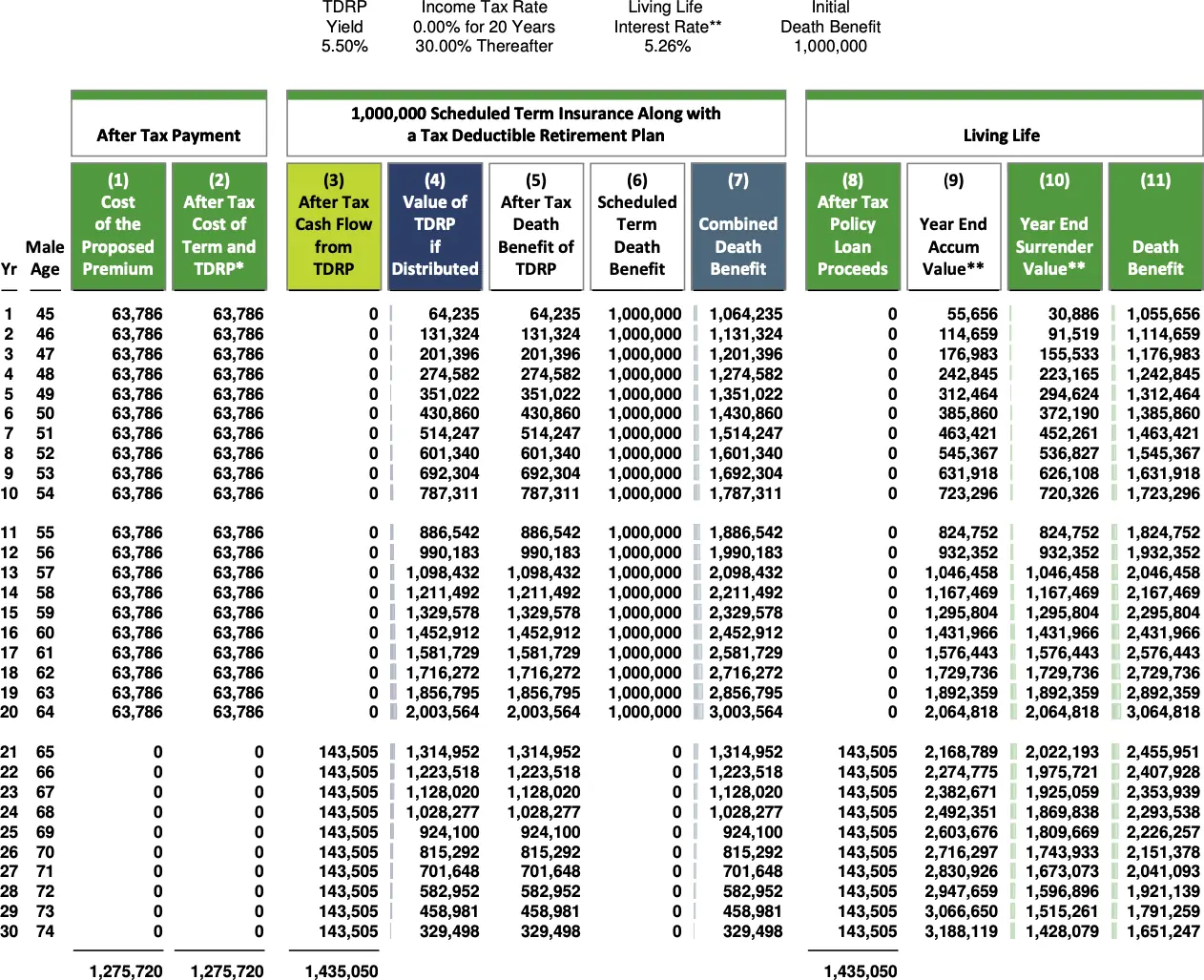
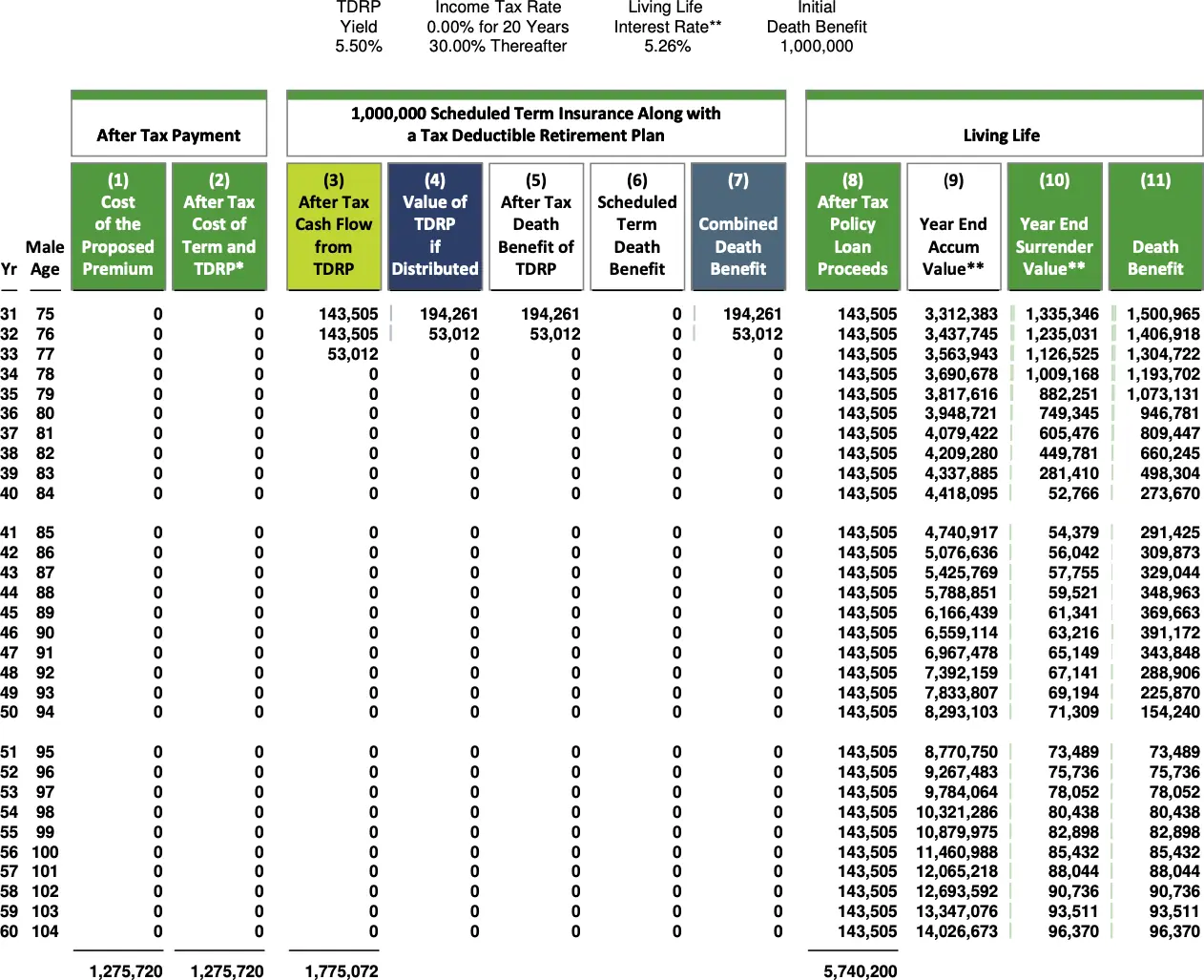
对比演示表第 1–30 年:每年 $63,786,A 为 $100 万定期加可抵税退休计划,B 为 Living Life;假设退休计划收益率 5.50%、所得税率前 20 年 0% 之后 30%、Living Life 记息率 5.26% / Comparison illustration, years 1–30: $63,786 a year; A is $1M term plus a tax-deductible retirement plan, B is Living Life; assumes a 5.50% plan yield, 0% income tax for 20 years then 30%, and 5.26% Living Life crediting 对比演示表第 31–60 年:A 的退休计划在 77 岁取完,累计税后取出 1,775,072;B 每年贷款 143,505 到 104 岁,累计 5,740,200 / Comparison illustration, years 31–60: A's plan is exhausted at 77 after 1,775,072 in after-tax income; B takes 143,505 a year in loans to age 104, 5,740,200 in total

演示值,非保证。原表没有注明制作日期与来源,只作演示。

Illustrated values, not guaranteed. The original table carries no date or source and is used for demonstration only.

这组假设要讲清楚Spell out the assumptions

「前 20 年税率 0%」让退休计划的抵税不带来任何好处,取钱时却按 30% 交税,这一条对 B 有利; 换一组税率,两边的差距会变。IUL 不会每年刚好记 5.26%;实际记息低于假设或贷款利率更高时, B 可能在身故前失效,累积的贷款会变成应税收入。B 的贷款不交所得税,前提是保单一直有效到身故。

"0% tax for 20 years" makes the retirement plan's deduction worthless while withdrawals are taxed at 30%, which favours B; change the tax rates and the gap changes. An IUL won't credit exactly 5.26% every year; with lower crediting or higher loan rates, B could lapse before death and the accumulated loans would become taxable. B's loans are income-tax-free only if the policy stays in force until death.

我们怎么讲How we put it

不说「BTID 是骗局」,也不贬低客户现有的定期或卖定期的同业。问客户两个问题: 这份定期打算保到什么时候、到期后还要不要保障?省下的钱每个月自动投到哪里、过去有没有坚持? 答得出、做得到,BTID 对他可能就合适;答不出,再一起看有现金值的保单,并把 IUL 自己的条件 (按设计缴足、管住贷款、每年检视)一起讲清楚。

Don't call BTID a scam, and don't run down the client's existing term or agents who sell it. Ask two questions: how long will you keep this term, and will you need cover after it ends? Where does the saving go each month, automatically, and have you kept it up? If the client can answer and has done it, BTID may suit them. If not, look at a policy with cash value together, and spell out the IUL's own conditions too: fund it as designed, keep loans in check, review it every year.

8. 六个维度总对照8. The master comparison

维度Dimension终身寿 Whole LifeWhole LifeIUL
保费Premium高且固定(强制储蓄)High and fixed (forced saving)灵活,可在区间内调整Flexible within a range
保险成本Cost of insurance黑箱,不单独披露A black box, not itemized透明,且净风险可随现金值增长而下降Itemized, and the amount at risk can fall as cash value grows
现金值增长Cash value growth合同保证的低速稳定增长Guaranteed, slow and steady挂钩指数:有封顶,有 0% 保底Index-linked: capped, with a 0% floor
生前福利Living benefits通常仅末期疾病Usually terminal illness only可附末期 + 慢性 + 重疾三类Terminal, chronic, and critical
保单贷款Policy loans通常非参与,借出部分少长或不长Usually non-participating; the borrowed part grows less or not at all可参与,边借边涨;也有标准贷款,第 11 年起利差为 0Can participate and keep growing; a standard loan's spread is zero from year 11
确定性Certainty三大保证Three core guarantees保证较少,靠三道防线:0% 保底、净风险下降、充足缴费与检视Fewer guarantees; three lines of defense: the 0% floor, a falling amount at risk, funding and review

讲完对照,可以用住房子把三种保单收一下:定期像租房,保额高、保费低,有期限、没有现金价值; 终身寿像精装交付房,保证多、现金价值稳定累积,但保费高、可调空间小; IUL 像定制住宅,按需要设计和加条款,指数最差记 0%(费用照扣),很多设计下同样保费可做更高保额。 预算紧先租,能力到了再买,买的时候挑适合自己的那一种。

To close the comparison, housing works as an analogy: term is renting, high coverage at low cost, with an end date and no cash value; whole life is the finished home, many guarantees and steady cash value, but expensive and hard to adjust; IUL is the custom home, designed and ridered to need, with a 0% index floor (charges still apply) and often more coverage per premium dollar. Rent while money is tight, buy when you can, and buy the kind that fits.

这张表怎么用How to use this table

不是用来证明终身寿是错的。要确定性、要强制储蓄、不想管任何事的客户, 终身寿是合适的。这张表是用来回答一个具体问题的: 为了那三个保证,客户多付了多少,换回来的条款又有多少限制。 把这个交换讲清楚,让客户自己选,这比你替他选更站得住。

Not to prove whole life is wrong. For a client who wants certainty, wants the saving to be compulsory, and doesn't want to manage anything, whole life fits. The table answers one specific question: what did those three guarantees cost, and what limits came attached to the riders? Lay the trade out and let them choose. That stands up better than choosing for them.

相关Related 保单费用Policy Costs 相关Related 保单替换Policy Replacement

内部培训资料,仅供签约经纪人使用,不可转发给客户。 文中保费报价、资产与市值数据、条款额度均为成稿时的数值,会随时间变动; 条款可得性与定义因产品、州而异,一切以保单合同与当期计划书为准。 本页不构成对任何公司或产品的推荐或贬低,也不构成收益承诺。

Internal training material for contracted agents; not for forwarding to clients. Premium quotes, asset and market-value figures, and rider limits were current when this page was written and change over time; rider availability and definitions vary by product and state, and the contract and current illustration govern. Nothing here is a recommendation against any company or product, or a promise of any result.